PRIORITY NOTICE: Information Regarding ESEA Dashboard and Implementation of the Federal Accountability Model Under ESSA

Dear District and School Leaders,

I am writing to provide you with an update regarding School Year (SY) 2018-19 data correction requests, the timeline for the release of the ESEA Dashboard, and implementation of the federal accountability model under ESSA.

Data requests submitted to the Maine DOE by the February 8, 2019 deadline will be completed by Friday, March 15, 2019. The updated data sets will be uploaded to the ESEA Dashboard and provided to Superintendents for review on Monday, April 15, 2019. The review period will end on Monday, April 29, 2019. After April 29, 2019, no further data corrections will be possible. The ESEA Dashboard will be publicly  available later in SY 2018-19.

Maine DOE leadership had a phone conversation with the US Department of Education (USDE) on December 12, 2018 to discuss Maine’s ESSA amendment. During this conversation Maine DOE staff members outlined Maine’s proposed amendment. USDE did not indicate required revisions to Maine DOE during the call or provide written follow-up. The Maine DOE submitted the amendment on December 14, 2018.

The Maine DOE leadership emailed USDE leaders several times over the past three months to inquire about the ESSA amendment status. To meet USDE’s required timeline for implementation, the previous administration instructed Maine DOE leaders to move forward with the implementation of the ESEA Dashboard and federal accountability system, without regard to the status of Maine’s amended ESSA Plan.

Under my leadership, Maine DOE leaders expressed concern regarding the implementation of the federal accountability model without federal approval of Maine’s amended model. After gaining a deeper understanding of the concerns expressed by Maine DOE leaders, I called Frank Brogan, Assistant Secretary of Elementary and Secondary Education, to inquire about the status of Maine’s amendment. As a result of that call, a meeting was scheduled with USDE staffers and Maine DOE leadership for Friday, March 8, 2019.  During the call, Maine DOE leadership connected with USDE to discuss Maine’s amended ESSA plan, which had been submitted to them on December 14, 2018. Given the USDE’s recent feedback provided during the March 8, 2019 call, the Maine DOE suspects current anticipated school identifications will likely remain unchanged. However, Maine DOE believes USDE’s proposed revisions will require Maine to identify additional schools. The Maine DOE expects to receive written feedback from USDE by Friday, March 15, 2019.

In light of these developments, Maine DOE will request an extension to make school identifications during SY 2019-20. Please know that the Maine DOE is doing everything conceivable to ensure Maine has an equitable federal accountability model that honors stakeholder feedback and Maine’s small, rural context.

Pender Makin
Commissioner
Maine Department of Education

Guidance Regarding Automated Translation/Interpretation Services

As Maine districts have experienced increasing numbers of students and parents who speak languages other than English, there has also been an increase in the availability of machine or automated translation/interpretation software and apps. While these tools may seem like a convenient (and oftentimes free) way to meet a district’s civil rights obligations for communicating with parents, they have not yet reached the level of accuracy necessary to serve as a substitute for a qualified human translator/interpreter. Meaningful communication with parents, including parents whose children have an Individualized Education Plan (IEP), is not only a civil rights requirement, but it also serves to strengthen family engagement and promote positive relationships between families and schools.

A 2015 guidance document from the US Department of Justice and US Department of Education clarifies that even a bilingual person without appropriate training cannot be used by a school to translate/interpret for parents. Whether for the vital communications listed in this guidance document or for more casual interactions, best practice is always to utilize trained professionals, such as through a phone interpretation service or translation/interpretation agency.

For a list of translation/interpretation providers, please refer to the Maine Department of Education website. For parent notices required under the Every Student Succeeds Act, the Maine Department of Education has partnered with TransACT to give districts free access to notices in 17 languages.

For further information about translation/interpretation please contact April Perkins, Director of ESOL/Bilingual Programs & Title III at (207) 624-6627 or april.perkins@maine.gov. For further information about supporting students with an IEP, please contact Maine DOE’s Office of Special Services at (207) 624-6713.

Maine Seeks Qualified Peer Reviewers for 21st CCLC Grant Applications

The Maine Department of Education is seeking qualified peer reviewers to read, assess, and score competitive grant proposals for the 21st Century Community Leaning Centers (21st CCLC) Program.  This federally-funded grant program provides opportunities for schools and communities to develop “community learning centers” that serve children and youth during out-of-school time.  Maine currently has 32 grant-funded 21st CCLC programs operating 55 individual centers in communities across the state.  Grant proposals for the 21st CCLC program will be evaluated through a formal peer review process, which will ensure that quality applications are selected for funding.

This year’s Request for Proposals (RFP) for the 21st CCLC program was released to the public on January 8 and is available online at: https://www.4pcamaine.org/century21/FY2019/. The Department anticipates receiving applications from local education agencies, community-based organizations, and other eligible entities seeking awards under this RFP.

Qualifications:

Peer reviewers will be selected for their experience in providing effective academic support, enrichment, youth development, and related support services for children and youth.  The most qualified reviewers will be individuals who have experience in the administration of high-quality youth development programs within schools and communities.  Examples of the experienced individuals sought include, but are not limited to:

  • 21st CCLC program directors and site coordinators
  • Teachers and principals
  • College and university staff
  • Youth development workers
  • Community service providers

Please note that an applicant or member of an applicant’s organization will not be selected to serve as a member of the Department’s peer review team.

Required Tasks:

Selected peer reviewers will work individually to read each assigned application and create detailed, objective, constructive, and well-written comments on approximately 10-15 applications on the basis of the criteria established in the RFP. These comments will be turned in to the Department prior to participating in on-site consensus scoring sessions.  Reviewers must be able to participate in an online training webinar and review grant applications through a web-based system.  It is anticipated that peer reviewers will have a three (3) week window in which to complete their individual review of assigned applications.  Following the individual review of applications, each peer reviewer will be required to travel to the Maine Department of Education for two scheduled scoring days.  It is during these consensus scoring sessions that each peer reviewer will work with the other members of the peer review team to score each application.

Selected peer reviewers must complete the following tasks during the following date(s):

Task Date(s) Time(s)
Participate in an online training webinar March 28, 2019 1:00 PM – 2:30 PM
Review grant applications through a web-based system and provide individual, written comments on each application (which MUST be turned in to the Department) April 8, 2019 –
April 27, 2019
Any Time
Participate in on-site consensus scoring sessions which will be located at the Maine Department of Education in Augusta, ME April 30, 2019;
May 1, 2019
9:00 AM – 4:00 PM;
9:00 AM – Finished

Compensation for Services:

Peer reviewers who complete the required tasks will be reimbursed for travel costs to and from the consensus scoring sessions as well as provided a $75 honorarium per assigned application.

Previous peer reviewers have found that serving as a member of the peer review team is an excellent opportunity for professional development and growth. It is likely that, if selected, reviewers will be exposed to new program models, strategies, and practices.  These new concepts may provide ideas and support for ongoing work as well as future grant writing efforts.  Most importantly, the time given to this effort will be of great benefit to the children and families of Maine.

How to Apply:

Interested parties must contact Travis Doughty at travis.w.doughty@maine.gov to obtain a copy of the 2019 peer reviewer application and then return the completed application along with a current resume or CV.

Pursuant to Title IV, Part B of the Elementary and Secondary Education Act, as amended by the Every Student Succeeds Act of 2015, peer reviewers may not include any applicant, or representative of an applicant, that has or will be submitting a proposal in response to the current competition.

Deadline:

The Maine Department of Education will be accepting peer reviewer applications on a rolling basis until March 7, 2019 or until the needed positions are filled.  Interested parties are encouraged to submit applicants as soon as possible.

Contact:

For more information, contact State Coordinator, Travis Doughty at travis.w.doughty@maine.gov or 624-6709.


PRIORITY NOTICE: Data Submission Correction Process Now Available; February 8 Deadline

Recognizing the collection of attendance data remains relatively new to Maine schools and districts and in response to school and district feedback, the Maine Department of Education is pleased to provide an opportunity for schools to correct errors related to data in the following three (3) areas:

  • Chronic Absenteeism
  • Student Group Indicators (misidentification, students not identified, etc.)
  • Full Academic Year Status

Revised data sets will update elements related to federal reporting for the Every Student Succeeds Act (ESSA) including schools’ eligibility to receive support under ESSA and the ESSA Data Dashboards (formerly called Report Cards).

For data related to the 2018 school year, requests to correct data from Superintendents must be submitted to MEDMS.Helpdesk@maine.gov by Friday, February 8, 2019 at 4 p.m. The following information must be included with the correction request:

  • A description of why the data is thought to be in error and why the correction is warranted
  • Contact name and email of the person responsible for resubmitting the data (if applicable)

Below is the proposed timeline for review and amendment of data:

February 11 -22, 2019:
Maine DOE will send a survey to the identified contact to solicit questions to help with the review of the request and validate data to be corrected.

March 1, 2019:
Survey and revised data set is due back to Maine DOE by 4 pm.
Please note: If the data is incorrect due to district error, the request should include if the district requires additional support from the Maine DOE and district next steps to correct the error for 2018-2019 data. A Data Correction Template is available here.

March 4-15, 2019:
Maine DOE will retrieve data sets and recalculate appropriate data sets.

The Department is working on to refine this process for each school year going forward, and will provide further information on the DOE website.

Also, as a reminder, upon completion of data revisions, districts and schools will be provided the opportunity to review the ESSA Data Dashboards prior their public release.

Further questions should be directed to Charlotte Ellis, Education Data Manager at Charlotte.Ellis@maine.gov.

Maine DOE Seeks Proposals for 21st Century Community Learning Center Programs

The Maine Department of Education is pleased to announce the release of a request for proposals (RFP) seeking bids from interested parties to implement comprehensive 21st Century Community Learning Center (21st CCLC) programs in 2019-2020.  It is anticipated that an estimated $1.75M will be available to issue grant awards later this year.

21st Century Community Learning Center Programs RFP (PDF)

Authorized under Title IV, Part B of the Elementary and Secondary Education Act, as amended by the Every Student Succeeds Act (ESSA) Act of 2015, the 21st CCLC program provides competitive grant funding to support before school, after school, and summer learning programs that focus on improving the academic performance of students in Pre-Kindergarten through grade 12.

The primary purpose of Maine’s 21st CCLC program is to provide school and community partnerships with funding to establish or expand programs that provide students in high-need, economically-disadvantaged communities with academic enrichment opportunities designed to complement their traditional school day curriculum.  In addition, these programs can provide a broad array of additional support services related to overall student health and well-being.

Local 21st CCLC programs – which can be located in elementary schools, secondary schools or similarly accessible community facilities – provide high quality support services to students during non-school hours.  As such, these programs also support working parents and families by providing safe, supportive learning environments for students at times when school is not in session.

The request for proposal (RFP), which includes information regarding eligibility, program requirements, and more, is available here. An informational webinar for this RFP will be posted to the Department’s application website on January 17, 2018.  It is strongly encouraged that interested parties view this presentation prior to completing an application for 21st CCLC program funding.

Below is the anticipated timeline for the Department’s 2019 21st CCLC grant competition:

Date Task
January 8, 2019 Grant Application Released to Public
January 17, 2019 Informational Webinar Posted Online
January 31, 2019 Deadline for Submission of Questions in Response to RFP
February 14, 2019 Interested Parties Submit Letter of Intent to Apply
April 4, 2019 Application Deadline
April 2019 – May 2019 Peer Review of Applications
May 2019 Grant Award Notifications
July 1, 2019 Grant Award Start Date

Please be advised that the dates above are subject to change. Interested parties must consult the RFP document for the most accurate dates and deadlines regarding this opportunity.

For more information on the 21st Century Community Learning Center (21st CCLC) Program, contact Federal Grant Coordinator, Travis Doughty, at travis.w.doughty@maine.gov.

McKinney Vento Sub-grant for the Education of Homeless Students

The Maine DOE congratulates the Bangor School Department for being conditionally awarded a $40,000 McKinney Vento sub-grant for the education of homeless students.  Through a focused needs assessment, Bangor discovered that their homeless students need help catching up to their peers in language arts, math, and high school credit accrual.  Bangor has committed to using the grant award in part to reduce school social worker caseloads, enabling them to coordinate more regularly with guidance staff, monitor and support students’ academic success, and focus on meeting identified needs of homeless students and families.

Maine DOE annually receives approximately $200,000 in federal McKinney Vento sub-grant funds to distribute statewide to supplement annual homeless education resources, such as Title IA funds. Maine DOE remains committed to distributing the unawarded sub-grant funds across the state so that they are broadly available to address statewide concerns and documented local needs.  A new RFP will be issued in early 2019 for the remaining funds. Districts who were not awarded a grant in this round are encouraged to apply.

If you have questions about homeless education or the McKinney Vento sub-grant program, contact Gayle Erdheim, gayle.erdheim@maine.gov or (207) 624-6637.


Recording & Materials from Presentation About ESSA & Report Cards

The Maine Department of Education held a presentation on Monday, December 10 about the details of Maine’s Model of School Support under the Every Student Succeeds Act (ESSA) which includes the release of the new, user-friendly, public Report Cards in early January. Below is a link to a recording of the session and links to the PowerPoint Presentation, in addition to all of the handouts from the presentation.

Further questions about Maine’s ESSA Plan, Maine’s Model of School Support, and the Report Cards should be directed to Acting Director of Learning Systems, Janette Kirk Janette.Kirk@maine.gov or ESEA Federal Programs & School Turnaround Director Chelsey Fortin-Trimble Chelsey.A.Fortin@maine.gov.

What Does Accountability Mean for a School?

Maine’s Model of School Support includes five indicators that focus on key areas of school and student success, adhere to the requirements of the Every Student Succeeds Act (ESSA), and directly align to Maine’s Priorities and Goals. Below is the list of indicators of school success:

  1. Chronic Absenteeism (K-12)
  2. Academic Progress (Grades 3-8 Only)
  3. Progress in English Language Proficiency (ELP) for English Learners (K-12)
  4. Academic Achievement (Grades 3-8, High School)
  5. Graduation Rate (High School Only)

Eligible individual student populations (where there are ten or more students of a specific student population) are also measured to identify where targeted support is needed. Student populations include: economically disadvantaged, students with disabilities, English learners, and students who are white, black, Asian, Native Hawaiian/Other Pacific Islander, Native American, Hispanic, or two or more races.

To determine each school’s performance on the indicators listed above, Maine uses data collected from public schools on an annual basis to provide each school with a performance rating on each applicable indicator.

School Indicators & Performance Levels

The chart below summarizes the indicators used in Maine’s Model of School Support for Maine’s public elementary, middle, and/or high schools. In addition, the criteria surrounding the performance levels for each indicator has been provided.

Indicators Performance Level
Emerging Developing Meeting Excelling
Chronic Absenteeism All eligible student group populations have a chronic absenteeism rate of 10% or higher. At least one eligible student group has a chronic absenteeism rate of less than 10%. All eligible student groups have a chronic absenteeism rate of less than 10%. All eligible student groups have a chronic absenteeism rate of 5% or less.
Academic Progress – English Language Arts All eligible student groups have score of less than 100. At least one eligible student group has a score of at least 100. All eligible student groups have a score of at least 100. All eligible student groups have a score of at least 150.
Academic Progress – Math All eligible student groups have a score of less than 100. At least one eligible student group has a score of at least 100. A scores of at least 100 for all eligible student group A scores of at least 150 for all eligible student group
Progress in English Language Proficiency  The average progress towards the student’s annual target is less than 65% The average progress towards the student’s annual target is between 65% and 80% The average progress towards the student’s annual target is between 80% and 95% The average progress towards the student’s annual target is greater than 95%
Academic Achievement – Math All eligible student groups did not make annual targets At least one eligible student group made its annual target All eligible student groups made their annual targets All eligible student groups exceeded their annual targets by at least 10%
Academic Achievement – English Language Arts All eligible student groups did not make annual targets At least one eligible student group made its annual target All eligible student groups made their annual targets All eligible student groups exceeded their annual targets by at least 10%
Graduation Rate – 4YR All eligible student groups did not make annual targets At least one eligible student group made its annual graduation target All eligible student groups made their annual graduation targets All eligible student groups have met or exceeded the long-term goal of 90%
Graduation Rate – 5/6YR All eligible student groups did not make annual targets At least one eligible student group made its annual graduation target All eligible student groups made their annual graduation targets All eligible student groups have met or exceeded the long-term goal of 92%

Based on student population performance within the school, each school will achieve performance level for each indicator that is applicable to the grade span (elementary/middle or high school). An example of performance levels for indicators is provided below:

report card

A school’s performance in the above indicators will determine the level of support available to the school.

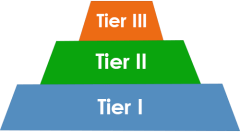
tiers of supportTiers of Support

Maine has developed three Tiers of Support designed to direct various levels of assistance from the Maine DOE.

Tier III supports are designated specifically for schools experiencing the most significant challenges across all eligible student groups, and who also receive Title I funding.

Tiers I and II are designed to support both Title I and non-Title I schools.

Support levels are determined based on eligible student groups (individual student populations with at least ten [10] students). Tier III supports are determined based on the performance of all eligible student groups while Tiers I and II are based on individual student groups. Student populations with fewer than 10 students are not included as part of the indicators for the school, this is consistent with federal FERPA regulations.

Below is a detailed summary that describes how a school’s level of support is determined, and the various supports that are available at each Tier.

Tier I
Additional Targeted Supports and Intervention
Tier II
Targeted Supports and Intervention
Tier III
Comprehensive Supports and Intervention
Any school with one or more eligible student group/s not meeting state expectations across all indicators in one or more content areas Any school with one or more eligible student group/s not meeting state expectations in the same indicator for three (3) consecutive years Schools that receive Title I funding and where all eligible student groups are not meeting state expectations in all indicators in one or more content areas.
Professional development will be available regionally and statewide at no cost. With access to a regional school leadership coach, schools will be responsible for developing and implementing a school level plan, in partnership with stakeholders, to include at least one evidence-based intervention.   Professional development will be available at no cost and driven by the needs of school staff and students. Tier II supports will be available during the 2019-2020 school year. With the support of a school leadership coach, schools will be responsible for developing and implementing a school level plan, in partnership with stakeholders, to include at least one evidence-based intervention. Schools will also have access to additional federal funds to support the implementation of a school leadership team and a school plan. Professional development will be available at no cost and driven by the needs of school staff and students.

Example scenarios demonstrating how a school is identified to receive support will be provided in the next room article.

Further questions should be directed to Janette Kirk, Acting Director, Office of Learning Systems at janette.kirk@maine.gov.

What Is Progress in English Language Proficiency? #success4ME

Maine defines English language proficiency (ELP) as sufficient skill in English necessary to meaningfully access the curriculum. As part of Maine’s Model of School Support, part of Maine’s rollout of the Every Student Succeeds Act (ESSA), this indicator of school success focuses on English learners and measures the progress they make toward English language proficiency each school year. ESSA requires that each state include an indicator that gauges, “progress in achieving English language proficiency as defined by the State and measured by the assessments within a State-determined timeline for all English learners.”

What does this look like in Maine?

English learners are students who have a primary or home language other than English and are in the process of learning English. Around 3% of Maine’s students are English learners and their schools support them in learning English to succeed academically. They may receive English language support services inside or outside of their regular classes, through programs specifically for English language development, or through a variety of other supports. It usually takes 4-7 years for an English learner to become proficient in English, but this can vary depending on many factors.

Each year, English learners are administered ACCESS for ELLs, an assessment that measures a student’s ability to listen, speak, read, and write in English. A student’s overall score ranges from 1.0-6.0. In Maine, English language proficiency is defined as level 4.5, so the progress in English language proficiency indicator measures how much progress a student makes each year toward reaching level 4.5. A school’s score for progress in English language proficiency is based on the average percentage made towards the annual target for each student, where there are at least ten (10) English learners.

School level descriptors for progress in ELP is as follows:

Emerging Developing Meeting Excelling
The average progress towards the students’ annual target is less than 65% The average progress towards the students’ annual target is between 65% and 80% The average progress towards the students’ annual target is between 80% and 95% The average progress towards the students’ annual target is greater than 95%

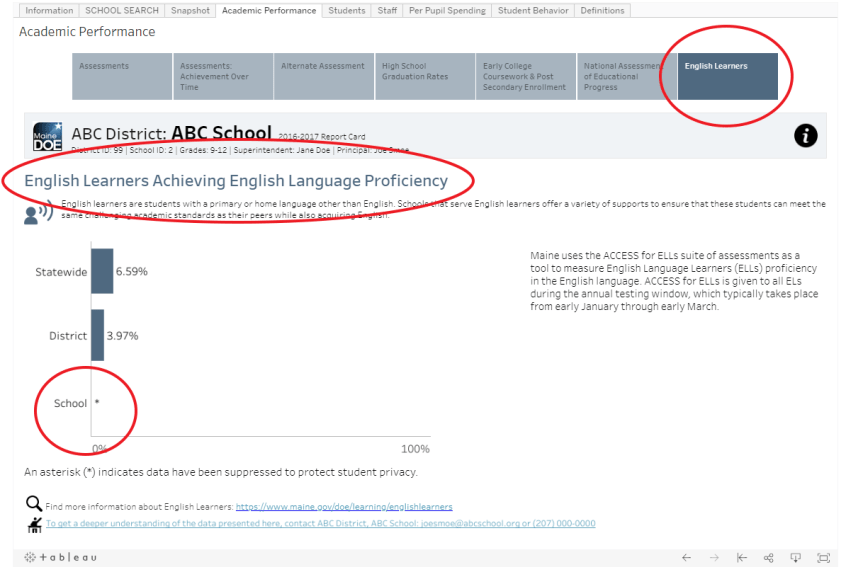
How progress in ELP will be presented on the report card:

ELPreportcard1.png

In the example provided below, there are less than 5 students who are English learners and therefore the data has been suppressed (notated by a *).

ELPreportcard2

ELPreportcard3


What is Graduation Rate? #success4ME

The graduation rate indicator is one of four indicators used in Maine’s Model of School Support. It will be used as an indicator of success for high schools only. Graduation is defined as graduating within four years after entering ninth grade. In Maine, the graduation rate indicator reflects the number of students graduating “on-time”, as well as the graduating students who progressed at a different rate and graduated in either five or six years.

In the past, graduation rate was never utilized when making determinations of schools eligible to receive support. Under Maine’s Model of School Support, the graduation rate for students meeting graduation requirements in four years in addition to the graduation rate of students meeting graduation requirements in five or six years will be utilized.

graduation rate 4 yr (blue)
4 Year Graduation Rate

What does this look like in Maine?

Achieving a diploma is a major accomplishment and marks a significant milestone in a student’s life. It is important to highlight the number of students achieving a diploma, whether it takes some students four years or longer to do so. As it relates to Maine’s Model of School Support, the Graduation Rate indicator is split into two rates of graduation:

  • graduation 5_6 yr (blue)
    5 and 6 Year Graduation Rate

    The 4-year rate is the number of students who graduate in four years with a high school diploma, divided by the number of students who form the adjusted cohort for the graduating class.

  • The 5 and 6 year rates reflect the number of graduating students who took 5 and 6 years, respectively to graduate from high school.

How will graduation rate data be presented on the school report card?

The school as a whole will receive a performance measure related to individual student groups meeting the annual graduation target.

Graduation Performance Descriptors:

Graduation – 4 Year

Emerging Developing Meeting Excelling
No eligible student group made their annual graduation target At least one eligible student group made their annual graduation target All eligible student groups made their annual graduation target All eligible student groups have met or exceeded the long-term goal of 90%

Graduation – Combined 5/6 Year

Emerging Developing Meeting Excelling
No eligible student group made their annual graduation target At least one eligible student group made their annual graduation target All eligible student groups made their annual graduation target All eligible student groups have met or exceeded the long-term goal of 92%

Eligible student groups include: Asian, Black, Hispanic/Latino, Two or More Races, White, Students with Disabilities, Economically Disadvantaged, Migrant Students, and English Learners.

Goals for four year adjusted cohort graduation rate:

Subgroup Baseline (Data and Year) Long-term Goal (Data and Year) 2030
All students 86.83% 2016 90% or maintain current 2016, whichever is greater, graduation percentages by 2030
Economically disadvantaged students 77.77% 2016
Children with disabilities 72.19% 2016
English learners 78.14% 2016
Race – Hispanic/Latino 83.46% 2016
Race – American Indian 84.91% 2016
Race – Asian 90.68 % 2016
Race – Black or African American 76.77% 2016
Race – Native Hawaiian or Other Pacific Islander 88.24% 2016
Race – White 87.29% 2016

The measurements of progress are based on increases in the percentage of all students in Maine who make progress toward the long-term goals on a three-year basis. Long-term goals were developed to reduce the percentage of non-graduating students to result in student groups all meeting the goal of 90% by 2030. The calculation process, for example, is as follows:

Subgroup: All Students

  • Step 1: 2016 Graduation Rate = 86.83%
  • Step 2: 90% (goal) – 86.83% (baseline) = 3.17%
  • Step 3: Differential for each 3-year step is 3.17 divided by 5 = .61%
  • Step 4: Add to the baseline .61 % and add the .61% to each subsequent step to reach the goal of 90% by 2030.

Goals for extended- year cohort graduation rate

Subgroup Baseline (Data and Year) Long-term Goal (Data and Year) 2030
All students 88.61% 2016 92% or maintain current 2016, whichever is greater, graduation percentages by 2030
Economically disadvantaged students 80.82% 2016
Children with disabilities 77.27% 2016
English learners 86.12% 2016
Asian 94.27% 2016
American Indian 83.49% 2016
Black 83.47% 2016
Hispanic 84.13% 2016
Native Hawaiian 93.33% 2016
White 88.84% 2016
Multiple Races 86.62% 2016

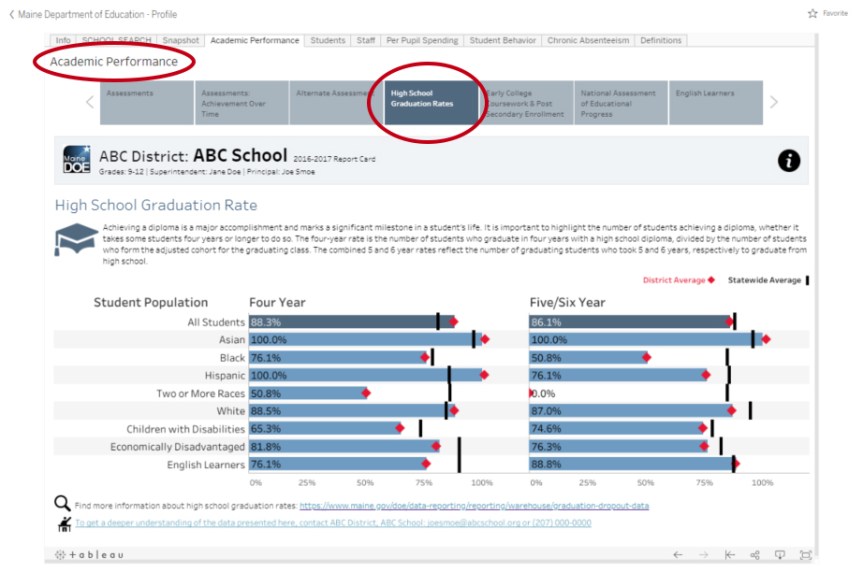
Graduation rate will be presented on the initial page of the report card in the following way:

reportcard1

reportcard2

reportcard3

reportcard4

For further information please contact Janette Kirk, Acting Director, Office of Learning Systems at Janette.Kirk@maine.gov.