2023 Spring Wellness Workshops

The Maine Department of Education Schoolsite Wellness team is pleased to host StrengthenME and the Northern Light Health Workforce EAP to provide educators and school staff with FREE wellness workshops.

Join any or all of the following 30-minute wellness workshops every other Thursday at either 7:15 a.m. or 3:15 p.m.

  • March 16 – Staying Grounded When Others are Escalating – Now, more than ever, our ability to stay calm is being put to the test. In this workshop, we’ll explore strategies for de-escalating ourselves and others, putting our minds ahead of our emotions to succeed as individuals and as part of a larger community.
  • March 30 – Asking for Help – It isn’t always easy to ask for help, particularly when you’re used to being the helper. This workshop explores common barriers to seeing help and offers strategies to effectively and mindfully ask for and receive the help you need.
  • April 13 – Letting Go of What We Can’t Control – Holding on to things we can’t control can cause us a great deal of stress and unhappiness. It also keeps us from growing and living our lives freely. This workshop explores strategies for letting go and includes a 10-minute guided mindfulness practice.
  • APRIL 27 – Boundary Setting and Saying No – Setting boundaries is an important part of establishing one’s identity and is a crucial aspect of mental health and well-being. This workshop reviews ways to set healthy emotional boundaries and ways to navigate boundary setting effectively.
  • May 11 – Quieting the Mind – In this workshop, we’ll explore the idea of Monkey Mind and how the demands of life impact our ability to experience a quiet mind. We will review ways to quiet the mind, and practice using mindfulness to slow racing thoughts.

These workshops are all accessible via this Zoom link.

Direct any questions to Ariele Worrall at aworrall@northernlight.org.
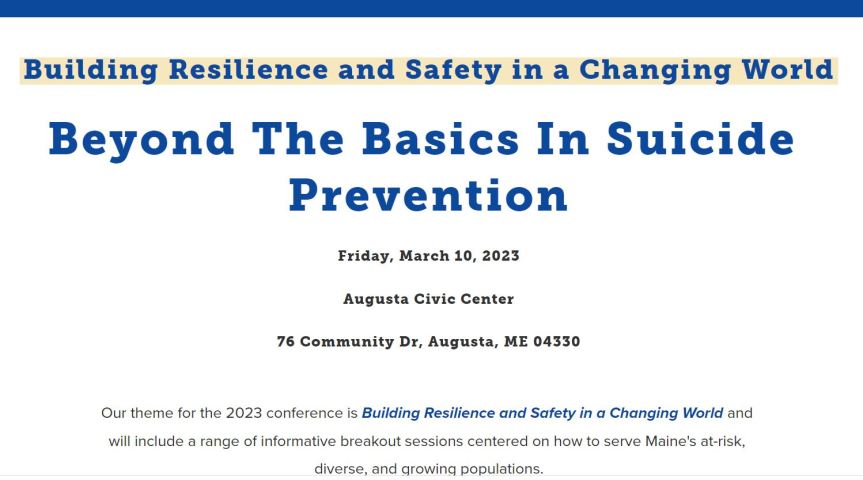
 

2023 Beyond the Basics in Suicide Prevention: Building Resilience and Safety in a Changing World 

NAMI Maine is hosting its annual Beyond the Basics in Suicide Prevention Conference, in person on Friday, March 10th at the Augusta Civic Center. Register Here today.

Maine’s annual Beyond the Basics in Suicide Prevention Conference has provided health professionals, educators, clinicians, first responders, and community members with best practice information, guidance, and resources in suicide prevention and management efforts since its inception in 2003. This conference is a collaboration of organizations and individuals working to reduce suicide and the stigma that surrounds it. It is designed for an adult audience including secondary students seeking to deepen their understanding of prevention and expand their skill set when it comes to suicide prevention, intervention and postvention. Visit NAMI Maine’s Beyond the Basics webpage for details about our Keynote speaker, Gia Drew, and a full list of the available breakout sessions.

Reduced rates are available for student registrations upon request from your school, email to mspp@namimaine.org, and a limited number of scholarships are available upon request.

If you have questions or need more information email either Julianne (mspp@namimaine.org) or Greg (gmarley@namimaine.org) at NAMI Maine’s Suicide prevention Program.

Virtual Training: No Cost Bomb Threat Assessment for Decision Makers

The Office for Bombing Prevention (OBP), a part of the Cybersecurity and Infrastructure Security Agency (CISA) of the  U.S. Department of Homeland Security (DHS), is announcing the addition of the new Bomb Threat Assessment for Decision Makers (AWR-945) course to its suite of Virtual Instructor Led Training (VILT) Courses. This course is provided at no cost to the participant or their organization.

This 75-minute VILT provides the participants with foundational knowledge on assessing and evaluating bomb threats, related responses, and considerations. This course introduces types of threats, the threat assessment process, and the implementation of a Bomb Threat Management (BTM) plan. Additionally, the course provides activities that allow participants to apply specific portions of the risk management process and their newly acquired knowledge about BTM procedures to develop a risk assessment of a bomb threat.

Classes are now open for registration! Participants can visit Office for Bombing Prevention (dhs.gov) to register for classes. Select the desired course and date from the listings and you will be automatically directed to the online application process. Registration must be completed two business days prior to class start date. If you have friends or colleagues that would benefit from this virtual training, we encourage you to share this information with them.

A FEMA Student Identification (SID) number and Password are required to apply. If you don’t have a FEMA SID one can be obtained by going to: https://cdp.dhs.gov/femasid/register

For registration issues, contact OBP Training Support at the CDP at: obp-support@cdpemail.dhs.gov or (256) 847-2195 during business hours.

Please contact OBP Training at OBPTraining@cisa.dhs.gov with any questions.

Work/Life Coaching Sessions Available for Education Workforce

Individual Work/Life Coaching sessions are available upon request through StregthenME, Maine’s Department of Health and Human Services program, which offers free stress management and resiliency resources to promote the health and well-being of all Mainers.

These sessions provide access to 1:1 confidential coaching with a licensed mental health counselor to assist with stress and explore wellness options and resiliency. Up to six 50-minute sessions, conducted via Zoom or phone.

To inquire about or schedule a session, please send an email to StrengthenME@northernlight.org or call 1-800-769-9819.

Seizure Management & Resource Guide

School nurses and staff can be prepared to recognize and treat seizures in the school setting. Seizures may occur for many reasons, including infection, fever, traumatic brain injury, neurological disorder, or related to a drug or medication. The Centers for Disease Control and Prevention (CDC) reports that 0.6% of children aged 0 to 17 are estimated to have seizure conditions. One of the most prevalent neurological illnesses affecting children and young people is epilepsy, a condition characterized by recurrent seizures with no other identifiable cause.  An epilepsy diagnosis extends beyond having seizures; it can impact many areas of a child’s life, including education. It is approximated that about half of the children with epilepsy struggle academically. The purpose of this resource guide is to assist school nurses and school staff in providing a safe and supportive environment for individuals with seizures and epilepsies to maximize educational and developmental opportunities.

The Department is happy to release the Maine Guide to School Health Services: Seizure and Epilepsy Resource Guide for school nurses to utilize within their schools. The purpose of this resource guide is to assist school nurses, educators, and all school staff members to help students with a seizure disorder participate fully and meet goals pertaining to academics, physical education, and extracurricular activities. This can be accomplished through clinical assessments, monitoring, nutrition, exercise, staff/student education and risk reduction measures. This document provides relevant, up-to-date information collected after review and collation of the most current content available from several national organizations. The Office of School and Students Supports Coordinated School Health team is pleased to provide this resource in order to support the evidence-based best practices for students with seizures in Maine schools.

The full Guide and other resources can be downloaded here. You may contact DOESchoolandStudentSupports@Maine.gov with any questions.

MaineHealth Virtual Workshop: MindUP – A School and Community-Based Mental Health Resource

The following virtual workshop is being hosted by MaineHealth to Maine schools.

We are facing an unprecedented mental health crisis across the country, especially in the wake of the acute pandemic. The literature indicates it will take many strategies across community and clinical settings to address this.

MindUP is one school and community-based strategy that is based firmly in neuroscience and has proven to be effective to improve stress regulation, to enhance tools for self-regulation, and has demonstrated positive effects on reducing aggression and managing stress, including through four randomized control trials. Although its use and research has been focused in K-12 schools, MindUP can easily be taught in other settings and with adults.

We are fortunate to have implemented MindUP in several schools in Maine, including with the leadership of the Spruce Mountain public schools (RSU 73) in Jay, Livermore Falls, and Livermore and the Healthy Community Coalition at Franklin Community Health Network. David Evans Shaw, a Maine-based philanthropist, has generously funded the efforts to bring MindUP to Maine.

If you or others are interested in learning more and how you can bring MindUP to your school or community setting, please join leaders from RSU 73, Franklin Community Health Network, and MindUP for a one-hour informational zoom on Thursday February 16th, 11:00 am ET – 12:00 pm ET.

We ask that you register here in advance for this meeting.

After registering, you will receive a confirmation email containing information about joining the meeting. The meeting will be recorded, and registrants will receive a link to the recording afterward.

Learn more about about MindUP here (PDF).

Monthly Sessions: Mental Health Promotion in the School Setting

Project ECHO© presents Mental Health Promotion in the School Setting ECHO Monthly Sessions begin on January 23, 2023, the 4th Monday of the month from 3:30 pm to 4:30 pm on ZOOM.  Bring your most challenging cases to colleagues and a panel of subject matter experts for review and recommendations. Access tools to foster positive social, emotional, and behavioral skills, and well-being for all. Join as your schedule allows. CEUs available upon survey completion.

Audience: Anyone working in the School Setting
Cost: Free

SESSION TOPICS:

  • Supporting Students with Anxiety
  • Building Emotional Resilience
  • Solutions for Challenging Behaviors
  • Trauma Sensitive De-Escalation
  • Promoting Rational Thinking
  • Connecting: Family-School-Community

Register here. (Once you register, you’ll receive convenient, day-of Zoom access direct to your inbox.)
Download a PDF flyer.

For further questions contact sbillings@mcd.org.

30 Maine School Nurses Complete National Certification in School Nursing 

As part of the Maine Department of Education’s (DOE) efforts to provide opportunities to the current workforce of school nurses to build upon their expertise and to promote evidence-based practice in all Maine schools, the Maine DOE hosted a National Certification in School Nursing (NCSN) Review Course created by Nurse Builders this past fall.

Fifty Maine school nurses participated in the course that was delivered online synchronously by Dr. Janice Selekman, DNSc, RN, NCSN, FNASN. As of January 1, 2023, 33 individuals have taken the certification exam with 30 passing. Those 30 are now able to use the NCSN credentials, which is a nationally accredited credential that validates specialized knowledge and expertise as a school nurse. We now have 30 more school nurses within the State of Maine who have met nationally recognized standards for providing excellence in school nursing care.

The National Association of School Nurses endorses national certification of school nurses through the National Board for Certification of School Nurses (NBCSN). School nursing is a subspecialty of public health nursing, incorporated into the baccalaureate nursing programs’ curriculum. Baccalaureate nursing education develops leadership, critical thinking, quality improvement, and systems thinking competencies attained through a minimum of a baccalaureate degree in nursing and validated by specialized certification in school nursing (IOM, 2011).

Congratulations to the following Maine School Nurses who completed the NCSN certification!

Jean Barbour, Falmouth Schools
Melissa Bishop, Mount Desert Island Regional School System
Brenda Bladen, Kittery School Department
Jennifer Bowdish, Brunswick School Department
Nell Bridger, Portland Public Schools
Angie Buker, MSAD 46
April Chapman, Blue Hill Consolidated School
Michele Cooney, RSU 40
Jean Cote, Waterville Public Schools
Candace Crocker, AOS 98
Sarah DeWitt, Winslow Public Schools
Heather Emerson, RSU 40
Jody Gray, RSU 4
Crystal Greaves, MSAD 46
Emily Guyer, RSU 5
Lori Huot, Maine DOE
Brittany Layman, RSU 22
Melanie Lord, Yamouth Schools
Monique Michaud, MSAD 27
Shirah O’Connell, Portland Public Schools
Tara Oxley, Erskine Academy
Alyssa Rainey, Waterville Public Schools
Cathryn Sherman, Brewer School Department
Elizabeth Spaulding, Portland Public Schools
Janneke Strickland, RSU 9
Melissa Tringali, Gorham Schools
Sherri Vail, RSU 40
Rosemary Wiser, MSAD 44
Jessi Woodman, MSAD 6

Resources to Prevent Opioid Overdose in Maine Schools

As directed by the 130th Maine legislature the Department of Education created and collected guidelines and resources for schools who choose to stock emergency medication for a suspected opioid overdose on school grounds.  Naloxone is used in opioid overdoses to counteract life-threatening depression of the central nervous system and respiratory system, allowing an overdose victim to breathe normally. Naloxone is a nonscheduled (i.e., non-addictive), prescription medication. Naloxone only works if a person has opioids in their system; the medication has no effect if opioids are absent. It can be administered by trained persons, which makes it ideal for treating a person experiencing an apparent opioid overdose during school or a school-sponsored activity or otherwise on school grounds. The Rule for Medication Administration in Schools [05-071, Ch. 40, Section 6 (last revised 5/11/2022)], outlines the requirements if a school administrative unit plans to stock naloxone. However, schools must consider including naloxone as only one strategy in combatting substance use disorder.

The Substance Use Among Young Adults Summary in Maine was recently released by Maine CDC and reported that in 2020, nearly one in three young adult Mainers qualified as having a substance use disorder: ranking Maine 3rd in the nation. Research suggests that the area of the brain responsible for decision-making does not fully mature until 25 years of age, making this population more vulnerable to risky and harmful behaviors. Now more than ever we must focus on upstream primary prevention efforts before negative health outcomes occur. Prevention programs within schools can be part of comprehensive health education and social-emotional learning.

Health education can assist students to be better consumers of information, manage the complex world around them and be more inclusive of others. Through an effective skills-based health education curriculum, students will practice skills that protect, promote, and enhance lifelong health. Similarly improving foundational social emotional skills such as self-awareness, self- regulation, social awareness (empathy, compassion & respect for self and others), relationships and critical thinking skill development can be applied to address risk factors for substance abuse. These educational programs can complement a Substance Use Policy within a school administrative unit along with distributing naloxone and educating people about how to prevent, recognize and intervene in overdoses to prevent deaths.

Procurement:

Other Resources:

Contact the Office of School and Student Supports at DOESchoolandStudentSupports@Maine.gov with questions.

Collection of Resources for Supporting Maine Schools During and After Crisis

The Maine PBIS (Positive Behavioral Intervention System) Team acknowledges the difficulties that may arise for schools, families, and communities in response to the threats of violence in Maine schools today. We recognize that individuals will respond to these events differently, and some may require additional supports to process the experience. Reassuring students, staff and families that school is a safe, predictable, positive, and supportive environment is an important first step. Below are several recommended resources that may be consulted to support administrators, teachers, and families as they work to return to normalcy and re-instill a sense of security for themselves and their students in the coming days.

Comprehensive Resources

This comprehensive guide provides guidance to state, district, school, and classroom leaders on how to recover and return to school following a crisis. Specific guidance on practices that can be used immediately can be found within the guide targeted to specific levels.

Supporting Schools During and After Crisis

  • Critical Practices Overview p. 9
  • Critical Practices for Districts p. 26
  • Critical Practices for Schools p. 29
  • Critical Practices in the Classroom p. 36

This page provides links to a variety of resources for schools and families to use when supporting students after incidents of community violence.

Resources for educators supporting students after an incident of violence

Quick References

This guide helps parents and teachers to discuss violence and threats of violence with students, and to help re-establish a sense of safety.

Talking to Children About Violence: Tips for Parents and Teachers

This resource provides concrete strategies for coping with increased stress after difficult situations.

Coping Tips for Traumatic Events and Disasters

This resource offers suggestions for family members when talking with youth after a crisis or unexpected events. It provides predictable youth reactions, how to support, and examples of things to do and say.

Parent Tips for Helping School-age Children

If you need additional support for your school or district, please contact pbis@maine.edu.