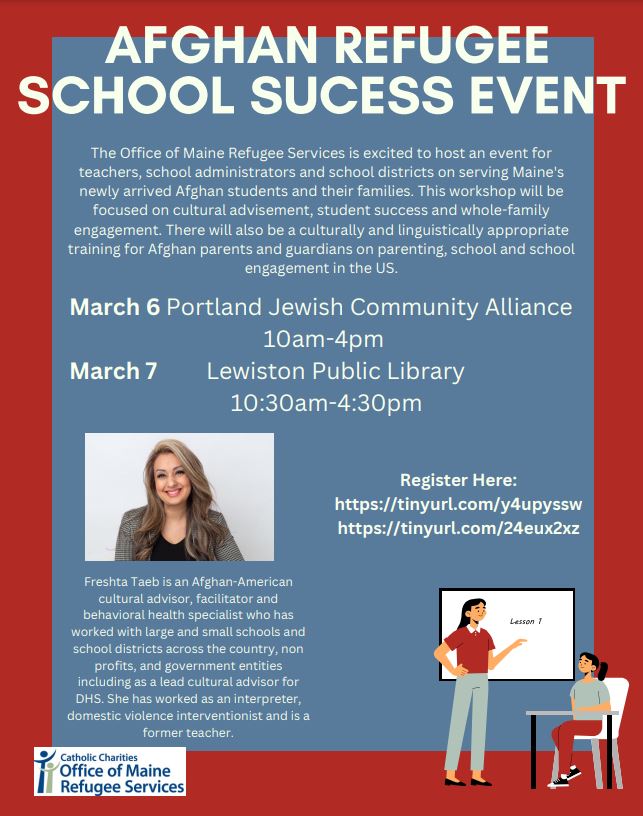
The Office of Maine Refugee Services is hosting events in both Portland and Lewiston for teachers, school administrators, and school districts that are serving Maine’s newly arrived Afghan students and their families. The workshop will be focused on cultural advisement, student success, and whole-family engagement. There will also be culturally and linguistically appropriate training for Afghan parents and guardians on parenting, school, and school engagement in the US.
The workshops with be held in Portland (March 6th) and Lewiston (March 7th). The morning workshop (10 am-12:30 pm) will be geared towards teachers and schools and will cover cultural advisement and particular challenges schools have identified in serving new populations, offering practical strategies to support refugee and immigrant students in school. The afternoon session (1-4 pm) will be the culturally and linguistically-appropriate workshop for Afghan parents and guardians on parenting, school, and school engagement in the US. Any teachers and school staff are welcome to attend the parent workshop as well. A free lunch will be provided. While these workshops are geared toward Afghan student success, the workshops will be applicable for teachers and schools working with students and families from any refugee background.
Where: Portland Jewish Community Alliance
When: March 6, 10 am-4 pm
Register here
Where: Lewiston Public Library
When: March 7, 10:30 am-4:30 pm
Register here
About the facilitator: Freshta Taeb is an Afghan-American cultural advisor, facilitator and behavioral health specialist who has worked with large and small schools and school districts across the country, non profits, and government entities including as a lead cultural advisor for DHS. She has worked as an interpreter, domestic violence interventionist and is a former teacher.