School administrative units that plan to make significant school grade configuration changes must notify the Maine Department of Education of these changes by the June 15 prior to the start of the school year in which they will take effect. For example, school grade configuration changes that will take effect for the 2017-18 school year must be communicated to the Department by June 15, 2017 using the Maine Schools module of NEO. Users must have a NEO login and access to the Maine Schools module to fill out this information.
The reason for this notice is to ensure that the Department has the necessary lead time to analyze the grade changes and to make the determination as to whether the school population changes are significant enough to warrant the creation of a new school ID for reporting purposes. If deemed necessary, the new school ID will need to be communicated to vendors and the USDOE by the start of the school year on July 1.
If local school boards have not approved school grade configuration changes by the June 15 deadline, please contact Shannon Bartash directly to discuss the proposed changes at 207.624.6799 or Shannon.Bartash@maine.gov.
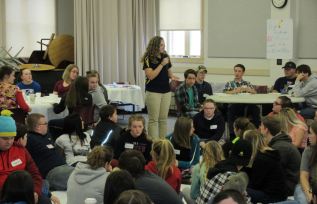
On April 27, Maine Department of Education (DOE) hosted 18 students who came to work with DOE staff as part of Take our Sons and Daughters to Work day. Ranging in age from 8 to 17, the students spent the day learning about working in public service at the Capitol and participated in activities throughout the day including interviews with DOE staff, up-close experience seeing some of the work at DOE, and a special tour of the State House with a behind-the-scenes look at how the legislature functions.
Maine DOE’s structure for the day was aligned to the State’s Career and Education Development Standards, part of the system of student outcomes in the Maine Learning Results. The day began by communicating self-knowledge and practicing interpersonal skills, followed by learning about the work done in a government agency, understanding the knowledge and skills necessary to do the work, and exploring the various education and work backgrounds that support the development of these skills.
A word cloud created from words the students used to describe their day.
At the beginning of the day, students were asked to introduce themselves with an acrostic that included words which represent their strengths, character traits, and interests.
One student described himself as joyful, outgoing, skateboarding, helpful, unpredictable, and adventurous. Throughout the day, participants learned about the traits needed to do the work they observed and about the people doing the various jobs. At the end of the day, they were able to reflect on their own interests and skills to determine how they matched with those they observed. This particular student reflected that an attitude of helpfulness was apparent in all the work he observed and being outgoing is an important strength.
Another student who was particularly interested in working with refugees who have been the victims of violence interviewed Jay Ketner, World Languages Specialist, about the role of language development relative to her career aspirations.
Ketner found that like most of us leaving high school, the student had ideas about college majors and future career possibilities without being definitively decided and fixed. However, she clearly conveyed how much it meant to her to be working with immigrant and refugee groups, and wanted to learn more about how language and cultural study could equip her for such work.
“As a former interpreter for refugees and immigrants seeking asylum, I was able to show her a whole world of language applications in school, study abroad, the workplace, and our changing communities. Opening students’ eyes to new realities and possibilities for the transfer of their learning is what education is all about,” Ketner stated after spending some time with the student.
Another student interviewed Jennifer Tarr, Maine DOE Director of Special Projects and Senator Shenna Bellows, representative to District 14: Chelsea, Farmingdale, Gardiner, Hallowell, Manchester, Monmouth, Pittston, Randolph, Readfield, West Gardiner, and Winthrop.
Of the experience, the student said, “As a teen who’s undecided about what they want to do after high school, this experience has really opened my eyes about possible opportunities and job paths I could take.”
Students also had the opportunity to sit down with Maine Department of Education Commissioner Robert Hasson and Deputy Commissioner Suzan Beaudoin to ask questions about their jobs and the Department.
Eager to find out more, students asked various questions: What is the hardest part of your job? What is the easiest part of your job? Do you love your job? How long have you worked here?
Students interviewing Commissioner Hasson and Deputy Commissioner Beaudoin
One of the biggest highlights of the day was an “insider’s” tour of the State House led by Aaron Chadbourne, Senior Policy Advisor to the Governor. The group sat in legislative seats, learned about all the work that goes on behind the scenes including what is done in the Reviser’s Office, by the legislative office and by the Secretary of the Senate. What was clear at the end of the tour was that it takes many people in supportive roles to make it all work.
The students in the Governor’s Cabinet Room with Adrienne Bennett, Press Secretary and Aaron Chadbourne, Senior Policy Advisor
Reflecting on the day, many were pleasantly surprised and inspired by how excited and passionate people were about what they do as they explained the importance of their jobs and expressed a deep concern for and commitment to Maine’s youth.
The Maine DOE’s Early Childhood Education (ECE) conference team is seeking presentation proposals from PreK and Kindergarten teachers for the 2nd annual ECE Conference scheduled for August 14 at the Augusta Civic Center.
This year’s conference focus is “STEAM Starts Early”. The morning keynote address will be given by national speaker Doug Clements and the teacher presentations will run concurrently during the afternoon session.
Presentations will be 90-120 minutes and will present a unit or lesson plan created by the teacher team and grounded in core STEAM concepts. The audience for the sessions will be PreK, K teachers and instructional staff and administrators. Proposals are due by May 30 and should be inquiry, experiential and exploration based. The request for presentations is for a team of teachers consisting of:
PreK or K teacher and;
Art teacher and/or technology integrationist.
The ECE conference team will select three proposals, each of which will receive an XYZ da Vinci Mini 3D Printer with filament as an appreciation for their time.
For more information and to obtain a copy of the detail requirements for the presentation proposal, please contact one of the Maine DOE’s ECE conference team members listed below:
The Department announced on March 15th that many of the schools ending their 2013 MLTI participation in June would be eligible for grants to continue providing 1:1 mobile computer devices to their students and staff.
The grants are available for:
Students and staff in 7th and 8th grades, where the school did not refresh its devices in 2016 students;
High school staff in schools where students are provided 1:1 mobile devices at local expense, provided their MLTI participation ends in June; and
High school staff in schools that have not participated in MLTI before, if they provide 1:1 mobile devices for their students at local expense.
The prior announcement focused on grants to continue 1:1 device programs, which is the intent of the program. In response to inquiries from technology directors and schools that wish to pursue more innovative approaches to achieving the same objectives as a 1:1 program, the Department is refining our guidance.
With this announcement, the Department is expanding the types of educational technology that can be funded by the grants.
The Department is seeking a statutory change that will allow more flexible use of these grant funds. Pending that change, the Department will fund 1:1 programs as well as programs that do not provide devices on a 1:1 basis. The focus of the programs must be on integrating technology into the classroom, for the purpose of enhancing student outcomes, and may include hardware, software, educational materials and support for educators in the use of technology in teaching. Schools will be asked to explain how student learning will be enhanced by the program, and how they will measure that enhancement.
Eligible schools may apply for the 1:1 program or the alternate program (not limited to 1:1). If the statutory change needed to authorize use of funds for the alternate program is not approved, those schools may re-apply for a grant for a 1:1 program.
Application materials are posted on the MLTI Website. For additional information; contact Deb Friedman, MLTI Project Manager at 624-6834 or deborah.friedman@maine.gov.
Summer vacation is a welcome break from the daily school routine for children and parents alike, but the summer months can be a significant interruption to students’ learning if young minds are not kept active while school is out of session. Summer learning loss is a well-documented phenomenon, particularly with respect to reading achievement. Students can lose up to three months of reading progress during the summer. When all of the summers in a child’s PK-8 school career are combined, this can result in 1-2 years of lost reading progress.
Fortunately, preventing the summer slide can be greatly reduced when students continue to read on a regular basis. When children are encouraged to read from a variety of resources for fun and the pleasure of learning, they continue to practice applying the skills they have learned, build their vocabulary and widen their knowledge of the world. For students who are not yet reading independently or just beginning to read, reading to and with them is equally beneficial.
In an effort to promote summer reading, the Maine Department of Education is collaborating with the Freemasons of Maine to sponsor the Read to Ride Summer Reading Challenge for students in grades PK-8. The 18,000 Freemasons of Maine are pleased to expand their popular statewide Bikes for Books student reading incentive program to now encourage children to read during the summer. The Bikes for Books program provides over 2,000 bikes to Maine schoolchildren each year to promote literacy. The Maine Freemasons have generously donated 48 bikes with helmets as prizes for the Read to Ride Summer Reading Challenge.
To earn a chance to be entered into the State level drawing, students must meet the challenge of reading at least 500 minutes during the summer vacation period. Any school with students in the PK-8 grade span may register to participate. Participating schools will collect documentation of students who have completed the challenge. They will hold school level drawings to select two students (one boy and one girl) whose names will be entered into the state level drawing to be held on September 22, 2017. Schools are encouraged to participate in this challenge, to coordinate it with any other summer reading challenges/programs they offer and to consider soliciting their own local level prizes for students who complete the challenge. Details about the Read to Ride Challenge and about how principals can register schools can be found at: http://www.maine.gov/doe/literacy-for-me/summer-literacy.html. Please forward this information to your school principal to make them aware of this opportunity.
Questions may be directed to Maine DOE’s Literacy Specialist, Lee Anne Larsen, through email (leeann.larsen@maine.gov) or phone (624-6628).
The Personalized Alternate Assessment Portfolio (PAAP) Science testing window is coming to a close. The PAAP assesses students with the most significant cognitive disabilities in grades 5, 8, and third year high school as an alternate to the MEA Science assessment.
All electronic PAAP submissions are due April 30th. Measured Progress has provided return material kits for student portfolios to be returned. UPS will pick up all portfolios on MAY 2nd. Please have the completed portfolios sealed in the envelopes provided by Measured Progress and in school offices by 8:00 am May 2nd.
All return mailing kits should contain individual student return envelopes, a student roster, directions for mailing the portfolio and directions for submitting an electronic Principal’s Certification of Proper Test Administration.
This message is for school administrative units that have received funding under the following grants under Rural Education Assistance Programs (REAP) including the Small, Rural School Achievement (SRSA) or Rural and Low Income Schools (RLIS). If your district has not received funds from these programs in the past, you may disregard this notice.
On April 3, the U.S. Department of Education sent a letter to local education agencies regarding the Rural Education Assistance Program (REAP) administered under Title VI of the Elementary Secondary Education Act. The U.S. Department of Education Letter outlines new provisions resulting from the passage of the Every Student Succeeds Act (ESSA) in December, 2015 and contains information regarding 2017 eligibility. Please note the following important notes regarding SRSA grants.
Districts eligible for SRSA Funds must submit an application directly to www.grants.gov
The application window opens early May and will remain open for 60 days.
If no application is received and the district is NOT dually eligible for RLIS then no Title VI funds will be awarded to the district
If a district is dually eligible and no application is received then they will be considered for the RLIS grant automatically
For questions regarding the Rural Education Assistance Program and available grants, contact Daniel Weeks at Daniel.r.weeks@maine.gov or 207-624-6749.
On May 16, 2016, the Maine Department of Education (Maine DOE) posted a notice regarding the issue of full certification of special education teachers under the Every Student Succeeds Act (ESSA). As the notice explained, ESSA amended the Individuals with Disabilities Education Act by reinstating a requirement that a person employed as a special education teacher in elementary, middle or secondary schools must have obtained full certification as a special education teacher. The teacher must not be working under certification requirements that are waived on an emergency, temporary or provisional basis. Maine schools were advised that effective July 1, 2017, the employment of a less than fully certified special education teacher would not be allowed.
Since that time, the Maine DOE has worked diligently to resolve this issue in a way that allows schools to staff their classrooms, assists not-fully-certified teachers to become fully certified, is achievable, and complies with the requirements of the law. At the same time, the Maine Department of Education approached the federal Office of Special Education Programs (OSEP) about its need for additional time to come into compliance. OSEP has granted that request, permitting Maine to have an additional year for this work. The ramification is that the information in the dispatch of May 16, 2016 in which we stated “. . . effective July 1, 2017, (SAUs) will not be able to employ a special education teacher who is not fully certified” is no longer applicable.
We will provide additional information as it becomes available. Questions may be directed to Janice E. Breton, Director of Special Services, Maine Department of Education (624-6676) or janice.breton@maine.gov.
The NEO Maine Schools Update form is required by all public school units and private schools to inform the Maine Department of Education of school and district contact information, changes in grade spans, and other SAU and school related information.
Changes:
Report will open May 1 and close June 15
Update any information for the District. All fields with the exception of Administrative Office Fax are required. PO Boxes will not be accepted in the “Physical Address” box. Mailing address is needed only if different from Physical address. Check the box to confirm that all SAU information has been reviewed before moving on to individual schools information.
The Cost Center information that has been added to Maine Schools references the three digit code that the business office uses in the financial system to assign building level costs. Each building will have at least one Cost Center, but may have two codes if the building has a combination of PreK-8 grade students and 9-12 grade students. PreK-8 grade will have a range of 010 through 290, and 9-12 grades will have a code in the range of 300 through 380. CTE Centers will have a Cost Center of 390. If school districts operate an alternative education program where they need to enter the building those will use a cost center in the range of 500 through 590. The cost center report can be downloaded here: http://www.maine.gov/education/data/handbook/codereport.htm
Student information system – enter the system you use to upload data to the state. **This is important ** we need your correct SIS vendor information for training and communication with the vendor**
If a school offers All-day K or Alternative Education, please indicate.
Click on Maine Schools (if you do not see this option on your menu, and are a superintendent, technical coordinator, or administrative assistant, please contact the MEDMS Helpdesk at MEDMS.Helpdesk@maine.gov or 207-624-6896.
The Maine Event: Creating Positive Climates for Youth conference will be held June 29-30 at Holiday Inn by the Bay in Portland. This year’s event combines the annual conferences of the Positive Youth Development Institute and the Collaboration for Perpetual Innovation into a single gathering of youth serving professionals and volunteers. With a long history of support and involvement from the Maine Department of Education, the event draws a strong following with presenters and participants from as many as seventeen states, Canada, and Scotland by providing training and information about key components to positive climate in all settings in which children and youth gather.
For educators, the conference supports many initiatives within the Maine Department of Education related to positive school culture/climate, brain-based practices for student engagement, and encouraging school-wide practices of inclusion for all students.
For questions related to the conference, contact Donna Duffey, Conference Manager at 800-294-4322 or duffey.donna47@gmail.com or Maine Department of Education specialist Sarah Ricker at 624-6685, or sarah.ricker@maine.gov.