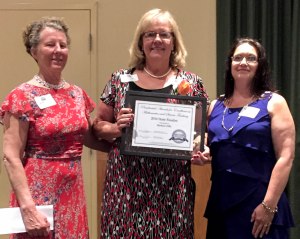
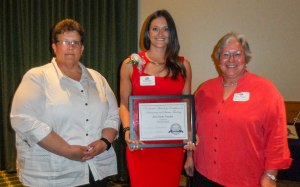
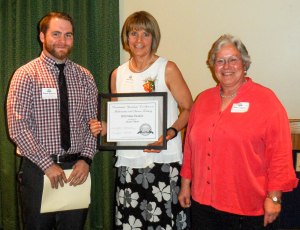
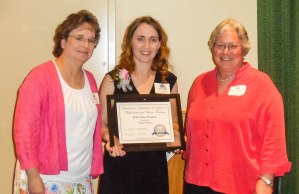
Five school districts participated in a professional development pilot from the Maine Department of Education this year to learn how to improve visual art offerings to public preschool students. Visual art and early childhood teachers from RSU 10, Lewiston School District, Glenburn School Department, MSAD 58 (Phillips), and MSAD 53 (Pittsfield) attended in teams for training three times during the 2016-2017 schoolyear. Guided during these session by early childhood expert, Terri Petnov, and early childhood arts specialist, Judy Fricke, teachers built collaborative partnerships as they broadened their skills in 2-D, 3-D, and Fiber Arts, as well as developmentally appropriate teaching for preschoolers. Both teachers learned strategies to be used in both in the early childhood classroom and the art room. This program was sponsored by Early Childhood Specialist, Sue Reed, and Visual and Performing Arts Specialist, Beth Lambert.
The training was aligned to Maine’s Early Learning and Development Standards and supported by research on the importance of art education being available every day in the early childhood classroom. Over the course of the three workshop days, teams learned a variety of visual art techniques and became more comfortable integrating art education into the other learning domains to support knowledge and development.
Here are some of the comments teachers had at the end of the experience:
“Children have become more engaged and have developed stamina to create and finish a project. It has created a calming effect on my room,” Lori Fowler, Preschool Teacher, Montello Elementary School.
“The collaboration and teamwork I now have with my art teacher has brought about valuable changes in my planning and instruction awareness of how the arts can connect and strengthen student learning opportunities,” Vicky Grotton, Preschool Teacher, Glenburn Elementary School.
“The value of this training, for me, was in learning the true and genuine connection between the arts and achievement across the curriculum. The foundation of learning and whole-student enrichment are clearest in prek, but persist throughout the entire academic career,” Adam Masterman, Art Teacher, SAD 58.
“(The prek teacher and I) have worked together to create a new space in her classroom where students are completely independent and encourage exploring materials…. I have gone into their classroom and taught lessons and group projects that would not be possible in my space,“ Karen Thayer, Art Teacher, RSU 10.
Due to the tremendous success of this pilot, the Maine Department of Education is exploring funding options to expand this training statewide during the 2017-2018 schoolyear as well as develop and offer music and performing arts in the early childhood classroom training.
For more information on this pilot you can visit our website http://www.maine.gov/doe/arts/ecevpa.html.
For more information on Early Childhood Education contact, Sue Reed, susan.d.reed@maine.gov . For more information about Visual and Performing Arts Education, contact, Beth Lambert, beth.lambert@maine.gov.