Maine Expanding K–12 Cybersecurity Grant in the 2025-2026 School Year; SAUs Must Opt in by June 20

The Maine Department of Education (DOE) is pleased to announce that the state will continue its participation in the State and Local Cybersecurity Grant Program (SLCGP) for a second year. Building on the success of Year One, this initiative will further strengthen cybersecurity infrastructure across Maine’s public K-12 schools. The multi-year SLCGP provides dedicated resources to help school administrative units (SAU) enhance their cybersecurity infrastructure and preparedness.

Action Required by June 20, 2025

To participate in Year Two, all Maine public K-12 SAUs must complete the Year Two Local Consent Form and Opt-In Survey by June 20, 2025. Opting into the grant does not bind a school to participate but is required for participation.

Eligible SAUs received a notification email on April 30, 2025, with a direct link to the form and survey.  The survey can also be accessed here.

Benefits of Participation

Participating SAUs will receive access to no-cost cybersecurity services designed to protect students, staff, and institutional data. These services may include:

  • Migration support for .gov domains
  • Cyber incident response planning
  • Endpoint detection and response (EDR)
  • Multi-factor authentication (MFA)
  • Security awareness training for staff


Year Two Highlights

  • Funding Available: $4.35 million in state-allocated funds will support local cybersecurity efforts, with a strong focus on K-12 readiness.
  • No Cost to SAUs: Services are provided at no cost to participants..

Year One Accomplishments

With broad participation in Year One, Maine achieved several key milestones:

  • Distributed more than 22,000 cybersecurity training licenses to 122 local entities.
  • Deployed more than 11,000 MFA keys to strengthen security.
  • Established statewide governance and planning committees.
  • Completed comprehensive cybersecurity capability assessments.

These accomplishments have laid the foundation for continued progress in Year Two of the grant program.

Questions?

If you have any questions or need assistance, please contact slcybersecurity.grant@maine.gov.

Year One Participating SAUs:

Acton Public Schools
Auburn Public Schools
Bangor Public Schools
Biddeford Public Schools
Boothbay-Boothbay Harbor CSD
Brunswick Public Schools
Calais Public Schools
Cape Elizabeth Public Schools
Community Regional Charter School
Ellsworth Public Schools
Eustis Public Schools
Glenburn Public Schools
Gorham Public Schools
Great Salt Bay CSD
Hancock Public Schools
Jonesport Public Schools
Kittery Public Schools
Lamoine Public Schools
Limestone Public Schools
Lisbon Public Schools
MSAD 27
Madawaska Public Schools
RSU 01 – LKRSU
RSU 02
RSU 03/MSAD 03
RSU 04
RSU 05
RSU 06/MSAD 06
RSU 09
RSU 10
RSU 11/MSAD 11
RSU 14
RSU 16
RSU 17/MSAD 17
RSU 18
RSU 19
RSU 20
RSU 22
RSU 24
RSU 25
RSU 28/MSAD 28
RSU 29/MSAD 29
RSU 33/MSAD 33
RSU 38
RSU 39
RSU 40/MSAD 40
RSU 44/MSAD 44
RSU 45/MSAD 45
RSU 52/MSAD 52
RSU 53/MSAD 53
RSU 55/MSAD 55
RSU 56
RSU 60/MSAD 60
RSU 61/MSAD 61
RSU 68/MSAD 68
RSU 70/MSAD 70
RSU 73
RSU 74/MSAD 74
RSU 78
RSU 83/MSAD 13
Saco Public Schools
South Portland Public Schools
St. George Public Schools
Veazie Public Schools
Wells-Ogunquit CSD
Winthrop Public Schools
Yarmouth Schools
York Public Schools
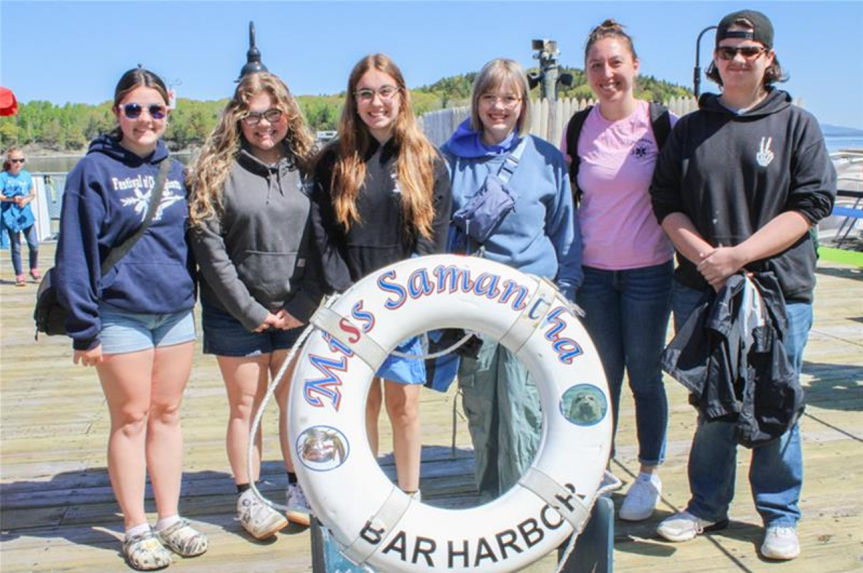
Dirigo Biology Students Make Waves with Ocean Learning

On May 27, students in Dirigo High School’s Marine Biology Class swapped the mountains of western Maine for the salty sea air of Bar Harbor, embarking on an unforgettable cruise that brought their classroom studies to life in the most immersive way possible.

The two-hour Lobster Fishing and Seal Watching Tour, operated by Bar Harbor Whale Watch Company, was more than a scenic ride along Maine’s coast for these students. It was a dynamic learning experience, as they engaged with real-world applications of marine science concepts. After studying marine ecosystems, the impact of climate change, and population regulation in class, this trip was a chance for these students to see the living proof of those lessons just beyond the boat rails.

As the boat glided across Frenchman Bay, students watched in awe as lobster traps were hauled in, revealing not only lobsters but also the important role that sustainable practices and long-standing community traditions play in Maine’s fishing industry. The crew explained the complex rules and etiquette of lobstering, emphasizing conservation efforts and the way that climate shifts are changing lobster migration patterns and yields.

One of the biggest thrills for students was the chance to see and hold a live, pre-banded lobster, a hands-on experience that sparked laughter, excitement, and surprise.

“The lobster tickles!” one student shouted, adding a memorable and light-hearted moment to a deeply meaningful day.

The educational impact didn’t stop with lobsters. The timing of the tour couldn’t have been better; it was seal pup season, and students were treated to views of harbor seals with their young, lounging on coastal rocks and swimming alongside the boat. The tour guides shared information about the life cycles, behaviors, and habitats of Maine’s native seal species, deepening students’ understanding of marine mammals and the fragile ecosystems they inhabit.

For many students, this trip offered a string of “firsts”: their first time seeing wild seals, the first time on a boat for one student, and the first-ever visit to Bar Harbor for others. These moments, monumental for these students, created a ripple of wonder that extended beyond the science lesson.

This experience was made possible entirely through grant funding, meaning the trip came at no cost to students or their families. For a rural district like RSU 56, where many families face economic challenges, the opportunity to offer this kind of enrichment is rare and deeply valued. By taking learning outside of the classroom and into a real-world marine setting, this field trip helped students form lasting connections between science content and the environment around them. From biology of lobsters and seals to the socioeconomic realities of Maine’s fisheries, students were able to see, touch, and understand their curriculum in a completely new way.

This is the second time that Dirigo High School’s students have been able to participate in an experience like this, thanks to grant support. Each time, it opens new doors, for curiosity, for confidence, and for a deeper sense of place. By connecting lessons from western Maine to the ecosystems of the coast, Dirigo’s Marine Biology Class proves that the best learning happens when students explore beyond the classroom and into the world.

This story was submitted by Dirigo High School. To submit a good news story to the Maine DOE, please fill out the good news submission form.

Maine Educators Explore the Power of Play in Innovative Professional Learning Experience at Noble Middle School

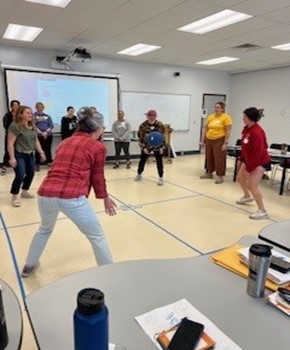
(Educators in action during the Playworks training at Noble Middle School)

On May 14, MaineHealth’s Healthy Eating, Active Living Team hosted a full-day professional learning event at Noble Middle School in Berwick that brought together educators from across southern Maine to explore the power of play in schools.

Teachers, ed techs, and administrators arrived from Noble Middle School, Sanford Middle School, York Middle School, Marshwood Middle School, Crooked River Elementary School, Saint Thomas School, and Harold B. Emery Jr. Memorial School. Many came curious about how play could shift school dynamics. They left with new tools, new energy, and a renewed appreciation for what it means to build connection through fun.

The day began early, with a check-in and casual conversation over coffee. By 8 a.m., educators were already in motion, diving into the first session, “The Power of Play.” This active morning segment focused on how structured games can promote inclusion, improve school climate, and help students practice critical social skills like communication and teamwork. Participants didn’t just talk about it; they played. They ran, laughed, learned, and rediscovered how powerful it feels to be a part of a team.

After a midday break for lunch and a chance to reflect, the afternoon shifted to “Proactive Group Management.” In this session, educators practiced real-life strategies for supporting students during recess and class time. They learned how to manage groups more effectively, address conflicts in the moment, and make sure all students feel seen, supported, and safe.

The workshop wrapped up around 3 p.m., but the enthusiasm in the room suggested that the lessons and the momentum would carry well beyond the day. One educator said, “Thank you again for the awesome workshop at Noble Middle School. We’ve already started using some things I learned. I’m totally reinvigorated about recess.”

Playworks, the national nonprofit that led the training, has a simple but powerful mission: to help schools use play as a force for inclusion, empowerment, and joy. Thanks to funding from Hannaford’s Eat Well, Be Well initiative and the support of MaineHealth’s Let’s Go! program, this workshop, and others like it, are free to participating schools.

For those who missed the May event, two more full-day Playworks workshops are coming on Friday, October 10. One will take place at Boothbay Region Elementary School for educators working with grades K through five. The other will be held at Guy E. Rowe School in Norway for educators supporting students in grades K through six. If you are interested in attending either of these workshops, please reach out to Sarah Carter at MaineHealth by email at Sarah.A.Carter@mainehealth.org.

This story was submitted by MaineHealth. To submit a good news story to the Maine DOE, please fill out the good news submission form.

Maine FFA Association Announces 2025 National FFA Officer Candidate

The Maine FFA Association is proud to recognize Delaney McKeen, a 19-year-old recent graduate from the University of Maine at Presque Isle, as its 2025 National FFA Officer Candidate.

McKeen was selected following interviews held at the 2025 Maine FFA Association State Convention. Candidates were invited to submit applications highlighting their eligibility for the National FFA Officer position, which a panel of judges then reviewed. Once all necessary paperwork was completed, and it was ensured that all criteria were met, candidates were invited to participate in formal interviews before the judging panel. McKeen not only impressed the panel, which consisted of FFA alumni, University of Maine staff members, and Maine Department of Agriculture, Conservation, and Forestry partners, but also current FFA members serving on the nomination committee. 

McKeen is no stranger to the leadership opportunities within FFA. As a past Maine FFA State Reporter/Sentinel and State Vice President, she helped to lead the organization through various challenges, including the COVID-19 pandemic. Her leadership skills shine not only within the FFA Organization but in the classroom, as well. Upon her recent graduation, McKeen received a degree in agricultural science and agribusiness. When asked about her experience with agriculture both inside and outside of the classroom, she said, “Being able to work in agriculture as my career has been one of the biggest blessings of my life. I’m so grateful that I had the experiences I did in FFA that led me here”. 

Though her time in the FFA blue jacket may have concluded when she retired as the Maine FFA State Vice President in 2022, McKeen has still made herself a prominent part of this organization, by volunteering at the state convention to mentoring the state officer team.  

McKeen, originally of the Mars Hill FFA Chapter, will travel to the 98th annual National FFA Convention and Expo, where she will represent the State of Maine as a 2025-2026 National FFA Officer Candidate. If elected to a national office, candidates relocate to Indianapolis in order to begin preparation for their upcoming year of service. They undergo months of training to learn how to properly host workshops, practice their speech-writing skills, and learn about all current agricultural issues and policies. The National FFA Officer team spends the year traveling to different states throughout the country, attending state conventions, taking industry tours, and connecting with FFA members nationwide! 

Maine’s last National FFA Officer was Malcolm Ellis, who served from 1952 to 1953. If McKeen is elected, she would become the first National FFA Officer from Maine in more than seven decades. We have the utmost faith that she will gracefully represent herself, her state, and the Maine FFA.

This article was written by Jillian McLaughlin, 2025 Maine FFA State Reporter. For questions and updates regarding McKeen’s journey to national office, please reach out to Jillian at jmclaughlinmeffa@gmail.com or contact the Maine FFA State Liaison, Emily Doughty, at emily.doughty@maine.gov.

Register for the Maine DOE 2025 Annual Summit on August 5 and 6; Fees Waived for Identified Schools

Registration is now open for the 2025 Maine Department of Education (DOE) Annual Summit, which will be held on August 5 and 6 at Thomas College. The two-day event, which costs $250 per person, includes breakfast, lunch, and access to nearly 100 sessions from 7:30 a.m. to 4 p.m. daily.

The Maine DOE is pleased to announce that registration fees will be waived for identified schools for up to $2,500 (the equivalent of 10 staff members) per school. Identified schools are those that have been identified as part of Maine’s Model of School Supports (MMSS), including:

  • TSI-Targeted School Improvement
  • ATSI-Additional Targeted School Improvement
  • CSI-Comprehensive School Improvement

Keynote speakers include Maine Education Commissioner Pender Makin and 2025 Maine Teacher of the Year Becky Hallowell, a teacher at Wiscasset Elementary School. 

This year’s Summit theme, Measure What Matters: The Expanding View of Educational Excellence in Maine, is emphasized through a variety of sessions on early childhood education, student behavior (including a session on The Regulated Classroom), social emotional learning, interdisciplinary instruction, youth engagement, special education and inclusivity, extended learning opportunities, outdoor learning and climate education, school safety, mental health literacy, emotional intelligence, literacy, math, technology in the classroom, and so much more!

Over the course of the two-day event, educators can earn up to 10 contact hours for their State of Maine educator and/or administrator credential renewal before the 2025-2026 school year. Additionally, the Educational Trip Leader Permit Course, a special training certification, will be offered during the event. This course is required for any educator taking students on field trips involving water. 

The Summit also features several information tables, including a booth where the Maine DOE Certification Team will be available both days to provide support and answer questions.

A full list of sessions is expected to be available at the end of June, when Summit participants can begin to customize their personal agenda.

The 2025 Maine DOE Annual Summit is a great place to connect with educational colleagues across Maine, share ideas, and get the high-quality professional learning, tools, and resources needed before the 2025-2026 school year!

Registration Information

The event cost is $250 per participant. Again, registration fees will be waived for identified schools for up to $2,500 (the equivalent of 10 staff members) per school.

If you believe you may work at an identified school and would like to attend the Maine DOE Annual Summit, work with your school administration to confirm your school is identified and coordinate ticket purchasing for the (up to) 10 waived tickets per school.

Once again, this year, the Maine DOE is utilizing Bizzabo, an all-in-one event platform, to support registration and attendance. Through Bizzabo, participants will be able to register for the Summit, create and access their personalized schedule and registration information, and receive access to real-time conference and scheduling updates.

Reserve your tickets here now!(Please note: The event website has a separate “MMSS” ticket for school administrators from identified schools who are bulk registering waived tickets.) After you reserve your ticket(s), you will be provided with one registration number per ticket. To access individual registrations, download the Bizzabo app (Bizzabo in Apple Store | Bizzabo on Google Play) and log in with your email and registration number to access the event.

Lodging Information

2025 Maine DOE Annual Summit attendees are responsible for travel and accommodation during the Summit. The Maine DOE has secured two possible options for accommodation on-site and within a short proximity to the venue:

For further information or questions about the Summit, please contact Teri Peaslee at teri.peaslee@maine.gov.

Hampden Academy Soars into the Future with New Drone Education Program

(Pictured: Student Pilot Marysssa LaBlanc and RSU 22 School Board member Ellen Hassan.)

Something exciting is taking off at Hampden Academy! Starting in the 2025-2026 school year, Hampden Academy is launching a cutting-edge drone education program, Higher Vision: Sparking Creativity and Careers Through Drones, designed to prepare students for the skies—and for the future.

With 67 students already enrolled, this two-course program is about more than flying drones; it is about building real-world skills, exploring emerging industries, and learning to think critically and ethically about powerful new technologies.

For enrolled students, the journey begins with an Introduction to Drones course, where students will start with the fundamentals—FAA regulations, Maine-specific laws, and best practices for safe and ethical drone operation. From flight simulators to piloting real drones, they will gain hands-on experience while exploring how drones are already transforming fields like agriculture, filmmaking, and emergency response.

In the second course, Commercial Drones, students learn advanced flight skills, mission planning, weather impacts, and drone data analysis. They will also prepare for the FAA Part 107 commercial drone pilot certification, which will give them a head start on careers in this growing field.

One of the program’s most unique aspects is its strong network of nine local partners—from Hampden Public Safety and Cianbro to News Center Maine and the U.S. Military—who will offer students real-world insights and hands-on learning opportunities in areas like public safety, construction, media, forestry, surveying, and more. (See a full list of partners at the end of this article.)

“This program represents our dedication to providing RSU 22 students with educational opportunities that connect directly to tomorrow’s careers,” Todd Moore, Technology Teacher at Hampden Academy, said. “This is about more than learning to fly; it is about building futures.”

With its blend of classroom rigor, practical experience, and community engagement, Hampden Academy’s drone program is lifting off—and bringing students along for a thrilling, high-tech ride into the future.

Hampden Academy would like to extend a big thank you to the following partners for helping to make this new program possible:

  • Hampden Public Safety for demonstrating emergency response applications and public safety uses for drone technology.
  • Cianbro Corporation for showcasing industrial applications in construction and infrastructure development.
  • News Center Maine for illustrating journalistic and media applications of drone photography and videography.
  • Haley Ward Civil Engineering for providing insights on surveying, mapping, and engineering applications.
  • American Forest Management for highlighting environmental monitoring and forestry management techniques.
  • Matt Thomas Media Productions: for sharing expertise in commercial drone photography and cinematography.
  • Allan Gordon Jr. Surveying for demonstrating precision mapping and land surveying applications.
  • United States Military for offering perspectives on drone operations and career opportunities in defense.
  • University of Maine at Augusta for advanced drone programs.

For more information about this program, please contact Todd Moore (tmoore@rsu22.us) or Charlie Huff (chuff@rsu22.us), Technology Teachers at Hampden Academy.

Information for this article was provided by Hampden Academy. To submit your good news to the Maine DOE, fill out our Good News Submission Form.

No-Cost Student Opportunity at York County Community College: Foundations of Machining Training Bootcamp

Applications are now open for the Foundations of Machining Training Bootcamp this summer for recent Maine high school graduates. Hosted by York County Community College, this 16-day training provides both classroom and hands-on machine time for students to learn how to safely operate mills and lathes and receive an introduction to CNC operations. Students who complete this program will be ready to apply for high-demand careers.

This program is no cost to Maine students, thanks to the generosity of the Harold Alfond Center for the Advancement of Maine’s Workforce.

Participants will learn:

  • Shop Safety Blueprint
  • Reading Math for Manufacturing
  • Precision Measurement
  • Lathe and Mill Operation
  • Geometric Dimensioning and Tolerancing
  • Metallurgy Essential Skills for the Workplace

Foundations of Machining Training Bootcamp schedule (Monday-Thursday):

  • July 7-10: 8 a.m. to 4:30 p.m.
  • July 14-17: 8 a.m. to 4:30 p.m.
  • July 21-24: 8 a.m. to 4:30 p.m. July 28-July 31: 8 a.m. to 4:30 p.m.

For more information and to apply, please contact York County Community College at YCCCworkforce@mainecc.edu or by calling 207-216-4475.

Second Annual ‘I Belong’ Youth Summit Empowers Maine Students with Disabilities to Dream Big

(Students from the Winslow High School Cheerleading Team pose with Maine Secretary of State Shenna Bellows.)

The Maine Department of Education (DOE) Office of Special Services and Inclusive Education held its second annual “I Belong” Youth Summit at Central Maine Community College on Thursday, May 29. This event brought together students from across the state with individualized education plans (IEPs) for a day dedicated to empowerment, connection, and celebration of student voice. Student participants ranged in age from 10 to 22 years old.

The summit is an initiative that happens through the Transition Maine program, which was developed by the Office of Special Services and Inclusive Education to provide accessible and inclusive transition services for students moving from high school into adulthood. The Executive Student Transition Committee, a team of students who assist with the Transition Maine program, plays a large role in the organization of this event, designed to amplify the voices of youth with varying abilities.“To see our students meaningfully engage and included in hands-on activities to help them imagine their future makes me and our team very proud,” Executive Student Transition Committee Co-Chair Connor Archer said, reflecting on the success of the summit. “As someone who received special education services right here in Maine, I know how unique and powerful this experience is.”

Secretary of State Shenna Bellows kicked off the summit by speaking with students about Maine’s new accessible voting machines, known as the ExpressVote.


The system allows voters to mark their ballots using a touchscreen or keypad, and it includes audio instructions for those who are visually impaired. It then prints a paper ballot that can be scanned and counted. Bellows emphasized the importance of civic participation and ensuring that all Mainers, including those with disabilities, have full access to the process.

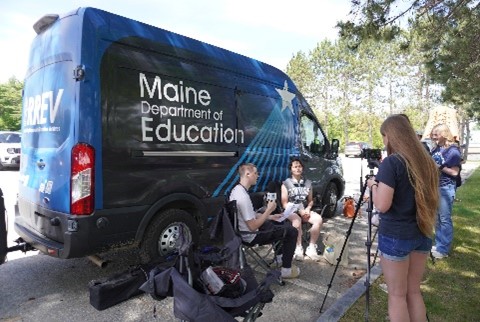
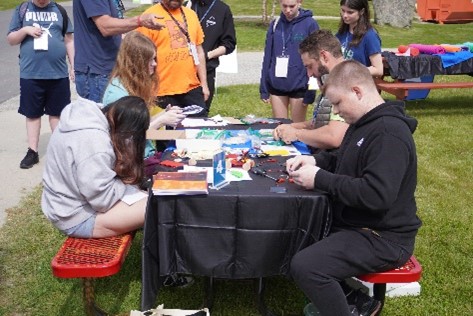
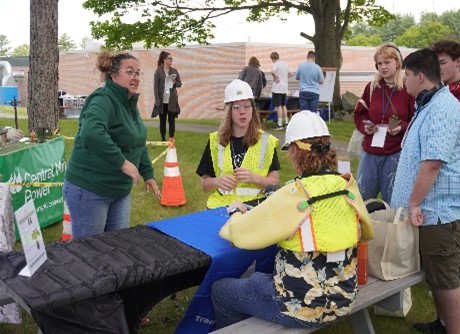
The daylong event allowed students to discover post-secondary opportunities through engaging, hands-on activities. Career paths in trades, culinary arts, agriculture, health care, media, and more were highlighted throughout the day. Students practiced knife skills with chefs, pulled lobsters from traps, and planted vegetables. They participated in Central Maine Power’s “Safety City” demonstration, regarding safety around power lines, and joined the Maine DOE Rethinking Responsive Education Ventures (RREV) team, along with the Student Leadership Ambassadors of Maine (SLAM) from Nokomis High School, for mock media interviews, designed for those interested in journalism and broadcasting.

L.L. Bean introduced the students to the world of retail through an interactive clothing activity that focused on merchandising and apparel knowledge. The iconic “Bootmobile” was also on display, drawing students in and sparking conversations about careers in retail and outdoor recreation.


“I want to become an EMT. If that doesn’t work out, I want to work in a mortuary,”  Abagail Giles, a student from Stearns High School, shared in an interview with NEWS CENTER Maine.

Educators and business partners at the summit emphasized the importance of creating inclusive pathways to employment.

“There is a ton of value, skill, brainpower, and I think it’s essential not to exclude a segment of the population,” Kim Cotta, Talent Development Manager at Darling’s Auto Group, said.

Titus O’Rourke, the Transition Specialist with the Maine DOE, emphasized the goal of the event in an interview with NEWS CENTER Maine: “[These students] belong in every single career pathway, and it’s important for students to understand what is available to them.”

By connecting students with real-world experiences and professional mentors, the “I Belong” Youth Summit helps to ensure that all Maine students with IEPs have the tools and confidence they need to shape their futures.

The third annual “I Belong” Youth Summit is set to take place in the Bangor area next spring. Due to the strong student participation from across the state for this event, Transition Maine and the Executive Student Transition Committee have plans to expand the “I Belong” Youth Summit.

For more information about the Maine DOE Transition Maine program, click here. Educators interested in connecting with someone about the Transition Maine program may contact her Titus O’Rourke at titus.orourke@maine.gov.

Your Voice Matters: Help to Name Maine’s New School Attendance Awareness Campaign!

As the Maine Department of Education (DOE) makes plans for Attendance Awareness Month in September, we are preparing to shine a spotlight on attendance and engagement in Maine schools with an attendance campaign name and slogan contest.

The Attendance Awareness Campaign will highlight what is working to bolster attendance and engagement in Maine schools; the ways in which educators and families are supporting the entire learning community; and how we can learn from and help one another in this work, ultimately leading to increased attendance and engagement in Maine schools.

You may submit up to three catchy naming ideas/phrases that capture the spirit of the importance of attendance and engagement in Maine schools. The Maine DOE will review all submissions, and then superintendents will vote on a winner this summer. The chosen name/slogan will become the heart of the Attendance Awareness Campaign, helping to guide the Maine DOE’s efforts in boosting attendance and engagement throughout the state. The creator of the winning submission will also earn statewide recognition!

Please submit your ideas using this form. Submissions are due by Tuesday, June 17, 2025, at 5 p.m. Let your voice be heard, and help us to craft an Attendance Awareness Campaign name and slogan that resonate across Maine!

Stay Tuned

This fall, the Maine DOE plans to continue this initiative with a logo design contest! Once the Attendance Awareness Campaign name/slogan are selected, a new phase of this effort will launch in September, as schools across Maine are invited to host their own logo design contests. Each school’s winning design may then be submitted to the Maine DOE for the opportunity to become the face of the campaign!

Be part of the movement. Inspire increased attendance in Maine schools. Make it count!

The Maine Engagement and Attendance Center (MEAC) is the sponsor of the Attendance Awareness Campaign contest. Learn more about MEAC here. With further questions, please contact Julie Smyth, Director of the Maine DOE Office of School and Student Supports, at julie.a.smyth@maine.gov.

Bowdoinham Community School Founds Its First ‘Play Club’

Second graders at Bowdoinham Community School experiment with old truck tires during Play Club earlier this spring. Kids find creative ways to play with standard, natural, and unusual playground items during this unstructured time.

Jonathan Haidt’s book “The Anxious Generation” planted a seed that took hold with Bowdoinham second-grade teacher, Kaleigh Frye. While much of the national conversation surrounding Haidt’s book has focused on phone-free schools, a second concept – “play-full schools” – piqued the interest of Bowdoinham Community School staff during professional conversations in August. Soon after, Frye approached Principal Chris Lajoie with a proposal: “I want to start a Play Club.”

Play Clubs promote a simple concept similar to neighborhoods of the past: They allow space and time for students of mixed ages to free play. Kids can play how they wish, are expected to organize and referee their own games, and find solutions to problems by themselves. Parents who sign their students up must acknowledge that not all kids may be happy all the time at Play Club, and supervising adults will intervene only in the case of an emergency or another big problem.

Utilizing a free implementation framework for schools from Let Grow, an organization dedicated to growing kids’ independence, the fall session of Bowdoinham Play Club started on Mondays after school, rain or shine. Fifty students spanning grades K-5 Participated. Students were allowed to use a wide swath of school property, including playground structures, natural play spaces in the woods, sports fields, and shady sitting spots.  

Early on, it took some trial and error for kids to navigate playing with much older or younger students—who, many times, were not their usual friends. 

“It didn’t come organically at first,” Frye recalled. “Kids innately want to involve an adult as soon as something goes wrong, so it has taken time and effort to learn how to handle these situations on their own.”

A Bowdoinham parent commends both the multi-age and extended-time aspects of Play Club – one full hour – compared to shorter and more grade-specific recess.

“I get the impression that the longer format on the playground feels more relaxing because they can really engage in whatever they are doing, uninterrupted by regular tasks,” the parent said.

After a winter reset, and as soon as the days became long enough once again, Frye started up a spring session of Play Club. Many students returned to the program, while welcoming a handful of new participants. The rules remained the same: 1. Don’t hurt anyone intentionally, and 2. Stay within the designated boundaries. Other than that, the supervising adults’ only role is just to say, “Go play!”

The impacts of Play Club have filtered into the school day. Teachers have reported hanging back and allowing kids to sort out recess disagreements, when in the past they may have stepped in more quickly. 

“We’ve watched as kids encounter trouble and then work with each other to find a fair and just solution,” Frye said. 

In many instances, the more time a teacher gave students to work out an issue, the more likely they were to navigate the challenge and resume play. Office referrals for recess conflict have dropped.

“Something changes for kids when they know the adults trust them to handle these things on their own,” Lajoie added. 

A parent of a third grader remarked that friendship issues for her son have greatly improved this year because “they are owning the resolution on their own.”

While some of these outcomes may have been predictable, one other result was not expected: Bowdoinham’s rate of chronic absenteeism has been cut nearly in half this year. Surely not all the credit can go to Play Club, but in the words of one young student whose attendance has been spotty, “Dude, I would never miss a Play Club day!”

This story was submitted by Bowdoinham Community School. To submit a good news story to the Maine DOE, please fill out the good news submission form.