The Maine Department of Education’s Office of School and Student Supports is partnering with Inspired Consulting Group, LLC, to support our school mental health providers
On Wednesday, November 1st from 2 p.m. – 3 p.m. or Thursday, November 2nd from 3:30 p.m. – 4:30 p.m., all Maine school-based mental health providers are invited to a virtual Office Hour with Chris McLaughlin, MSW, LCSW, Executive Director of NASW Maine (National Association of Social Workers) and owner of Inspired Consulting Group, LLC.
No matter where you are in the state, you are invited to log on for support, and resources, or to be with your colleagues around Maine. “These times are an opportunity to hold space for anyone who desires it,” said McLaughlin. “No agenda. Nothing formal. Just a safe space.”
Join one or both offerings for whatever amount of time you can! We in the Office of School and Student Supports are so thankful for all you are doing to support students, families, and school personnel – please know how important it is for you to make time for yourselves! There is no need to register for these sessions. Find the Zoom links to join the virtual office hours below.
Wednesday, November 1st from 2 p.m. – 3 p.m. – Zoom Link
Thursday, November 2nd from 3:30 p.m. – 4:30 p.m. – Zoom Link
For further questions, please contact Maine DOE Office of School and Student Supports Director Julie Smyth at Julie.A.Smyth@maine.gov or Maine DOE Coordinated School Health Coordinator Emily Poland at Emily.Poland@maine.gov.
Maine Department of Education (DOE) staff are hosting several virtual office hours in the coming days for educators and school staff to provide resources and provide a space for people to come together for professional support in responding to the horrific tragedy in Lewiston. More support times will be available next week, and we will continue to update you on additional office hours and resources.
We also wanted to reshare the resources that the DOE sent out last night on how to talk to children about gun violence.
Thank you for all that you continue to do to help students and staff cope with and process the heartbreaking events of this week and to create safe places for our students to have the routines and support from caring adults that they need in this moment.
Office of Student and School Supports Office Hours
Maine DOE School Nurse Consultant Emily Polandwill be available on Friday 10/27/2023 from 3:00-4:00 PM for an open space opportunity for anyone who is working in a school health office. This time will focus on helping one another to process and provide peer support for the recent tragedy in Lewiston.
Maine DOE SEL Specialist Kellie Doyle Baileywill be available on Friday 10/27/2023 and Monday 10/30/2023 from 4:30-5:30 PM to offer administrators and any other school staff Emotional Supports. This time will focus on helping one another to address the stress response of the recent tragedy in Lewiston and how best to support both adults and students with traumatic events.
Maine DOE Behavioral Threat Assessment & Management Coordinator Dr. Karen Barneswill be available on Friday 10/27/23 and Monday 10/30/23 from 2:00-3:00 PM to provide resources to assist educators and school staff with emotionally supporting students and staff around the recent acts of targeted community violence in Lewiston.
These sessions are not intended to be clinician interventions. If any person should need formal clinical support please consider these resources:
If you are an educator in need of additional support, The FrontLine WarmLine is also available from 8am to 8pm, 7 days a week by calling 207-221-8196 or texting 898-211.
If you or someone you know is in crisis, call 988.
StrengthenME is available to provide supports by connecting 1:1 and/or offer resources, StrengthenME: 24/7 at 1-800-769-9819.
In light of the tragedy in Lewiston, the Maine Department of Education (DOE) has curated resources for talking to children about violence and resources for schools and educators.
Talking to Children About Violence
Provide a short statement of fact: Violence took place in our community and many people were hurt. Students are safe here. You are safe. There are people here who can help you.
Early elementary schoolchildren need brief, simple information that should be balanced with reassurances that their school and homes are safe and that adults are there to protect them. Give simple examples of school safety like reminding children about exterior doors being locked, child monitoring efforts on the playground, and emergency drills practiced during the school day.
Upper elementary and early middle school children will be more vocal in asking questions about whether they truly are safe and what is being done at their school. They may need assistance processing the incident. Discuss efforts of school and community leaders to ensure their safety.
Upper middle school and high school students will have strong and varying opinions about the causes of violence in society. They will share concrete suggestions about how to prevent tragedies in society. Emphasize the role that students have in maintaining safe communities and schools, communicating any personal safety concerns to school administrators and parents/guardians, and accessing support for emotional needs.
Mental Health First Aid
Monitor and assess impact: Students and colleagues will be affected in different ways. We do not know how this event has affected people – directly and/or indirectly. Continue to assess impact of the event on those around you.
Be mindful of self-regulation to assist youth in maintaining a level of safety and connection.
If you are an educator in need of additional support, The FrontLine WarmLine is also available from 8am to 8pm, 7 days a week by calling 207-221-8196 or texting 898-211.
If you or someone you know is in crisis, call 988.
StrengthenME is available to provide supports by connecting 1:1 and/or offer resources, StrengthenME: 24/7 at 1-800-769-9819.
National Child Traumatic Stress Network offers Talking to Children about the Shooting (nctsn.org).Shootings such as this tragedy evokes many emotions—sadness, grief, helplessness, anxiety, and anger. Children and adults are likely struggling with their thoughts and feelings about the stories and images of the shooting may turn to trusted adults for help and guidance.
EPS Reports are due on Monday, October 30th. The following reports need to be reviewed and certified first by special education directors and then by superintendents:
Special Education Student Count EF-S-05 Part 1
October 1 Student Enrollment Count
Special Education Staff EF-S-05 Part 2
Staff Certification
CTE October Counts
If you have questions about any of these reports, please reach out to the MEDMS.Helpdesk@maine.gov or call 207-624-6896
The Maine State Board of Education was directed by the Joint Standing Committee on Education and Cultural Affairs of the 131st Legislature to study potential revisions to the State Board Rule Chapter 115, the Credentialing of Education Personnel, and to make recommendations as needed via L.D. 485 and a letter from the chairs of the committee dated August 4, 2023. This report is to be submitted by January 2, 2024.
Two special Certification & Higher Education committee meetings:
November 13, 2023 at 1:00 p.m.
In-person in Room 500 of the Burton Cross Office Building and virtually via Zoom (join here)
November 27, 2023 at 3:00 p.m.
In-person in Room 500 of the Burton Cross Office Building and virtually via Zoom (join here)
At these meetings, members of the public are invited to provide comments regarding potential revisions to the State Board Rule Chapter 115. Comments at the meeting will be limited to 3 minutes. Written comments are invited until 5 pm November 27 and can be submitted to the contact below.
A single set of comments from a constituency is more helpful than multiple repeated sets of comments from many constituents, that is, multiple people sending in the same comment is not as useful as that comment being submitted by a single letter signed by those people.
The State Board will review the report at their December 13, 2023, meeting and take final action.
Contact: Sandra Bourget, Maine State Board of Education, 23 State House Station, Augusta, Maine 04333-0023, Email: Sandra.A.Bourget@maine.gov, Phone: (207) 624-6616.
Teaching with Tech is back! The Maine Department of Education (DOE), Learning Through Technology team is excited for the second season of their MLTI (Maine Learning Technology Initiative) Ambassador podcast where they will highlight new faces and voices centered around supporting technology integration across Maine. In the first season of Teaching with Tech, episodes focused on a variety of topics ranging from digital citizenship, artificial intelligence, STEAM-based learning, and gamification in the classroom. The Ambassadors share exciting strategies and tools as well as interviews from the field which showcase how teachers and schools are using innovative educational strategies to provide students with the best experience possible.
The MLTI Ambassador team kicked off season two with an episode titled “What are the Ambassadors Working on?” This episode highlights projects that the team is looking forward to this year as well as gives examples of ways they can support districts, schools, and teachers all over Maine. October will be the first themed month, focusing both episodes around educational technology in the arts. Join the team as they interview educators about how they incorporate technology, tools, and strategies into their classrooms and schools. Be sure to look out for “Community Corner” bonus episodes which cover additional topics outside of the monthly theme. Last season saw bonus episodes dedicated to game-based learning in elementary physical education, the Educate Maine Symposium, and Student Leadership Ambassadors of Maine (SLAM) Clubs.
Do you have a topic you want to hear on Teaching with Tech or know an educator doing exciting work with technology integration? The MLTI Ambassadors would love to hear from you! To join the conversation, email the team at DOE-LTT@maine.gov. Teaching with Tech is now streaming on Apple Podcasts, Spotify, Google Podcasts, and YouTube Music.
For more information about the Teaching with Tech podcast or other MLTI Ambassador initiatives, contact the MLTI Ambassador Program Facilitator, Jonathan R. Werner, jonathan.werner@maine.gov
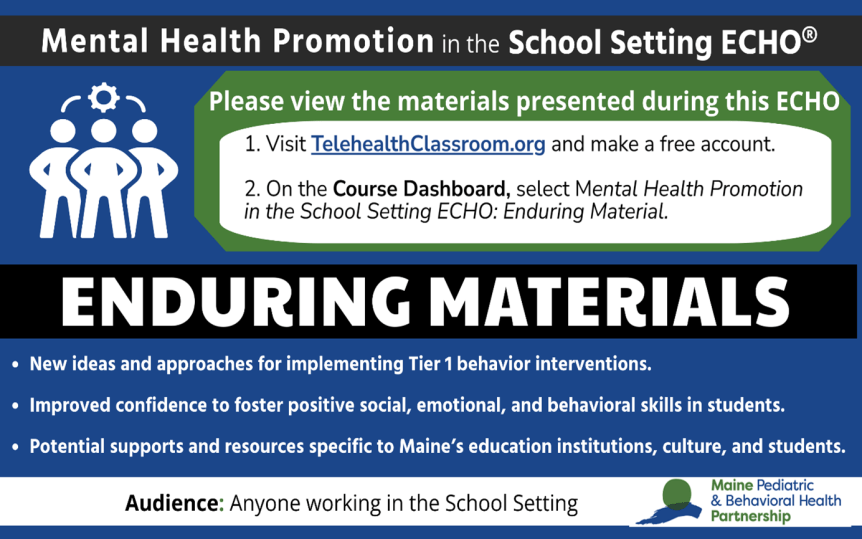
In early 2023, The Maine Pediatric and Behavioral Health Partnership, a partnership between The Department of Health and Human Services, Northern Light Acadia Hospital, and MaineHealth, used ECHO® Methodology to connect 125 participants across Maine, including teachers, ed techs, school nurses, social workers, counselors, and administrators to specialists in child and adolescent mental health.
Each of the six ECHO sessions contained a brief high-yield didactic presentation and provided a structured forum for those working in Maine schools to bring forward complicated behavioral health cases for exploration and review.
As a learning collaborative, we were reminded of mental health promotion skills we were already using and gained new ideas to put into action. We addressed the needs of our student population by learning from each other using case-based methodology.
As a result of the learning collaborative, MCD Global Health created the Mental Health Promotion Toolkit. A collection of helpful resources can be found inside. These materials provide information on mental health promotion, tips for addressing health disparities, and roadmaps for implementing innovative strategies to improve mental health and substance use prevention efforts in schools.
Maine youth have shown they want to take action on things that matter in their community. That is why Volunteer Maine, the state service commission, is offering $1,500 mini-grants to support youth-led projects through its Semester of Service grant program. Applications are due on or before November 2, 2023.
Youth groups in schools, faith communities, service organizations, and nonprofits are eligible to apply and participate. The Semester of Service begins on Martin Luther King Day of Service in January 2024 and ends with National Youth Service Day in April 2024. Proposals that tackle issues related to climate, mental or physical health, and housing are encouraged.“Youth-led” means individuals 17 or younger take the lead in all aspects of the initiative (research, decision-making, design, implementation). Advisors over 18 years old are resources and process facilitators. Youth-leadership is critical because it develops young people’s knowledge, skills and confidence to be catalysts for positive change within their communities.Participating youth groups are asked to learn what Dr. King meant by the “Beloved Community” and reflect on what their actions can contribute to making it a reality in their locale. “The Beloved Community” is a term first coined in the early 20th Century by the philosopher-theologian Josiah Royce, b1855 – d1916. For Dr. King, the Beloved Community was not an altruistic goal but rather a realistic, achievable goal. It could be attained by people working together to end poverty, hunger, homelessness, racism, prejudice, violence, bullying, and other conditions that divide or weaken a community.
Proposals for youth-led projects will be accepted from organizations with youth programs or youth constituents, 17 years old or younger, that are Maine public or private nonprofits, state/county/local units of government, higher ed institutions, faith-based organizations, Indigenous communities, and local schools.
Regardless of the type of youth group, the legal applicant must have an employer identification number (EIN) or taxpayer identification number (TIN) and, if selected, accept responsibility for signing the grant agreement, accounting for grant funds, and submitting a report on the outcomes of the project. Awards will not be made to individuals.
For more information contact Maryalice Crofton, Executive Director of Volunteer Maine at (207) 624-7792 or maryalice.crofton@maine.gov.
About Volunteer Maine
Volunteer Maine, the Maine Commission for Community Service, builds capacity and sustainability in Maine’s volunteer sector by funding service programs, developing volunteer managers and service-learning practitioners, raising awareness of the scope and the impact of the volunteer sector, and encouraging an ethic of service.
(Pictured: Educator Amy Trombley, with students Sustada Ma, El-Shammah Nsadha, and Ammala Ma)
At the beginning of the 23/24 school year, Limestone Community School was facing a need for an ESOL (English for Speakers of Other Languages) educator to meet the federal requirements of newly enrolled students. As the language use survey indicated a need for assessments, Principal Ben Lothrop recognized that while a 660-certified teacher wasn’t necessary on-site in the past, now it was. He first posted a position for a 660-certified educator with no success. In rural communities in Maine, finding a certified multilingual learner educator is often difficult, as it does fall in the US Department of Education’s teacher shortage.
“In rural areas across the state of Maine like Limestone and Aroostook County, we struggle to find qualified regular education teachers, much less anything more specialized like an ESOL teacher. In the past, I’ve had to ‘grow my own,’ and this is no different. It’s a great opportunity for the teacher, our students, and the local area as more and more people with various cultural and language backgrounds are moving into our area.”
The next step was for Lothrop to identify an educator who may want to pursue the emergency certification for 660. Title I teacher, Amy Trombley, jumped at the opportunity. “ESOL is a very rare certification, especially in this rural area of Maine, but it is still very much needed. I have a history of working with multilingual learners before my teaching career and loved the experiences that it brought with it. It is a very rewarding job! My main goal in teaching is to make sure the needs of every single student is met. With this certification, I can ensure needs are met for all demographics and make the education experience for multilingual students is that much more equitable.” Trombley applied for and received emergency 660 certification and then enrolled in the University of Southern Maine in the Teaching English to Students of Other Languages (TESOL) program with the District’s support. She has also taken advantage of free professional learning offered by the Maine Department of Education (DOE): WIDA webinar series, “Scaffolding Learning through Language.”
At the Maine DOE, we recognize an increased demand for 660 certification specialists in Maine. We are offering a collaborative webinar with Maine DOE ESOL Specialist Jane Armstrong, Certification Coordinator Erin Reinhard, Family Engagement Specialist Melanie Junkins, and the University of Southern Maine TESOL program instructors Dr. Andrea Stairs-Davenport, Dr. Alec Lapidus, and Dr. Melinda Butler. This one hour webinar is designed for administrators and educators in the state who want to learn more about obtaining a 660 certification, the differences in emergency, conditional, and full certification, and a pathway to earn this certification at the University of Southern Maine.
Questions regarding the webinar can be directed to Melanie Junkins (melanie.junkins@maine.gov), Maine DOE Family Engagement and Culturally Responsive Specialist.
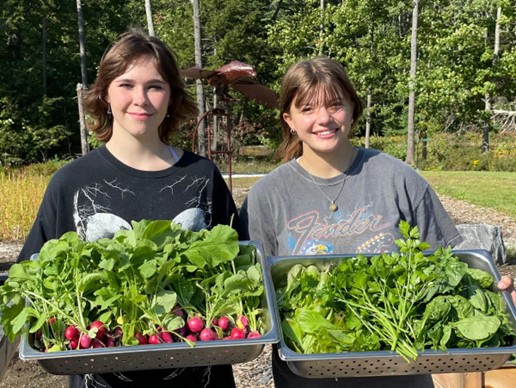
Project G.R.O.W. (Garden Roots & Outdoor Wellness) at Mt. Ararat High School has taken off! The program is led by Darcy Baggett and Becca Norklun.
Throughout the 2022/2023 school year, they had garden involvement in a variety of ways, all of which contributed to meeting their impact goal of 1870 student hours.
In the Fall, the team was able to partner with both the Interact Club and the Brunswick Area Rotary Club to build a tool shed. Two adults and five students built it together over a weekend using the MAITC (Maine Agriculture in the Classroom) grant-funded shed kit. This now enables them to house all of their new tools and equipment, also purchased with the funding, out of harm, and in a locked space.
Perhaps the most exciting project of the year was the collaborative sculpture project, organized by the school’s Art Department, their Community Pathways Program, and Project GROW. They invited internationally known environmental sculptor, Patrick Dougherty and his son, Sam Dougherty to work with roughly 200 students over the course of two full days to make large garden sculptures out of local saplings. It was featured on local news and in local papers – a huge success that students are still talking about!
Project GROW Garden Group met weekly, even throughout the winter, to plan the garden’s development, write area businesses and collaborators, harvest and sow Maine native seeds from their own school property, and more. The Leadership group is led by two Garden Coordinators, and eight students of varying high school ages. In the Spring, this group continued their work in the physical garden space, planting, harvesting, and planning new sections of the project’s “campus.”
Science teachers brought their students out to the garden during class time to teach them about the environment, plant and animal biology, and conduct soil science. An estimated number of students who were involved in the program through science classes is 100; some classes did this one time, others used the garden several times throughout the year for their research and outdoor exploration.
The health classes also used the garden to explore healthy living options, such as growing one’s own food, and discussing garden work as an opportunity for physical exercise. More specifically, t
he teacher of the “Fit for Life” course brought her students to the garden each semester, creating short-term visits with long-term impact for approximately 50 students.The Functional Life Skills class, Alternative Education Program, and the Community Pathways programs each used the garden this spring as a place for healthy, hands-on, outdoor learning. Collectively, these programs serve approximately thirty students and do a variety of things appropriate for their students’ needs.
This year, the district’s extended school year program for students with special needs was offered at Mt. Ararat High School, which means that 95 elementary and middle school students had access to Project GROW, as well. Every rain-free day of the 4-week program, these young students could be seen walking the gardens, sampling green beans, exploring our stick sculptures, and playing games.
“As a garden coordinator, it was an incredibly rewarding and unexpected scene this summer,” said one of the Project GROW organizers.
While their goal for student use has been met this year, they still hope to increase garden access even further. The Project organizers believe all academic disciplines at MTA can benefit from the use of Project GROW.
Follow along on their new Instagram account: @MTA_ProjectGROW
This story originated in the Maine Agriculture in the Classroom Newsletter where you can find more good news, grants, resources and more. To submit a story or an idea to showcase the great things happening in Maine schools email Rachel Paling at rachel.paling@maine.gov.



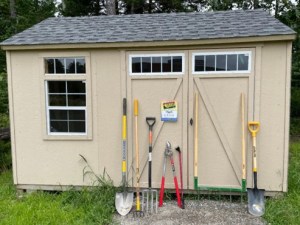 In the Fall, the team was able to partner with both the Interact Club and the Brunswick Area Rotary Club to build a tool shed. Two adults and five students built it together over a weekend using the MAITC (Maine Agriculture in the Classroom) grant-funded shed kit. This now enables them to house all of their new tools and equipment, also purchased with the funding, out of harm, and in a locked space.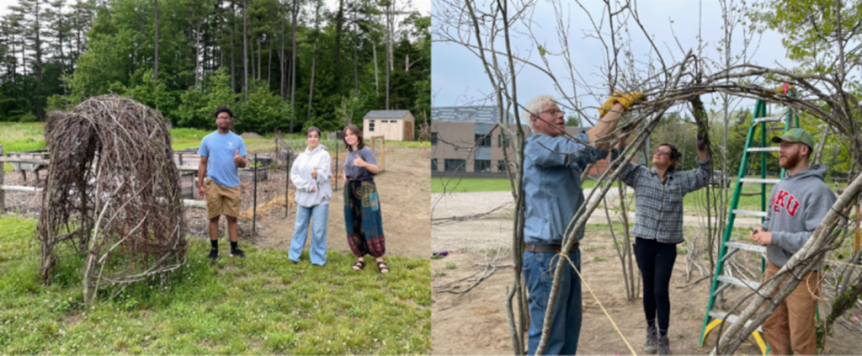
 Maine DOE Newsroom