Seeking Educators to Pilot MOOSE Modules; Info Session 9/21/23

Do you want to explore and implement innovative curriculum this fall? Are you interested in expanding your impact outside your classroom/school? The Maine Department of Education (DOE) is currently looking for educators to pilot MOOSE modules and would love to have your class participate!

Now in its fourth year, Maine’s Online Opportunities for Sustained Education (MOOSE) platform continues to grow. Last year, we added additional PreK-12 Learning Progressions to our already robust bank of MOOSE modules – created by Maine teachers for Maine students. These modules center on interdisciplinary, project-based learning experiences that are accessible, inclusive, and available for free online.

Feedback on the modules themselves and their usability is vitally important as we are constantly improving existing modules and applying lessons learned to new creations. We are looking for Maine educators interested in using an existing MOOSE module in their classroom with five (5) or more students and providing feedback about the experience. You get to decide the module(s) you want to pilot based on what works best for you and your students. Stipends will be provided for up to two modules ($500 each) that you have piloted and provided feedback on. All required elements must be completed by January 12th, 2024.

If you are interested in applying but still have questions, the MOOSE team will be holding a Q&A session via Zoom on Thursday, September 21st, 2023 from 4:30-5:30 pm. Registration for the Q&A session can be found here. The session will be recorded and sent to anyone who registers even if they aren’t able to make it in person. Questions can be submitted ahead of time to be answered in the session. For more information, please contact Project Manager Jennifer Page (jennifer.page@maine.gov).

If you are ready to apply applications can be found here. Applications for the fall session are due by Sunday, October 8th, 2023.

Join the Maine Association for Improving Literacy (MAIL)

The Cambridge Dictionary simply defines literacy as the ability to read and write. The National Assessment of Adult Literacy (NAAL) defines literacy as the ability to use printed and written information to function in society, to achieve one’s goals, and to develop one’s knowledge and potential. The International Literacy Association defines literacy as the ability to identify, understand, interpret, create, compute, and communicate using visual, audible, and digital materials across disciplines and in any context. Over time, literacy has been applied to a wide range of activities and appears as computer literacy, math literacy, or dietary literacy; in such contexts, it refers to basic knowledge rather than to anything specific to reading and writing. No matter the definition, we know that high-quality access to literacy instruction is a key component of equity of access to student success and access to the world.

In the fall of 2022, the Maine Department of Education brought together the first group of individuals who were interested in the inaugural network called the Maine Association for Improving Literacy. More than 100 educators came together to discuss literacy education across the State. Through monthly meetings, text studies, and regular email communication educators started the process of connecting a collaborating to improve literacy education across the state.

The mission of this network is to support children as they learn to read and love reading, address the diverse literacy needs of all Maine students, and discover a common ground of a supportive literacy community across the state. We welcome all people with a passion to learn and take action to increase literacy access to every person in the state. We encourage the participation of classroom teachers, administrators, special services educators, school support staff, educational specialists, and all of you who have a passion for literacy.

If you are interested in joining the MAIL network to attend monthly meetings, join text and article studies, or to simply be on the MAIL email list please consider completing the 2023-2024 membership form on the link below:

Register for the 2023-2024 Maine Association for Improving Literacy (MAIL) Network

If you have additional questions about the MAIL network, please do not hesitate to contact Dee Saucier, Inclusive Education Literacy Specialist and Dyslexia Coordinator, (danielle.m.saucier@maine.gov).

A Day With Maine Teacher of the Year Finalist Joshua Chard’s Class

“We take care of everybody”

“Everyone is valued”

“People are kind”

Those are some of the things that Mr. Joshua Chard’s third-grade students want people to know about their school.

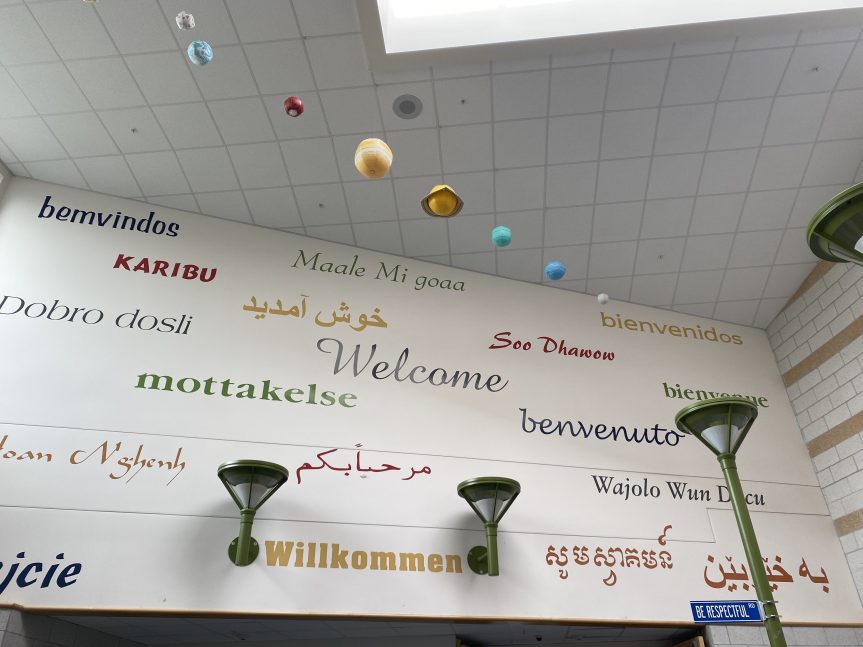
The Chardlings, as they’re affectionately called, go to school at East End Community School in Portland. East End is a diverse and welcoming school that sits on a hill overlooking the city and the water. Beyond extraordinary teachers, the school has its own garden with an outdoor classroom, a closet where students can get free clothes and other supplies, and a deep connection to the neighborhood and families as a community school.

Mr. Chard is one of four finalists for 2024 Maine Teacher of the Year and the 2023 Cumberland County Teacher of the Year. He was nominated by his principal and assistant principal. Colleagues say he builds relationships with every student, meets every student where they’re at, and finds joy in the uniqueness of each human.

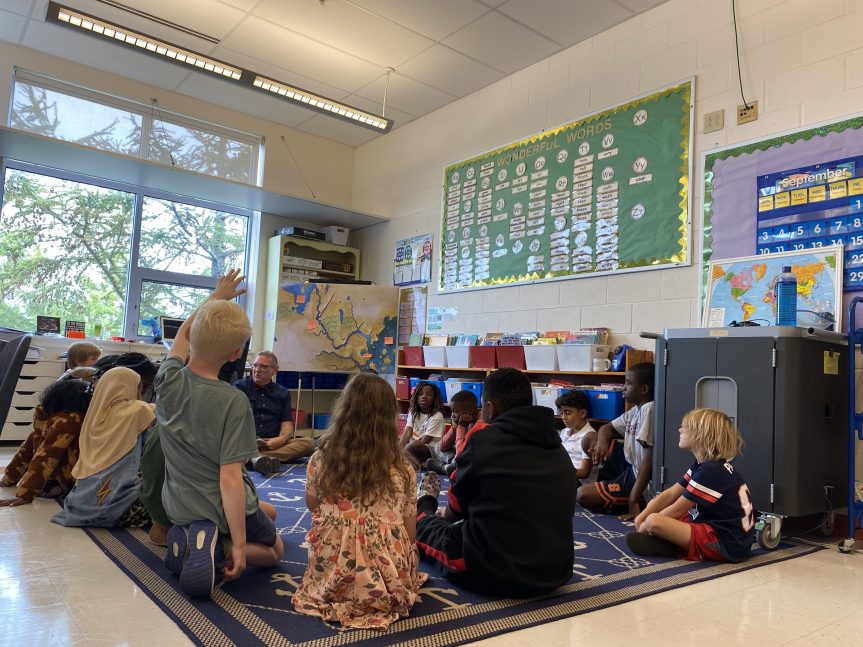
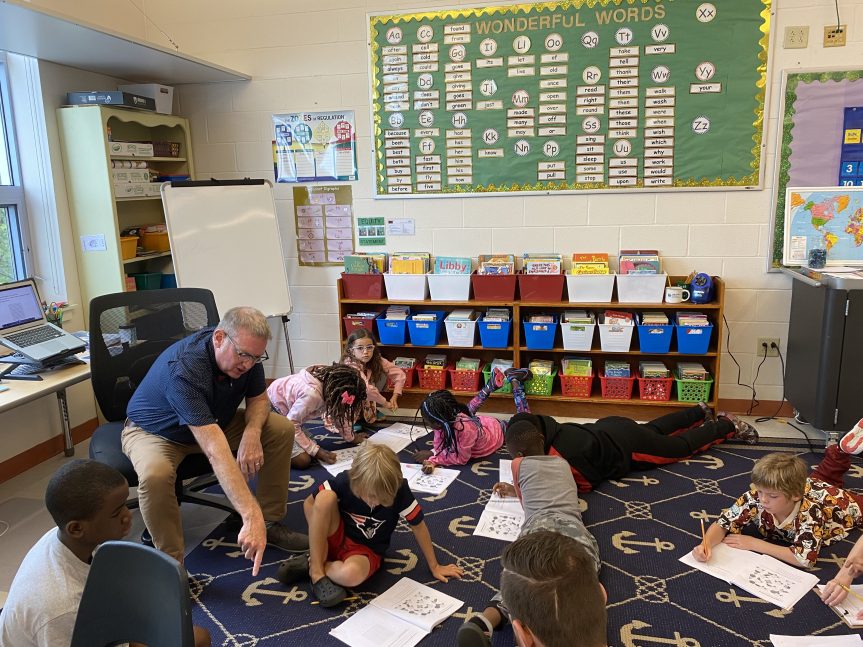
It’s easy to see why people say that about him. On a recent morning visiting Mr. Chard’s class, he and his Chardlings were happily seated on a colorful carpet, passing around a stuffed bear and telling their visitors what’s great about their school.

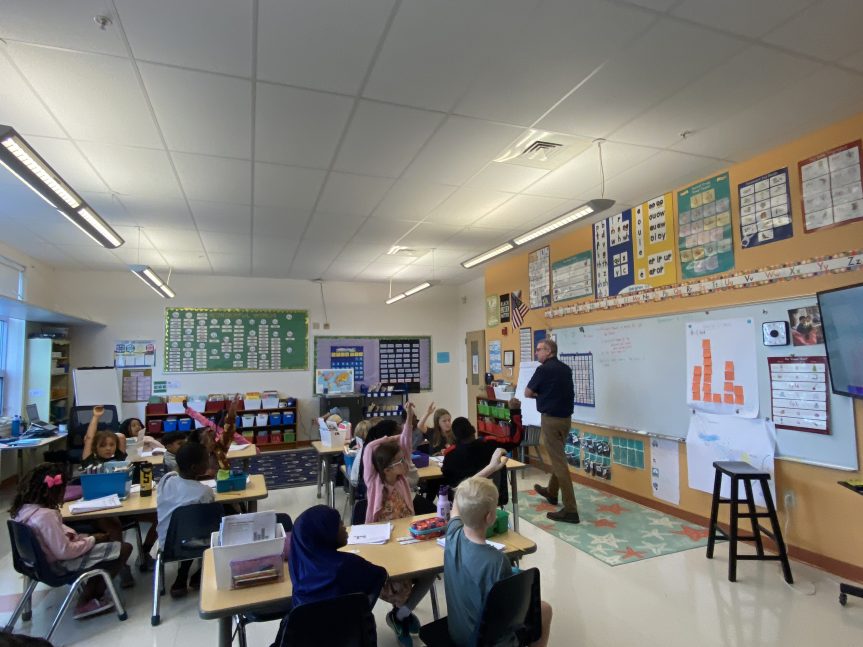
Next, it was math time. With the learning target written on the board, Mr. Chard asked the class who could tell him the math learning target for the day. He called on people one by one until the entire class said in unison, “Let’s choose a scale for our bar graph!” The students were given a scenario to measure the different shapes found on a piece of paper in bar graph form. Instead of working alone, they joined groups to discuss the problem and give their reasoning for what scale they should use to measure the shapes. Today was not about getting the right answer but working through the problem together and defending their reasoning.


Later in the day, and after a snack, it was time for science. Mr. Chard and the students returned to their carpet to learn about Wabanaki history and rivers, using the Columbia River to compare to Maine’s Presumpscot River. Mr. Chard asked what the students had learned the day before, with almost every hand going up with excitement. The students talked about what they knew about the Wabanaki, the immigrants who arrived, and 20 million years since the Columbia River was first formed. But if we know the Columbia is 20 million years old, then how old would that make the Presumpscot? After lots of class discussion, the class collectively inferred that the Presumpscot must have been around the same age.

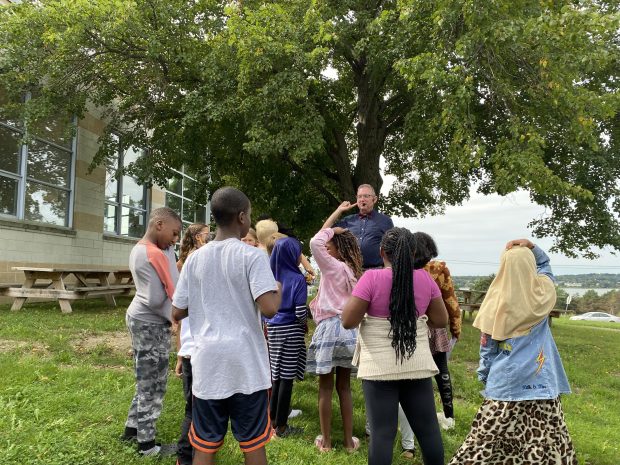
Then it was time for another of Mr. Chard’s “juicy” words—flora. Using cards with images of flora, Mr. Chard asked the class if they could tell us what flora meant. But why just talk about flora when you can experience flora? So, everyone took a card with an image of flora, and outside they all went to roam the perimeter of the school in search of flora that is often found near the banks of the Presumpscot River.

“That’s my flora!”

“I found it!”

“I think this is it!”

The Chardlings were enthusiastically committed to their mission to find their flora.

That’s just a bit of a glimpse into the engaging, project-based, immersive, and rigorous learning on display in Mr. Chard’s class.

When asked why he teaches, Mr. Chard said, “I teach because I stand tall on the shoulders of the teachers who lifted me up and saw my potential even when I couldn’t see it myself. I strive to be the teacher who lifts his students up in the same way, so that those students look back and say, ‘I stand tall on Mr. Chard’s shoulders.’ I can think of no better legacy than that.”

One of Mr. Chard’s fellow teachers talked about his magical formula that combines joy and fun with high expectations and his ability to meet the unique needs of every student. That was on full display on our wonderful day with the Chardlings.

Media Release: Maine Department of Education Announces $1.8 Million Climate Education Professional Development Grant Opportunity for Maine Schools

Grants Will Allow Maine Schools to Partner with Climate and Environmental Community Organizations to Strengthen Climate Education Across the State

The Maine Department of Education (DOE) announced a new climate education professional development grant opportunity today to support the growth of climate education throughout the state, especially in underserved communities. This $1.8 million grant initiative was designed out of LD 1902, which was passed by the legislature in 2022 to establish a pilot program to encourage climate education in Maine public schools.

The pilot grant opportunity allows schools to partner with non-profit community-based organizations that play an integral role in Maine communities. This allows schools to get expert knowledge from organizations that have created, sustained, and grown an incredible framework of outdoor and environmental education opportunities and programs that are tailored to their local region’s assets and needs. These partnerships will support teachers and schools to bring climate education to more of Maine’s students.

“These grants can provide Maine educators and schools with the tools, resources, and partnerships they need to provide students with engaging, hands on climate and environmental education. From the mountains to the coast, Maine has enormous natural resources for students to explore and learn from so they can be effective environmental stewards and leaders,” said Maine Education Commissioner Pender Makin.

Priority will be given to communities historically underserved by climate education, socioeconomically disadvantaged communities, and interdisciplinary, place-based, and project-based learning focused activities. The RFA can be found here, and applications are due on November 3, 2023. A second climate education RFA will be announced early in 2024.

Maine continues to be a leader in outdoor learning and climate education. The Maine DOE’s Rethinking Responsive Education Ventures (RREV) initiative, funded through a $16.9 million federal grant, has supported the expansion of outdoor education “classrooms”, programs, professional learning, partnerships, and spaces across the state. Schools across Maine utilized federal relief funding to expand outdoor learning spaces and programs. Governor Mills’ Maine Outdoor Learning Initiative, which just concluded its second year, has provided thousands of Maine middle and high school students with coastal and inland forestry learning and career exploration opportunities during the summer. The Maine DOE recently hired a Climate Education Specialist to support and expand this work with educators, schools, and community partners across the state. You can learn more about the Maine DOE’s climate and outdoor education work here.

###

Maine Department of Education Releases Climate Education Professional Development Grant to Promote Climate Education in Maine Schools

The Maine Department of Education (DOE) is excited to launch a new climate education professional development pilot grant opportunity to support the growth of climate education throughout the state and most especially in underserved communities. This grant initiative was designed out of LD 1902 which passed in the spring of 2022. This grant initiative is designed first and foremost to support teachers and schools. Climate change content and pedagogy can be challenging to approach for many different reasons. It can be a new area for teachers, a subject matter that is challenging to navigate in a school’s community, and an area of education where teachers and schools just don’t know where to get started.  

This initiative asks that schools partner with a non-profit community-based organization because these organizations are integral to communities throughout Maine. They have created, sustained, and grown an incredible framework of outdoor and environmental education opportunities and programs that are tailored to their local regions traits and needs. This initiative will expand on their work to form new connections and expand partnerships between community organizations and schools. These partnerships will support teachers and schools to bring climate education to more of Maine’s students. 

The RFA can be found here, and applications are due on November 3, 2023.

The RFA grant will be phase 1 of 2 initial phases the Maine DOE plans for this effort. Phase 1 will have an application window from early September to October 20th. Phase 1 professional development programs will be awarded for a term from mid-November through the end of August 2024. Phase 2 will build on the successes and learnings of phase one. Phase 2 will have an application window in the winter of 2024 and be designed for programs leading up to and during the school year of 2024-2025. These phases are designed for a wide variety of applicants and programs that might vary in style, content, age, duration, and breadth or depth. 

Applicants should take the time to review the application and ask questions by September 29th (full instructions in the RFA). Just like the program itself, the application can be collaborative with community partners and other local education providers if desired. Applicants that hit priorities one and/or two and cannot connect with a partner or do not know where to start are still encouraged to apply. If the timeline for phase 1 is too tight for applying or the award window does not make sense for this year, phase 2 is a great option with additional time to plan and connect with a partner. 

This program is overseen by Teddy Lyman, the Maine DOE’s new Climate Education Specialist. Teddy will coordinate this program including the application, awards, and deliverables. During the RFA application window, Teddy cannot communicate directly with anyone that might benefit from direct communication that is not publicly available.  

Questions about the RFA should be emailed to Teddy at: Theodore.Lyman@maine.gov by 11:59 pm on September 29th, 2023. Questions and answers will be posted publicly at the link below.  The Climate Education Specialist will also set and execute a wider range of climate education initiatives throughout the state. This will include working with grant recipients, stakeholders, and youth to design, encourage, and build the future of climate education around Maine. 

For more information and updates, check out the DOE climate education webpage.  

A copy of the RFA, as well as the Question & Answer Summary and all amendments related to the RFA, can be obtained at: https://www.maine.gov/dafs/bbm/procurementservices/vendors/grants. 


Webinar: October 1 Enrollment (EPS Student Count) – September 26, 2023

Join the Data Team for information about the October 1 Student Enrollment report. The data from this report is part of determining state funding allocations to SAUs.

This webinar will be recorded and posted to the DOE Data Youtube Playlist. It may take a few days for the recording to be posted, however, it will be available as soon as possible. Additional information about this webinar can be found on the Webinars page of the Helpdesk Website.

If this webinar is canceled, there will be a notice posted on the Helpdesk Website at the top of the page.

EPS October 1 Student Enrollment Reporting Webinar:

September 26th at 10:00 am

Join the Live event here


For questions about data reporting webinars, please contact Alexandra.Cookson@maine.gov

Reports Open Soon: Fall Reports – October 1 Enrollment, Dropout, and Quarterly Reports

Fall reports will be opening soon. All reports require review, validation and/or certification by superintendents.

Reports Opening:

  • EPS October 1 Student Enrollment – Opens 10/1, Certification Opens 10/16, Due 10/30
  • Dropout – Opens 10/2, Due 10/15
  • Bullying – Opens 10/1, Due 10/15
  • Behavior – Opens 10/1, Due 10/15
  • Daily Attendance – Opens 10/1, Due 10/15
  • Truancy – Opens 10/1, Due 10/15

Reporting guidance, instructions, and webinars about these reports can be found on the Maine DOE Helpdesk page. For questions about these reports please contact MEDMS.Helpdesk@maine.gov or call 207-624-6896

For training in navigating state reporting resources and systems, please submit a State Reporting System Training request, or call 207-446-3897

Learning Series: Supporting Children, Families, and Communities to Thrive

Maine’s Department of Education’s (DOE) Early Learning Team and Maine’s Office of Child and Family Services are excited to announce a professional learning opportunity for child care and public-school educators working with children birth-8 years old. This opportunity is funded through Maine’s Preschool Development Renewal Grant.

The Maine Resilience Building Network will be hosting a series of free virtual (via ZOOM) professional development sessions. Supporting Children, Families, and Communities to Thrive: Promoting Positive Childhood Experiences and Resilience will bring together early childhood and PK-3 public-school educators to participate in sessions during the fall of 2023. These sessions will focus on:

  • How adverse and positive childhood experiences impact children’s development,
  • ideas for how to support a stronger focus on positive experiences and for building resilience for young children, and
  • strategies for how educators can address compassion fatigue and build their own resilience.

Descriptions of all 3 available offerings can be found here. Two contact hours are available for each session. Registration is required and links to each session are provided within the table below.

Date/Time Program and Registration Link
Tuesday, 10/17/23

6:00-8:00pm

The Impact of Experience: How Adverse Childhood Experiences and Positive Childhood Experiences Impact Healthy Child Development (Part I)

https://maineresilience.org/event-5407497

Monday, 10/23/23 6:00-8:00pm A Framework for Implementing Positive Childhood Experiences to Support Healthy Child Development (Part II)

https://maineresilience.org/event-5407549

Thursday, 11/2/23 3:00-5:00pm Addressing Compassion Fatigue and Resilience Strategies in Educators and Caregivers

https://maineresilience.org/event-5407636

Saturday, 11/4/23 9:00-11:00am The Impact of Experience: How Adverse Childhood Experiences and Positive Childhood Experiences Impact Healthy Child Development (Part I)

https://maineresilience.org/event-5407584

Thursday, 11/9/23 3:00-5:00pm The Impact of Experience: How Adverse Childhood Experiences and Positive Childhood Experiences Impact Healthy Child Development (Part I)

https://maineresilience.org/event-5407589

Saturday, 11/18/23 9:00-11:00am Addressing Compassion Fatigue and Resilience Strategies in Educators and Caregivers

https://maineresilience.org/event-5407625

Monday, 11/27/23 3:00-5:00pm A Framework for Implementing Positive Childhood Experiences to Support Healthy Child Development (Part II)

https://maineresilience.org/event-5407598

Saturday, 12/9/23 9:00-11:00am A Framework for Implementing Positive Childhood Experiences to Support Healthy Child Development (Part II)

https://maineresilience.org/event-5407617

Tuesday, 12/12/23 6:00-8:00pm Addressing Compassion Fatigue and Resilience Strategies in Educators and Caregivers

https://maineresilience.org/event-5407706

Monday, 12/18/23 6:00-8:00pm Addressing Compassion Fatigue and Resilience Strategies in Educators and Caregivers

https://maineresilience.org/event-5407630

Additional questions can be directed to Maine DOE Early Childhood Specialist, nicole.madore@maine.gov.

Spruce Mountain High School Envirothon Team Finishes 16th at the Envirothon World Championships

This story and photos were provided by Spruce Mountain High School Teacher Rob Taylor (2019 Franklin County Teacher of the Year).

Do you know what a frogsickle is? Can you find the perimeter of a circular 1/250th hectare plot of forest land? Can you interpret LIDAR images to identify landforms? Do you know that manmade salt marshes work more effectively than dykes to protect shorelines from rising sea levels? These are just a few things that Spruce Mountain High School students learned as they competed in the 2023 National Conservation Foundation Envirothon in Tantramar New Brunswick, Canada from July 23rd to the 29th. The team represented Maine well, taking 16th place out of 49 teams at the competition held at Mount Allison University.

Envirothon is the world’s largest environmental science competition and students compete on field tests on Forestry, Aquatic Ecology, Wildlife Biology, Soil Science, and a Current Issue, which for 2023 was adapting to a changing climate.

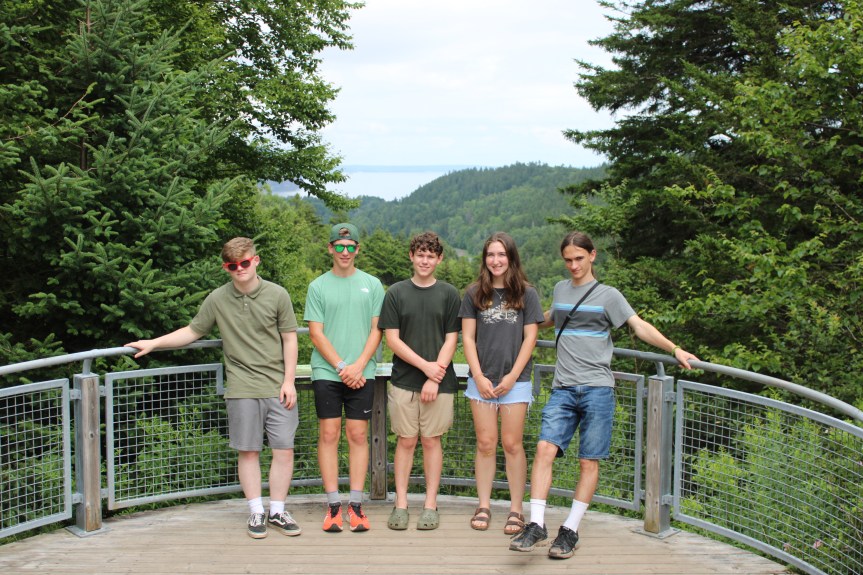
The Spruce Mountain High School Team won the Maine Envirothon on June 7th at the Viles Arboretum in Augusta, earning the right to represent Maine at the National Conservation Foundation International Envirothon, which included championship teams from most US States, Canadian Provinces, China, and for the first time, Singapore. The team includes graduated seniors Abrahm Geissinger, Owen Schwab, and Dan Wilson, as well as rising seniors Leah Burgess and Brenden Veilleux. The students spent a great deal of time this summer studying, learning from natural resource professionals, solving practice problem scenarios, and working on oral presentation skills.

Brenden Veilleux plans to major in Biology in college and said, “The hours we spent learning the 700 pages of resource materials for the competition really paid off and will help me in the future.”

For graduates Geissinger, Schwab, and Wilson, this was their third consecutive trip to the world championships and Schwab said, “This was a wonderful finale to my Envirothon career.”

Geissinger added, “Envirothon has helped me both as a public speaker and as a student.”

Wilson said, “I have been able to figure out what I want to do in life from Envirothon. This program has allowed me to make lifetime connections and meet some really interesting people.” Both Wilson and Schwab will attend the University of Maine in the fall and will major in Environmental Science.

According to Team co-advisor Ken Baker, “It has been a pleasure to work with the team preparing them to compete and it was rewarding to see them get to meet other students from around the world. The level of completion was intense and the students certainly rose to the challenge.”

The team finished 16th overall with a score of 537 out of a possible 700 points. The team was 21st in Aquatics with a score of 78%, 12th in Forestry with a score of 79%, 19th in Soils with a score of 69%, 17th in Wildlife with a score of 85%, 34th in Current Issue Test with a score of 75%, and 16th in Current Issue Oral presentation with a score of 151/200.

Baker said, “The team’s 16th place finish in the Oral Presentation is particularly noteworthy. The team was able to work with a number of experts in the field of climate change prior to the completion. This really helped them with their ability to solve the problems with adapting to climate change in New Brunswick.”

The students prepared prior to the competition by meeting with Senior Climate Resilience Coordinator Brian Ambrede and Community Resilience Partnership Program Manager Ashley Krulik, both of whom work for the Governor’s Office of Policy Innovation and the Future. They also met with Jordan Daigle, a Spruce Mountain High School Envirothon and Harvard Alumnus who serves as an Air and Greenhouse Gas Specialist at Chevron Corporation and they were provided resources by Environmental and Resiliency Planner Zach Gosselin of the Androscoggin Valley Council of Governments. Brenden Veilleux said, “Working with these professionals gave us a real-world perspective on how to deal with climate change.”

The team also learned about a number of technologies including LIDAR, which makes 3-dimensional images of land forms. They also met with Senior Geo Engineer Scott Dixon at Main-land Development in Livermore Falls, who taught team members how to use special 3D stereoscopic glasses to interpret aerial photographs, in addition to reviewing information on interpreting soils. Joel Gilbert of Berry Fruit Farm and the Jay Livermore Falls Chamber of Commerce met with the team to help them understand the business aspects of running a farm and farmstand, helping team members understand that sustainability requires analyzing social, environmental, and economic factors. Owen Schwab said, “It was awesome that local businesses and experts are willing to help us!”

Team member Leah Burgess said, “For me, this week of completion was a chance for our team to put our hard work to use. We managed to improve on last year’s 20th place finish, one of our major goals. The host committee from New Brunswick put on an amazing event not only for us to learn new things, but also for us to have so much fun!”

The team entered New Brunswick by ferry, visiting Campobello and Deer Islands, and saw porpoises and seals along the way. They visited places like Hopewell Rocks Provincial Park, Fundy National Park, the City of St. John New Brunswick, Irving Ecocenter: La Dune de Boutouche, and Irving Nature Park as part of the competition.
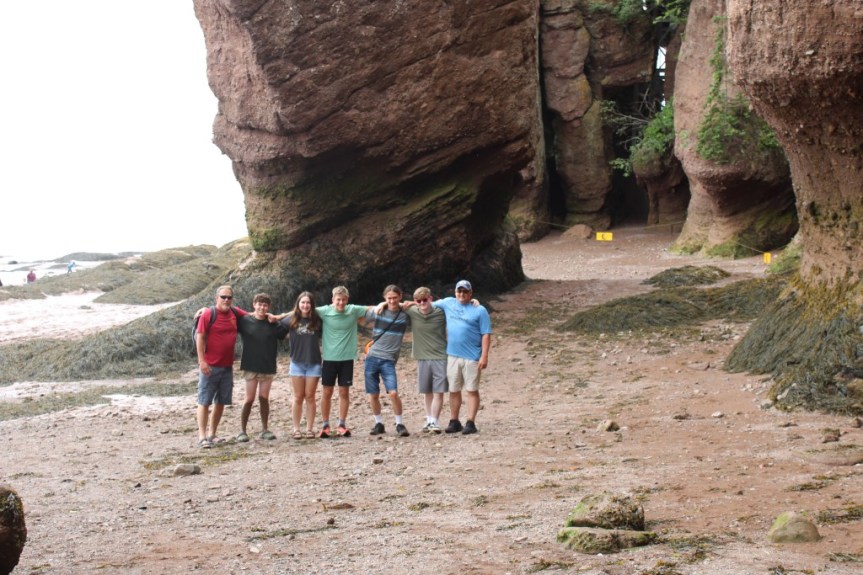
Spruce Mountain High School Envirothon Team

In the Current Issue Oral Presentation Competition, the team was provided information about the Isthmus of Tantramar in New Brunswick, which is especially vulnerable to the effects of climate change and they were sequestered together in a room for 6 hours with limited resources, where they developed a plan to make the area more resilient. The team’s solution featured using salt marshes as an effective strategy to help with coastal flooding instead of building expensive dykes. Salt marshes rise with increasing sea levels, while dykes require costly regular maintenance. The plan also identified stakeholders and described how to involve local residents by listening to their concerns and helping them identify and implement resilience strategies. You can view their presentation here:

Advisor Rob Taylor said, “I am really proud of this team. Our community has had 12 teams compete in the International Envirothon program over the years and this team had the second highest finish in school history. It is great to work and live in a community that supports our young people in programs like Envirothon. It is also a pleasure to work with all the Envirothon students at Spruce Mountain High School.”

The team from Massachusetts won the competition with an amazing score of 644/700 and swept the top scores in the five subject area tests. Pennsylvania took second and won the Current Issue Oral Presentation Competition with a score of 174.67/200. The remaining teams recognized with awards for overall top ten finishes were Ontario, Florida, New Mexico, North Carolina, California, New York, Tennessee, and Maryland (in order 3rd-10th). The Maine team’s 16th place score of 537/700 overall was only 21 points shy of earning a spot in the top ten.

By the way, if you are still wondering what a frogsickle is, it is not a cold treat on a summer’s day. It refers to the hibernating strategies of wood frogs that live in forests and breed in vernal pools that dry up in late summer. The frogs survive winter by lowering their body temperatures and freezing solid. One impact of climate change may be winters in the future where stretches of warm weather cause thaws followed by refreezing. This may be a problem for hibernators like wood frogs.

The team would like to thank the many local and Maine professionals, businesses, and community members who supported our trip to New Brunswick. It would not have been possible without their support.

Technical Support:

Scott Dixon – Senior Geo Engineer – Main-land Development, Livermore Falls ME

Brian Ambrette – Senior Climate Resilience Coordinator – Governor’s Office of Policy InnovaEon and the Future

Ashley Krulik – Community Resilience Partnership Program Manager – Governor’s Office of Policy InnovaEon and the Future

Jordan Daigle – Greenhouse Gas Specialist at Chevron CorporaEon

Joel Gilbert – CEO Berry Fruit Farm LLC, Chairman Jay Livermore Falls Chamber of Commerce

Dale Finseth – Kennebec County Soil and Water District

Frank Lopez, Merle Ring, and Ken Lausten – Our Fearless Forestry experts!

Justin Trinqet and Nikki Leroux – JustNiks Mycosilva, LLC

Steve Gettle – Woodland Investment Services

Robin Beck – Rockin Sheep Farm

Sponsors:

Maine Association of Conservation Districts – Maine Envirothon

Androscoggin Bank Linda Burgess
Ameriprise Financial – Michelle Maki Main-land Development
AMVETS North Star Lodge
Belinda Poland OEs Federal Credit Union
Counter Point Farm Pallet One of Maine
Debi Gagnon Ray and Audrey Henderson
Debra Hardy Timberlake Rockin Sheep Farm
Dr. William Beaker Sandy and Wynn Muller
Ellen Shaw Sappi Paper
Eloise Poland Spruce Mountain Pharmacy
Fitch Company Engineers T & L Automotive
Friends of Wilson Lake Wilton Masonic Lodge
Jay Livermore Falls Lions Club Dianne Maurais (great whoopie pies for the swap!)


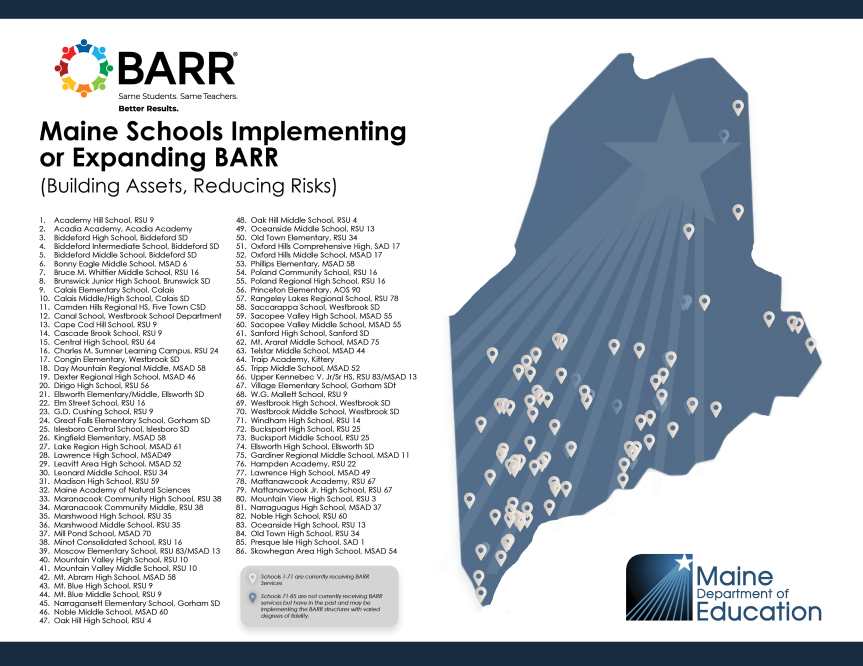
71 Maine Schools Begin BARR Model Implementation to Increase Student and Staff Wellbeing and Increase Academic Achievement

Maine DOE Invested $10 Million in Federal Funds to Offer Building Assets, Reducing Risks (BARR) Model to Schools. BARR is a Research-Backed Model Focused on Strengthening Relationships, Improving Achievement, and Reducing High-Risk Student Behavior

As the new school year begins, 71 schools across Maine launched their first year of implementing the BARR (Building Assets, Reducing Risks) model with students and staff. The Maine Department of Education (DOE) invested $10 million in federal emergency relief funds to provide access to the BARR model for Maine schools. BARR is a research-backed model focused on strengthening relationships, reducing high-risk student behavior, and improving academic achievement.

The Maine DOE made the investment to support educators, students, and schools in recovering from the impact the pandemic has had on wellbeing, engagement with school, and school climate. The BARR model strengthens relationships between educators and between students and educators and utilizes real-time data to support students based on their strengths and connections to school. BARR aligns with the Maine Department of Education’s whole student approach focused on ensuring all students are healthy, safe, engaged, supported, challenged, and prepared.

Educators at new BARR model schools spent their summers participating in multi-day trainings with BARR coaches to learn about the model and adapt it to their school cultures. The trainings helped develop stronger ties between educators and between educators, administrators, counseling staff, and other school support staff who will form the school-based BARR teams and work together to support students and one another. They also participated in several interactive, hands-on learning and relationship-building activities that they will be able to lead with their students.

Here are photos from trainings that took place across Maine:

“Camden Hills has always been committed to helping our students transition smoothly into high school, and we are excited to do so in a coordinated and systematic way with the support of the BARR program. Now more than ever, schools need to reinvest in creating a safe and empathetic space for kids to flourish academically, emotionally, and socially. I’m proud to share that our reinvestment includes adding research-based BARR strategies to our dedicated teachers’ toolbox,” said Camden Hills Regional High School Principal Jen Curtis.

“Our [BARR] training last week was just what the doctor ordered. It helped to reestablish our commitment, our structure, and our process. The training also helped to guide a conversation about resiliency which we all need post-pandemic,” said Westbrook High School Co-Principal Wendy Harvey.

“I was just saying to our curriculum director that while I appreciate the contacts she has lined up from a school that is currently implementing BARR, we really don’t need them. The teachers and staff who attended the BARR training are our most compelling supporters of this initiative,” said Maranacook High School Principal Michele LaForge.

“We [BARR trainers] had a great two days with Sanford. The team of freshmen teachers was enthusiastic, excited, and super energized after the two days. Three of the teachers and an assistant principal were a part of the original freshmen teams at Sanford back in 2011 and they all spoke super highly of BARR and how excited they were to bring it back. I heard a few folks making connections to other BARR schools. Two teachers mentioned how much the lessons and resources have grown. Lots of laughter and smiles. All in all a great kickoff to their year,” said Rachel & Andrea, BARR Trainers/Coaches

“The training resuscitated my staff. It felt like we were on life support last year. Yes, we can breathe!,” said a school administrator at Narragansett Elementary School.

Studies show that the BARR model results in increased student engagement, reduced chronic absenteeism, a 40 percent reduction on average in failure rates after one year of implementation, increased student achievement rates, and a reduction in high-risk student behavior and substance use. BARR reports that the effects are strongest for male students, students of color, students eligible for free or reduced-price lunch, multilingual learners, and students with disabilities. Educators report increased job satisfaction and higher levels of collaboration after implementing BARR.

15 Maine schools previously implemented BARR. Noble High School first implemented BARR with half of its 9th grade class in 2014. By the end of the first semester, BARR students had missed roughly half as many days of school as non-BARR students and the school expanded BARR to include all students. Bucksport High School’s graduation rate increased by more than 15 percent after implementing BARR.

Last week, the National Governors Association (NGA) selected Maine as one of five states to participate in a new initiative launched to bolster the mental health and wellbeing of students and school staff. Through this initiative, the NGA will support the implementation of the BARR model. Maine will receive technical support from the NGA and their national and state partners and engage in peer learning opportunities with the other states chosen for the initiative, New Hampshire, North Carolina, Oregon, and Wyoming.

Find more information on the BARR model here.

Watch a video featuring current and past BARR model schools in Maine:

Maine’s 71 new BARR model schools:


School District School Name
Acadia Academy Acadia Academy
AOS 90 Princeton Elementary
Biddeford School Department Biddeford High School
Biddeford School Department Biddeford Intermediate School
Biddeford School Department Biddeford Middle School
Brunswick School District Brunswick Junior High School
Calais Calais Elementary School
Calais School Department Calais Middle/High School
Ellsworth Ellsworth Elementary Middle School
Five Town CSD Camden Hills Regional HS
Gorham School Department Great Falls Elementary School
Gorham School Department Narragansett Elementary School
Gorham School Department Village Elementary School
Islesboro School Department Islesboro Central School
Kittery Traip Academy
Maine Academy of Natural Sciences Maine Academy of Natural Sciences
MSAD #46 Dexter Regional High School
MSAD 44 Telstar Middle School
MSAD 52 Leavitt Area High School
MSAD 52 Tripp Middle School
MSAD 55 Sacopee Valley High School
MSAD 55 Sacopee Valley Middle School
MSAD 58 Day Mountain Regional Middle School
MSAD 58 Kingfield Elementary
MSAD 58 Mt. Abram High School
MSAD 58 Phillips Elementary
MSAD 6 Bonny Eagle Middle School
MSAD 60 Noble Middle School
MSAD 61 Lake Region High School
MSAD 70 Mill Pond School
MSAD 75 Mt. Ararat Middle School
MSAD#17 OXford Hills Middle School
MSAD#49 Lawrence High School
Regional School Unit #24 Charles M. Sumner Learning Campus
RSU #34 Leonard Middle School
RSU #38 Maranacook Community High School
RSU #38 Maranacook Community Middle School
RSU #4 Oak Hill High School
RSU #4 Oak Hill Middle School
RSU #78 Rangeley Lakes Regional School
RSU 10 Mountain Valley High School
RSU 10 Mountain Valley Middle School
RSU 13 Oceanside Middle School
RSU 14 Windham High School
RSU 16 Bruce M. Whittier Middle School
RSU 16 Elm Street School
RSU 16 Minot Consolidated School
RSU 16 Poland Community School
RSU 34 Old Town Elementary
RSU 35 Marshwood High School
RSU 35 Marshwood Middle School
RSU 56 Dirigo High School
RSU 59 Madison High School
RSU 83/MSAD 13 Moscow Elementary School
RSU 83/MSAD 13 Upper Kennebec Valley Jr/Sr High School
RSU 9 Academy Hill School
RSU 9 Cape Cod Hill School
RSU 9 G.D. Cushing School
RSU 9 Mt. Blue High School
RSU 9 Mt. Blue Middle School
RSU 9 W.G. Mallett School
RSU16 Poland Regional High School
RSU64 Central High School
RSU9 Cascade Brook School
SAD17 Oxford Hills Comprehensive High School
Sanford School Department Sanford High School
Westbrook School Department Canal School
Westbrook School Department Congin Elementary
Westbrook School Department Saccarappa School
Westbrook School Department Westbrook High School
Westbrook School Department Westbrook Middle School