Virtual Tuesday Power Hour Series by TransitionME: 1/31 Session – Teaching Skills that Matter

The Maine Department of Education, Office of Special Services & Inclusive Education presents TransitionME Virtual Tuesday Power Hour Series, a best practices forum to provide opportunities for our State educators and transition leaders to grapple with and actuate strategies and support for our scholars’ diverse needs and pathways to post-secondary opportunities

Upcoming session: What central skills do students, including students with exceptionalities, need to find success in life and work?

Audience: All teachers; Highly recommended for Sped teachers, Case managers & Transition Leads

When: Jan 31, 2023 03:00 PM Eastern Time (US and Canada)

Amy Poland, a member of Maine Department of Education (DOE) Adult Education Team, will discuss nine central skills that are critical for success in life and work and will share the Teaching Skills that Matter toolkit, a set of high-quality lessons that integrate the skills into relevant contexts, such as civics education, health literacy, and workforce preparation. While written for adult learners, the TSTM toolkit materials are also relevant for high school learners, including multilingual learners.

Register here in advance for this meeting. After registering, you will receive a confirmation email containing information about joining the meeting. Participants who take part in this Professional Development will receive 1 contact hour.

For further information contact Titus O’Rourke, Maine DOE Eligibility & Transition Specialist at titus.orourke@maine.gov or call 207-215-6303.


Warsaw Middle Schoolers Put Courage to the Test with SpiritCorps

“I learned that I could face my fears if I put my mind to it,” one Warsaw 7th grader concluded as ELA teacher, Jake Marcoux, took his classes on a journey of self-discovery during their 3-week personal narrative writing and storytelling project celebrating Courage with SpiritCorps.

KEMPTON COURAGE – SPIRITCORPS.mp4 from Spirit Series on Vimeo.

Students engaged in a rigorous 5-step writing process to craft their stories of Courage. And they were supported along the way by their teacher, peer Story Partners, program videos and materials, as well as an adult SpiritCorps Story Coach. These trained program volunteers provide each student approximately one hour of personalized feedback to help them create their very best work. The best thing about SpiritCorps,” said another Warsaw 7th grader “is knowing that adults are out there helping children.”

The project culminates with students recording their story on video, then sharing and celebrating these with classmates and family, for an average of 2 hours of viewing time and 40 views for each 3-4 minute video.

In partnership with the Maine DOE, we can offer SpiritCorps to students statewide. Thanks to a federally funded grant, participating schools are given 100% scholarship in the first year. We would love to work with you and your students!

If you would like the SpiritCorps experience at your school, please email Dr. Christina O’Neal, our Director of Program Partnerships, at coneal@spiritseries.org.

Seeking Writing Teams and Targeted Reviewers for Update of the Maine Early Learning and Development Standards

The Maine Early Learning and Development Standards (MELDS) are the state’s learning standards for children ages three-five. Building from the Infant Toddler MELDS (IT MELDS) and bridging developmental expectations to the Maine Learning Results (MLRs), the MELDS inform all early childhood professionals about the typically developing expectations of young children as well as curriculum and assessment practices.

The MELDS Steering Committee is now accepting applications from individuals interested in being part of the review process to serve as participants on one of the writing teams, or as a targeted reviewer.  The Steering Committee is seeking professionals in the field of Early Care and Education that work or have worked with or on behalf of children. Prospective participants must apply  no later than February 21, 2023.

To understand the details of participation, please read the following Frequently Asked Questions (FAQ):

Q: What are the Maine Early Learning Development Standards (MELDS)?

A: Early Learning and Development Standards describe the concepts and skills children develop and learn along the developmental continuum from birth to kindergarten entry. Their purpose is to support the development and well-being of young children and to foster their learning.

The standards promote the understanding of early learning and development, provide a comprehensive and coherent set of early childhood educational expectations for children’s development and learning, and guide the design and implementation of curriculum, assessment, and instructional practices with young children.

Maine’s Early Learning and Development Standards (MELDS) serve as a guide for state and local early childhood educators’ efforts to improve practice and programs for young children during their preschool years.  The Infant/Toddler MELDS is a companion tool for ages birth-36 months.

Q: Who should consider participating?

A: In order to develop an evidence-based set of standards, we are seeking a diverse population of professionals from the Early Care and Education (ECE) field:

  • Child Care and School Administrators
  • Child Care Health Consultants
  • Child Care Providers and staff of all licensed programs (family, small facility, facility, nursery school, out of school time programs)
  • Child Care Providers and staff from licensed exempt programs
  • Early educators within the school setting (Pre-K through 3rd grade)
  • Ed Techs
  • English to Speakers of Other Languages (ESOL) Professionals
  • Head Start staff
  • Higher education professionals and their students within or specializing in the ECE/ECS field
  • Individuals that provide professional development to the Early Care and Education field
  • Parents, Guardians, Caregivers, or Family Members
  • Special Education Teachers / Specialists
  • Student and School Support Specialists: Speech, Occupational and Physical Therapists, School Counselors, School Social Workers, Interventionists, Title I staff
  • Other professionals serving families of young children

Q: What are writing teams and what is the time commitment?

A: Each of the domains of development will need a team of professionals to review content for relevance and alignment to current research in order for the MELDS to provide early childhood educators with guidance as they design inclusive environments, shape curriculum, lead professional development initiatives, build intentionality into teaching practice, engage families, and support children’s learning at home.  The domains include:

  • Social and Emotional Development
    • Goal Areas: Trust and emotional security, self-regulation; sense of self, self-awareness, and self-concept, relationships with adults, relationships with children
  • Approaches to Learning
    • Goal Areas: Engagement and persistence, initiative and curiosity, creativity
  • Early Language and Literacy
    • Goal Areas: Language comprehension (receptive language), language expression (Expressive/productive communication), emergent literacy
  • Physical Development and Health
    • Goal Areas: Perceptual development, gross motor (large muscle), fine motor (small muscle), self-help and adaptive skills
  • Cognitive Development
    • Goal Areas: exploration and inquiry, concept development and working memory, reflection and problem-solving, mathematical thinking, scientific reasoning, social studies learning

In addition to the domains of development, there are additional sections of the document that will need review.  Those sections include:

  • Introduction, History, Key Components of Early Learning Standards,
  • Purpose Statement and Potential Users, Guiding Principles and Universal Design for Learning
  • Introduction to the Stages of Development Ages 3-5

Time Commitment: The facilitator(s) for each writing team will determine the time necessary for both whole group and individual review. Participants should expect this to be no more than two hours per week. Writing teams will convene in March and work through June.

Q: What are targeted reviewers and what is the time commitment?

A:  Targeted reviewers will review the updated sections provided to them and offer structured feedback. Targeted reviewers will begin review once the initial updates have been made to provide feedback to the Steering Committee.

The time commitment will be less for targeted reviewers than writing team participants, however the  window for review and feedback will be shorter and more time sensitive (approximate document turnaround time of two weeks).

Q: What will I earn in exchange for my time and expertise?

A: Not only will individuals be afforded an opportunity to participate in furthering the field of Early Care and Education, but each participant will also be awarded contact hours at the completion of the writing team cycle based on attendance and at the discretion of the team leader.

Contact hours may be used for furthering education, documentation of professional development experiences, or for continuing education credits (CEUs) and/or training hour conversion.

Q: Why is periodic updating of learning and development standards important?

A: Research in the field of early care and education is constantly evolving.  A regular process of updating early learning and development standards helps to ensure their validity and alignment with other sets of standards across the birth to grade 12 spans.  The updated MELDS will result in a child-centered tool that will inform program development, instruction, assessment, policy decisions, and professional learning for early care and education efforts across Maine.

Q: What is the overall timeline for the MELDS revision?

A: MELDS revision began in the Fall of 2022 with the creation of the Steering Committee. This group has been meeting regularly to discuss the current format of Maine’s MELDS as well as to review feedback from the field, other states’ Early Learning and Development Standards and national research trends/findings. The remaining work is set to unfold on the following timeline:

  • January-February 2023: Recruit writing team members and targeted reviewers
  • February 2023: Assign Steering Committee members and teams to review the current standards
  • March-June 2023: Teams will work to review terminology, assure alignment to Maine’s Infant/Toddler MELDS and to the Maine Learning Results, and review for readability, diversity, inclusion and ease of use
  • July-August 2023: A final version will be translated and introduced to the field for further use

Thank you for time and consideration. If you have any questions, please contact the Department of Education’s Early Childhood Specialist, Nicole.Madore@maine.gov or the Office of Child and Family Services First4ME Program Manager, Megan.Swanson@maine.gov

MaineHealth Virtual Workshop: MindUP – A School and Community-Based Mental Health Resource

The following virtual workshop is being hosted by MaineHealth to Maine schools.

We are facing an unprecedented mental health crisis across the country, especially in the wake of the acute pandemic. The literature indicates it will take many strategies across community and clinical settings to address this.

MindUP is one school and community-based strategy that is based firmly in neuroscience and has proven to be effective to improve stress regulation, to enhance tools for self-regulation, and has demonstrated positive effects on reducing aggression and managing stress, including through four randomized control trials. Although its use and research has been focused in K-12 schools, MindUP can easily be taught in other settings and with adults.

We are fortunate to have implemented MindUP in several schools in Maine, including with the leadership of the Spruce Mountain public schools (RSU 73) in Jay, Livermore Falls, and Livermore and the Healthy Community Coalition at Franklin Community Health Network. David Evans Shaw, a Maine-based philanthropist, has generously funded the efforts to bring MindUP to Maine.

If you or others are interested in learning more and how you can bring MindUP to your school or community setting, please join leaders from RSU 73, Franklin Community Health Network, and MindUP for a one-hour informational zoom on Thursday February 16th, 11:00 am ET – 12:00 pm ET.

We ask that you register here in advance for this meeting.

After registering, you will receive a confirmation email containing information about joining the meeting. The meeting will be recorded, and registrants will receive a link to the recording afterward.

Learn more about about MindUP here (PDF).

Read to ME Challenge Kicks Off This Week

The Maine Department of Education (DOE) is pleased to announce that Commissioner Pender Makin will kick off the 8th annual Read to ME Challenge on Wednesday, February 1, 2023. You can watch a live stream of the event on the Maine DOE YouTube Channel.

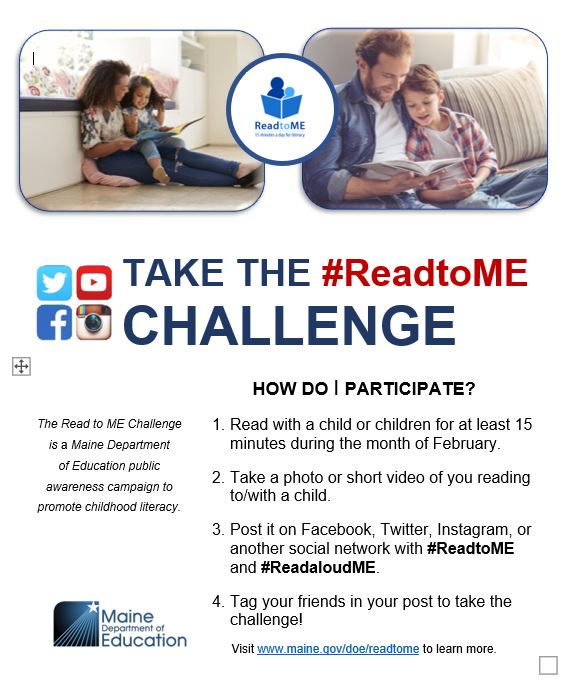
The Read to ME Challenge is a month-long public awareness campaign held in February to promote childhood literacy in Maine. The challenge is an opportunity to promote children’s literacy growth by reading aloud to one or more children for at least 15 minutes. Part of the challenge is capturing the moment via a photo or video and then posting it on social media (with the hashtag #ReadtoME and tag the Maine DOE at @mdoenews on Twitter and @MaineDepartmentofEducation1 on Facebook! Keep watching the Maine DOE social media sites to see who has accepted the challenge of sharing the joy of reading with a child.

The Read to ME Challenge will run for the month of February, leading up to Read Across America Day on March 2, 2023. Learn more about the Read to ME Challenge on the Maine DOE Website. If you have a school or community organization that plans on participating in this challenge, please let us know by signing up at this link.

Download a promotional flyer here (PDF).

For more information, contact Dee Saucier (danielle.m.saucier@maine.gov), Inclusive Education Literacy Specialist for the Maine DOE Office of Special Services and Inclusive Education.

Maine Alternative Education Association Spring Conference to Be Held March 10 at Thomas

The 2023 Alternative Education Association (AEA) of Maine’s Spring Conference will take place at Thomas College on March 10th from 8:30-2:30. AEA will offer six contact hours for participants of this conference.

If interested, please take a moment to fill out the Choices for Conference Presentation form, which will help the AEA define the topics that will be presented at the conference.

If you are ready to register for the conference, please submit the Conference Registration Form – all individuals must fill out the form, even if multiple people are attending from one school district.  Step two of the registration process is to print out the AEA of Maine Conference Invoice and send it to Dawn Matthews with your payment. (address and conference information is on the form) If you have already paid your dues for the Association this year, you DO NOT need to do Step 2. If you are not sure, send Dawn an email at dawn.matthews@rsu29.org

For further information and questions about the conference reach out to Lenny Holmes Leonard Holmes at lholmes@bonnyeagle.org.

The Mission of the Alternative Education Association of Maine is to provide support, guidance and direction to Maine Alternative Educators and the students they serve. The AEA’s purpose is to be an advocate and provide resources for all those in Maine who are involved in Alternative Education. Learn more about AEA here.


2023 Mitchell Scholarship Application Open

The 2023 Mitchell Scholarship online application is now open until April 1. You can find the application link, requirements, and a few additional college and scholarship resources on the Mitchell Institute’s web site.

New for the 2023 Mitchell Scholarship application season!

The Mitchell Institute is pleased to announce an expanded commitment to increasing college access for Maine students. In addition to the longstanding commitment of awarding at least one $10,000 scholarship annually to a graduating student from each of the 135 public high schools in Maine, the Institute will award 20 more scholarships across the state, bringing its annual total to $1.55M in support for the class of 2023 Mitchell Scholars. Visit this site more information: The 2023 Mitchell Scholarship Application is Now Open

In addition to the $10,000 scholarship that the Mitchell Institute will award to a graduating student from every public high school in the state, they provide numerous resources and programs for Mitchell Scholars:

  • Leadership and career development events
  • Access to a wide array of professional networks
  • Customized career advising and personal support through individual meetings with Mitchell Institute staff and community members
  • Fellowship Awards of up to $1,500 to support internships and personal/professional growth opportunities
  • Emergency financial assistance for unexpected financial challenges

Mitchell Scholarships are awarded to students planning to attend two- or four-year degree programs at colleges either in- or out-of-state. Candidates are evaluated based on the following criteria: academics, community impact, and financial need. Please encourage any graduating college-bound students from Maine’s public high schools to apply before the April 1 deadline.

For more information, contact the Mitchell Institute at info@mitchellinstitute.org or (207) 773-7700. Click here to subscribe an e-newsletter that offers a monthly roundup of news: The Mitchell Institute Update

WEBINAR: Functional Communication – More Than Just a New App!

The Maine Department of Education is pleased to present “Functional Communication: More than just a new app!”

Please join us on February 1st from 3:30-5:00 pm for a free virtual workshop presented by Fran Bodkin, MA CCC-SLP, in order to support all school personnel in understanding students with communication needs. Communication is vital to participating in society at all levels; school, home and community. Students who have difficulty expressing themselves and getting their needs met frequently experience frustration and may exhibit interfering behaviors in attempting to communicate what they need and want.

In this presentation you will learn:

  • How functional communication impacts students across settings
  • What is a functional communication evaluation and who can do one?
  • How to seek an evaluation or alternate supports
  • Different levels of assistive technology to support communication
  • How you can support students across settings
  • How to help students reach their full potential
  • How to leverage communication to support positive behaviors
  • How to have fun with communication!

1.5 contact hours will be offered to participants of this webinar.

Register here.

For more information contact Erin Frazier at Erin.Frazier@maine.gov.

Functional Behavior Assessment (FBA) Training for Maine PBIS Schools

Maine PBIS is offering a 3 day Functional Behavior Assessment (FBA) Training for our Maine PBIS schools. A FBA is the process used to assess a specific behavior that is interfering with a student’s academic, social, emotional and behavioral goals.  This team-based training will support your school staff in identifying why the behavior is happening through a variety of assessment tools and procedures leading to the development of a positive behavior support plan individualized to the student’s strengths and needs.

  • Team-based training, minimum of three team members per school
  • In-person training 8:30-3:00 pm (3/21, 4/4, 4/25)
  • The training is cumulative, participants will need to attend all three sessions – 18 contact hours are available to participants who attend all 3 sessions.
  • In-person at University of Southern Maine, Gorham Campus: 37 College Ave, 8 Bailey Hall – Room 301/301C in Gorham, ME

Register for the training on this form: https://forms.gle/LE89e6x1dGzkrcrQ7

Please contact Anne-Marie Adamson (anne-marie.adamson@maine.gov) with questions.