Maine Celebrates 21 New and 5 Renewed National Board Certified Teachers in Virtual Ceremony

Maine recognized 21 teachers newly certified by the National Board for Professional Teaching Standards (NBPTS) during an April 8 virtual ceremony. These exemplary educators join more than 400 teachers across the state who have gone through this highly reflective and transformative professional development, including five of their colleagues who renewed their National Board Certification this year.

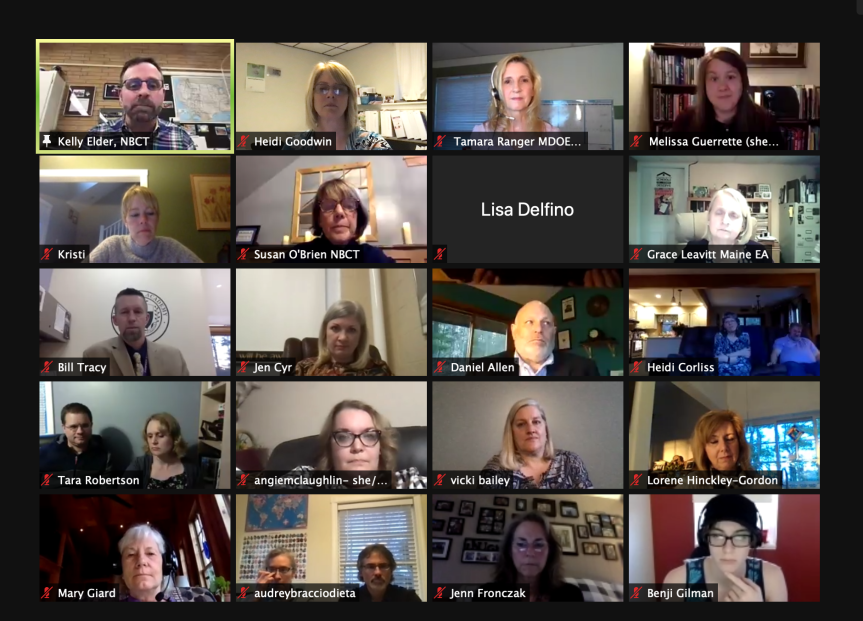
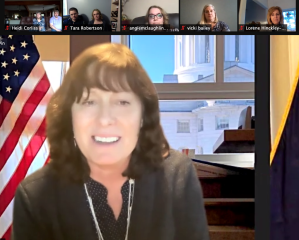
Friends, family, colleagues and administrators joined the celebration hosted by the Maine Education Association (MEA) and the National Board Certified Teachers Network of Maine (NBCTs of Maine). Offering congratulatory remarks were Education Commissioner Pender Makin, MEA President and NBCT Grace Leavitt, NBCTs of Maine Chair and NBCT, Melissa Guerrette, and Representative Rebecca Millett.
Featured speaker Kelly Elder, NBPTS, NBCT Board of Directors, 2017 Montana Teacher of the Year and 2018 NEA Foundation Fellow, shared a talk titled “What’s Next? Moving Forward from the Intersection of Emotional Health and Learning in a Post-pandemic World” Elder, a grade 6 geography teacher, acknowledged the challenges involved in teaching in a year unlike any other, and the disproportionate impact the pandemic had on our most vulnerable students. Elder noted that NBCTs, given their experience in such a highly reflective process as National Board Certification, are uniquely positioned to create, innovate, and lead the differentiated work (including rethinking assessment practices) in the coming years, in order to meet the needs of all of our students.

The event’s emcee, Heidi Goodwin, NBCT and NB Professional Learning Facilitator, was joined by Kristi Charette, NBCT and NB Professional Learning Facilitator, in leading this year’s unique pinning ceremony, with attendees being “pinned” by a family member at home. Dan Allen, MEA Professional Development Director, offered closing remarks, encouraging the NBCTs to engage in ongoing leadership opportunities, including offering support to candidates working on National Board Certification.

The journey to National Board Certification is a challenging one—the process, on average, requires nearly 400 hours of time and effort to achieve. Educators must submit a detailed portfolio that includes examples of student work and video recordings that show how they teach and interact with students. In addition, they must submit a reflective piece on student assessment and learning and demonstrate mastery of the content of their chosen certification area. This evidence must meet the Five Core Propositions and the National Board Standards, a body of knowledge that is maintained by teachers. Practicing teachers, through a peer-review process, assess the portfolios.

In pursuing and achieving National Board Certification, the following teachers have demonstrated an outstanding commitment to their students, schools, and districts. Please join us in congratulating them!

Maine 2020 New NBCTS

  Name National Board Certificate Position District/School
1. Heather Sinclair Science: Early Adolescence Middle School Science Teacher RSU 2 Hall-Dale Middle High School
2. Heidi Corliss Music: Early Adolescence/YA Fine & Performing Arts Teacher RSU 22 Hampden Academy
3. Alyce Delfino Exceptional Needs Specialist: Early Adolescence/ YA Special Education Teacher Five Town CSD

Camden Hills Regional High School

4. Christopher Driscoll Mathematics, Early Adolescence Middle School Math Teacher Falmouth Public Schools/ Falmouth Middle School
5. Sara Jones Mathematics: Early Adolescence Middle School Math Teacher Falmouth Public Schools/ Falmouth Middle School
6. Tara Robertson Literacy: Reading -Lang Arts: Early & Middle Childhood Title I Teacher Lisbon Public Schools

Lisbon Community School

7. Linda LaCasse Literacy: Reading -Language Arts: Early & Middle Childhood Title I Teacher Lisbon Public Schools

Lisbon Community School

8. Julia Bemis Science: Adolescence and Young Adulthood High School Science Teacher RSU 6 Bonny Eagle HS
9. Jennifer Fronczak- Math: Early Adolescence Middle School Math Teacher RSU 84 East Grand School
10. Vicki Bailey Generalist: Early Childhood Grade 1 Teacher RSU 22 Earl C McGraw Elementary School
11. Audrey Bracciodieta Exceptional Needs Specialist: Early Childhood through Young Adulthood Special Education Teacher RSU 22 George B Weatherbee School
12. Jennifer Brown Generalist: Early Childhood Kindergarten Teacher RSU 12 Chelsea Elementary School
13. Robin Tiller Science: Early Adolescence Middle School Science Teacher Biddeford Public Schools

Biddeford Middle School

14. Rachel Singh Generalist: Early Childhood Grade 1 Teacher Bar Harbor Public Schools

Conners-Emerson School

15. Rebecca Sanborn Generalist: Early Childhood Kindergarten Teacher RSU 60 North Berwick Elementary
16. Krista St. Cyr English as a New Language: Early Adolescence/YA English Language Learner Teacher Lewiston Public Schools

Lewiston Middle School

17. Lacey Todd Generalist: Middle Childhood Grade 5 Science Teacher RSU 10 Mountain Valley Middle School
18. Kaitlin Woodbury Literacy, Reading Language Arts: Early/Middle Childhood Grade 1 Teacher RSU 1 Phippsburg Elementary School
19. Lorene Hinkley – Gordon Literacy, Reading Language Arts: Early/Middle Childhood Title I Teacher RSU 49 Albion Elementary School
20. Jessica Archer English Language Arts: Early Adolescence Middle School: English, Science and Health Teacher RSU 26 Orono Middle School
21. Danielle Quimby Exceptional Needs Specialist: Early Childhood through Young Adulthood Gifted & Talented Teacher RSU 6 Buxton Center Elementary School

Maine 2020 Renewed NBCTS

  Name National Board Certificate Position District/ School
1. Laurie Alves Literacy, Reading Language Arts: Early/Middle Childhood Grade 5 Teacher Scarborough Public Schools Wentworth School
2. Brian Cote Science: Early Adolescence Middle School Science Teacher Bar Harbor Public School

Conners-Emerson School

3. David Doubleday Literacy, Reading Language Arts: Adolescence/YA High School English Language Arts Five Town CSD

Camden Hills Regional High School

4. Rachel Landry Exceptional Needs Specialist: Early Childhood/YA Special Education Teacher Portland Public Schools

Harrison Lyseth Elementary School

5. Joanne Powers Literacy, Reading Language Arts: Early Middle Childhood Elementary Literacy Teacher RSU 1 Dike-Newell School

National Board certification is voluntary and open to all teachers who have at least three years of classroom experience and a bachelor’s degree. Certification is available in 25 certificate areas, from preschool through 12th grade.

Maine offers an annual salary supplement for teachers who have achieved National Board Certification and scholarships to support up to 30 teachers, annually, in attaining National Board Certification.

Contact information for National Board Certification in Maine:

NBCTS of Maine:

Heidi Goodwin: nbct.heidi@gmail.com

Melissa Guerrette: nbct.melissa@gmail.com

Susan O’Brien: nbct.susan@gmail.com

Kristi Charette: nbct.kristi@gmail.com

Maine Education Association:

Dan Allen: DAllen@maineea.org

Maine Department of Education:

Tamara Ranger: tamara.ranger@Maine.Gov

Considerations for Schools Supporting Observances During School Year- Ramadan Begins

Other than the Christian observance of Christmas, Maine school calendars do not currently include days off from school for religious holidays. As a result, those of other faiths must navigate their observances around the expectations of schools – including expectations regarding attendance and participation – which may conflict with the traditions of the observance. To assist schools in understanding the timing, traditions, and possible impacts of some religious holidays, the Maine Department of Education has shared a calendar and considerations for major religious observances that may occur during the school year.

Islam is the second most populous religion in the world, and Maine is home to many Muslim families. Maine Department of Education would like to provide some general information about Ramadan and Eid-al-Fitr to schools, so they can support their Muslim students and community members as they enjoy this very special time of year.

Ramadan is a month-long fast observed by Muslims around the world. Fasting during Ramadan is one of the five pillars of Islam. To wish someone a happy Ramadan, you can say “Ramadan Kareem” or “Ramadan Mubarak.”

This year, in the United States Ramadan will start around April 12th and end around May 12th. The official beginning and end of the month of Ramadan will not be announced until the sighting of the new moon. Since the Islamic lunar calendar year is about 11 days shorter than the Gregorian calendar, Ramadan happens about 11 days earlier each year.

During Ramadan, most Muslims fast (i.e., consume no food or water) from dawn to dusk. Many Muslims also pray more frequently, recite the Quran (Islamic book) and make special efforts to be kind, generous, and compassionate. This is a joyous time of year, and each Iftar (post-sunset meal to break the fast) is a celebrated opportunity to gather with friends and family. Muslims may also wake before dawn to eat Suhoor (a pre-dawn meal), which helps give them energy to endure the day’s fast. (Iftar and Suhoor timings can be found here.) For some Muslims, the typical patterns of sleep are shifted so that more waking hours occur during the night, which can make it difficult to wake up early and stay alert during the day.

After Ramadan, Eid-al-Fitr (the festival of breaking the fast) is a three-day celebration with feasts and gatherings of families. This is an extremely important and cheerful time of year for Muslims, and students will likely be absent for all or part of the three days. Children often receive a new outfit or a small amount of money as a gift from their family for the holiday. To wish someone a happy Eid, you can say, “Eid Saeed” or “Eid Mubarak.”

Here are a few tips for supporting students during Ramadan and Eid-al-Fitr.

  1. Learn about Ramadan and Eid-al-Fitr.

There are many resources available online that can help you understand how and why Ramadan is observed. Keep in mind that practices may vary depending on culture, so your students and their families are the best sources of information about their Ramadan traditions. Here are a couple of articles that give a general overview.

https://www.nbcnews.com/news/religion/what-ramadan-six-things-know-about-muslim-holy-month-n586426

https://www.history.com/topics/holidays/ramadan

https://www.britannica.com/topic/Eid-al-Fitr

This video provides a brief and accessible explanation.

  1. Encourage cultural sensitivity for all school community members.

Fasting can have many physical and mental effects, such as fatigue, lack of concentration, and irritability. For your students, your understanding and support can help ensure that they continue to learn and make the most out of their time at school while fasting. Teachers, school nurses, sports coaches, bus drivers, cafeteria staff, and all other staff who interact with students will need to know how fasting can affect students.

Talking with staff and students about Ramadan and Eid-al-Fitr helps encourage an atmosphere of cultural awareness and sensitivity for the whole school community. Sensitivity towards fasting students includes avoiding consuming food and beverages in front of them whenever possible. Consider holding any celebrations that include food, such as awards banquets, after Iftar (breaking fast at sunset).

  1. Ask students and their families how you can best support them.

Some schools may choose to offer a place for students to go during lunchtime, alternative options for physical education, or dedicated prayer spaces. Schools may also avoid scheduling assessments or other required activities during Eid-al-Fitr, when students are likely to be absent. The best way to ensure that your school is a supportive, culturally-aware learning environment is to involve students, families, and other community members in planning and policy creation. Check out these two articles for some practical ideas that may benefit fasting students.

https://www.pbs.org/newshour/education/column-teachers-can-support-students-ramadan

http://www.isre.org.au/wp-content/uploads/2014/07/Schools-Guide-to-Ramadan-2.pdf

  1. Have a clear, well-communicated policy on tardies and absences.

Maine’s statute on excused absences is Title 20-A, Section §3272. It states that an absence is excused when it is for “observance of a recognized religious holiday when the observance is required during the regular school day and the absence has prior approval.” Fasting during Ramadan is a required religious observance, and the physical and mental demands of fasting may cause students’ tardies and absences to increase. Eid-al-Fitr celebrations are also religious observances. Districts will need to share clear expectations for attendance with students and families. It is highly recommended to develop these expectations in collaboration with your community members, recognizing that interpretation and translation may be necessary to ensure meaningful communication.

Approved Non-public School Data Needed by May 14 for Equitable Service Calculations

The Maine Department of Education (DOE) is seeking overall school enrollment and economically disadvantaged student count data from all approved non-public schools across the state.  The Department needs this important data to calculate equitable service levels for non-public schools under the Elementary and Secondary Education Act (ESEA).  Approved non-public schools are encouraged to provide this data as soon as possible, but no later than May 14, 2021. Any approved non-public school that does not provide the Department with this requested data by the May 14, 2021, deadline will not be eligible for equitable services during in the 2021-2022 school year.

The Maine DOE is collecting this data from approved non-public schools through an online survey.  As part of this survey, approved non-public schools will be asked for the following information:

  • Overall school enrollment as of October 1, 2020 (required)
  • Economically disadvantaged student information (optional for those seeking Title I services)

October 1, 2020, enrollment counts are used to calculate equitable service levels for both Titles II and IV of the ESEA.  Similarly, economically disadvantaged student information is used to calculate equitable service levels for the Title I program.

The economically disadvantaged student data needed for the survey includes each student’s:  (1) home address, (2) grade level, (3) eligibility criteria met (i.e. Free Lunch, Reduced Lunch, TANF, Medicare, or Tuition Assistance based on Free or Reduced Lunch Income Levels); and (4) the SAU District and School the student would have attended based on their residence.  Equitable service levels for Title I include those identified economically disadvantaged children who would have attended public schools that have Title I services.  Children who would not attend a public Title I school do not contribute to the equitable service levels.  Generally, children ages 5-17 can be counted for this data collection.  Please note that the low-income measure used for Title I for current students could be from the beginning of the 2020-2021 school year.

For more on the economically disadvantaged student data elements requested within the survey, as well as information about Title I program implementation, please review a snapshot of .

Approved non-public school officials are encouraged to review Equitable Services Guidelines as well as the non-regulatory guidance for Titles I, II, and IV when thinking about possible ways to support the needs of their students through ESEA programs.  Non-regulatory guidance for each program is provided below:

The information provided by each approved non-public school will be used to calculate the level of equitable services that school would be eligible for during the 2021-2022 school year.

For any questions regarding this data collection process or the survey itself, please contact Title IA Program Specialist, Jackie Godbout, at jackie.godbout@maine.gov

Priority Notice: Popular Multi-Tiered Systems of Support MicroPD Session Offered for Second Round

Beginning April 29th, the 6-week MicroPD LIVE MTSS training will be repeated. This professional learning session focuses on strategies for strengthening tier 1 supports for all students by exploring a 4-step problem solving process as it is applied at the tier 1 level.

The goal of the training is to develop both understanding and application strategies for improving supports for all students through tier 1 instruction. Participation in this MicroPD live training will prepare administrators, interventionists, and other support staff/teams with skills to evaluate the tier 1 setting in their school, application of a four-step problem solving process for addressing areas of need, and action planning for initiating the process to better support teachers and students as they round out the school year and begin planning summer and fall professional learning.

This live training will be held on Thursdays from 3:00-4:00 PM for 6 weeks. Unlike other MicroPD offerings, this is a live training and is being capped at 25 participants (or teams, when applicable) due to the highly interactive nature of the training. Individuals may register, but it is recommended that teams of at least 2 join together.

Session dates and topics:

· Session 1: April 29: Exploring effective four step problem solving models

· Session 2: May 6: Goal/Problem Identification

· Session 3: May 13: Problem Analysis

· Session 4: May 20: Instructional/Intervention Design

· Session 5: May 27: Response to Instruction/Intervention

· Session 6: June 3: Implications for leaders/action planning

You MUST register for this new PD series even if you have registered for MTSS MicroPD in the past. Registration for this PD will close on Wednesday, April 28th (or when it is at capacity, whichever comes first). To register for this new professional learning opportunity, click here.

Get to Know the Maine DOE Team: Meet Marcy Whitcomb

Maine DOE team member Marcy Whitcomb is being highlighted this week as part of the Get to Know the Maine DOE Team Campaign. Learn a little more about Marcy in the question and answer below.

What are your roles with DOE? 

I sit on the Early Learning Team, as the Early Childhood Monitor.  My position is to connect with public pre-k programs across our state for monitoring, observation and support around best practice.  I also work closely with our team, and other agencies on initiatives that also support the field, children, and families in our state.

What do you like best about your job?

This is a field that I am very passionate about.  I love the inclusion within the Early Learning team, and the support that I receive from my colleagues.  I enjoy working on each and every project that comes my way.  Being in a position to support our educators in the field is an honor.

How or why did you decide on this career?

I chose the EC field as my career when my youngest entered into preschool at 3 years old.  Learning how important those early formative years are for children, and for my son specifically at the time, was something the really resonated with me.  I started my career in the field as a classroom substitute, and over the years, have held many roles and worn many hats in early childhood programs, which led me to where I am today.

What do you like to do outside of work for fun?

I have two teenage children who keep me busy, and I am usually found at a sporting event supporting them.  Living in the mid-coast area, I enjoy the local reserves and trails to the rocky coast, and of course, the beach.  And, finally it is spring and the flowers are coming up – playing in the garden is my happy place.

Maine Community College Students Named to All-Maine Academic Team

Twenty-one Maine community college students have been named to the All-Maine Academic Team in recognition of their outstanding academic achievement, leadership, and service.

They were honored last night in a virtual ceremony. For a recording of the presentation go to: https://youtu.be/91_Vk9STdH8

The students receiving the award and a $500 scholarship from the MCCS Board of Trustees, are:

  • Nicholas Bennett, Gray, Central Maine Community College in Auburn
  • Emma Gay, Winthrop, Central Maine Community College;
  • Coleen Heiser, Canton, Central Maine Community College;
  • Jeffrey Palmer, Tamworth, NH, Central Maine Community College;
  • Britney Eberhardt, Prospect, Eastern Maine Community College in Bangor;
  • Jennifer Hodgins, Brewer, Eastern Maine Community College;
  • Joy Sharrow, Bowerbank, Eastern Maine Community College;
  • Adrian Hoyt, Benton, Kennebec Valley Community College in Fairfield/Hinckley;
  • Felecia Paradis, Fairfield, Kennebec Valley Community College;
  • Natacha Valley, Winslow, Kennebec Valley Community College;
  • Kristin Wallaker, New Portland, Kennebec Valley Community College;
  • Valerie Bilogue Minkala, Presque Isle, Northern Maine Community College in Presque Isle;
  • Leeann Kaiser, Easton, Northern Maine Community College;
  • John McNally, Patten, Northern Maine Community College;
  • Savannah Green, South Portland, Southern Maine Community College in South Portland/Brunswick;
  • Cortney Luce, Poland, Southern Maine Community College;
  • Rachel Ackley, Cooper, Washington County Community College in Calais;
  • Donna Mutty, Calais,  Washington County Community College;
  • Jessica Stevens, East Machias,  Washington County Community College;
  • Dana Comeau,  Kennebunkport,  York County Community College in Wells and
  • Travis Richards, Moody, York County Community College.

In addition, Jennifer Hodgins (EMCC) and Kristin Wallaker (KVCC) have been named Maine New Century Scholars for earning the highest scores in the state on their All-USA Academic Team applications.

Hodgins has been named the 2021 Maine New Century Transfer Pathway Scholar and will receive a $2,250 scholarship.

Wallaker is the 2021 Maine New Century Workforce Pathway Scholar and will receive a $1,250 scholarship.

KVCC’s Adrian Hoyt was one of only 50 students nationwide name a Coca-Cola Academic Team Silver Scholar and will receive a $1,250 scholarship.

The New Century Pathway Scholarship program is sponsored by The Coca-Cola Foundation, The Coca-Cola Scholars Foundation, the American Association of Community Colleges, and Phi Theta Kappa. Only one New Century Transfer and Workforce Scholar is selected from each state.

The All-Maine Academic Team is a program of Phi Theta Kappa, an international honor society for two-year colleges. Students are nominated and selected for the team by their college.

Information for this article was provided by Maine Community College System as part of the Maine Schools Sharing Success Campaign. The Maine Schools Sharing Success Campaign is an avenue for Maine schools to celebrate successes and share innovative ideas, practices, and models that can be adapted and easily implemented by other Maine schools. Stories are not an endorsement of specific materials, services, or practices and are not intended to promote learning programs that are of cost to students, families, or schools. To submit a story or an idea, email it to Rachel at rachel.paling@maine.gov. 

Travel Quick Reference Guide

With the evolving state and federal requirements for travel, and the added variables of vaccinations, timeframes, and location, Maine Department of Education has created a “cheat sheet” with relevant links as it relates to travel requirements. Included you will find information about domestic and international travel and any testing or quarantine requirements, and for whom. There are links to additional information included.
You can find this quick reference guide, here, or on our COVID-19 Toolkit, along with other resources, updates and information.

MEDIA RELEASE: Mills Administration Updates COVID-19 School Health Advisory System

For Immediate Release
Contact:  Kelli Deveaux, Director of Communications

All counties remain green; Androscoggin and Oxford counties closely monitored

AUGUSTA — The Mills Administration today released an update to its color-coded Health Advisory System that classifies counties’ relative risk of COVID-19 transmission to assist schools as they continue with their efforts to deliver instruction and support students safely.

ALL COUNTIES GREEN, although Androscoggin and Oxford counties will be closely monitored. Statewide, both new case rates and positivity rates have increased in the last two weeks, but for the purpose of in-person learning, all counties remain within the green categorization. Androscoggin County has experienced a significant increase in its two-week new case rate, now 51.4 per 10,000, due in part to the outbreak at Bates College. Oxford County’s positivity rate has risen to 6.1 percent and its new case rate to 40.5 per 10,000. As such, trends in these counties will be closely monitored.

The Maine Department of Health and Human Services (DHHS) and Maine Center for Disease Control and Prevention (Maine CDC) continue to review evidence that indicates lower transmission of COVID-19 in schools compared to the general population.

Over the last 30 days, the rate of new cases for school staff and students is 37 per 10,000, about 25 percent lower than a new case rate of 50 per 10,000 for the general population.  This continues to demonstrate that in-person learning in schools that follow public health precautions can be conducted safely, without increased transmission of COVID-19, and supports schools’ adherence to the six requirements for returning to in-person instruction and protocols for identifying close contacts that are found in the Standard Operating Procedure for a positive case in schools, regardless of their county color designation.

These designations are provided for the consideration of school administrative units in their decisions on how best to safely deliver instruction.

The county-level assessments are based on both quantitative and qualitative data, including but not limited to recent case rates, positivity rates, and syndromic data (e.g., symptoms of influenza or COVID-19). Those data are publicly posted every week on the Maine CDC website. DHHS and Maine CDC also consider qualitative factors, such as the presence of outbreaks that may potentially affect school-age children. The qualitative and quantitative considerations and data used by the CDC in determining community transmission risk levels for schools can be located here: How County Risk Levels for Maine Schools are Determined

The Health Advisory System categorizations are defined as follows:

  • GREEN: Categorization as “green” suggests that the county has a relatively low risk of COVID-19 spread and that schools may consider in-person instruction, as long as they are able to implement the required health and safety measures.  Schools in a “green” county may need to use hybrid instruction models if there is insufficient capacity or other factors (facilities, staffing, geography/transportation, etc.) that may prevent full implementation of the health and safety requirements.
  • YELLOW: Categorization as “yellow” suggests that that the county has an elevated risk of COVID-19 spread and that schools may consider additional precautions and/or hybrid instructional models to reduce the number of people in schools and classrooms at any one time.
  • RED: Categorization as “red” suggests that the county has a high risk of COVID-19 spread and that in-person instruction is not advisable.

The next update will be provided on April 23, 2021. Updating this advisory on a two-week basis aligns with the incubation period for COVID-19 and allows for greater stability in the trend data for small counties.

###


The Portland Public Schools Is Grand Prize Winner for Equity Work

Portland Public Schools has been recognized for its commitment to equity as a Grand Prize winner in the National School Boards Association (NSBA) 2021 Magna Awards program. This is the first time in that program’s 27-year history that a Maine school district has been recognized with a Magna Award for its equity work.

The annual Magna Awards honor school districts across the country for programs that advance equity and break down barriers for underserved students. PPS, Maine’s largest and most diverse school district, won for one of our signature programs: Make It Happen! – a college readiness program that helps multilingual students build competitive academic profiles for college admission and financial aid.

An independent panel of school board members, administrators, and other educators selected the 15 winners – three Grand Prize winners and 12 first place winners. PPS is the Grand Prize winner in the category of districts with enrollment between 5,000 and 20,000 students. The other two Grand Prize winners were Massachusetts’s Mashpee Public Schools, which won in the under-5,000-enrollment category, and Michigan’s Detroit Public Schools, which was the winner for districts with more than 20,000 students.  This is the fourth year that the Magna Awards program has recognized school districts and their leaders for their efforts to bring educational equity to their students. It is believed that PPS is the first Maine school district ever to win a Magna Award.

“We are thrilled and honored to be chosen as a Grand Prize winner for our work to achieve equity for all our students, which is the central goal of our Portland Promise, the district’s strategic plan,” said PPS Superintendent Xavier Botana. “This recognition shines a national spotlight on the need to remove barriers to equity at a particularly important time, when the COVID-19 pandemic has increased the longstanding disparities that exist between different groups of students in our schools. Programs like Make It Happen! are vital to helping address these disparities, but there is much more we need to do. That is why my proposed FY22 school budget targets resources to the students to whom we owe the largest educational debt: those who are learning English, have disabilities or are alienated in our schools.”

Make It Happen!, founded 14 years ago, is a program of the district’s Multilingual & Multicultural Center. It’s a college-readiness and academic success program for language minority students in grades 9 through 12, and is designed to help students raise and realize their academic aspirations. The program provides students with personalized and structured academic support to ensure their success in school and help prepare them for college. Many graduates of the program are the first in their families to attend an institute of higher education.

Steve Bailey, Executive Director of the Maine School Management Association, said that Make It Happen! “is designed to meet students where they are and assist them in achieving their goal through personalized support.” Make It Happen! site coordinators and volunteer academic coaches, recruited from the community, help students take challenging classes, develop strong college applications, and engage in civic and leadership activities.

Diora Ndagano, a senior at Deering High School, said, “I joined Make It Happen! right after I arrived at Deering. I was an immigrant and I didn’t know anything about the education system in America, but with the help of the Make It Happen! program, I was able to adapt to school and apply to college. That’s how amazing that program was to me.”

In addition to bringing national attention to the district’s ongoing equity work, the Grand Prize includes a $5,000 grant that the district will use as a foundational investment to establish a college scholarship fund for students who participate in the Make It Happen! Program. The district plans to leverage this money to grow the fund. More details around the “Make it Happen Scholarship Fund” will be announced later this spring.

“2020 was a year like no other,” said NSBA Executive Director and CEO Anna Maria Chávez. “The 2021 Magna Award-winning districts represent the enormous efforts of school leaders during the pandemic to continue removing barriers to achievement for their underserved and vulnerable students.”

“The Portland Public Schools is very grateful to have our equity work recognized nationally,” said Portland Board of Public Education Chair Emily Figdor. “Achieving equity,  the centerpiece of our Portland Promise goals, is essential for us to fully realize our other strategic plan goals – achievement, whole student and people.”

The 27th annual Magna Awards program is sponsored by the National School Boards Association’s flagship magazine, American School Board Journal (ASBJ). PPS’ Grand Prize win is highlighted in the April issue of ASBJ. Read about the award-winning Make It Happen! program and the two other Grand Prize-winning districts at nsba.org/ASBJ/2021/april/grand-prize-magna-awards programs.

Information for this article was provided by Portland Public Schools as part of the Maine Schools Sharing Success Campaign. The Maine Schools Sharing Success Campaign is an avenue for Maine schools to celebrate successes and share innovative ideas, practices, and models that can be adapted and easily implemented by other Maine schools. Stories are not an endorsement of specific materials, services, or practices and are not intended to promote learning programs that are of cost to students, families, or schools. To submit a story or an idea, email it to Rachel at rachel.paling@maine.gov. 

Deering High School Senior Is Top Winner at Maine State Science Fair

Linh Nguyen, a senior at Deering High School, is the First Place Grand Award winner in the 2021 Maine State Science Fair. Nguyen came out on top among the nearly 160 students competing for prestigious state titles and more than $1 million in scholarships and awards. She won for her research on how carbon nanotubes could be used as an inexpensive remover of arsenic in drinking water systems.

In other news, Nguyen also was named on April 8 as a Cooke College Scholar, one of just 61 students nationwide to receive that prestigious honor – and the only one from Maine. The Cooke College Scholars receive up to $40,000 annually for up to four years to attend the college or university of their choice, in addition to comprehensive advising and other program support.

Celebrating its 75th year, the Maine State Science Fair (MSSF) is organized by The Jackson Laboratory and Maine Mathematics and Science Alliance (MMSA). This year’s event took place virtually on April 3, and 157 students representing 23 Maine schools tuned in to present virtual research or engineering projects to a panel of judges and attend events.

Dr. Nirav Shah, director of the Maine Center for Disease Control, was the keynote speaker. Dr. Shah encouraged the students to communicate their science clearly to non-scientific audiences. “Just as important as learning the tools of science are learning the tools of science communication,” Shah said. “The principle that I always keep in my mind [when answering a scientific question] is you shouldn’t tell them how to build a clock, you should tell them what time it is, because that’s what they are really interested in.”

Nguyen’s research project has a very practical application. She won for her work titled “Applications of Carbon Nanotube Based Sorbents for Removal of Arsenic from Polluted Water.” She studied how carbon nanotubes could be used as an inexpensive remover of arsenic in drinking water systems, including private wells where arsenic contamination is prevalent. A nanotube is a microscopic tube whose diameter is measured in nanometers.

Nguyen was one of three Grand Award winners – students whose MSSF projects were judged to be at the top overall.

The Second Place Grand Award winner was Vetri Vel, a Bangor High School senior, who won for improving his fall-detection software that uses a thermal-imaging detector of his own creation. His system could help elderly people living alone detect falls and send a call for help. Mateus Nascimento, a junior at Brunswick High School, won the Third Place Grand Award for his project titled: “Animals Talk: Understanding Silk Moth Communication through Detection of Pheromones with an Electronic Nose.”

The three MSSF Grand Award winners are invited to form the Maine delegation to the Regeneron International Science and Engineering Fair. This is a significant honor and speaks to the quality and significance of the student’s research or engineering project. This year, the Regeneron ISEF is virtual and will be held in May. Regeneron ISEF is a competition with significant financial and scholarship awards.

In addition to winning the MSSF First Place Grand Award, Nguyen placed first in the Environmental Engineering category award. Nguyen also was the recipient of the first Cary James Water Ride Scholarship, a $5,000 scholarship that she can apply to the college of her choice.

Also, Nguyen was notified April 8 by the Jack Kent Cooke Foundation that she is one of their  2021 Cooke College Scholars. This year’s 61 recipients were chosen from a pool of more than 5,800 applicants nationwide. The Cooke College Scholarship Program seeks to close the gaps in higher education access for driven students with financial need. Along with financial support, Cooke College Scholars will receive ongoing educational advising and opportunities for internships, study abroad, and access to graduate school funding.

“Linh is the kind of student who inspires everyone around her. She is driven by her curiosity and she is not afraid of putting in the hard work needed to accomplish any task,” said Deering science teacher Cyle Davenport. “As someone fortunate enough to have her in two of my classes, I can say that her success at the MSSF is completely deserved. Linh does not give up. All of her teachers are overwhelmed with pride for this young woman; and we are all eager to see what she does next.”

Deering school counselor Libby Heselton said, “Linh is highly conscientious and determined, with an outstanding work ethic. She seeks to understand concepts rather than just complete assignments, and adds to her classmates’ learning with probing questions that tie back to ‘why this matters.’ She is all about collaborative problem solving. Linh’s character outshines even her academics.  Accordingly, she has the very difficult decision of choosing among Stanford, MIT, Harvard, Princeton, and Yale.”

“The Portland Public Schools is extremely proud of this talented, hardworking student,” said Superintendent Xavier Botana. “One of the primary goals of our Portland Promise, the district’s strategic plan, is to empower and prepare our students for 21st century careers, and STEM learning is key to achieving that goal. Linh’s work stands out. Her STEM knowledge is impressive and she used it to solve an important problem. She is an all-around student  leader and excels in everything she does. The credit goes to her and also to her teachers and others who have supported her along the way. We look forward to seeing all the ways in which Linh will continue to achieve in the future.”

Learn more about other Maine State  Science Fair awards and scholarship winners.

“This year’s Maine State Science Fair was an inspiring showcase of the STEM talent being fostered in Maine high schools,” said Michael McKernan, Program Director for STEM and Undergraduate Education at The Jackson Laboratory and a co-director of the Science Fair. “Students presented projects that were both highly creative and also relevant to pervasive issues in Maine.”

“It has been awe-inspiring to see the achievements of Maine’s students as the Science Fair has grown to involve more schools and educators from across the state,” said Dr. Ruth Kermish-Allen, executive director of the Maine Mathematics and Science Alliance (MMSA). “Our young people are creating outstanding scientific research that truly can make a difference in the world, and we are able to recognize those efforts through increased scholarships to diverse higher education options available to MSSF students. The creativity and innovation we see in these complex scientific studies highlights the amazing talents of Maine’s next generation of leaders.”

Information for this article was provided by Portland Public Schools as part of the Maine Schools Sharing Success Campaign. The Maine Schools Sharing Success Campaign is an avenue for Maine schools to celebrate successes and share innovative ideas, practices, and models that can be adapted and easily implemented by other Maine schools. Stories are not an endorsement of specific materials, services, or practices and are not intended to promote learning programs that are of cost to students, families, or schools. To submit a story or an idea, email it to Rachel at rachel.paling@maine.gov.