DOE Providing Office Hours to Assist SAUs in ESSER Application Preparation

On Monday, May 4, the Maine Department of Education’s School Finance Team began hosting office hours to support School Administrative Units’ (SAUs) federal programs coordinators and business managers by providing additional information around the Elementary and Secondary School Emergency Relief (ESSER) funding application preparations. The application will be made available via the Department of Education’s Consolidated Application and Grant Reimbursement website 

Based on feedback, the Department has restructured the office hours to meet the needs of the field. The ESSER funding office hours will be structured in the following manner, starting on May 6th: 

  • Tuesday and Thursday at 10:00am will focus on programmatic support 
  • Monday, Wednesday, and Friday at 10:00am will focus on fiscal/financial support 

 Please email Tyler Backus at tyler.backus@maine.gov to receive an office hour invite.  

The Department’s CARES Act webpage, located here, contains a recorded training, policy guidance, waivers, and links to federal resources.

To date, the following releases have been shared by the Department regarding Coronavirus Aid, Relief, and Economic Security (CARES) Act:  

  • Maine awarded funding, found here.
  • CARES Act information and FAQ documents, found here.
  •  Questions for SAUs to consider in preparation of application, found here

Teacher Appreciation Week: Maine DOE Staff Recognize Teachers Who Have Positively Impacted Their Lives

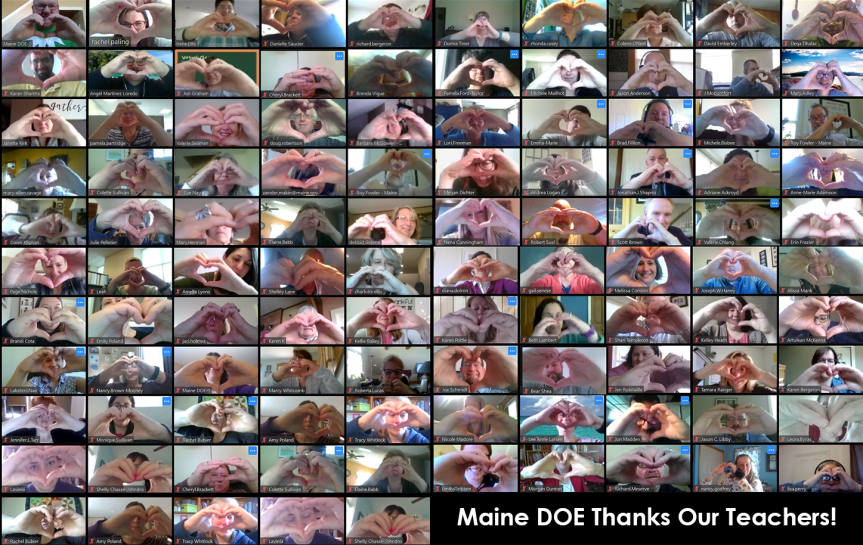
During a regular Maine Department of Education (DOE) conference call that hosts more than 125 staff members each week, staff were invited to share the name of a teacher who has positively impacted their lives as a nomination for a random drawing for a gift card for Teacher Appreciation Week.

The drawing normally goes to a DOE staff member as part of the Maine DOE’s weekly all staff meetings but instead this week, the Department is awarding an educator from the names that were nominated by staff members. We would also like to the opportunity to acknowledge all of the teachers that were nominated.

In addition to deeply impacting the lives of their students, teachers also have a tremendous impact on the adults around them, whether it is the family and extended family of their students or through the mentorship and encouragement of their colleagues, administrators, and their own friends and family members. That is why we felt it was important to acknowledge the group of educators listed below for positively influencing the lives of Maine DOE staff members either where they currently teach or a previous setting. #Thanks4TeachingME

The Maine DOE also recognizes and thanks all teachers in Maine for their tireless efforts and dedication to educate Maine’s students.

Susan (Muzzy) Martin – DOE Teacher Appreciation Raffle Winner!
formerly of Gilbert School, now at Cornville Charter School

Beatrice Stevens, former educator
Once taught at Mt. Vernon Elementary School, Maranacook Area Schools/RSU #38

Susan Dana, Spanish Teacher
Cape Elizabeth Middle School, Cape Elizabeth Schools

Janice Smith, English Teacher
Brunswick High School, Brunswick School Department

Lawrence Peters, RTI Behavior Teacher
Greely High School, MSAD 51

Caitlin Keating, Special Education
Coastal Ridge Elementary School, York School Department

Sue Whitney, 5th Grade Teacher
Manchester Elementary School, Maranacook Area Schools/RSU #38

Paige Fournier, Special Education Teacher
Freeport Middle School, RSU 5

Jenna Zemrak, 2nd Grade Teacher
Belgrade Central School, RSU 18

Patty Mullis, Classroom Teacher
Nokomis Regional High School, RSU 19

Linda Vitale, former educator
Once taught at Albion Elementary School, MSAD 49

Andrea Wilson, 3rd Grade Teacher
Harriet Beecher Stowe School, Brunswick School Department

Heidi Corliss, Choral Educator
Hampden Academy, RSU 22

Elizabeth Ross, Math Teacher
Monmouth Academy, RSU 2

Jennifer Lagasse, 3rd Grade Teacher
Ellsworth Elementary School, Ellsworth School Department

Margaret Corral, Spanish Teacher
Greely High School, MSAD 51

Marshalyn Baker, former educator
Once taught at Messalonskee Middle School, RSU 18

Laurie Stiles, Classroom Teacher for Grades 6-8
Nobleboro Central School, AOS 93

Melissa Allen, Art Teacher
Spruce Mountain Middle and High School, RSU 73

Claudette Brassil, former English Teacher
Mt. Ararat High School, MSAD 75

Tara DiVincenzo, 4th Grade Teacher
Coastal Ridge Elementary School, York School District

Edwin “Barry” McLaughlin, former educator
Once taught at Katahdin High School

Arlo Smith, former educator
Once taught at Perry Elementary School

Theresa Cerceo, District Art Teacher
MSAD 33

Erica St.Peter, Principal
James Bean Elementary School, RSU 18

Mark Stubbs, Functional Life Skills Teacher
Edward Little High School, Auburn School Department

Gary Clendening,
Hall-Dale High School, RSU 2

Mildred Brown, former educator
Once taught at a one room school house on the Frenchville Road outside of Patten

Kayanne Nadeau, Classroom Teacher
Fort Kent Elementary, MSAD 27

Kellie Irving, Preschool special education teacher
PATHS in Portland

Sue Perkins, Science Teacher
Brunswick High School, Brunswick School Department

Craig Borgerson, former educator
Once taught at Owls Head Central School, Owls Head

Cindy Williams, Adult Education Instructor
RSU 6

Pat Jacobs, educator
Turner Elementary School

Jennifer Poulin, Pre-K Teacher
Saco School Department

Allison Desjardins, 1st Grade Teacher
Governor John Fairfield School, Saco School Department

Helen Beesley, Middle School ELA Teacher
Windsor Elementary, RSU 12

Dot Bowie, Kindergarten Teacher
Williams-Cone Elementary School, MSAD 75

Eric Brown, Science Teacher
Lawrence High School, MSAD 49

Larry LaPointe, English Literature Teacher
Gardiner Area High School, MSAD 11

Karen Mayo, 4th Grade Teacher
Williams Elementary, RSU 18

Kristie Houghton, 2nd Grade Teacher
Great Salt Bay School, AOS 93

Heidi Bourgeois, Literacy Coach
RSU 3

Karen Magnusson, Physical Education Teacher
Maranacook Community Middle School, RSU 38

Laurie Dale, Science Educator
Cony, Augusta Schools

Crystal Cyr, Classroom Teacher
Tripp Middle School in Turner, MSAD 52

Lisa Weeks, PreK Program
Somerville Elementary School RSU 12

Carly McKeil, PreK Program
Somerville Elementary School, RSU 12

Tara Morse, PreK Program
Somerville Elementary School RSU 12

Rick Wilson, Community Outreach and Extended Learning Coordinator
Brunswick High School, Brunswick School Department

Amy Gammon, educator
Dirigo Elementary School, RSU 56

Whitney Williams, Science Teacher
Central Aroostook Middle School, MSAD 42

Jeanna Carver, PreK Teacher
Jonesport Elementary School, Union 103

Alison Hinkley, educator
Lyman Moore Middle School, Portland Public Schools

Andrea Levinsky, Extended Learning Coordinator
Portland High School, Portland Public Schools

Jen Dearborn, Special Education Teacher
Gardiner Middle School, MSAD 11

Judy Mank, Music Teacher
Monmouth, RSU 2

Paige Fournier, Special Education Teacher
Freeport Middle School, RSU 5

Ashley LaCroix, Technology Integrator
Brunswick School Department

Dr. Carol Russell, former educator

Sarah Lucas, former educator
Once taught at TC Hamlin School

Hannah Boss, Kindergarten Teacher
Leroy H. Smith School, Winterport, RSU 22

Maria Cyr, Grade 6 Teacher
Oxford Elementary, Oxford Hills School District

Johanna Bridges, Spanish Teacher
William S. Cohen Middle School, Bangor Public Schools

Anne Mourkas, Math and Science Teacher
James F. Doughty School, Bangor Public Schools

Kelly Horton, Pathways
Falmouth High School, Falmouth Public Schools

Megan Cociou, educator
Augusta School Department

Karyn Bussell, Health Education Teacher
Madison Area Memorial High School, MSAD 59

Samantha Person, Physical Education Teacher
Waterboro Elementary School, RSU 57

Christine Rasmussen, Special Education Teacher
Waterville Senior High School, AOS 92

New Webinar: April Enrollment Count Report

To assist those who are responsible for the important task of reporting student data to the Maine Department of Education, the DOE Data Team will be holding a topical webinar about the new April Enrollment Count Report on Wednesday May 13th, from 11am to 12pm.

Why do we collect April 1 data?

The April Enrollment Count Reports will be used for calculating tuition rates in accordance with Title 20-A, 5805, subsection 1.B. This count will not be used for the Essential Services and Programs (EPS) School funding formula, but is still necessary for calculating the tuition rates. Please note that students who are attending outside placements at regional programs or special purpose private schools, are not included attending counts in the primary enrollment district.

New this year

The United States Department of Education (USED) has waived assessment and accountability requirements for the 2019-2020 school year, however the requirement for report cards has not been waived.  The following items are still needed on the ESSA data dashboard (report card):

  • Enrollment data, including student groups
  • Teacher data
  • Graduation data

In addition to these requirements, English Learners have completed their English proficiency assessments for this year, and demographic information is needed for them to load into the Maine Assessment and Accountability Reporting System (MAARS) for local use.

We will use demographics from the April Enrollment Count Report, requiring only one spring data certification that can be used for multiple purposes. Usually, the student demographic data would be verified by schools on ESEA Demographics Certification Report (formerly known as the Accountability Certification).  Because the April Enrollment Count Report does not normally report out demographics, there are some adjustments that have been made to the report so that data staff can properly validate the student demographics.

What is it?

Please note that for the April 1 count, “enrollment and attending” are referring to the school that is responsible for educating the student for April 1, 2020.  We are not asking schools to take attendance on April 1, just to certify the students for which they are responsible on this date.

The new April Enrollment Count Report became available for districts to submit and certify May 4th with a certify by date of June 15th.

If you have trouble logging into NEO, have other technical issues, or have questions about the April Enrollment Count Report, please contact the data systems help desk at 207-624-6896 or MEDMS.Helpdesk@maine.gov .

To register for the webinar, please click the following registration link and fill out the appropriate fields.

Extension Granted For Food Service Program Thru June 30, 2020.

USDA has released a waiver which allows Summer Food Service Program Unanticipated School Closure operations to continue through June 30, 2020. Operations can continue through the end of June regardless of a district’s last scheduled school day.* Maine has accepted this waiver.

USDA waiver #21 (Nationwide Waiver to Extend Unanticipated School Closure Operations through June 30, 2020)

This waiver delays the transition from the Summer Food Service Program (SFSP) operations during unanticipated school closures associated with the COVID-19 pandemic to traditional SFSP operations to June 30, 2020.

* This waiver only applies to those operating SFSP during the closure. If your district has continued operations through the National School Lunch Program or the At-Risk Child and Adult Care Food Program, operations must be discontinued at the end of the school year. As a reminder, USDA has granted Maine an Area Eligibility waiver which provides more opportunity to switch, even if districts haven’t historically qualified for SFSP.

For more information, please contact adriane.ackroyd@maine.gov / 207-624-6726

School Health Annual Reporting Window is Open

The Maine Department Of Education is announcing that the School Health Annual Report is now available through the Reporting Calendar.

We understand that schools are dealing with tremendous adversity and stress as they have adapted to various states of distance learning, building closures, and staff reassignment. With that in mind, this announcement is being made with the following assumptions: many of the hearing and vision screenings were not completed, some data is inaccessible at this time, staff are currently working in alternative settings and schedules. At the same time, we realize that some school nurses and school districts are dedicated to data collection and want to complete as much of the required reporting as possible. We only ask that you report what and if you are able and we are also extending the reporting window to August 31.

The reporting link is available through the DC&R Calendar and the superintendent will determine who will compile and submit the data from all schools within the SAU. The data does not need to be submitted by your health staff, it can be entered by whomever the Superintendent determines is appropriate. Please remember that these reports once submitted, are manually verified so it may take up to two weeks for your report to show up in DC&R as completed.

You may download the reporting worksheet in order to aid data collection among your schools.

Now more than ever, being able to quantify the workload of your school health staff is of utmost importance as we continue in this unprecedented time. Advocating for the multiple needs of your students helps to inform evidence-based school nursing practice and improve overall youth health outcomes. Healthy students are better learners.

The School Health Annual Report summary for 2018-19 is available for review.

If you have questions about the School Health Annual Report please contact the MDOE School Nurse Consultant, Emily.Poland@Maine.gov or 207-592-0387.

MEDIA RELEASE: Maine DOE Issues Guidance on High School Graduation Ceremonies

On Wednesday, the Maine Department of Education issued guidance to Maine’s education leaders regarding high school graduation ceremonies amid the COVID-19 pandemic. The guidance was issued at the request of superintendents and other school leaders who are making extremely difficult decisions about graduation ceremonies, as the 2019-2020 school year comes to a close.

Maine Department of Education assembled a group to explore and make recommendations on ways that schools can celebrate the class of 2020, while taking into consideration public health concerns, social distancing recommendations, and government-issued restrictions on social gatherings. The group complied the best available advice and information, which was then reviewed by health and education experts.

“School and district leaders have requested guidance, and unfortunately there is no one right way to approach this,” said Commissioner Pender Makin.  “Local school communities must assess their unique needs and capacities, and many variables will impact decisions around graduation celebrations. Many schools are hosting virtual events or postponing the ceremonies, but for those who are planning an in-person event, this guidance addresses important safeguards and considerations.“

Decisions around whether to host graduation ceremonies will remain at the discretion of local school boards and superintendents and must be conducted in accordance with Governor Mills’ “Stay Safer at Home Orders.” As we remain in a state of civil emergency, planners of important events are urged to consider the fact that regulations and recommendations are subject to change, due to the dynamic nature of this situation.

The following guidelines must be taken into consideration when planning events:

  • June-August, 2020, social gatherings will be limited to no more than 50 people. (In May, the limit is no more than 10 people).Physical (social) distancing of at least 6 feet must be maintained at all times.
  • Cloth face coverings must be used in all public settings. (Exceptions: Cloth face coverings are not required for children under age 2, a child in a child care setting, or for anyone who has trouble breathing or related medical conditions, or who is otherwise unable to remove the mask without assistance).
  • A 14-Day Quarantine is required for all individuals entering or returning to Maine prior to going out in public.
  • Some municipalities have additional requirements and guidelines that must be followed.

In-Person Outdoor or Indoor Ceremonies:

Beginning in June, when group sizes of up to 50 will be permitted, there are some options available for very small graduating classes (or for larger classes, broken into smaller groups through multiple ceremonies) while maintaining social distancing. The following guidelines should be followed to ensure a safe event:

  • Limit the number of participants, staff, and guests to fewer than 50 people, in total.
  • Seat graduates 6 feet apart in all directions.
  • Seat guests 6 feet apart in all directions.
  • Require use of cloth face masks.
  • Develop accommodations, with increased distancing and precautions, for those with underlying health issues.
  • Mark the standing locations of graduates waiting in line and during processional at 6 foot intervals.
  • Ensure additional staff support to monitor and maintain acceptable distance.
  • Utilize one-way direction of movements and use separate entrances and exits if possible.
  • Consider how diplomas will be collected when a student’s name is called. Staff may consider placing the diploma on a table for the student to collect. Students may walk across the stage, collect the diploma from the table, and pose for a picture individually or appropriately distanced from a school/district official.
  • Communicate expectations and guidelines in advance to ensure understanding and compliance.
  • Develop plans for use of restrooms and access to soap and water for hand washing with marked waiting spaces at 6 foot intervals to avoid crowding at bathroom stalls or sinks. Arrange for a custodian to monitor and replenish soap/paper towels.
  • Provide hand sanitizer in multiple areas.
  • Contact your local law enforcement to help with planning and crowd control.
  • Consider designating a single person to take an official photo/video of each graduate receiving their diploma and prohibit others from approaching the area to take their own pictures or video.

Drive-In Options:

  • Before planning a drive-in ceremony, please consider the needs and rights of families who do not have access to a vehicle and make equitable arrangements.
  • Maine drive-in movie theaters have been granted permission to open, as long as they meet a set of criteria and follow certain guidelines. Schools may contract with a drive-in movie theater operating within those regulations.
  • If a school wishes to plan a “drive in” ceremony outside of an approved, open, theater, there are many precautions that should be taken:
    • Work with local law enforcement to get approval for use of a field or parking lot, and to support traffic flow and crowd control.
    • Measure out parking spots that are spaced a minimum of 6’ apart.
    • Communicate rules ahead of time regarding the need for all participants to stay inside the cars with the doors closed and to wear cloth masks if windows are down.
    • Allow one student at a time to leave the family’s vehicle to pick up a diploma, using the guidelines above for in-person ceremonies.

Other options for honoring graduates:

  • Virtual Ceremonies or video tributes:  Ask seniors to send individual videos with short messages to their graduating classmates. This can be compiled with more traditional speeches that can be done by video or livestream to create a keepsake video.
  • Hashtag Campaigns:  Highlight seniors on social media each day with special hashtags that allow for family, friends, and community members to congratulate individual students (who agree to participate) with photos and messages.
  • Postpone the graduation ceremonies until it is safe to gather in large groups once again, or host them in one year as an “early reunion.”

Casco Bay High School Teacher, Students Winners in Engineering Contest

Casco Bay High School science teacher Anne Loughlin and her engineering students are among the grand prize winners in this year’s Autodesk Make It Real Challenge 2020, an engineering competition. The win means CBHS will receive more than $10,000 in makerspace tools for its DIY lab.

“I am so proud of Ms. Loughlin and our engineering students for their creative and provocative solutions for addressing knotty, vital tech and social justice challenges,” said CBHS Principal Derek Pierce. “Hooray for Anne and her students!”

Autodesk, Inc. is an American multinational software corporation that makes software services for the architecture, engineering, construction, manufacturing, media, education, and entertainment industries.

This year’s contest was directed at educators in New England interested in teaching their students how to make a difference through design. There were three Grand Prize winners in the 2020 contest: Linden STEAM Academy in Malden, Mass., Jackson/Mann K-8 School in Boston and Casco Bay High School.

In the contest’s Make Justice challenge, Loughlin led her students in researching issues of poverty, disaster relief, and affordable housing, according to the company’s blog post on the winners. https://blog.tinkercad.com/make-it-real-2020-grand-prize-award-winners

Loughlin explained that her students did research on the future of housing to understand the innovations that are currently on their way to the marketplace. “We continually looked at meeting the needs of the users of these products. We started with the empathy resources that were provided [in the ‘Make Justice’ challenge.],” she said. “After creating their initial sketches, we did a tuning protocol where they got feedback from peers on their designs.”

Loughlin encouraged students to design for the context of their oceanside community — resulting in innovative ideas such as a tidally influenced generator. Her students used a variety of Autodesk tools, such as Formit for affordable housing design and Fusion 360 to visualize concepts such as a portable, solar-powered heater for the homeless population, and a caddy for collecting gray water, the blog said.

“I think as much as possible, [the students] tended to think about their projects in the context of our community, Portland, and what they have seen and experienced. Our school serves a large immigrant community,” said Loughlin, whose students include refugees fleeing violence and persecution. “Issues of poverty are part of daily life for many of my students. This also provides a personal perspective on the needs of the user.”

Designs like an emergency shelter made from shipping containers had personal meaning for students whose families had emigrated as refugees.

Loughlin has been teaching science in Portland Schools since 1991. Ms. Loughlin earned recognition as one of the nation’s top teachers by winning the prestigious Milken Award in 2003. Loughlin created CBHS’ Digital Fabrication lab and teaches engineering, STEM investigations and AP environmental science.


Extended Deadline: Funding Opportunity Notice for School Lighting Projects

To date, Efficiency Maine has received more than fifty applications for school lighting projects as part of this Funding Opportunity Notice. In fact, one project has already been completed.

Because of the level of interest, we have extended the deadline for a second time to allow more schools to apply — Efficiency Maine has extended the deadline for the School Lighting Funding Opportunity Notice to June 1, 2020. This decision has been made so that all parties involved will have more time to work through logistics and take part in these elevated incentives. Efficiency Maine does not oversee interactions between school personnel and the Qualified Partner; the program trusts that you will work with your contractor to determine how to handle site assessments and projects.

Efficiency Maine has extended the deadline for schools to apply through CIP FON-001-2020 for enhanced financial incentives to convert old, inefficient school lighting to LEDs.  Funding will be provided as an incentive of $0.30/kWh saved (first-year savings) capped at $100,000 per school district. Applications may be submitted through June 1, 2020.

To learn more about the Funding Opportunity Notice, please click here.

MEDIA RELEASE:  Maine Department of Education Awarded CARES Act Funding to Support Maine Schools

On March 27, 2020 the CARES Act was signed into law, providing emergency federal funds to states for the purpose of addressing COVID-19 related impacts to education.  The three funds include the Higher Education Emergency Relief Fund(HEER), the Governor’s Emergency Education Relief Fund(GEER), and the Elementary and Secondary School Emergency Relief Fund(ESSER). Maine’s Department of Education is pleased to announce they applied for, and been awarded, the GEER and ESSER funding.

As information about the CARES Act funding became available during the past six weeks, Commissioner Makin and her leadership team met daily with Maine CDC, the Governor’s COVID Response Team, educators and education leaders statewide to identify priorities for the emergency relief. Through these discussions and a statewide needs assessment, DOE identified the lack of universal connectivity as the most profound impact of the coronavirus pandemic on our state’s education system as a whole.

On Wednesday, April 15, the US Department of Education released the application and on Thursday, April 23, Maine’s GEER application was submitted, articulating a plan to address the digital divide with their #ConnectKidsNow initiative.  On Friday, April 24, the US Department of Education approved Maine’s GEER application. At this time Maine is one of only twelve states who have received approval.

“Our stakeholders have clearly identified student connectedness as being the top priority as we face a new future for education in Maine.  Remote learning, in some form, will be an important part of a system that is responsive and resilient and student centered,” said Maine Commissioner of Education, Pender Makin. “Together we recognized that what was once a concerning inequity quickly became a humanitarian crisis during this unprecedented emergency, with lack of access for so many students to the educational resources and experiences offered by our schools.  If we can’t reach them, we can’t teach them, and I am proud of our DOE team, who has worked swiftly to address this issue.”

With support from the Department of Administration and Finance, the DOE is working to procure devices and wireless contracts for the K-12 students statewide who are lacking connectivity. Of the approximately 24,000 students lacking connectivity, 15,652 need a wireless contract and 8,262 need only a device. As the Department’s #ConnectKidsNow! initiative gains attention statewide, some districts have reached out to provide the Department with an update regarding their current needs. To ensure all schools in Maine receive support in providing connectivity for every K-12 learner, the DOE has partnered with the Maine’s Principals Association (MPA) to follow-up with every school leader that did not submit a connectivity survey to the Department last month. Commissioner Makin is also currently working with leaders from Adult Education, University of Maine System, and Maine Community College System to identify connectivity needs for higher education students.

The U.S. Department of Education (USED) released the ESSER funding application on the afternoon of Thursday, April 23, 2020. The Maine Department of Education submitted Maine’s ESSER funding application to the USED on Friday, April 24, 2020 and received approval on Wednesday, April 29, 2020. These funds will be allocated to districts using the Title IA funding formula, as required by statute. School Administrative Units will have some flexibility in determining how best to utilize these funds to mitigate the unforeseen fiscal impacts of this current crisis.

“These funds are desperately needed by our schools, as they have suddenly been tasked with finding ways to continue to provide for the educational, social/emotional, and nutritional needs of their students,” said Maine School Superintendents Association Executive Director, Eileen King.  “Maine Superintendents have expressed serious concerns about the lack of equity of access for many of our students that seriously impacts our students’ ability to participate in remote learning. These funds can certainly begin to address this issue. We are thrilled with the rapid response of the Department of Education and their advocacy and efforts to procure these much needed funds for our schools as quickly as possible.”

Maine DOE team members are currently working with US ED to clarify guidance and to develop an application for School Administrative Units.

MEDIA RELEASE: Governor Janet Mills Kicks off Teacher Appreciation Week with a Special Message

Governor Janet Mills is helping to kick off a week-long celebration of Maine educators for Teacher Appreciation Week. Celebrated May 4th through May 8th this year, Teacher Appreciation Week is observed nationally, and is a time when all are encouraged to take a moment to thank teachers for all they do to positively impact the lives of students and families.

“This is national Teacher Appreciation Week, a time to recognize the significant contributions our teachers make to public education and honor their commitment to the success of Maine students,” said Governor Mills in a special video message. “On behalf of the people of Maine, I want to thank all teachers for dedicating their careers to providing our students the foundation for greater opportunity and lifelong learning.”

The Governor and the Maine Department of Education are encouraging families and students across Maine to join them by sending letters, cards, and social media posts to thank and acknowledge the dedicated teachers in their lives.

“We have never been prouder of the Maine educators who have been serving students in countless innovative ways during the COVID-19 pandemic,” said Commissioner of Education Pender Makin. “Teachers are working harder than ever before, and I can’t think of a better time for families around the state to applaud their tireless efforts to educate Maine students under some of the most challenging circumstances we’ve ever experienced.”

Join us as this week by taking a moment to thank your teacher for all their hard work! If you are posting on social media be sure to use the hashtag #Thanks4TeachingME, and tag the Maine Department of Education at @mdoenews (Twitter) at @MaineDepartmentofEducation1 (Facebook) the Maine DOE the Maine DOE will help share your message.