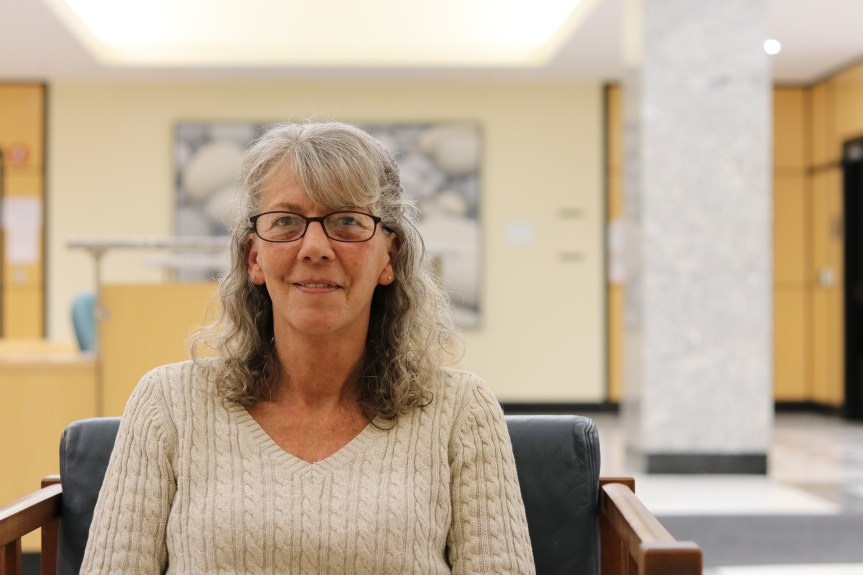
Maine DOE team member Lori Freeman is being highlighted this week as part of the Get to know the DOE team. Learn a little more about Lori in the question and answer below.
What are your roles with DOE?
I work for Special Services of DOE. I process the EFS-04’s which are State Agency Client Reimbursement Forms. Special education costs for state agency clients.
What do you like best about your job?
I enjoy working with all the school districts, getting to know them all. My position requires quite a bit of research and organization which I truly enjoy. I work with a great team that really cares.
How or why did you decide on this career?
I am here to serve. I’ve worked in the service field for years, including working for the homeless shelter and animal shelter. I enjoy working for the greater good.
What do you like to do outside of work for fun?
My passion is gardening, planting, and maintaining flowers and vegetables. I just love being outside with my two Labs, taking long walks in the woods behind my house. At the moment I am teaching myself how to play the guitar.
The Coronavirus Aid, Relief and Economic Security (CARES) Act was signed into law by President Trump on March 27, 2020. The relief promised by the CARES Act is desperately needed statewide, and the Maine Department of Education is eagerly waiting for the US Department of Education (USDE) to issue a notice inviting applications from State Education Agencies to apply for the funding. USDE’s statutory deadline to release the application is April 26, 2020.
Over the past several weeks leaders from the Maine Department of Education have been engaging in national discussions and internal planning sessions to prepare for the implementation of the CARES Act stimulus funding. Maine expects to receive $95.645 million in overall education stabilization funding, with $9.3 million for the Governor’s emergency education relief fund, $43.7 million in K-12 relief funding, and $42.5 million in higher education funding. The Maine Department of Education will apply for and manage the K-12 funding. It will be allocated to districts using the Title IA funding formula, as required by statute.
Additional details regarding the CARES Act funding are included in the Department’s Frequently Asked Questions document available here.
Please send your CARES Act related questions to the Department’s Director of Policy and Government Affairs, Chelsey Fortin-Trimble at chelsey.a.fortin@maine.gov.
Narragansett Elementary School 2nd grade teacher Stephanie Nichols and Brooksville Elementary School PK-8 art teacher Nick Patterson are the first two to win prizes.
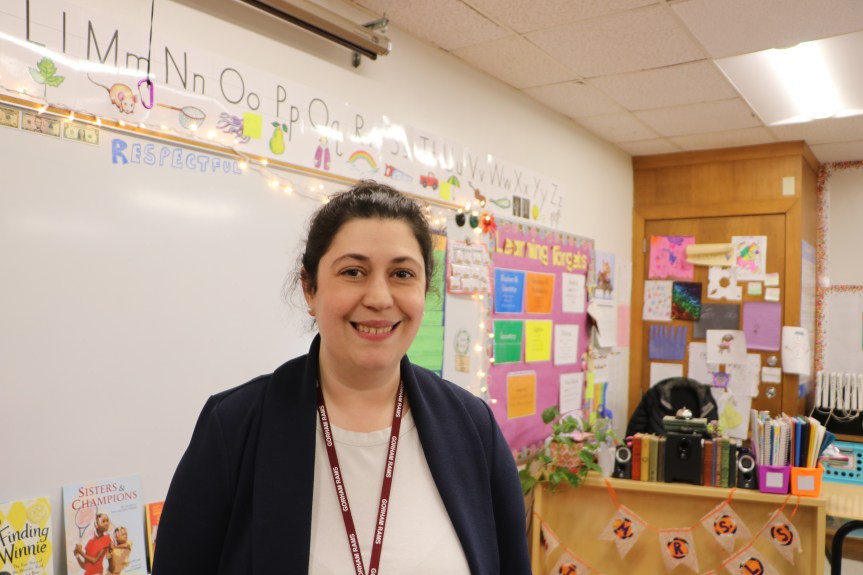
Stephanie Nichols, a 2nd grade teacher at Narragansett Elementary School in Gorham School District is the first to win a $400 cash prize as the February drawing winner. There will be drawings held every month until December 2020 as part of Maine’s Bicentennial Curriculum Sharing Initiative.
The Maine Department of Education (DOE), in collaboration with the Maine Bicentennial Commission (maine200.org) and the Maine Historical Society launched the online resource in February as a way to help Maine teachers integrate Maine’s Bicentennial into their lessons.
Stephanie is one of several educators who have shared their lesson plans through the curriculum sharing initiative by uploading it into the curriculum tool since its launch. Stephanie’s lesson plan is called “How Communities Represent Themselves” and helps students learn to identify the historical and current flags of Maine, and understand the concept of “community” representation through the symbols on the flags. The lesson includes an activity where students work in small groups to create flags to represent their classroom/school communities.
Nick Patterson
Nick Patterson is the drawing winner for the month of March. A PK-8 art teacher for Brooksville Elementary School, he says his lesson plan first started as an interest in silhouettes and blob painting which prompted him to start having his middle school art students work with images from the internet including sea creatures, an interest of theirs.
“This lesson plan will give students an overview of the creatures in the Gulf of Maine,” said Patterson describing the lesson plan he uploaded for other educators to use. “Students will be able to describe the creatures they learn about, first learning simple art skills, and then combining these simple skills to make an Oceanscape picture that is complex.”
The Initiative enables educators to share their own lesson plans, download lesson plans created by other Maine teachers, and access new curriculum resources and primary documents related to Maine, its history, and culture.
“Now more than ever is it imperative that we embrace the online resources we have in place to share ideas and lesson plans, and that we continue to celebrate the 200th anniversary of our amazing state,” said Maine Education Commissioner Pender Makin. “I encourage all Maine educators to use this tool to share their curriculum resources related to Maine with other educators around the state so that we can encapsulate and celebrate our land, culture, history, and community for generations to come.”
To submit a lesson plan, educators can visit mainememory.net/lessons/submit to complete a simple submission template, and then upload additional resources. Once uploaded, lesson submissions will be reviewed for completeness and then placed on the, where other educators from across the state can access them.
Educators who participate by sharing resources will have their names entered into a random monthly drawing (February 2020 – December 2020) for $400 in cash for use for lesson planning and teaching. Participants for this program are intended to be public and private school educators for grades pre-k to 12, Career and Technical Educators, Adult Education Instructors, and Post-Secondary Instructors.
By participating in this unique collaboration, not only are you are setting the stage for present and future Mainers to learn more about our great state, you can also share and learn from the collective brain of educators around Maine.
For more information or to ask questions about the process, please contact Kathleen Neumann kneumann@mainehistory.org.
Virtual office hour schedule for Wednesday, April 15, 2020
The Maine Department of Education continues to schedule virtual office hours with Department Specialist to support educators and administrators during extended remote learning. During these meetings, our specialists will be available to provide support and guidance regarding distance learning and school supports, as well as to facilitate networking and resource sharing between educators.
As a reminder, virtual meeting schedules are regularly updated on this web page: https://www.maine.gov/doe/covid-19/contentmeetings. The Department will continue scheduling content specific office hours as needed.
Please note that Department staff hosting the virtual meetings have ramped up security measures to keep out participants that are attempting to join the meetings for reasons other than to participate in education related conversations – this includes password protecting meetings and in some cases requiring registration. Thank you for your patience!
Virtual Office Hours:
(Please note: some meetings have a 100 person max capacity.)
The College Board has released the new AP® Exam (Advanced Placement) schedule, which includes optional free, online AP classes and take-at-home AP Exams to support the challenges that students and families are facing because of the coronavirus pandemic. In addition, the Collage Board is also offering the opportunity for families to apply for help securing an internet connection and a device in order to take the exams.
Advanced Placement (AP), a program implemented by the College Board, allows high schoolers to take high school courses that can earn them college credit and/or qualify them for more advanced classes when they begin college. Many of Maine’s high schoolers were amid AP classes when they transitioned to remote learning. In a response to this drastic change in learning, the College Board has released additional resources for families and educators.
It is recommended by the College Board that parents and teachers whose students are planning on taking any of the AP exams take the weeks of April 13 and April 20th to help students work through the remaining course content and/or encourage them to participate in the live online classes and review sessions. Find them here: FREE AP Online Classes and Review Sessions
In addition, the College Board has also asked parents to let students know about the technology they’ll need to take the AP tests and to contact the College Board by April 24 if they need devices or connectivity. Here is where you can find information about getting internet connection and devices for AP exams: Information about getting Internet or a Device for AP Classes and Exams
You can find more information about the AP exams and the College Board’s response to the coronavirus on their website. In addition to the parent resources, College Board is also offering a listing of webinars among other resources for AP educators to help answer questions about the upcoming tests.
Maine Resilience Building Network (MRBN) will once again offer free professional learning opportunities focused on Adverse Childhood Experiences (ACES) and resilience building. MRBN offered this training in the fall of 2019 and is now offering 6 more sessions virtually between April 21-June 2, 2020. This learning opportunity is funded through the Preschool Development Grant, a collaboration between Maine Departments of Education and Health and Human Services. These new sessions are open for Pre-K and child care educators, as well as other staff working with this population, to strengthen their role in supporting children and families.
Strong Kids, Strong Families, Strong Communities: The Impact of ACEs and Resilience Building will bring together childcare and public Pre-K professionals to learn about Adverse Childhood Experiences research, early brain development science, the effects of toxic stress on social emotional learning and protective factors including positive relationships. This training will provide an understanding of how adverse experiences at a young age can affect a person’s emotional and behavioral development. Participants will also hear suggestions for how to support the individual and family and learn classroom strategies including the practices of mindfulness, compassion and co-regulation.
In the fall of 2019, the training was offered in 12 sites across the state to early childhood educators working with children up through Pre-K. Through the evaluation, participants shared that they learned strategies to build stronger connections and relationships with children and families, to be more compassionate and less judgmental, and to be better prepared for stressful situations. They felt they had a better understanding and awareness of where children are “coming from” and to think about what happened to the child as opposed to what is wrong with the child. One participant commented that “All professionals who work with children should attend.”
Virtual office hour schedule for Tuesday, April 14, 2020
The Maine Department of Education continues to schedule virtual office hours with Department Specialist to support educators and administrators during extended remote learning. During these meetings, our specialists will be available to provide support and guidance regarding distance learning and school supports, as well as to facilitate networking and resource sharing between educators.
As a reminder, virtual meeting schedules are regularly updated on this web page: https://www.maine.gov/doe/covid-19/contentmeetings. The Department will continue scheduling content specific office hours as needed.
Please note that Department staff hosting the virtual meetings have ramped up security measures to keep out participants that are attempting to join the meetings for reasons other than to participate in education related conversations – this includes password protecting meetings and in some cases requiring registration. Thank you for your patience!
Virtual Office Hours:
(Please note: some meetings have a 100 person max capacity.)
The United States Department of Education (USED) has waived assessment and accountability requirements for the 2019-2020 school year, however the requirement for report cards has not been waived. The following items are still needed on the ESSA data dashboard (report card):
Enrollment data, including student groups
Teacher data
In addition to these requirements, English Learners have completed their English proficiency assessments for this year, and demographic information is needed for them to load into the Maine Assessment and Accountability Reporting System (MAARS) for local use.
We will use demographics from the April Enrollment Count Report, requiring only one spring data certification that can be used for multiple purposes. Usually, the student demographic data would be verified by schools on ESEA Demographics Certification Report (formerly known as the Accountability Certification). Because the April Enrollment Count Report does not normally report out demographics, there are some adjustments that need to be made to the report so that data staff can properly validate the student demographics. We are asking superintendents to hold off on certifying the April Enrollment Count Report until we provide further guidance that the report is now available to serve both purposes.
The Data Team will be providing another April Enrollment Count Report webinar in the near future to explain the changes and the dual purpose of the report. Please look for that announcement in the coming weeks. The deadline for this report will be adjusted accordingly. Thank you for your patience as we work to ensure that federal requirements are met in what we hope to be the least disruptive method as possible.
On Tuesday evening, April 7, 2020, Commissioner of Education Pender Makin, with the support of Governor Mills, made the recommendation to Maine schools to extend their remote learning plans until the end of the current school year. “School classrooms are closed, but schools are not,” said Commissioner Makin.| More
Rural Aspirations, in collaboration with many other cross-sector organizations, has developed a tool for teachers and families to support and highlight community-based learning opportunities in Maine.| More
The Maine Department of Education delivered wifi enabled Samsung Tab A’s with a 12 month Verizon service to Piscataquis county schools yesterday afternoon, in a effort that is helping students in the area with their school work while they are engaged in remote learning during the COVID-19 pandemic. As part of this pilot program, the Maine DOE surveyed building principals across Maine to identify needs, and are working to procure device and hotspots for all students that need them as quickly as possible. | More
An Act Regarding the Reserve Funds of Certain School Organizational Structures was signed by Governor Mills on March 12, 2020 and will become effective on June 16, 2020. | More
Virtual Meetings Will be Available Again Next Week
The Maine Department of Education will continue to schedule virtual office hours to support educators and administrators during extended school closures. We are working on further security measures for our virtual meetings and will have an updated schedule ready on Monday. | Check the schedule here next week


 Maine DOE Newsroom