The Tobacco and Substance Use Prevention and Control Program with the Maine Centers for Disease Control and Prevention (MECDC), in partnership with the Maine Department of Education (Maine DOE), is seeking interest from Maine schools who would like to pilot the social emotional learning (SEL) program, Second Step, funded by a grant through MECDC.
The grant’s larger goal is to provide primary prevention for substance use and is part of Maine’s State Opioid Response plan. The Second Step Curriculum is research-based and available for grades Kindergarten through 8th grade. Many of the skills within the Maine Learning Results for Health Education in elementary school align with goals of Second Step, to nurture skill building and prevent problematic developmental behaviors that are part of the trajectory toward later substance use.
If you are interested in adding Second Step to your school’s curriculum, are already implementing Second Step, or are implementing a SEL curriculum other than Second Step, the MECDC and Maine DOE would like your feedback about your interest and experience.
This brief survey will take approximately 5 minutes. Your input will be used to assess what programs are currently being implemented, where there are opportunities to pilot Second Step in Maine, and what districts are specifically interested in piloting Second Step.
Maine CDC and DOE will select pilot sites based on best fit and evaluate the program’s success, with the goal of expanding the program to more sites in coming years. Thank you in advance for your interest and feedback.
Throughout the 2018- 2019 school year, the Maine Department of Education, State Fire Marshal’s Office, Department of Health and Human Services, Maine State Police, Maine Sheriffs Association, Maine Chiefs of Police Association, and the Maine Emergency Management Agency will provide tips and resource information to Maine schools to help provide some guidance for identifying signs and preventing school violence.
School Safety and Security Bulletin – November 2018
The graduation rate indicator is one of four indicators used in Maine’s Model of School Support. It will be used as an indicator of success for high schools only. Graduation is defined as graduating within four years after entering ninth grade. In Maine, the graduation rate indicator reflects the number of students graduating “on-time”, as well as the graduating students who progressed at a different rate and graduated in either five or six years.
In the past, graduation rate was never utilized when making determinations of schools eligible to receive support. Under Maine’s Model of School Support, the graduation rate for students meeting graduation requirements in four years in addition to the graduation rate of students meeting graduation requirements in five or six years will be utilized.
4 Year Graduation Rate
What does this look like in Maine?
Achieving a diploma is a major accomplishment and marks a significant milestone in a student’s life. It is important to highlight the number of students achieving a diploma, whether it takes some students four years or longer to do so. As it relates to Maine’s Model of School Support, the Graduation Rate indicator is split into two rates of graduation:
5 and 6 Year Graduation Rate
The 4-year rate is the number of students who graduate in four years with a high school diploma, divided by the number of students who form the adjusted cohort for the graduating class.
The 5 and 6 year rates reflect the number of graduating students who took 5 and 6 years, respectively to graduate from high school.
How will graduation rate data be presented on the school report card?
The school as a whole will receive a performance measure related to individual student groups meeting the annual graduation target.
Graduation Performance Descriptors:
Graduation – 4 Year
Emerging
Developing
Meeting
Excelling
No eligible student group made their annual graduation target
At least one eligible student group made their annual graduation target
All eligible student groups made their annual graduation target
All eligible student groups have met or exceeded the long-term goal of 90%
Graduation – Combined 5/6 Year
Emerging
Developing
Meeting
Excelling
No eligible student group made their annual graduation target
At least one eligible student group made their annual graduation target
All eligible student groups made their annual graduation target
All eligible student groups have met or exceeded the long-term goal of 92%
Eligible student groups include: Asian, Black, Hispanic/Latino, Two or More Races, White, Students with Disabilities, Economically Disadvantaged, Migrant Students, and English Learners.
Goals for four year adjusted cohort graduation rate:
Subgroup
Baseline (Data and Year)
Long-term Goal (Data and Year) 2030
All students
86.83% 2016
90% or maintain current 2016, whichever is greater, graduation percentages by 2030
Economically disadvantaged students
77.77% 2016
Children with disabilities
72.19% 2016
English learners
78.14% 2016
Race – Hispanic/Latino
83.46% 2016
Race – American Indian
84.91% 2016
Race – Asian
90.68 % 2016
Race – Black or African American
76.77% 2016
Race – Native Hawaiian or Other Pacific Islander
88.24% 2016
Race – White
87.29% 2016
The measurements of progress are based on increases in the percentage of all students in Maine who make progress toward the long-term goals on a three-year basis. Long-term goals were developed to reduce the percentage of non-graduating students to result in student groups all meeting the goal of 90% by 2030. The calculation process, for example, is as follows:
Subgroup: All Students
Step 1: 2016 Graduation Rate = 86.83%
Step 2: 90% (goal) – 86.83% (baseline) = 3.17%
Step 3: Differential for each 3-year step is 3.17 divided by 5 = .61%
Step 4: Add to the baseline .61 % and add the .61% to each subsequent step to reach the goal of 90% by 2030.
Goals for extended- year cohort graduation rate
Subgroup
Baseline (Data and Year)
Long-term Goal (Data and Year) 2030
All students
88.61% 2016
92% or maintain current 2016, whichever is greater, graduation percentages by 2030
Economically disadvantaged students
80.82% 2016
Children with disabilities
77.27% 2016
English learners
86.12% 2016
Asian
94.27% 2016
American Indian
83.49% 2016
Black
83.47% 2016
Hispanic
84.13% 2016
Native Hawaiian
93.33% 2016
White
88.84% 2016
Multiple Races
86.62% 2016
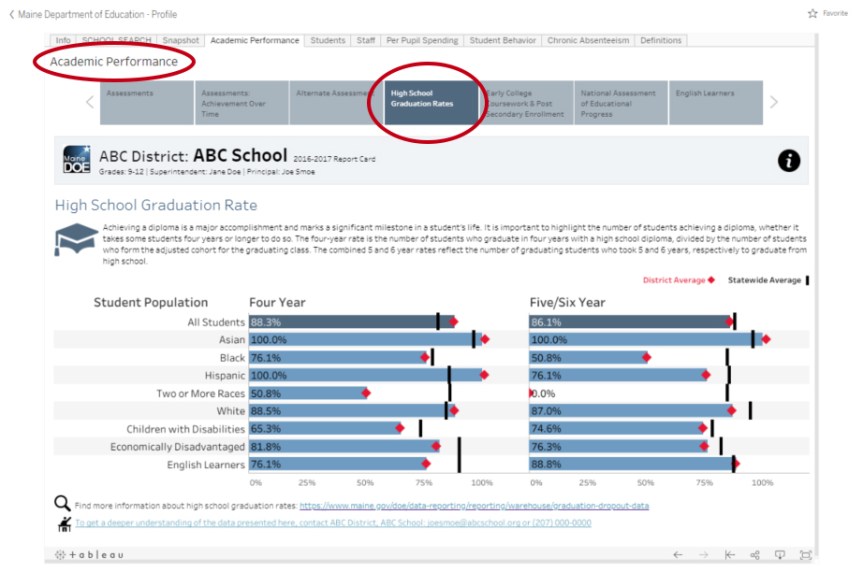
Graduation rate will be presented on the initial page of the report card in the following way:
For further information please contact Janette Kirk, Acting Director, Office of Learning Systems at Janette.Kirk@maine.gov.
Maine educators are invited to participate in a professional learning workshop that supports the integration of technology across multiple content areas with a focus on STEAM (Science, Technology, Engineering, Art, and Math) as well as computer science, coding, and computational thinking. By using arts and craft techniques to teach circuits and programming, the workshop will introduce ways to engage learners of diverse backgrounds and interests in designing and building their own technologies and getting excited about STEAM!
During the workshop, educators will:
Engage in activities that can be used in classrooms with students who are learning STEAM, coding, and computational thinking concepts
Explore techniques that blend craft and code: students can use skills they have (crafting) to learn new skills (coding), offering new pathways to coding for students who find traditional pathways to learning code less accessible
Learn how to develop integrated learning opportunities, where the technology is used in service of the learning (instead of as the focus of the learning).
Understand how to create and foster a sense of wonder (instead of fear) when students try something new and somewhat challenging
The workshop will be led by a team from Chibitronics that has created Love to Code, an electronics and coding toolkit that gets students building circuits and coding in an art-friendly, hands-on way. Students will learn to build and program functioning circuitry within the pages of a picture book and then take these skills to design their own paper circuits (sample paper circuit projects). Students can then program a “Chibi Chip” to control their art work, making interactive artwork that comes to life with code!
Love to Code’s innovative features include a:
Picture book format, which teaches complex coding concepts by embedding them in metaphor and story;
Blend of craft and code, which allows learners to use skills they already have (crafting) as they learn new skills (coding).
Learn more about the presenters and see some of their projects, Jie Qi and Natalie Freed.
Event Information:
Date: Saturday, December 1st, 2018
Time: 8:30am – 3:30pm
Location: RiSE Center, University of Maine, Orono
Contact Hours: 8 hours can be earned
Cost: $15 (includes light breakfast, lunch, and Love To Code Kit)
Please bring a laptop or tablet with you to the event. In order to program the Chibi Chips, devices need to have a headphone port available. This might require you to bring an adapter/dongle depending on your device.
Draft Agenda:
8:00am: Registration and light breakfast
8:30am: Welcome, Introductions, and Connections
9:00am: Jie Qi and Natalie Freed– “From Make Believe to Making Tech: Paper Circuits and Programming”
10:00am: Break
10:15am: Learning with the Love to Code Kits
11:45am: Lunch – includes a networking activity
12:45pm: Expectations and goals for afternoon design and creation time
1:15pm: Design and Create: Make what you’ll take back to your school – workshop for colleagues, unit or lesson with students, etc
3:00pm: Wrap up, reflections, connecting forward
For answers to questions or more information, please contact Amanda Nguyen, Digital Learning Specialist for the Maine Department of Education at Amanda.Nguyen@maine.gov.
As a reminder, the Maine Department of Education has scheduled public hearings this week as part of the scheduled periodic review of the Maine Learning Results. The Department is seeking public comments regarding the current English language arts, mathematics, and career and education development standards.
Public hearings for each standard have been scheduled back to back in room 103 of the Burton Cross Building in Augusta. Anyone may speak at the public hearings which will be live-streamed. People wishing to speak will be asked to sign in and it will be helpful, but not mandatory, to provide a written copy of comments.
Below is a list of relevant links, as well as hearing times including live broadcast links for each event:
Hearing information:
November 7, 2018
Location: Cross Office Building, room 103, 111 Sewell Street, Augusta
Time: 6:00 – 8:00pm
Live link: https://zoom.us/j/136003377
Anyone unable to attend the public hearing may send written comments by 5pm on December 1, 2018. Written comments may be emailed to sis.doe@maine.gov with the subject “CED Standards Review,” “Mathematics Standards Review,” or “English Language Arts Standards Review,” or mailed to Maine Department of Education, attn: Beth Lambert, 23 State House Station, Augusta, ME 04333.
For further information about the standards review process contact Beth Lambert at Beth.Lambert@maine.gov.
The public release of the Maine Education Assessment (MEA) data scheduled for today, November 5, 2018, has been delayed.
The validation process is taking longer than anticipated and extra time is needed to allow the Department to work with our vendor, Focal Point K-12, to ensure that the data is accurate prior to its release.
The Department is making a concerted effort to complete the validation process so that we can release the results as soon as possible.
Thank you for your patience and understanding as we work through this unanticipated delay.
The Maine Department of Education recently hosted the 9 regional service center (RSC) executive directors in the inaugural meeting of RSC statewide leadership. Representatives from each RSC participated in the meeting led by the Maine Department of Education’s EMBRACE team.
The meeting provided opportunities for:
Discussing a framework for continued state-level support for RSCs
Creating a professional cohort of RSC Executive Directors
Questions and answers from Maine DOE staff and each other
Gaining a statewide perspective on RSC implementation, organizational development, activities, and services
Maine DOE outlined the data points the regional service center will report in the first year of operation, in addition to the following:
Define the RSC goals
Define how the RSC will measure year 1 success
Provide financial reports
Detail specific elements of state-level support needed
Regional Service Center executive directors shared their RSC’s activities. It was noted that RSCs are in varying stages of development; some are further along because the regional collaboration is a continuation of efforts already in place.
Ben Sirois, Superintendent of MSAD 27 & Executive Director of Valley Unified RSC updates other RSC Executive Directors
Some highlights include:
In 2015-16 Valley Unified’s RSC (prior to becoming an RSC) began working on their comprehensive regional strategic plan, which allowed them to be well-positioned to apply for Maine DOE’s EMBRACE I and II grant funding opportunities. Most recently the RSC was approved for an integrated, consolidated 9-16 facilities project.
In southern Maine, the Greater Sebago Education Alliance RSC is developing, among their many services, resources for a leadership academy in partnership with the University of Southern Maine, and developing resources for English Learners diversity training and intake procedures.
Maine law (20A M.R.S.A. 6358, Chapters 126 & 216) requires students enrolled in grades K-12 to be immunized against diphtheria, tetanus, pertussis, measles, mumps, rubella, polio and varicella (chicken pox). Additionally, all students enrolled in grades 7-12 must be immunized against meningococcal meningitis. Under this law, students are required to have either vaccine administration records, a physician note or laboratory evidence to prove immunity, a physician note indicating the student is medically exempt, or a religious or philosophical objection note from a parent/guardian for each of the required vaccines listed above.
In accordance with this law, each year, the Maine Department of Health and Human Services (DHHS) Maine Immunization Program, in conjunction with the Maine Department of Education, sends out the Maine School Age Immunization Assessment Survey to collect immunization information on all students enrolled in Maine public and private schools. The data from this survey is used to measure compliance with this law and also to assess the level of immunization coverage throughout the State of Maine. The survey can be completed online using Survey Monkey through the following web link: https://www.surveymonkey.com/r/school2018me
Who must report and what is reported:
All schools with students enrolled in these grades (K, 7th, 12th) MUST report. If you fail to report by the deadline the superintendent of your school will be notified.
Kindergarten – reporting on all required school age immunizations (DTaP, Polio, MMR, Varicella)
Seventh grade– Tdap and meningococcal conjugate vaccine (MCV4) ONLY – 1 dose of each is required
Twelfth grade – MCV4 ONLY – 1 or 2 doses required based on age the first dose was given
Missing immunizations will require follow up. All students must either have an immunization record or exemption on file for each required vaccine. Superintendents will be notified of any non-compliance.
To complete the survey, you will need the number of students enrolled (full or part-time) for grades K, 7th, and 12th. For each required vaccine, you will need the number of students vaccinated, the number of students with either medical, religious, or philosophical exemptions, and the number of students missing records (non-compliant). A pdf copy of the survey is available here:
Complete the survey online The deadline for completing the survey is December 31, 2018, after which the survey will be closed. This is extended from the usual December 15 deadline.
For additional information or assistance, contact Jessica Shiminski from DHHS at 207-287-3746 or 1-800-867-4775 or email: jessica.shiminski@maine.gov.
Adverse childhood experiences—commonly known as ACEs—affect children and families across all communities. ACEs can impact kids’ health and well-being, and they can have long-term effects on adults’ health and wellness. They can even have consequences that impact entire families, communities, and our whole society. Thankfully, ACEs are preventable.
This training will help you understand, recognize, and prevent ACEs. You’ll learn about risk and protective factors, outcomes associated with ACEs, and evidence-based strategies you can use to reduce or eliminate the impact of ACEs and stop them from occurring in the first place.
Get the knowledge and insights you need to help create healthier, happier childhoods for kids today, and bright futures for adults tomorrow.
Training topics include:
Adverse Childhood Experiences, Brain Development, and Toxic Stress
The ACE Study
Prevalence and Consequences of ACEs
Risk and Protective Factors for ACEs
Essentials for Childhood: Assuring Safe, Stable, Nurturing Relationships and Environments
For further information, contact Emily Poland, School Nurse Consultant for the Maine Department of Education at emily.poland@maine.gov.
The TransACT training scheduled for November 6, 2018 in Machias, as described in this DOE newsroom article, has been cancelled due to low registration. Please note that the trainings scheduled for November 5, 2018 in Portland and Bangor are still happening as planned.
If you would like further information about TransACT Parent Notices, especially as it pertains to their use as a parent and family engagement tool, please contact April Perkins, Director of ESOL/Bilingual Programs & Title III at (207)624-6627 or april.perkins@maine.gov





 Maine DOE Newsroom