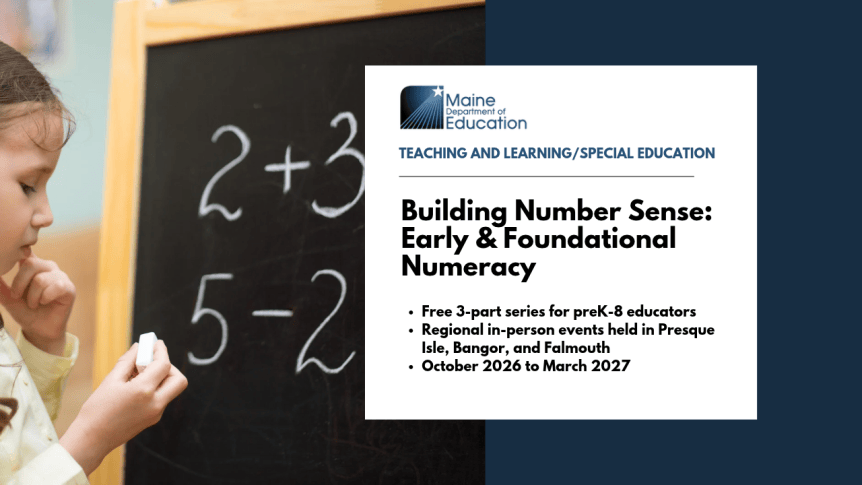
The Maine Department of Education (DOE) is excited to offer a free professional learning series to support educators in helping all students develop deep number sense and flexible mathematical thinking across preK through grade 8. Participants should plan to attend all 3 sessions at their selected regional location.
The focus will be on strong Tier I inclusive instructional strategies, the use of multiple representations, and real-world problem solving to support learning for all students, including those with disabilities. Educators will engage in hands-on learning experiences and have opportunities to apply inclusive instructional strategies in their own settings between sessions.
Participants will receive a copy of Understanding the Math We Teach and How to Teach It by Marian Small, and the series will connect participants with resources in the Maine DOE Numeracy Playbook. Educators may earn up to 24 contact hours. Participants will select their preferred regional location when registering and should bring their own lunch to each session.
The following regional series are available:
Northern Maine Series – Presque Isle
Where: University of Maine (MPR Room) – Presque Isle
When:
Tuesday, October 20, 2026
Thursday, January 21, 2027
Friday, March 26, 2027
Hours: 8:30 a.m. – 3:00 p.m.
Central Maine Series – Bangor
Where: Husson University (Family Center) – Bangor
When:
Friday, October 16, 2026
Thursday, January 14, 2027
Wednesday, March 31, 2027
Hours: 8:30 a.m. – 3:00 p.m.
Southern Maine Series – Falmouth
Where: The Maine Educational Center for the Deaf and Hard of Hearing – Falmouth (Mackworth Island)
For more information or questions, please contact Maine DOE Inclusive Education Mathematics Specialist, Jen Robitaille at jennifer.r.robitaille@maine.gov, or Maine DOE Interdisciplinary Instruction Specialist, Michele Mailhot at michele.r.mailhot@maine.gov.
The Maine Department of Education (DOE) Maine School Safety Center’s (MSSC) free training for the School Safety Specialist Program is open to schools and school administrative units (SAUs). The School Safety Specialist (SSS) Program helps schools and districts fulfill the requirements of Public Law 2023, chapter 254, to have a designated employee having oversight regarding school safety.
School Safety Specialist (SSS) Program prepares participants to:
Support and assist administrators in coordinating the review, editing, and updating of Emergency Operations Plans for their district and/or school building each year.
Involve appropriate stakeholders in the development of district/school- level emergency operations planning through the formation of a safety team to include the following: police and fire departments, emergency management agency, emergency medical services (EMS), local medical facilities, community members, administrators, parents, and students.
Network with appropriate stakeholders to enhance school safety at the SAU and school level.
Act as a resource for other individuals in the SAU on issues related to school safety.
Work with the Maine School Safety Center to provide professional development for faculty and staff on school safety-related issues that encourage a safe school environment.
The details of the program:
Cohorts start at the beginning of every other month and have 6 weeks to complete. The first cohort of this school year begins in October.
All work is done asynchronously and takes approximately 20-25 hours to complete.
Work is divided into badges. Each badge is earned when participants review interactive modules and complete a quiz and reflection questions. Incident Command System (ICS) courses are included in the SSS coursework and are accessed through the Federal Emergency Management Agency (FEMA) website.
Benefits of participation:
Become a safety leader in your school.
Earn digital badges and contact hours for recertification.
Become a partner with the Maine School Safety Center
Join a community of practice and network with safety specialists across the state.
The Maine School Safety Center has a School Emergency Management Coordinator who can help with resources, training, and guidance on emergency management in schools. The areas include, but are not limited to:
Emergency Operations Plans
Emergency Exercises and Drills
Implementation of Multi-Disciplinary Teams
Implementation of Safety Teams
For further support or information regarding School Emergency Management, reach out to Maine DOE School Emergency Management Coordinator, Jack Peck Jack.Peck@maine.gov.
The Maine Department of Education (DOE), in collaboration with the Académie de Nantes in France, invites Maine schools and school administrative units (SAUs) to express interest in a new international sustainability collaboration for the 2026–2027 school year.
This opportunity is designed to connect students and educators through French language education, climate literacy, outdoor learning, environmental action, cultural exchange, and global learning. Building on Maine’s international partnership with the Académie de Nantes, the campaign offers schools a flexible way to explore shared learning with French partner schools while connecting with work that many Maine students and educators are already leading in their own communities. Participation is open to schools and educators across subject areas, including French language education, outdoor learning, environmental science, sustainability, and student leadership.
Through the Maine–France Sustainability Collaboration Campaign, students will have the opportunity to learn across cultures, compare environmental challenges in their local communities, exchange ideas, practice or apply French language skills, and consider how local action contributes to a more sustainable future.
We hope to cultivate intentional connections for Académie de Nantes and Maine schools working in areas such as climate literacy, environmental sustainability, outdoor learning, French language and culture, student leadership, civic engagement, or project-based learning. It may also be of interest to schools supporting students pursuing the Seal of Climate Literacy or developing career-connected learning opportunities.
Schools can choose an approach that fits their interests, capacity, and learning goals. Some options are pairing with a school in France, collaborating with a classroom for a short-term project, or creating a shared student project or showcase.
Collaboration Examples
Partner classrooms could exchange information about environmental concerns in their communities, compare sustainability practices, or complete related local projects involving composting, recycling, school gardens, outdoor stewardship, sustainability planning, or climate literacy experiences. Students could then share what they learned through presentations, posters, videos, webpages, or a joint virtual event.
Through these experiences, students can strengthen communication, collaboration, critical thinking, and problem-solving skills while developing greater cultural understanding. The campaign also gives students an authentic opportunity to see how environmental challenges connect communities across national borders and how young people can contribute to solutions close to home.
Help Shape the Collaboration
Maine DOE is inviting public schools and SAUs to take part in developing the Maine–France Environmental Sustainability Collaboration. Schools that are interested should complete the Maine–France Sustainability Collaboration Interest Survey to indicate their current environmental and climate literacy work, the type of collaboration they prefer, topics they may want to explore with a partner school, and the support they may need to make the partnership successful.
An information session will be held on October 15 at 3:30 p.m. to provide additional details, answer questions, and discuss ways schools can participate. Following the meeting, interested schools will be contacted about potential school pairings and collaboration opportunities.
Outreach and planning are underway, with interested schools exploring possible connections and projects during the 2026–2027 school year.
For additional information, contact Ayesha Hall, Maine DOE Director of Strategic Partnerships, at ayesha.hall@maine.gov.
This announcement was co-developed by Abigail Rasquinha, a Maine DOE Extended Learning Opportunities student contributor, 2026 Scarborough High School graduate, and Northeastern University Freshman.
The Maine Engagement and Attendance Center (MEAC), a statewide collaboration working to strengthen student engagement and attendance and to address chronic absenteeism in Maine schools, is focused on weaving together Maine Department of Education (DOE) initiatives to coordinate practical tools and opportunities for educators to learn from one another to improve student attendance.
To support this work, MEAC has cultivated a growing collection of resources and professional learning opportunities on data use, family engagement, school leadership, progress monitoring, and Tier 1 attendance strategies.
Check out the MEAC webpage to find updated resources and tools, including the Maine Attendance Toolkit. For more information on how the toolkit can strengthen your classroom, school, or district practices, view this four-part recorded series highlighting aspects of the Attendance Toolkit:
Consider adopting the MEAC motto to support attendance efforts: “Rooted in Learning, Growing Every Day: Be Pine Tree Present!”
September is National Attendance Awareness Month, and MEAC will add Maine-themed resources throughout the month to help educators improve attendance. One resource to support our Maine educators is this Pine Tree Present Fact Sheet.
MEAC has also developed a two-page Attendance Tracker designed to help families monitor missed school days and identify when additional support may be needed. The resource pairs a family-facing tracker with Maine DOE’s Evidence-Based Interventions and Attendance Support Plan. Educators can share copies with families or design their own to support their learning community. Research shows that families underestimate how quickly absences add up throughout the school year.
This month, MEAC will launch a virtual Attendance Support Series for those seeking technical assistance from data experts at Maine DOE and school personnel throughout the state, including classroom teachers, building administrators, school counselors, and attendance team members.
The series’ topics are aligned with the natural rhythm of the school year and will highlight positive relationship-building and effective use of data, barrier identification and intervention, and reflection and planning for next steps.
Monthly attendance topics:
DatesEach session will take place from 3:30-4:30 p.m.
Topics
September 17, 2026
Using Attendance Data to Drive Action
October 22, 2026
Building Routine, Relationships, and Relevance
November 19, 2026
Creating Emotionally and Physically Safe Learning Environments
December 17, 2026
Using Consistent, Growth-Focused Attendance Messaging
January 21, 2027
Removing Logistical and Emotional Barriers to Learning
February 25, 2027
Strengthening School-Home Partnerships
March 18, 2027
Engaging Families Through Proactive, Supportive Outreach
April 29, 2027
Implementing Positive Recognition and Motivation Strategies
May 20, 2027
Establishing Early Warning Systems and Team-Based Responses
For further information and questions about MEAC, please visit the Maine DOE MEAC webpage or reach out to Sarah Nelson, Maine DOE Attendance and Engagement Specialist at Sarah.Nelson@maine.gov.
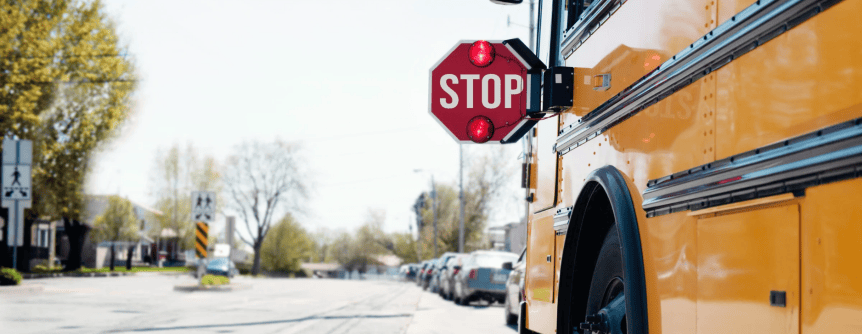
The Maine Department of Education (DOE), Maine School Safety Center (MSSC), is pleased to announce the release of the first phase of training modules developed for school bus drivers. The training modules are available in EnGiNE, the Maine DOE’s online professional learning platform.
The self-paced modules are designed to provide school bus drivers and school transportation professionals with the information and resources they need to train students in safe school bus riding practices. One of the goals of this initiative is to establish consistent safety standards across Maine so that students throughout the state receive the same safety messages from their school bus drivers.
The training modules were developed using nationally recognized school transportation safety guidance and best practices, including resources and recommendations from the National Highway Traffic Safety Administration (NHTSA), the National Association of State Directors of Pupil Transportation Services (NASDPTS), the National Transportation Safety Board (NTSB), the National Congress on School Transportation (NCST), and other recognized school transportation safety organizations.
The modules use a “train-the-trainer” approach. School bus drivers across Maine will complete the modules followed by a short quiz at the end of each course. The training provides drivers with consistent information and talking points they can use when teaching students about staying safe on and around the school bus.
The first phase includes modules to teach students about:
Waiting at the Bus Stop
Crossing in Front of the Bus
The Danger Zone
Loading and Unloading Practices
Riding on the Bus
Respect on the Bus
Emergency Exits
Railroad Crossing Awareness
Each module also includes an information sheet for parents and families. Schools may share these materials with parents so they are aware of the safety topics being taught to their children and can reinforce the same messages at home.
To access the modules, log in toEnGiNE. EnGiNE is the Maine DOE’s online professional learning platform. Those who do not already have login credentials can easily create them using their school email address. For support in creating an account and/or using EnGiNE, please visit the EnGiNE Support Page.
When a module is completed by the school bus drivers, the transportation directors will be able to access the information and keep proof of the training on record.
The Maine School Safety Center is proud to be part of Maine’s continued efforts to strengthen school transportation safety throughout the state. These training modules provide schools and transportation programs with a consistent resource for teaching students how to safely ride, board, exit, and interact around the school bus.
By providing school bus drivers with consistent training materials and safety messages, Maine can work toward a standardized approach to student school bus safety education across the state, while incorporating nationally recognized safety guidance and best practices.
For more information, please reach out to Maine DOE Transportation Specialist Cheryl Brackett at Cheryl.Brackett@maine.gov.
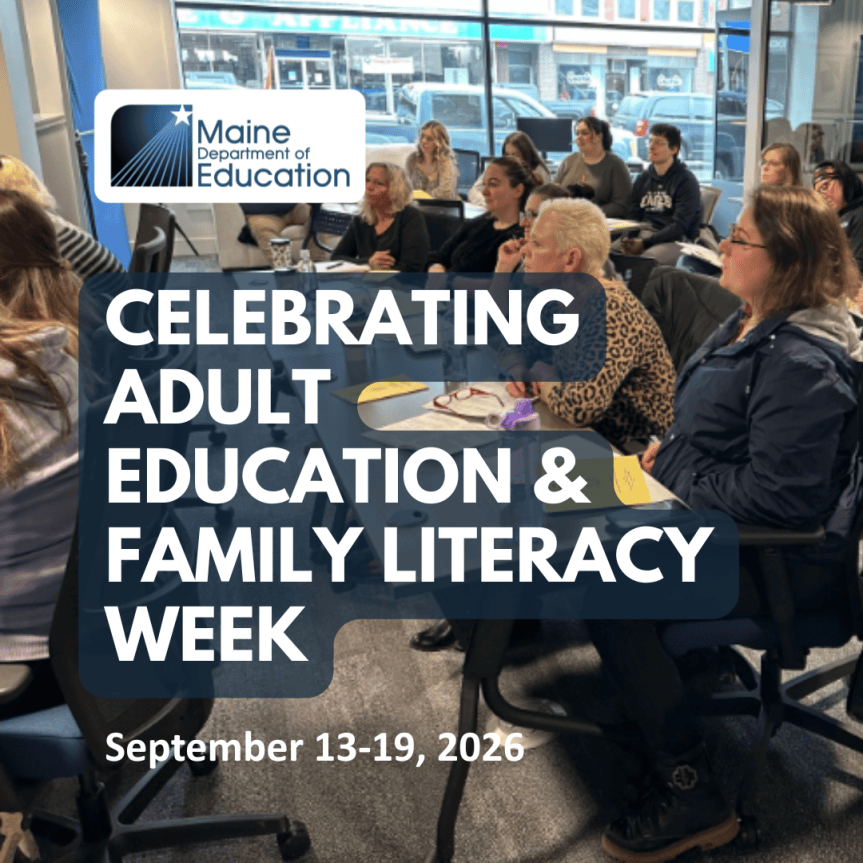
The Maine Department of Education (DOE), in collaboration with Governor Janet Mills and adult education programs across Maine, is celebrating Adult Education and Family Literacy Week (AEFLA), September 13-19, 2026.
AEFLA Week is a chance to recognize that adult education is about helping Maine adults move forward—from strengthening basic skills to earning a high school credential, from a credential to college, and from education to a career. Acknowledging the lasting impact education can have on generations of families across Maine. As part of this week’s AEFLA recognition, Governor Mills has issued a proclamation. The proclamation states, in part:
“Thousands of adults in Maine need assistance to qualify for better-paying and more fulfilling jobs to achieve a post-secondary education, or to improve their English language skills.” It continues, “Success in these endeavors leads to adults becoming more effective family members, citizens, and workers.”
As Maine celebrates AEFLA Week, we recognize Maine Adult Education programs as one of the most important components of the workforce and education system. Across more than 65 local programs, Maine Adult Education, helps adults earn high school credentials, strengthen basic skills, learn English, prepare for college, and gain the skills and credentials employers need.
The impact is substantial. Last year, more than 12,400 adults participated in Maine Adult Education programs. 1,113 adults earned high school credentials, and adult learners earned more than 3,000 certifications and credentials in high-demand career fields.
The numbers tell part of the story; the local stories tell the rest. Whether it is a parent earning a diploma after years away from school, a newcomer learning English while preparing for a career, or a worker earning a credential for a growing industry, Maine Adult Education helps people turn education into opportunity.
A second chance at a high school credential
For adults who did not complete high school, adult education provides a flexible pathway to a Maine Adult High School Diploma or the HiSET, Maine’s high school equivalency credential. HiSET preparation combines instruction, assessment, and individualized support, giving adults a pathway to the same legal standing as a high school diploma.
From basic skills to a better job
Maine’s AEFLA-funded adult basic education programs help adults build skills in reading, writing, mathematics, English-language proficiency, and problem-solving—the foundational skills people need to succeed at work, in college, and in their communities.
Increasingly, those foundational skills are connected directly to career pathways. Adult Education, for example, offers pre-apprenticeship programs that combine contextual education in math or literacy, digital literacy, work readiness, and career exploration with pathways into healthcare, the trades, early childhood education, and banking to name a few.
Opening the door to college and careers
For adults ready for the next step, Maine College and Career Access (MCCA) is a comprehensive program that provides academic preparation, advising, mentoring, and support for those transitioning into postsecondary education or training. Adults can receive help with academic skills, career planning, and the transition to a credential or degree that leads to high-quality employment.
The program helps adults move from a high school credential to community college or university, turning a diploma or HiSET into a launch point rather than an endpoint.
Across Maine, this work is strengthened through partnerships among adult education programs, employers, CareerCenters, colleges, libraries, and community organizations. Maine’s system is intentionally designed as a career pathway and service system, linking basic education, high school completion, college transition, and workforce training rather than treating them as separate services.
This AEFLA Week, Maine can celebrate adult education for what it is: an essential part of the state’s education system, workforce strategy, and economic future.
WIOA Title II funds received from the U.S. Department of Education (ED) supplement the implementation of adult education programming. The contents are those of the author(s) and do not necessarily represent the official views of, nor an endorsement by, ED or the U.S. government.
The Maine Department of Education is offering quarterly Office Hours for the 2026-2027 school year to support all Home Instruction Points of Contact (PoC).
The Office Hours are being provided during two separate times: 8:30-9:15 a.m. and 3:00-3:45 p.m., on the following Wednesdays to accommodate as many PoCs as possible:
September 30, 2026
December 16, 2026
March 10, 2027
May 12, 2027
Attendees may choose the time that is most convenient for them. The agendas are identical, but the questions that arise will depend on the attendees. These sessions are intended to allow Home Instruction Points of Contact to connect directly with Maine DOE School Approval and Enrollment Specialist Sierra Wood regarding questions that have arisen. If time allows, POCs will collaborate and share effective practices in providing Maine families with accurate, timely guidance.
Here are some questions to guide discussion during these office hours:
What is your method of communicating regularly with all home instruction families? When information is shared by the Maine DOE, how is it then shared with home instruction families?
How are you reviewing assessment progress reports that are due September 1 each year, and what further supports might be helpful with this?
What technical supports would be most helpful to you in your responsibilities as the local home instruction point of contact?
What practices do you have in place that others could benefit from regarding deadlines for Notices of Intent and Assessment reminders?
Home Instruction Points of Contact may register for one or both of the two office-hour sessions below:
Please share this information with your school administrative unit’s Home Instruction Point of Contact. To find Home Instruction Point of Contact information, please visit the Maine DOE’s NEO data system.
With questions or potential topics for discussion, please contact Sierra Wood, Maine DOE School Approval and Enrollment Specialist, at Sierra.Wood@maine.gov.
We are excited to share the Dirigo Schools of Distinction (DSD) framework as a resource for Maine schools. DSD is intended to celebrate Maine schools that are making a meaningful difference for students, staff, and communities. DSD also offers a clear, supportive roadmap for schools and school administrative units (SAUs), as they consider where to focus time, energy, and resources to strengthen student outcomes. | More
The Maine Department of Education (DOE) invites students, friends, families, community members, educational organizations or associations, co-workers, and supervisors to nominate school employees for the RISE Award. Anyone can nominate! | More
For students in RSU 74’s Alternative Education program, learning this spring started in the forest and ended with maple syrup on ice cream. A month-long maple sugaring project gave students an opportunity to experience the full process of making maple syrup while building skills in observation, data collection, problem-solving, teamwork, and perseverance. | More
In the very early morning hours of August 28, Marcy Soucy, a fourth- and fifth-grade teacher at Fairmount School in Bangor and the 2026 Penobscot County Teacher of the Year, headed north. And not just north, north north, to the picturesque, close-knit community of St. Agatha, Maine, to visit fellow educator and 2026 Aroostook County Teacher of the Year Kathy Theriault, the high school math teacher at Wisdom Middle and High School, part of MSAD #33. | More
The Maine Department of Education (DOE) Offices of Teaching and Learning and Innovation are pleased to announce that registration is now open for EngageMEnt 2026-2027, a statewide professional learning opportunity designed to support educators in exploring innovative, engaging, and impactful practices for teaching and learning. Offered in partnership with the University of Maine and University of Southern Maine, EngageMEnt creates opportunities for educators from across the state to learn, collaborate, reflect, and apply new ideas in their classrooms, schools, and communities. The initiative also provides opportunities for practicing educators and pre-service educators to learn alongside one another while exploring current educational priorities and practices. | More
The Maine Department of Education (DOE), in collaboration with teacher leaders from across the state, is once again offering professional learning communities (PLCs) for educators and caregivers implementing the For Me Instructional Programming, which include Pre-K for ME, K for ME, 1st Grade for ME, and 2nd Grade for ME. | More
The Maine Department of Education (DOE) Office of Teaching and Learning invites educators to apply for American Ancestors: Unlocking Maine’s Story, a free professional learning cohort that begins with an in-person kickoff on October 13, 2026, at the University of Maine at Farmington from 9:00 a.m. to 4:00 p.m. The cohort is designed to help educators use genealogy and local history to strengthen classroom learning. | More
Maine’s Positive Behavioral Interventions and Supports (Maine PBIS) program, a collaboration between the Maine Department of Education (DOE) and the University of Maine System (UMS), will host its annual conference on November 19, 2026, from 8:30 a.m. to 4 p.m. at the Augusta Civic Center. | More
The Maine Department of Education (DOE) Offices of Teaching and Learning and Special Services and Inclusive Education invite educators and education professionals—including teachers, administrators, literacy specialists, and educational technicians—to participate in a free virtual literacy professional learning series during the 2026–2027 school year. | More
Kathy Theriault (left), a high school math teacher at Wisdom Middle and High School, part of MSAD #33, and 2026 Aroostook County Teacher of the Year, and Marcy Soucy (right), a fourth- and fifth-grade teacher at Fairmount School in Bangor and the 2026 Penobscot County Teacher of the Year.
In the very early morning hours of August 28, Marcy Soucy, a fourth- and fifth-grade teacher at Fairmount School in Bangor and the 2026 Penobscot County Teacher of the Year, headed north. And not just north, north north, to the picturesque, close-knit community of St. Agatha, Maine, to visit fellow educator and 2026 Aroostook County Teacher of the Year Kathy Theriault, the high school math teacher at Wisdom Middle and High School, part of MSAD #33.
The nearly 200-mile trip was about much more than a classroom visit. It was an opportunity for two educators from different grade levels, schools, and regions of Maine to open their classroom doors, learn from one another, and explore a simple question: What happens when teachers become students of one another’s practice?
The plan began months earlier during a workshop for the 2026 Maine County Teachers of the Year. In addition to being selected and recognized as County Teachers of the Year and considered for Maine Teacher of the Year, these educators spend a year in service, participating in professional learning and leadership opportunities with the Maine Department of Education (DOE) and Educate Maine. They also form a cohort and work on individual and group projects designed to strengthen Maine’s education landscape and elevate the voices of Maine educators through grassroots, teacher-led efforts.
It was during one of these professional learning opportunities this summer that County Teachers of the Year were encouraged to step outside their own classrooms, visit one another’s schools and learn from the incredible educators who make up the cohort.
“Kathy and I didn’t need much convincing. We wanted to see the amazing work of other educators.” Soucy stated. “We had already discovered how much we could learn from one another through conversations about our classrooms, our students, and our shared love for math. So we decided to turn those conversations into action.” The decision was made; the collaboration would be a two-way learning experience. Soucy would travel north in August to spend time learning alongside Theriault and her students, and during Potato Harvest Break in Northern Maine, Theriault would travel south to visit Fairmount School, an elementary school in Bangor.
This year, MSAD #33 has placed a districtwide emphasis on student engagement, with educators drawing inspiration from Jonathan Alsheimer’s School of Engagement and exploring strategies designed to increase connection, participation, and joy in learning. Drawing on work from her master’s program in Human Relations at Husson University, with a focus on creating positive classroom environments, Soucy gathered a collection of team-building games and collaborative activities. When asked his thoughts, WMHS Principal Robby Nadeau said, “The best ideas in education usually come from collaboration, rather than a singular thought.”
Although Soucy wondered if the team building activities would translate from her younger classroom to Theriault’s older classroom, Theriault wasn’t worried at all. “I was so excited to share my classroom with Marcy and knew she would have insight on team-building activities. I loved how she set the ‘stage’ with essential questions and criteria while allowing students to feel comfortable choosing to participate or help in another way,” Theriault said. “I am totally going to steal that for the future!”
And then the students walked into the room. The first activity was a simple game of competitive Rock, Paper, Scissors, one of Soucy’s favorites. Simple, perhaps, but within minutes, the room was buzzing.
Students were laughing, cheering for their classmates, celebrating wins, and playfully groaning over losses. The energy continued to build as students moved around the room, challenging one another and searching for their next opponent. What began as a familiar childhood game quickly became something much bigger: an opportunity to connect, encourage one another, and simply bring joy into the learning process. The engagement was immediate and genuine. There was no need to convince students to participate. They were in it.
Soucy stated, “As I watched the room, I was struck by how quickly joy can open the door to connection. Students were interacting, practicing positive sportsmanship, and discovering that learning together can feel a lot like play. It was magic.”
With the next game of Bottle Flip Team Tic-Tac-Toe, students who initially hung back began participating. Teams began communicating more intentionally. Students encouraged classmates who were struggling. The room became louder, more animated, and more connected.
The impact was perhaps best captured not by either teacher, but by the students themselves. When Soucy invited students to reflect on the experience, seventh grader Elsi Picard explained, “It makes you energized when your team is cheering for you!”
This is what happens when educators open the doors to their classrooms and allow themselves to be learners, too. “Kathy and I come from different educational settings and work with different age groups, but our goals are remarkably similar. We both want students to feel connected and feel that sense of belonging to their learning community. We want them to see themselves as capable and a valued member. We want them to take risks, learn from mistakes, and understand that they matter. Great ideas don’t belong to one grade level, one school, or one district. We were not trying to create a perfect lesson. We were trying something new. We talked. We questioned. We adjusted. We laughed. We learned, ” Soucy said in her reflection.
As educators, it can be easy to become focused on our own classrooms, our own students, and our own responsibilities. Yet some of our greatest professional learning can happen when we step outside those four walls. The invitation to visit one another’s classrooms was simple: Get out. Visit. Learn from each other. Soucy said, “I am so grateful that Kathy and I said yes.”
That day at Wisdom Middle and High School was about much more than team-building activities. It was about professional generosity. It was about trusting another educator enough to open the door and say, Come see what I’m doing. Let me see what you’re doing. Let’s figure this out together. That kind of collaboration makes all educators better. And it reminds us that learning isn’t something that ends when we become teachers. Teachers are still learners. They are still curious. They are still trying new things.
When educators model that curiosity for one another, students see something important: learning is not something that ends when we leave school. It is a lifelong process and it can be joyful.
The collaboration between Soucy and Theriault is only halfway finished. During Northern Maine’s Potato Harvest Break, Theriault will head south to Fairmount School in Bangor, where the roles will reverse and she will step into Soucy’s elementary classroom as the learner.
Because when educators open their classroom doors to one another, everyone learns.
This story was submitted by Maine 2025 County Teachers of the Year Marcy Soucy (Penobscot County) and Kathy Theriault (Aroostook County). To submit a good news story to the Maine DOE, please fill out the good news submission form.
The Maine Department of Education (DOE) Office of Teaching and Learning invites educators to apply for American Ancestors: Unlocking Maine’s Story, a free professional learning cohort that begins with an in-person kickoff on October 13, 2026, at the University of Maine at Farmington from 9:00 a.m. to 4:00 p.m. The cohort is designed to help educators use genealogy and local history to strengthen classroom learning.
The cohort is designed for educators serving students in grades 4–8, with an emphasis on English language arts, social studies, and humanities instruction. Participants will explore how interdisciplinary learning can strengthen literacy and historical thinking while engaging students in meaningful research and inquiry. Genealogical research provides students with meaningful opportunities to work directly with primary sources and historical evidence. Throughout the cohort, educators will explore ways to support students in investigating family and community histories, examining archival materials, developing questions, evaluating sources, and sharing their discoveries.
The approximately 30-hour cohort includes both synchronous and asynchronous learning. Participants will engage in an in-person kickoff, four monthly one-hour virtual synchronous meetings, and two to eight hours of online individual or small-group coaching with American Ancestors, depending on each group’s needs. The remaining time will be completed asynchronously through the Maine DOE learning management system, EnGiNE. Approximately half of the cohort will consist of synchronous learning, with the exact balance depending on participants’ coaching needs.
The initiative brings together organizations with expertise in Maine history and education, including American Ancestors, the Maine Historical Society, the Maine Genealogical Society, and the University of Maine at Farmington. Participants will collaborate with staff from these organizations, historians, archivists, Maine DOE specialists, fellow educators, and community partners to develop interdisciplinary learning experiences that integrate literacy, history, research skills, and inquiry-based learning. These partners will provide access to historical resources, archival expertise, and perspectives that can help bring Maine’s diverse history into the classroom.
Participants can earn professional development contact hours and may qualify for a $500 implementation grant to support classroom projects incorporating genealogy, local history, research, and interdisciplinary learning.
To expand access to professional learning opportunities across Maine, preference will be given to educators from underserved areas. Overnight accommodations will be provided for participants traveling more than 50 miles to the University of Maine at Farmington.
A limited number of spots are available. Apply online.
For more information, please contact Interdisciplinary Instruction Specialist Geoffrey Wingard at Geoffrey.Wingard@maine.gov