Webinar: Culturally Responsive Practices in Special Education

The Maine Department of Education (DOE) Office of Special Services and Inclusive Education and its partners at Maine Access to Inclusive Education Resources (MAIER) invite you to join Penn State University’s Dr. Jonte’ C. Taylor (JT), for a webinar on Culturally Responsive Practices in Special Education. This LIVE session will provide well-structured content on different pedagogies and how teaching and learning can be conducted by developing strategies that promote environmental characteristics and principles for students with disabilities in inclusive settings.

Participants will learn the importance of developing cultural practices in special education and how to provide intensive support for students regardless of dis/ability. The session will help the participant to develop action points and strategies necessary for incorporating cultural practices into the teaching and learning process.

  • The webinar will be held on Tuesday, January 23rd from 4:00 – 5:00 pm via Zoom (a link will be provided to you once you register)
  • Register here NOTE: This webinar will NOT be recorded, you need to attend to see the webinar.

Dr. Jonte’ C. Taylor (JT) is an Associate Professor of Special Education in the Department of Educational Psychology, Counseling, and Special Education in the College of Education at Penn State University. He taught for approximately 10 years with various populations from PreK to Adults in settings ranging from inclusive classrooms to residential treatment facilities. His research interests include science education for students with disabilities, evaluating innovative classroom practices, and bullying issues for students with Autism, Learning Disabilities, and Emotional/Behavioral Disorders.  His most recent publication Mixtape Volume 1: Culturally Sustaining Practices Within MTSS Featuring the Everlasting Mission of Student Engagement was published this year.

NOTE: There are additional learning options regarding this topic from MAIER. MAIER has 5 hours of free, online/asynchronous learning modules from Dr. Taylor HERE. You can take these online learning modules before or after the webinar. You can get UMaine contact hours for these online learning modules once you complete the modules and an evaluation.

For additional information contact Sarah Howorth at sarah.howorth@maine.edu

Dyslexia Resources for Schools: Screener Reimbursement Project & Free Dyslexia Awareness Kit

Dr. Sally Shaywitz states in Overcoming Dyslexia, “The human brain is resilient, but there is no question that early intervention and treatment bring about more positive change at a faster pace than an intervention provided to an older child. The sooner a diagnosis is made, the quicker your child can get help, and the more likely you are to prevent secondary blows to her self-esteem.”

Dyslexia is a specific learning disability that is neurological in origin. It is characterized by difficulties with accurate and/or fluent word recognition and by poor spelling and decoding abilities. These difficulties typically result from a deficit in the phonological component of language that is often unexpected in relation to other cognitive abilities and the provision of effective classroom instruction. A secondary consequence may include problems in reading comprehension and reduced reading experience that can impede the growth of vocabulary and background knowledge.

In 2016 the Maine Dyslexia Screening Statute went into effect. In this statute it is stated that each school administrative unit shall screen for dyslexia all students from kindergarten to grade 2 who are identified as having difficulty in phonological awareness, phonemic awareness, sound-symbol relationships (phonics), alphabet knowledge, decoding, rapid naming or encoding. If a student in kindergarten through grade 2 has a weakness in any one of these areas the student screening must include an examination of the student’s:

  1. Phonological and phonemic awareness
  2. Sound-symbol recognition
  3. Alphabet knowledge
  4. Decoding skills
  5. Rapid naming skills and
  6. Encoding skills

To support the work of early screening and early intervention the Maine Department of Education Office of Special Services and Inclusive Education is pleased to announce a second year of the Maine Dyslexia Screening Project. This project is designed to support schools in a one-time reimbursement opportunity of up to $4,500 towards a high-quality screener for the 2023-2024 school year. For more information about the evidence needed for reimbursement and the video overview please visit the 2023-2024 screening page here.

If you have additional questions please contact Dee Saucier at danielle.m.saucier@maine.gov or Anne-Marie Adamson at anne-marie.adamson@maine.gov.

Sign Up for a Free Dyslexia Awareness Kit

As part of our expanded efforts to improve communication and deepen understanding about dyslexia screening and supporting struggling readers we are offering one free dyslexia awareness kit to each school in Maine. The kit includes a copy of Conquering Dyslexia: A Guide to Early Detection and Intervention for Teachers and Families by Dr. Jan Hasbrouck, IDA information sheets and informational articles and links.

To request a kit for your school please complete this request form. If you have additional questions, please contact Dee Saucier at danielle.m.saucier@maine.gov.

PUBLIC COMMENT: Filing of Targeted Revisions to Rule Chapter 101: Maine Unified Special Education Rule (MUSER)

Public Law 2023, Chapter 450 amends 20-A MRSA §7001, 7002, 7258, and 8305 to amend the upper age limit to under 22 years of age, changes hearing impairment to deafness, including hearing loss, changes serious emotional disturbance to emotional disability, and changes deafness and blindness to deaf-blindness. Public Law 2023, Chapter 450 also amends outdated language by changing the term pupil evaluation to individualized education program. These changes are now reflected in the revised MUSER.

With respect to the change initially made by emergency rule, the Maine Department of Education (DOE) determined that the funding structure previously outlined in Section XVIII.3.C(2) of MUSER for private schools that serve exclusively students with disabilities (“special purpose private schools”) was causing those schools to limit or cease operations, leaving some of Maine’s most significantly impacted children without the educational placements they are entitled to by law. Further breakdown of this critical component of the continuum of educational placements would leave the State unable to maintain compliance with IDEA and MUSER. This problem was initially resolved with the emergency rule filing of July 7, 2023. The Department seeks to make the change permanent in this rulemaking process.

This amendment makes those changes and no others.

As required by law, a period of public comment opens October 25, 2023 through November 27, 2023. Written comments may be submitted to Maine DOE Rulemaking Liaison Laura Cyr, State House Station #23, Augusta, Maine 04333; 207-446-8791 or laura.cyr@maine.gov until 5:00 pm November 27, 2023. For documentation purposes, written comments are preferred.

In addition, a public hearing for the revised Rule Chapter 101 will be held in person and virtually on November 17, 2023, from 3:00-5:00 pm at the Burton Cross Office Building, located at 111 Sewall Street, Augusta, Maine 04333, Room 103. As space will be limited, participants are encouraged to attend virtually through Zoom, using this link:

Topic: Rule Chapter 101 Public Hearing
Time: November 17, 2023, 3:00 pm Eastern Time (US and Canada)
Join Zoom Meeting
Meeting ID: 823 5264 8387
Passcode: 56401141

Timeline for Rulemaking for Rule Chapter 101 – Major Substantive

  • File: October 17, 2023
  • Post: October 25, 2023
  • Comment Period End: November 27, 2023

The revised Rule Chapter 101 can be found here.

You may also submit comments to the following location: CH 101 Form

CONTACT PERSON FOR THIS FILING (include name, mailing address, telephone, fax, TTY, email):

Laura Cyr, laura.cyr@maine.gov, 446-8791


Maine DOE and Maine Association of School Psychologist to Host Presentation on Fetal Alcohol Spectrum Disorders on Oct 30

The Maine Department of Education and the Maine Association of School Psychologists (MASP) are co-hosting a presentation: Fetal Alcohol Spectrum Disorders with Christie L. M. Petrenko, Ph.D. on Monday, October 30, 2023, from 8:30 am to 4:00 pm at the Harraseeket Inn Freeport.

Christie Petrenko, Ph.D. is a clinical psychologist and researcher who has been working with people with fetal alcohol spectrum disorders (FASD) since 2003. She completed her graduate training with Edward Riley and Sarah Mattson in San Diego, CA and is currently a Research Associate Professor at Mt. Hope Family Center, University of Rochester in NY. Her research focuses on developing and evaluating interventions for people with FASD, including the use of mobile health technology to increase access to care. She has experience training teams of providers both regionally and internationally in FASD diagnosis. Dr. Petrenko also runs a multidisciplinary FASD clinic providing diagnostic, intervention, and family support services in Rochester, NY.

Fetal alcohol spectrum disorders (FASD) represent one of the most common developmental disabilities worldwide. FASD are life-long conditions and affect 2-5% of the US population. Rates of FASD are even higher in special populations such as those served within child welfare, mental health, special education, and justice systems. Yet most professionals in these systems are not provided the necessary education and training to effectively serve people with FASD. Without access to knowledgeable providers, people with FASD experience considerable inequity and lower quality of life.

This accessible and interactive training offers attendees the essential knowledge and skills to begin to implement FASD-informed care with their clients. Attendees will learn the advantages of identifying FASD in their clients and implementing FASD-informed care principles and skills in their practice. Attendees will see how key skills such as “reframing” and “accommodations” can build on successful strategies they are already using with clients, and effectively tailor them to meet the strengths and needs of people with FASD. Given the high rates of FASD in special education and mental health settings, this will allow providers to promote healthcare equity and improve quality of life in their clients.

To register for the event go to Maine Association of School Psychologists – Fetal Alcohol Spectrum Disorders (masponline.net)

For questions about the event contact maineasp@gmail.com.

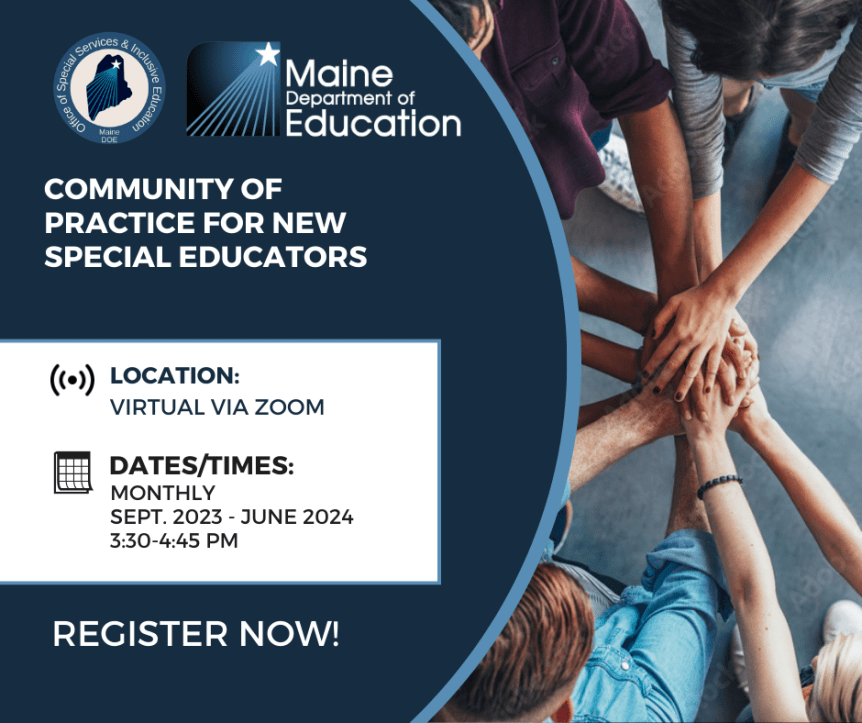
2023/2024 Community of Practice for New Special Educators

Are you a new special education teacher in your first year or two of teaching? Beginning in September 2023, the Office of Special Services & Inclusive Education’s Special Educator Engagement, Development & Supports (SEEDS) project will host a community of practice for you!  Each session will be held virtually after school hours and will focus on the most relevant and meaningful topics for you as you start your career as an educator.  Topics will be decided by the community of practice and may include areas such as inclusion, co-teaching, collaboration, IEP writing, behavior supports, literacy and math interventions, etc.  The community of practice will also have an online platform to engage and support one another in between the monthly meetings.

To register for the New Special Educator Community of Practice, please fill out this survey.  The sessions for the 2023-2024 school year are from 3:30-4:45 pm on September 11, October 10, November 8, December 14, January 8, February 13, March 13, April 11, May 13, and June 11.

If you have any questions, please contact Tracy Whitlock at tracy.w.whitlock@maine.gov

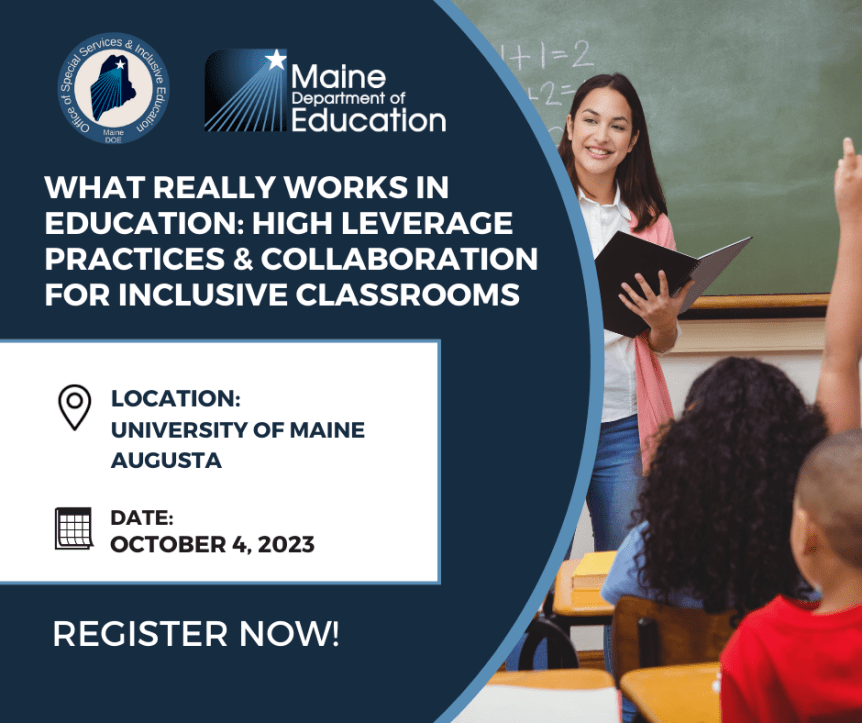
What Really Works in Education 2023 Conference: High Leverage Practices & Collaboration for Inclusive Classrooms

Are you looking for strategies, tips, and practical techniques around high-leverage instructional practices and collaboration that work with diverse learners to create Inclusive Classrooms?  This conference is for you and your team!

For the first time ever, the popular What Really Works in Education conference is coming to Maine!  This year’s conference, hosted by the Maine Department of Education’s Office of Special Services and Inclusive Education, will engage learners around high-leverage practices by local, national, and international experts.

Participants will leave with tips, tricks, strategies, and tools to add to their educational toolkit from each session in the conference.

The one-day event will feature strategies on Collaboration and Inclusion for administrators, general and special education teachers, preservice educators, educational technicians, and related service personnel including strands on Collaboration and Behavior and Collaboration and Academics.

  • Date:  Wednesday, October 4, 2023
  • Location: University of Maine Augusta
  • Cost: $50 per participant which includes breakfast, lunch, and a copy of the 2023 book of Connecting High Leverage Practices to Student Success: Collaboration in Inclusive Classrooms (Jenkins & Murawski).
  • Register for the conference here.
  • For more information visit the Inclusion Conference website.

Keynote Speakers 

Dr. Wendy W. Murawski

Wendy W. Murawski, PhD, is the Executive Director and Eisner Endowed Chair for the Center for Teaching and Learning at California State University, Northridge (CSUN), where she is also a professor in the Department of Special Education and the Director of SIMPACT Immersive Learning. Dr. Murawski is the national Past President of the Teacher Education Division (TED) of CEC and award-winning researcher, author, and educator, including Teacher Educator of the Year for the state of California. Dr. Murawski holds an EdS, MEd, and MBA and  is an internationally known speaker and frequently requested keynote speaker, presenting in Europe, Asia, Africa, and North America. She has published extensively around inclusive education, co-teaching, collaboration, and Universal Design for Learning, including 18 books and numerous chapters, blogs, and peer-reviewed articles. Prior to higher education, she was a general and special education teacher in Virginia and in California. Currently, Dr. Murawski is the CEO of 2 TEACHâ (www.2TeachLLC.com), an educational consulting company dedicated to promoting inclusive education, and 2 TEACHâ Global, championing inclusive education around the world.

Dr. Melissa C. Jenkins

Melissa C. Jenkins, PhD, is an assistant professor of Special Education at the University of Mary Washington in Fredericksburg, VA and co-author of Connecting High-Leverage Practices to Student Success: Collaboration in Inclusive Classrooms. She brings over 18 years of public school experience to her role as a teacher educator, having worked in Virginia public schools as a special education teacher, instructional coach, and central office administrator. Dr. Jenkins is dedicated to helping educators bring high-quality, inclusive practices to schools. She is also a consultant with 2 TEACHâ Global educational consulting. She loves speaking and writing about collaborative practices, early mathematics intervention, and positive behavioral support. When not working, Melissa enjoys practicing yoga to find literal and figurative balance in life.

Why Inclusion?

The federal Individuals with Disabilities Act (IDEA) requires that each public agency (SAU) must ensure that to the maximum extent appropriate, children with disabilities, including children in public or private institutions or other care facilities, are educated with children who are nondisabled; and special classes, separate schooling, or other removal of children with disabilities from the regular educational environment occurs only if the nature or severity of the disability is such that education in regular classes with the use of supplementary aids and services cannot be achieved satisfactorily. §300.114

Over 20 years of research studies have consistently demonstrated that the inclusion of students with disabilities in general education classrooms results in favorable academic, social, and economic outcomes. This includes positive benefits for typical peers in classrooms who benefit from involvement and relationships with students who have disabilities in inclusive settings.

Effectively including students with disabilities in the general education classroom requires teachers and school administrators to further develop an understanding of the individual strengths and needs of the whole student.

For more information about Inclusion in Maine or the What Really Works in Education conference, contact Tracy Whitlock at tracy.w.whitlock@maine.gov.

Requests for Applications (RFA) for the Maine Transition Regional Interagency Collaborative (MeTRIC) Grants

The Office of Special Services and Inclusive Education at the Maine Department of Education is now accepting applications from school administrative units for the Maine Transition Regional Interagency Collaborative (MeTRIC) grants. The purpose of these grants is to provide students with disabilities the necessary support and resources to seamlessly transition to post-secondary education or employment.

To qualify, applicants must demonstrate innovative and sustainable partnerships among multiple agencies to provide inclusive transition services such as vocational training, job readiness, financial literacy, and advocacy.

The MeTRIC initiative also encourages inclusive transition opportunities like apprenticeships, work based learning, mentoring, and community college partnerships. Applicants must facilitate a forum for sharing best practices and resources with students and agency participants.

The Maine DOE, Office of Special Services and Inclusive Education applied and received a $$750,000.00 ESSA grant award to develop regional transition collaboratives. Each SAU applying and approved will receive a minimum of $100,000.00 each to establish their seamless and sustainable coordinated set of transition program(s) in their region. The number and size of awards will depend on the number of applications received and available funds. The Department reserves the right to eliminate the lowest scoring application(s) and/or make awards for amounts less than requested, whichever is in the best interest of the State.

Eligible schools interested in the Maine Transition Regional Collaboratives (MeTRIC) Grant Program opportunity may access the application through the Grant RFPs and RFAs webpage.

A timeline for the RFA process is provided below.

Deadline Action Steps
Fri      – 06/30/23 Questions due date from SAUs emailed to titus.orourke@maine.gov
Mid July Answers will be posted to the public via Procurement
Wed   – 07/26/23 RFA Applications due

All questions related to the Maine Transition Regional Interagency Collaborative (MeTRIC)  RFA should be submitted to:

Titus O’Rourke, Transition Specialist, Office of Special Education and Inclusive Education, titus.orourke@maine.gov no later than Friday, June 30, 2023.

REMINDER: 2023 Summer Symposium on Inclusive Practices for Students with Autism and Developmental Disabilities

Join the Council for Exceptional Children’s (CEC) Division of Autism and Developmental Disabilities (DADD) groups face-to-face at UMaine Orono or join via Zoom on July 21st from 9:00 am – 3:00 pm for a full day of inclusion-building topics in education centered around two strands of learning- 1) access to the curriculum and 2) quality of life. There are multiple ways of joining and learning. Get more information and register HERE now!

Contact hours are available. For more information please reach out to Anica Miller Rushing anica.miller.rushing@maine.edu.

Webinar: The Role of Special Educators in School Safety Efforts

The U.S. Department of Education, Office of Elementary and Secondary Education, Office of Safe and Supportive Schools and its Readiness and Emergency Management for Schools (REMS) Technical Assistance (TA) Center will host a Webinar on Tuesday, June 13, 2023, from 12:00 p.m. to 1:00 p.m. ET. This Webinar will highlight the role of special educators in school safety, security, emergency management, and preparedness activities, including emergency operations plan (EOP) development.

The objectives of this 60-minute Webinar are to:

  • Demonstrate the importance of a collaborative planning team, as outlined in Step 1 of the six-step planning process detailed in the Guide for Developing High-Quality School Emergency Operations Plans.
  • Discuss the role that special educators play in implementing the National Preparedness System mission areas before, during, and after an emergency.
  • Reinforce how special educators can enhance EOP development and serve as key stewards in the behavioral threat assessments, continuity of operations, recovery, and more.
  • Share relevant resources to be used by special educators and core planning teams.

Register on the REMS TA Center Website to participate in the Webinar!

Presenters

  • Maryland Department of Health
    • Dr. Toni Beckett, School Administrative Coordinator
  • REMS TA Center
    • Janelle Hughes, Project Director

Questions

Contact the REMS TA Center Help Desk at 1-855-781-REMS [7367] or info@remstacenter.org from 9:00 a.m. to 5:00 p.m. ET, Monday through Friday. Can’t make the live event? This Webinar will be archived on the REMS TA Center’s Website within 7 business days.

MADSEC Names 2023 Special Education Honorees of the Year

Maine Administrators of Services for Children with Disabilities (MADSEC) has announced its 2023 Honorees of the Year working in the field of Special Education in Maine schools.

The Maine Department of Education (DOE) joins MADSEC in congratulating these individuals on their recent honor as well as thanking all the professionals who work in the field of special education supporting students.
MADSEC will be honoring the awardees at their annual Directors’ Academy in June.
To learn more about MADSEC and these awards visit their website: https://www.madsec.org/