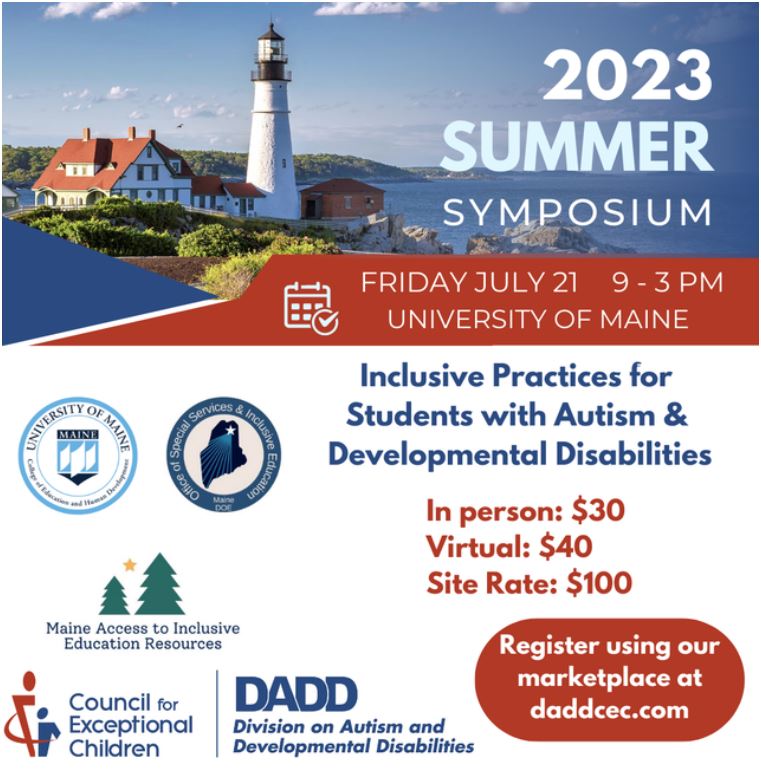
2023 Summer Symposium on Inclusive Practices for Students with Autism and Developmental Disabilities

Join the Council for Exceptional Children’s (CEC) Division of Autism and Developmental Disabilities (DADD) groups face-to-face at UMaine Orono or join via Zoom on July 21st from 9:00 am – 3:00 pm for a full day of inclusion-building topics in education centered around two strands of learning- 1) access to the curriculum and 2) quality of life. There are multiple ways of joining and learning. Get more information and register HERE now!

Contact hours are available. For more information please reach out to Anica Miller Rushing anica.miller.rushing@maine.edu.

Webinar McKinney-Vento Program 101 – May 30th 3:30 – 4:30 pm

Join MAIER and Maine’s Department of Education’s Amelia Lyons for a webinar on the McKinney-Vento program. This session will provide an overview of the act that allows each state to provide a program to assist students with their rights when they are experiencing unstable housing situations.  Participants will learn about student rights including the rights to immediate school enrollment even when records not present, remaining in the school of origin, if in the student’s best interest, receiving transportation to and from the school of origin, and receiving support for academic success. Amelia Lyons will go over the McKinney-Vento Act, common misconceptions of the program requirements and ways educators and family members can help youth receive these services so that every student can have an opportunity for academic success. Registration is free but required.

When/Where: Online Zoom meeting (link provided once you register). Tuesday, May 30th, 3:30 – 4:30 pm

Come to the webinar (register here) and get your questions asked, but if you miss it, this webinar will be recorded and made available on the MAIER website within a few weeks after the event.

Contact hours are available. For more information please reach out to Anica Miller Rushing anica.miller.rushing@maine.edu.

New Series: Co-Teaching for Inclusion in Maine

Maine Access to Inclusive Education Resources (MAIER), a collaborative between the Maine Department of Education (DOE) Office of Special Services and Inclusive Education and the University of Maine, has a variety of professional learning opportunities for the field and is pleased to announce a new series of co-teaching supports for inclusive classrooms and schools.

Co-teaching is being implemented in schools across the nation to address the needs of all students in classrooms with the goal of creating more inclusive environments.   Co-teaching involves having a general education teacher and special service provider (e.g., special education teacher, Title I teacher, ELL specialist, speech/language pathologist) collaboratively planning, teaching, and assessing to ensure success of all students.

Dr. Wendy Murawski, national expert and author on co-teaching and CEO of 2Teach, has created Co-Teaching Modules for Maine.  These modules, titled Co-Teaching 101, provide professional learning for Maine educators addressing co-teaching, planning, and assessing learning options for your classrooms and school.   These asynchronous modules may be found at https://umaine.edu/maier/co-planning-101/.

Additionally, MAIER is providing a Co-Teaching Community of Practice facilitated and supported by MAIER’s Research Associate, Dr. Anica Miller Rushing, and 2Teach’s Dr. Melissa Jenkins.  The purpose of this CoP is to increase both general and special educators’ ability to use co-teaching to improve inclusion practices. The CoP starts meeting in May and you may register at https://docs.google.com/forms/d/e/1FAIpQLSc4HBkVmuPIiJ3eaqoT0kj11ZcfaMJop9DfrvWpeG6OdYKzoA/viewform.

Contact hours are available.  To learn more about this programming, please contact Anica Miller Rushing at anica.miller.rushing@maine.edu.

Family & Caregiver Effective Dispute Resolution Information Session

The Maine Department of Education (DOE) Office of Special Services and Inclusive Education and the Maine Parent Federation will host a Family & Caregiver Effective Dispute Resolution Information Session on May 9 from 11:30 am – 12:30 pm. The session will provide information about procedural safeguards, facilitated IEPs (Individualized Educational Plans), and dispute resolution options.

Date/Time: May 9 from 11:30 am – 12:30 pm
Location: Virtually via Zoom
Join the information session here – There is no need to register for this info session, just click the link at the time of the session.

For more information about the session, please contact Maine DOE Due Process Coordinator, Leigh Lardieri, at leigh.lardieri@maine.gov.

Announcing: The L.I.F.E. Readiness Program Career Exploration Fair

The Maine Department of Education in collaboration with Maine educators, is excited to announce the L.I.F.E. Readiness Program Career Exploration Fair. This opportunity is for ALL our scholars with I.E.P.s to engage with hands-on career exploration activities designed to help students experience, learn, and develop an interest in their future career choices. Students can explore up to 10 career clusters at the career fair and complete transition-aligned activities and record self-directed assessments in their event “Passport.”

In turn, the “Passport”  support case managers in developing their scholars’ transition portfolio, thus informing the development of their transition services and plans, specifically section 9 and section 4 of the I.E.P.

This opportunity is part of the Maine Department of Education’s 2022 – 2023 Transition Tuesday Power Hour Series, a best practices forum to provide opportunities for our state educators and transition leaders to grapple with and actuate strategies and support for our scholars’ diverse needs and pathways to post-secondary opportunities. for more information about the Transition Tuesday Power Hour Series, contact Titus titus.orourke@maine.gov.

Filing of Chapter 101: Maine Unified Special Education Regulation Emergency Rulemaking

The Maine Department of Education has identified a barrier to its obligation pursuant to the Individuals with Disabilities Education Act (IDEA) and the Maine Unified Special Education Regulation (MUSER) to ensure the provision of a free, appropriate public education (FAPE) to all eligible students, including the availability of a continuum of educational placements. The current funding structure outlined in Section XVIII.3.C(2) of MUSER for private schools that serve exclusively students with disabilities (referred to throughout as “special purpose private schools”) is causing those schools to limit or cease operations, leaving some of Maine’s most significantly impacted children without the educational placements they are entitled to by law. Further breakdown of this critical component of the continuum of educational placements will leave the State unable to maintain compliance with IDEA and MUSER. 

The Department has determined that a rule change is necessary on an emergency basis in order to protect the public health, safety and general welfare by ensuring that there is a continuum of placements available for all students with individualized education programs (IEPs) in accordance with federal and state law as follows: 

  • Change #1: Section XVIII.3.C(2) is amended to change the required number of instructional days to the “sum of the days on which instruction was provided in accordance with the school’s calendarrather than the actual days of student attendance for the year.  Rationale:  The current funding formula penalizes the private school when a student is unable to attend, even if the lack of attendance is due to a disability-related reason, despite the obligation of the private school to have staff and supports available for the student every day of the school year. 
  • Change #2: adds a section (2A) to allow the Department to “recalculate the number of student days for the remainder of the fiscal year 2023 and the entirety of fiscal year 2024 using the number of days on which instruction was provided in accordance with the school’s fiscal year 2022 calendar and recalculate each school’s allowable expenditures and 2023 tuition rate using the revised number of student days.  The Department shall notify each special purpose private school of its revised tuition rate, which shall be effective immediately and applies to the remainder of fiscal year 2023 and the entirety of fiscal year 2024.”  Rationale:  The current funding formula operates on a one-year delay – this change ensures that additional monies will flow to the impacted schools now, to prevent closures or cutbacks.    
  • Change #3: adds a section (4A) which provides that nothing in subparagraph (4) shall limit any increase in the tuition rate resulting from the change in calculating the number of student days in subparagraph (2) from the actual days of student attendance to the days on which instruction was provided in accordance with the school’s calendar.”  Rationale:  This change ensures that any increase in tuition resulting from the change in 2023 does not get reduced by the cap on the percentage of increase from year to year. 

A period of public comment opens today, March 24, 2023. Due to the need to prevent imminent harm to the students who depend on these educational placements and the emergency status of this rule change, the public comment period has been reduced to 10 days.  

Written comments may be submitted to DOE Legislative Team member Laura Cyr, State House Station #23, Augusta, Maine 04333; 207-446-8791 or laura.cyr@maine.gov until 5:00 p.m. on April 3, 2023. 

In addition, a public hearing for the proposed new rule will be suspended due to the emergency nature of this change. As an emergency filing, the proposed changes become active upon filing and are in effect for a period of one year from the filing date.  

Timeline for Rulemaking for Chapter 101 – Emergency, Major Substantive  

Comment Period Begins: March 24, 2023 

Comment Period Ends: April 3, 2023 

Anticipated Date of Adoption: April 10, 2023 

The proposed amendment to Chapter 101 can be found here: https://www.maine.gov/doe/about/laws/rulechanges   


Making Math Meaningful For All: Math4ME is Accepting Applications for Newest Cohort

Math4ME is a free, three-year, whole-school project designed to support all educators (classroom teachers, special educators, ed techs, and interventionists) to strengthen math proficiency for all learners with a specific focus on increased math proficiency for students with math IEP goals.  The project will focus around building positive math school communities and classrooms, mathematical content and pedagogical skills, supporting inclusionary practices through MTSS, and formative assessment including the Early Mathematics Diagnostic Interview (EMDI).

For more details about the Math4ME project check out the informational video.

We are accepting applications for the newest cohort until April 15, 2023.  Math4ME Application

We will hold a virtual informational meeting on Tuesday, April 4, 2023 at 4:00 PM. Register here in advance for this meeting.

For questions or more information contact Susan Hogan, susan.hogan@maine.gov or Jen Robitaille, jennifer.r.robitaille@maine.gov.

Math4ME: Engage Families in Mathematics

Is your school hoping to engage families in mathematics? Math4ME is for YOU!!

Math4ME is a free, three-year, K-5, whole-school project designed to support all educators (classroom teachers, special educators, ed techs, and interventionists) to strengthen math proficiency for all learners with a specific focus on increased math proficiency for students with math IEP goals.

Math4ME Application Form

Register for the Math4ME Info Session March 8, 2023 at 3:30-4:30 PM

“I liked the breakout groups and providing different ways to solve the problems. It helped close the gap in my way of thinking.” – Math4ME Participant

“It gave me ideas of what to think about in regards to delving more deeply into NWEA scores and how to use some of this information to inform both my instruction and the writing of IEP goals.” – Math4ME Participant

For more information contact: Susan Hogan, susan.hogan@maine.gov


Math4ME: Building a Positive Math Culture Within Your School

Are you looking to increase math confidence in students and staff and build a positive math culture within your school?

Math4ME is for YOU!!

Math4ME is a free, three-year, K-5, whole-school project designed to support all educators (classroom teachers, special educators, ed techs, and interventionists) to strengthen math proficiency for all learners with a specific focus on increased math proficiency for students with math IEP goals.

Math4ME Application Form

Register for the Math4ME Info Session March 8, 2023 at 3:30-4:30 PM

“I really enjoy these conversations with other Maine teachers and the Math4ME coaches. I feel much more confident as a math instructor now that I am doing this. I appreciate it so much!” – Math4ME Participant

“Doing the assessment form together today and making an action plan made me feel more confident in the process.” – Math4ME Participant

For more information contact: Susan Hogan, susan.hogan@maine.gov

Resources and Guidance for Ensuring a High-Quality Education for Highly Mobile Children

The following message is from the United States Department of Education Office of Special Education and Rehabilitative Services: 

The letter below and the list of resources provides guidance and describes several important principles that states, school districts, school staff, parents, families, and others may find helpful in ensuring that highly mobile children with disabilities receive required special education and related services designed to meet their unique needs in a timely manner.

Ensuring a high-quality education for highly mobile children is a critical responsibility for all of us. Highly mobile children include children and youth experiencing frequent moves into new school districts, such as military-connected children, migratory children, children who are homeless, and children in the foster care system. While these children often possess remarkable resilience, they also experience formidable challenges as they cope with frequent educational transitions.

  • Identify ways to make State and district policies and procedures consistent with guidelines and rules set forth under the Military Interstate Children’s Compact Commission (MIC3) Compact;
  • Honor and respect the previous academic standing and accomplishments of highly mobile children in their new districts;
  • Involve district and school leaders, teachers, school counselors, social workers, coaches, school nurses, and administrators at all levels in efforts to better address the needs of highly mobile children; and
  • Provide professional development opportunities to educators, related service providers, and staff on how to recognize and respond to the needs of highly mobile children.

Issue #1: Highly mobile children should have timely and expedited evaluations and eligibility determinations.

Issue #2: Comparable services include services during the summer, such as Extended School Year (ESY) services.

Read more and access the letter.

We ask you to share this information with your local school staff to help ensure highly mobile children with disabilities receive the appropriate special education and related services in a timely manner. Thank you for your continued interest in improving results for children with disabilities.

The Maine Department of Education is available to support SAUs with these requirements. For professional development requests on this topic, please contact Amelia Lyons Rukema, Maine DOE McKinney Vento Specialist at amelia.lyons@maine.gov or 207-557-1787 and/or Colette Sullivan, Maine DOE Federal Programs Coordinator at colette.sullivan@maine.gov.