Helping Young People Find Their Voice Through Public Media – An article by Mid-Maine Technical Center Instructor David Boardman

Mid-Maine Technical Center (MMTC) Instructor of Mass Media Communications David Boardman recently contributed to an article in the the national Association for Career & Technical Education (ACTE) magazine, Techniques.

The article, “Helping Young People Find Their Voice Through Public Media,” is about the power and importance of student-led media projects with a focus on a team of students from Boardman’s class at MMTC that produced a four-minute story for Maine Public Television on a student-led groundwater testing study that found high levels of arsenic in drinking water.

Boardman writes, “Not only did students contribute to the ‘participatory culture’ of our media-rich society, but, as young consumers, they gained a sense of how to watch news with a critical eye. They learned to seek out connections where they exist and about what good journalism looks like, as a producer and as a consumer.”

The article is an enthusiastic nod to how important project-based learning and student led initiatives are to student learning and pays tribute to the amazing things happening within the learning communities of career and technical education programs all over Maine and across the country.

To read the article, scroll to pages 24-28 of this digital version of Techniques magazine.

This story idea was provided by MMTC as part of the Maine Schools Sharing Success Campaign. To submit a story or an idea email it to Rachel at rachel.paling@maine.gov.

RSU 22 Arts Educators Transform Curriculum to Provide Safe and Meaningful Music Education

Music is alive and well in RSU22. Let me start by saying that from the very beginning, the teachers of the arts and the administration never thought of cutting the arts during the pandemic. The question was, “How do we deliver these subjects to our students with quality?”

Before COVID-19, our music program included general music K-5, choruses and bands 5-12, with before or after school jazz ensembles and show choirs 6-12, and Tri-M Music Honor Society at the high school.

During the pandemic, our offerings are the same with the addition of remote classes. However, they look a bit different. Our system is operating under a hybrid system. Half of the students attend in-person Monday and Thursday with asynchronous assignments on Tuesday and Friday. The other half attends in-person Tuesday and Friday with asynchronous assignments on Monday and Thursday. AP classes also meet on Wednesdays remotely and chorus and band students have 1 to 1 sectionals/lessons on a rotating basis on Wednesdays via google meet. The high school ordinarily has 4 blocks per day every other day for 8 total blocks on an A/B day system. This year we are running 4 blocks (A day) every day for 1st and 3rd quarters and the other 4 blocks every day for 2nd and 4th quarter. This is not ideal for skills based classes, but it is better than splitting it by semester and makes things easier to keep track of for both teachers and students.

Elementary music classes are meeting every other week and posting activity choice boards reinforcing musical concepts on the opposite weeks. All music teachers who teach elementary classes have divided up our districtwide remote classes, each of us having 1 or 2. Each elementary student has their own white board, marker, and eraser. Some classes have been given rhythm sticks. Older students are playing melodic instruments such as boomwhackers, tone bells, and glockenspiels that must be wiped down after each class.

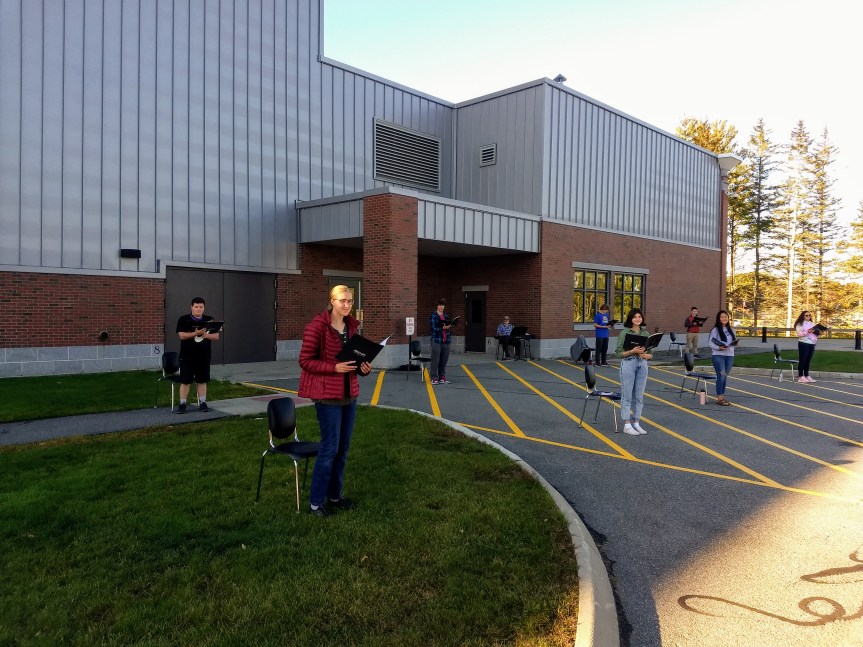
Chorus classes are singing outside 14 feet apart unmasked as long as the weather is 40 degrees or higher and not raining. When it is raining or too cold to be outside, we are learning basic piano skills, ear training, humming softly distanced with masks, music theory, listening examples, discussions about song texts, artistry, etc. Their asynchronous lessons include sight singing with “thepracticeroom.net“, learning tracks with practice log, recording themselves for teacher critique, music theory, listening examples, etc. We are also working with our technology department to allow our high school students to work in small ensembles virtually through the Jacktrip foundation.  We have rhythm sections rehearsing in person after school.  We have been working with composer Kris Berg.  He has written several high school arrangements for small jazz ensembles which include interchangeable parts for various instruments.  Students can also play along with the mp3 files of each song Kris has arranged.  Horn players and vocalists have been assigned to each group and are practicing their songs at home.  We are hoping for adjustments to be made to allow our students to play in person using the required PPE.

Bands are learning similar concepts. Some of our bands are playing outside 14 feet apart unmasked. Those not going outside are studying music as it relates to social issues, music history, music theory, rhythm using sticks and drums, ear training, listening to musical examples, recording themselves for critique by teachers, etc.

In the music department, we start on Wednesday mornings together discussing our successes and struggles for the week in order to pass on any things we have learned or to get help with our hurdles. Our K-2 classes all use Seesaw and our 3-12 students all use Google classroom for their work and our district has decided that we will all use google meet for our virtual classes and meetings. We regularly use Google slides, Screencastify, Padlet, Quicktime Player, YouTube, VideoLink, Soundtrap, and now we are exploring Jacktrip to use for virtual teaching with very little time lag.

For our subject area, this is anything but ideal. However, our focus continues to be on how we can foster musical growth in our students and supporting their musical goals.

This story was submitted by Heidi Corliss, Choral Music Teacher at RSU 22 Hampden Academy Visual and Performing Arts Team Leader, with support from Jason Anderson, Maine DOE Visual and Performing Arts Specialist as part of the Maine Schools Sharing Success Campaign. So submit a story or an idea email it to Rachel at rachel.paling@maine.gov.

Everyone Has a Story: Lewiston Mom Finds a New Passion and Career Through Local Adult Education Program

A podcast called “We All Have a Story” features standup comedian Dawn Hartill, who got her start by taking a Lewiston Adult Education class called “Standup Comedy Workshop.” Check out her story and how she got stated on We All Have a Story – A podcast about people @WAHASpodcast. Here is a link to where you can listen to her story (She mentions adult education at 4:13 during her interview).

Now teaching the standup class at Lewiston Adult Education, Dawn’s story exemplifies how important education can be at any age, and how trying something new through a wonderful local resource can change your life in so many positive ways.

To learn more about the Lewiston Adult Education Program, check out their website, or you can contact your local school system to learn more about the Adult Education classes available near you.

MEDIA RELEASE: Court of Appeals Decides in Favor of DOE Commissioner

On October 29, 2020, the Maine Department of Education received word of the Court of Appeals for the First Circuit’s decision in favor of Commissioner Pender Makin in Carson v. Makin. This decision of the Court of Appeals affirms the earlier decision of the United States District Court for the District of Maine.

Maine’s Constitution requires the local provision of public education; however, the expansive landscape and small communities of Maine are not conducive to the operation of a school within every school administrative unit. For this reason, Maine has a long-established “tuition” program through which the children within a community that cannot or does not operate a public school are permitted to access a public education through the payment of state and local funds to a nearby public or approved private school.  Public dollars cannot be used for sectarian schools; however, a family is not prevented from accessing, at their own cost, a religious education.

“As the Commissioner of Education, I am charged with the responsibility of ensuring that public funds allocated for education in Maine are spent within the legal and intended use of those funds,” stated Commissioner Pender Makin when learning of the decision. “I am pleased that the court has recognized the lawfulness of our fiscal stewardship.”

The case was argued before the Court of Appeals by Assistant Attorney General Sarah Forster on January 8, 2020.  Assistant Attorney General Forster and Deputy Attorney General Christopher Taub have represented the Commissioner throughout the legal proceedings in this matter.

“I am pleased that the First Circuit correctly found that Maine has created a narrowly tailored “tuition” program that responds to our unique need to ensure that a public education is available in school administrative units that do not operate public schools,” said Attorney General Aaron M. Frey regarding the court’s decision. “The Court recognized that because the only purpose of Maine’s program is to replicate the education that a student would receive at a public school, Maine is not discriminating based on the religious status of any private school. Rather, Maine is simply declining to pay for religious instruction that would be unavailable in a public school. In this way, Maine’s program is unlike the “no-aid” clause in the Montana Constitution at issue in the Supreme Court’s recent Espinoza decision, or any prior school choice program that has been subject to review.”

The decision in its entirety can be read, here.

Maine DOE Update – October 30, 2020

From the Maine Department of Education


Reporting Items

| Visit the DC&R Reporting Calendar |


News & Updates

MEDIA RELEASE: Mills Administration Updates COVID-19 School Health Advisory System

The Mills Administration today released an update to its color-coded Health Advisory System that classifies counties’ relative risk of COVID-19 transmission by color and is provided to assist schools as they continue with their plans to deliver instruction and support students safely this fall. The Maine Department of Health and Human Services (DHHS) and Maine Center for Disease Control and Prevention (Maine CDC) assessed the data and trends for all counties. Based on this assessment, Somerset and Washington counties are now categorized as yellow, joining Waldo County, which was designated yellow last week. All other counties remain green. | More

PRIORITY NOTICE: Maine DOE Launches Social Emotional Learning Curriculum

The Maine Department of Education is excited to announce the release of Maine’s first, state owned and free, PreK-12th grade Social Emotional Learning (SEL) Curriculum. | More

U.S. DOE Seeks Maine Educators for National School Ambassador Fellowship

This opportunity is for school-based educators. The Fellowship is designed to improve educational outcomes for students by leveraging the expertise of school-based practitioners in the creation, dissemination, and evaluation of national education policy. Founded on the principles of partnership, collaboration and cooperation with school-based educators, the Fellowship seeks to: | More

Maine Integrated Youth Health Survey Administration Postponed

The Maine Integrated Youth Health Survey (MIYHS) has been conducted in the February of odd-numbered years since 2009, with the next administration due in February 2021. Given the extraordinary circumstances due to the COVID-19 pandemic, the MIYHS will be postponed to Fall 2021. With a significant portion of students learning remotely in some capacity, high quality data collection is not feasible for the 2020-2021 academic year. | More

Educators Honored at Unique Teacher of the Year Tailgate Gala

The Maine Teacher of the Year Program hosted a unique celebration this year to honor its 2020 Maine County Teachers of the Year and the 2021 Maine Teacher of the Year. With COVID-19 health protocols in mind, the innovative team of people behind Maine’s Teacher of the Year Program planned a safe, in-person tailgate event this year in place of the traditional indoor evening gala. | More

Updated Resources Available in COVID-19 Toolkit for Schools

The Maine Department of Education has transformed the Back to School Toolkit rolled out at the beginning of the year into a COVID-19 Toolkit with additional tools to help schools as they face the challenges and realities of providing education during the COVID-19 pandemic.  | More

Computer Science in Maine: Updates and News

Resilient even amidst a pandemic, the computer science education community is continuing to grow and expand computer science opportunities throughout Maine.  Many partners including the Maine Computer Science Teachers Association (CSTA), Maine Department of Education, Maine Mathematics and Science Alliance (MMSA), Educate Maine, and others are working together to make sure that computer science education is available to Maine students throughout the state. Check out these upcoming computer science learning opportunities for students and educators below! | More


Maine Schools Sharing Success Stories

| Submit your Maine School Success Story |


Professional Development & Training Opportunities

MYAN Hosting Fall and Winter Virtual Training Series & Youth Action Forum

This year, MYAN (Maine Youth Action Network) has eight new virtual trainings across three topic areas: Supporting Social Justice Movements, Community Based Action, and Positive Youth Development. | More

Early Childhood Text Studies: Free Professional Development for Educators

Specialists from the Maine Department of Education’s Early Learning Team are excited to offer a web-based professional development opportunity for early childhood educators in the Pre-K and Kg grade span.| More

Community Learning for ME Offers November Wellness Wednesdays for Educators

Community Learning for ME will be hosting wellness related workshops and activities for teachers on Wednesdays in November.  All workshops are FREE to attend and participants will receive contact hours for participation in live sessions. More

| Visit the Professional Development Calendar |


Latest DOE Career/Project Opportunities View current Maine Department of Education employment opportunities here


Computer Science in Maine: Updates and News

Resilient even amidst a pandemic, the computer science education community is continuing to grow and expand computer science opportunities throughout Maine.  Many partners including the Maine Computer Science Teachers Association (CSTA), Maine Department of Education, Maine Mathematics and Science Alliance (MMSA), Educate Maine, and others are working together to make sure that computer science education is available to Maine students throughout the state. Check out these upcoming computer science learning opportunities for students and educators below!

Virtual Family Code Nights

Date/Time: Various Dates, November 2nd through December 9th

In the past three years, more than 100 Maine schools and community organizations have hosted Family Code Nights. These events have brought together nearly 3,000 children and parents to learn how to code side-by-side. Now, the makers of Family Code Night have started a program called CS is Elementary.

It’s simple and free for Maine elementary schools to get involved. Visit Maine Mathematics and Science Alliance’s Family Code Night Host site to learn more – https://mmsa.org/familycodenight/

CS Connected

Date/Time: Wednesdays, 12pm

A weekly virtual series for college students, produced by Project>Login & UMaine’s School of Computing and Information Sciences. Check out CS Connected on Eventbrite to register for upcoming sessions.

CS Educator Happy Hour

Date/Time: Thursdays, 5pm

Are you teaching computer science or interested in doing so in the future? Join a virtual Zoom gathering of the Maine Computer Science educator community to engage in themed informal interactions. Email angela@educatemaine.org for the link to join!

CodeHS

Date/Time: November 12th, 4:30pm

Join a one-hour workshop for middle school teachers on JavaScript using Intro to Programming with Karel the Dog.

Click here to sign up for this event, hosted by Maine CSTA President, Sean Wasson.

Would you like to see your computer science events and news listed in a computer science release? Are you doing something new and exciting with computer science that you want to share with the rest of the community? Reach out to Emma-Marie Banks, Computer Science Specialist at the Maine Department of Education. emma-marie.banks@maine.gov


Community Learning for ME Offers November Wellness Wednesdays for Educators

Community Learning for ME will be hosting wellness related workshops and activities for teachers on Wednesdays in November.  All workshops are FREE to attend and participants will receive contact hours for participation in live sessions.

November 4th, 11th and 18th:

  • 7:15 – 7:30 AM – Start your day with a meditation session, physical activity or a good laugh.
  • 12:00 & 3:00 PM- Workshop sessions to provide teachers with a variety of practical and applicable wellness resources.

Self-Care is never selfish! For more information and to sign up visit Community Learning for ME or contact Megan Leach, Communications and Content Coordinator for Rural Asperations at megan@ruralaspirations.org.

MEDIA RELEASE: Mills Administration Updates COVID-19 School Health Advisory System

Somerset and Washington counties join Waldo County with yellow designation, all other counties remain green

AUGUSTA — The Mills Administration today released an update to its color-coded Health Advisory System that classifies counties’ relative risk of COVID-19 transmission by color and is provided to assist schools as they continue with their plans to deliver instruction and support students safely this fall. The Maine Department of Health and Human Services (DHHS) and Maine Center for Disease Control and Prevention (Maine CDC) assessed the data and trends for all counties. Based on this assessment, Somerset and Washington counties are now categorized as yellow, joining Waldo County, which was designated yellow last week. All other counties remain green.

In Somerset County, both the positivity rate and the rate of new cases per 10,000 people have risen over the previous 14-day period. In Washington County, the site of the Second Baptist Church outbreak, the new two-week case rate per 10,000 is four times higher than it was last week. Waldo County continues to have Maine’s highest county positivity rate at 3.0% and highest new case rate of 17.4 per 10,000 over the last two weeks.  No outbreaks have been identified in Waldo or Washington county schools at this time.

Under the “yellow” designation, which indicates an increased (moderate) level of community risk, schools may consider additional precautions, such as limiting numbers of people in school buildings at the same time, suspending extracurricular or co-curricular activities including competitions between schools, limiting interaction through cohorting, or other measures based on the unique needs of each school community.

These designations are made out of an abundance of caution and for the consideration of school administrative units in their decisions to deliver instruction.

It is essential that school districts across the State of Maine continue to implement plans that adhere to the six requirements for returning to in-person instruction, regardless of their county’s red, yellow, or green designation:

Symptom Screening at Home Before Coming to School (for all Staff and Students) – Students (parents/caregivers) and staff members must conduct self-checks for symptoms prior to boarding buses or entering school buildings each day.  Schools should provide information to families in their primary language to support them in conducting this check.   Any person showing symptoms must report their symptoms and not be present at school.  Schools must provide clear and accessible directions to parents/caregivers and students for reporting symptoms and absences.

Physical Distancing and Facilities – Adults must maintain 6 feet of distance from others to the extent possible. Maintaining 3 feet of distance is acceptable between and among students when combined with the other measures outlined in this list of safety requirements.  6 feet of physical distancing is required for students while eating breakfast and lunch, as students will be unable to wear masks at that time.   A “medical isolation space” (separate from the nurse’s office) must be designated for students/staff who exhibit COVID-19 symptoms during the school day. Adequate ventilation is required for classrooms, with schools having flexibility in implementation such as using properly working ventilation systems or outdoor air exchange using fans in open windows or doors. Groups in any one area, room, or classroom must not exceed the Governor’s gathering size limits.

Masks/Face Coverings – Adults, including educators and staff, are required to wear a mask/face covering. Students age five and above are required to wear a mask/face covering that covers their nose and mouth.  Masks are recommended for children ages two to four, when developmentally appropriate. Masks/face coverings must be worn by all students on the bus. Face shields may be an alternative for those students with documented medical or behavioral challenges who are unable to wear masks/face coverings. The same applies to staff with medical or other health reasons for being unable to wear face coverings. Face shields worn in place of a face covering must extend below the chin and back to the ears. An exception for wearing a mask or face shield applies only to an individual participating in voluntary school sports during vigorous physical exercise. Nothing in the mask/face covering requirements should be interpreted as preventing a school from making accommodations on an individualized basis as required by state or federal disabilities laws.

Hand Hygiene – All students and staff in a school must receive training in proper hand hygiene. All students and staff must wash hands or use sanitizing gel upon entering the school, before and after eating, before and after donning or removing a face mask, after using the restroom, before and after use of playgrounds and shared equipment, and before and after riding school transportation.

Personal Protective Equipment – Additional safety precautions are required for school nurses and/or any staff supporting students in close proximity, when distance is not possible, or when student require physical assistance. These precautions must at a minimum include eye protection (e.g., face shield or goggles) and a mask/face covering. Classrooms and/or areas that have been used by an individual diagnosed with Covid-19 must be closed off until thorough cleaning and sanitization takes place.

Return to School after Illness – Sick staff members and students must use home isolation until they meet criteria for returning to school.

The Health Advisory System categorizations are defined as follows:

  • RED: Categorization as “red” suggests that the county has a high risk of COVID-19 spread and that in-person instruction is not advisable.
  • YELLOW: Categorization as “yellow” suggests that that the county has an elevated risk of COVID-19 spread and that schools may consider additional precautions and/or hybrid instructional models as a way to reduce the number of people in schools and classrooms at any one time.
  • GREEN: Categorization as “green” suggests that the county has a relatively low risk of COVID-19 spread and that schools may consider in-person instruction, as long as they are able to implement the required health and safety measures.  Schools in a “green” county may need to use hybrid instruction models if there is insufficient capacity or other factors (facilities, staffing, geography/transportation, etc.) that may prevent full implementation of the health and safety requirements.

The county-level assessments are based on both quantitative and qualitative data, including but not limited to recent case rates, positivity rates, and syndromic data (e.g., symptoms of influenza or COVID-19). Those data are publicly posted every week on the Maine CDC website. DHHS and Maine CDC also consider qualitative factors, such as the presence of outbreaks that may potentially affect school-age children.

The Health Advisory System reflects ongoing analysis of evolving data, and serves as one piece of information that school and district leaders can use to make decisions about how to deliver education this fall. The qualitative and quantitative considerations and data used by the CDC in determining community transmission risk levels for schools can be located here: How County Risk Levels for Maine Schools are Determined

The Health Advisory System can be found on the Maine DOE website in Part I of the Framework for Reopening Schools and Returning to In-Person Classroom Instructionhttps://www.maine.gov/doe/framework/part-I.

###

Updated Resources Available in COVID-19 Toolkit for Schools 

The Maine Department of Education has transformed the Back to School Toolkit rolled out at the beginning of the year into a COVID-19 Toolkit with additional tools to help schools as they face the challenges and realities of providing education during the COVID-19 pandemic.  

In addition to the myriad of links to printable resources, videos, websites, and posters about COVID-19, how to identify its symptoms, and how to prevent its spread, the toolkit now has expanded to include a section of resources for positive cases of COVID-19 in schools. This includes direct links to the Standard Operating Procedure (SOP) for Positive COVID-19 Cases in Schools and includes additional resources to help school nurses and other school staff navigate the SOP with greater ease.   

Visit the COVID-19 ToolKit »  

Other important updates include the following: 

  • Updated contact information for the FrontLine WarmLine (FLWL)Now available for school staff, FLWL volunteers can help callers address concerns with anxiety, irritability, poor sleep, grief or worry and, if needed, connect them with additional supports. Contact them from 8 AM to 8 PM, 7 days a week by calling (207) 221-8196 or text the word “frontline” to 898-211 for support. 
  • Updated translations of the Pre-screening Tool for School Attendance. This flyer is available in several translated versionsEnglish | Arabic | Chinese | French | Vietnamese | Swahili | Spanish | Somali | Portuguese | 
    Kinyarwanda | Khmer 
  • Updated COVID-19 Child Feels or Appears Unwell Flowchart – now available in easier to print formats:  PDF Legal Sized | JPG Legal Sized 
  • A Community Support Information Flyer from Maine DHHS that can be provided to families that need support in isolation or quarantine. This flyer is available in several translated versions: English | Arabic | Azerbaijani | Croatian | Dari | Farsi | French | Hindi | Khmer | Kinyarwanda | Kirundi | Lingala | Pashto | Portuguese | Russian | Somali | Spanish | Swahili | Telugu | Vietnamese 

Visit the COVID-19 ToolKit » 

Early Childhood Text Studies: Free Professional Development for Educators

Specialists from the Maine Department of Education’s Early Learning Team are excited to offer a web-based professional development opportunity for early childhood educators in the Pre-K and Kg grade span. Participants in this opportunity will get the chance to explore strategies for managing student trauma and mental health behaviors through a text study of both Responding to Student Trauma by Stephanie Filio, M.Ed. and A Practical Guide to Mental Health & Learning Disorders for Every Educator by Myles Cooley, Ph.D.

The text studies will take place virtually in hour-long sessions on a weekly basis between November 30, 2020 and April 2, 2021:

  • Responding to Student Trauma by Stephanie Filio, M.Ed is tentatively set to run Nov. 30-January 8, 2021 (with a scheduled holiday break).
  • A Practical Guide to Mental Health & Learning Disorders for Every Educator by Myles Cooley, Ph.D. is tentatively set to run January 11, 2021 through April 2, 2021.

The learning groups will be limited to 48 participants each. Goals of this professional learning opportunity are to improve participant awareness and understanding of what causes student trauma and to acquire strategies for how to better educate our students exhibiting behaviors related to trauma, mental health, and learning disorders.

Those interested are welcomed to register for one or both studies. Participants will receive a copy of the book(s). Contact hours will be provided at the end of each text study.

Registration is free and can be completed here. Registration closes November 13th at 5pm. Participants will be notified on a first come, first served basis.

For further information, please contact Nicole Madore, Early Childhood Specialist at Nicole.madore@maine.gov.