Important Updates and Information About New Certification System

The Maine Department if Education is celebrating the Maine Educators Information System’s (MEIS) one year anniversary. MEIS has officially been in production for one year as of November 14, 2018. Over the course of the past year the following has occurred:

  • All applications have been processed internally by the Maine DOE in the new system.
  • The increase in data entry has allowed for data analysis never available prior to having MEIS in place.
  • All superintendents have online access to educator credentials and violations.
  • All certification chairpersons can recommend educators for renewal completely online.
  • All educators can now renew their credentials online.
  • 40,866 applications have been processed in the last 365 days! The chart below breaks down the application types:
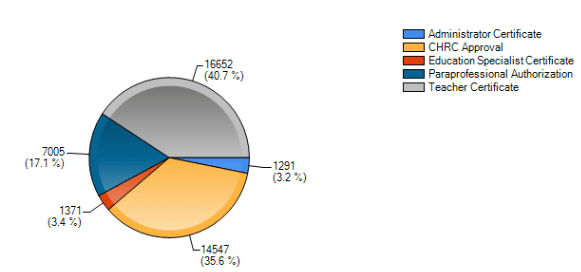
Cert App Types

Next steps for MEIS:

  • Add an upload button so that educators can upload their supplemental documents outside of the application process and,
  • Roll out the ability for educators to complete initial applications online.

Stay tuned for these features in the near future.

Important Updates and Reminders for Educators:

  • All educators who have not yet created an account in the new online certification system are encouraged to do so. By creating an account, educators are ensuring the certification team has the most recent contact information available. Step by step instructions on how to create an account are available on the certification site.
  • Please ensure applications are complete upon submission with all test scores, transcripts, and other supporting documentation. Submitting incomplete applications or parts of applications at different times will result in significant delays in processing, beyond the typical processing time.
  • The Department would like anyone who has gotten a fingerprint to call the certification office at 624-6603 two days (or more) after completing your fingerprinting at IdentoGO. Placing this quick call will allow the Department to efficiently process your application.
  • Conditional certificates will now be issued without securing employment. It is important to note that the conditional certificate is only active for three years and cannot be renewed. For this reason, educators who call to request the conditional must understand that it is a commitment to fulfill deficiencies within a three-year time limit.

For more information about the Maine DOE certification and fingerprinting process please visit the Certification webpage on the Department’s website.




MEDIA RELEASE: Maine DOE Celebrates Educational Support Professionals Day

In celebration of Educational Support Professionals Day, the Maine Department of Education would like to thank and congratulate the tens of thousands of educational support professionals working in Maine’s public schools.

Educational Support Professionals Day is held the Wednesday during American Education Week each year in November. The day celebrates and honors the significant contributions that school support staff make in public schools every day.

Education support professionals include education technicians, bus drivers, security guards, school nurses, facilities staff, office assistants and more. They drive students to school, clean classrooms and hallways, bandage scraped knees, and prepare and cook meals, among many other things. They are often the first to arrive at school and the last to leave.

We hope that schools state-wide will share in thanking and congratulating education support professionals for everything that they do to support students, schools, and communities throughout Maine.

PRIORITY NOTICE: Live Broadcast Available for Public Hearing on Proposed Revisions to Science and Technology, and Social Studies Standards

As a reminder, the Maine Department of Education has scheduled a public hearing on November 15, 2018 as part of the scheduled periodic review of the Maine Learning Results. The Department is seeking public comments regarding the proposed revisions to Rule Chapter 132, revised science and technology and social studies standards.

The public hearing will take place in room 103A of the Burton Cross Building in Augusta. Anyone present may speak at the public hearing, which will be live-streamed. People that wish to speak will be asked to sign in and, preferably, provide two written copies of comments, as well as an electronic copy.

Anyone unable to attend the public hearing may send written comments by 5 pm on December 3, 2018. Written comments may be emailed to sis.doe@maine.gov with the subject “Science Standards Review,” or “Social Studies Standards Review,” or mailed to Maine Department of Education, attn: Beth Lambert, 23 State House Station, Augusta, ME 04333.

Below is a list of relevant links, as well as the hearing information including a link for the live stream:

For further information about the standards review process contact Beth Lambert at Beth.Lambert@maine.gov.

PRIORITY NOTICE: MEA Released Items and Individual Student Reports Available

The Maine Department of Education in collaboration with school districts and schools have verified their 2018 Maine Educational Assessments (MEA) results data within the Maine Assessment and Accountability Reporting System (MAARS). All data in the confidential (login credentials needed), and public sites is now available. Individual Student Reports (ISRs) are also available to districts to download.

This year to support Maine educators, the Department is excited to be able to release items from the math, English language arts (ELA) and science assessments at each grade level in which students in grades 3 – 8 take state assessments. School and district users will also be able to incorporate the released item data in their analysis of student performance. Data regarding district, school and individual student responses to released items are available the confidential MAARS site within Interactive Reports. The actual pdf versions of the released items are available on the maine.onlinehelp.measuredprogress.org/released-items site.

Elements for release include:

  1. The student versions consist of one item booklet per grade, 3-8, that contains each assessed content area (Math, Reading, Writing/Language, Essay).
  2. The associated teacher versions consist of one document per grade, 3-8, that contains each assessed content area and which include:
  • Items as seen on student version
  • Standard alignment notation
  • Answer key
  • Scoring rubrics where applicable
  • Scorer training notes and annotations
  • Exemplary responses where applicable
  • Sample student responses
  • Table of released item information

As a reminder to those who registered, the Department will be using these materials during the scheduled workshops to assist educators in navigating MAARS, examining their data, and linking it to instructional practice.

Further questions can be directed to Janette Kirk, Acting Director, Office of Learning Systems at janette.kirk@maine.gov.

MEDIA RELEASE: Maine DOE Releases 2017/2018 Education Assessment Results

The Maine Department of Education has released the 2017-2018 Maine Education Assessment (MEA) results in the content areas of mathematics, English language arts/literacy, and science.

The Department would like to thank schools, districts, and community members for their continued patience while an additional validation was completed after the initial delay in releasing the 2017/2018 results.

“This year the Department has three years of data from the same assessments which will allow for measurement across multiple years,” said Maine Department of Education Commissioner Robert G. Hasson, Jr. “The new trend lines will assist the Department in determining where support is needed to help increase student achievement across the state.”

The public results can be viewed by school or district and by student group, including grade level groups, in the Maine Assessment and Accountability Reporting System (MAARS).

Maine DOE Update – November 8, 2018

From the Maine Department of Education


Reporting Items

2018-2019 Maine School Immunization Report Due December 31, 2018

Maine law (20A M.R.S.A. 6358, Chapters 126 & 216) requires students enrolled in grades K-12 to be immunized against diphtheria, tetanus, pertussis, measles, mumps, rubella, polio and varicella (chicken pox). Additionally, all students enrolled in grades 7-12 must be immunized against meningococcal meningitis. Under this law, students are required to have either vaccine administration records, a physician note or laboratory evidence to prove immunity, a physician note indicating the student is medically exempt, or a religious or philosophical objection note from a parent/guardian for each of the required vaccines listed above. | More

| Visit the DC&R Reporting Calendar |


News & Updates

PRIORITY NOTICE: Delayed Public Release of Maine Education Assessment (MEA) Results

The public release of the Maine Education Assessment (MEA) data scheduled for November 5, 2018, has been delayed. | More

What is Graduation Rate? #success4ME

The graduation rate indicator is one of four indicators used in Maine’s Model of School Support. It will be used as an indicator of success for high schools only. Graduation is defined as graduating within four years after entering ninth grade. In Maine, the graduation rate indicator reflects the number of students graduating “on-time”, as well as the graduating students who progressed at a different rate and graduated in either five or six years. | More

Maine DOE Hosts Meeting of Regional Service Center Executive Directors

The Maine Department of Education recently hosted the 9 regional service center (RSC) executive directors in the inaugural meeting of RSC statewide leadership. Representatives from each RSC participated in the meeting led by the Maine Department of Education’s EMBRACE team. | More

School Safety and Security Bulletin: Door Locks and Code Compliance

Throughout the 2018- 2019 school year, the Maine Department of Education, State Fire Marshal’s Office, Department of Health and Human Services, Maine State Police, Maine Sheriffs Association, Maine Chiefs of Police Association, and the Maine Emergency Management Agency will provide tips and resource information to Maine schools to help provide some guidance for identifying signs and preventing school violence.| More

Seeking Maine Schools for Social Emotional Learning Pilot Program

The Tobacco and Substance Use Prevention and Control Program with the Maine Centers for Disease Control and Prevention (MECDC), in partnership with the Maine Department of Education (Maine DOE), is seeking interest from Maine schools who would like to pilot the social emotional learning (SEL) program, Second Step, funded by a grant through MECDC. | More

RSU 13 Superintendent John McDonald Honored with Commissioner’s Award

Superintendent John McDonald of Rockland Public Schools in Regional School Unit (RSU) 13 has been honored with the Maine Department of Education 2018 Commissioner’s Award from Commissioner Robert G. Hasson, Jr. | More


More Dispatches | Press Releases | Priority Notices


Professional Development & Training Opportunities

Resource to Help Prevent Adverse Childhood Experiences

Adverse childhood experiences—commonly known as ACEs—affect children and families across all communities. ACEs can impact kids’ health and well-being, and they can have long-term effects on adults’ health and wellness. They can even have consequences that impact entire families, communities, and our whole society. Thankfully, ACEs are preventable. | More

Love to Code: STEAM Professional Learning Workshop – Register by 11/16

Maine educators are invited to participate in a professional learning workshop that supports the integration of technology across multiple content areas with a focus on STEAM (Science, Technology, Engineering, Art, and Math) as well as computer science, coding, and computational thinking. By using arts and craft techniques to teach circuits and programming, the workshop will introduce ways to engage learners of diverse backgrounds and interests in designing and building their own technologies and getting excited about STEAM! | More

Visit the Professional Development Calendar |


Latest DOE Career/Project Opportunities

MEDIA RELEASE: RSU 13 Superintendent John McDonald Honored with Commissioner’s Award

Superintendent John McDonald of Rockland Public Schools in Regional School Unit (RSU) 13 has been honored with the Maine Department of Education 2018 Commissioner’s Award from Commissioner Robert G. Hasson, Jr.

As part of a celebration and recognition of Maine’s educational leaders during the annual Commissioner’s Conference held in the spring, the Commissioner awards an outstanding Maine superintendent who has gone above and beyond in his or her duties as a leader in their community.

“John is an extraordinary leader. He is very focused on students and the needs of the whole child,” said Commissioner Hasson. “His success in helping to develop school boards by holding workshops that allow them to set achievable goals for students is a testament to his vision for the success of all students.”

John McDonald has held various roles during his multi-year career and service to public education, including teacher, technology and assessment director, school board member, assistant principal, principal, assistant superintendent and now in his current role as Superintendent of RSU 13. He holds Master’s degrees in both educational leadership and elementary education, and Bachelor’s degrees in both anthropology and writing.

“John is a quiet person. He does not promote his own success as an educational leader, but he is truly deserving of this recognition for his many years of service to Maine students,” added Commissioner Hasson.

The 2017 recipient of the Commissioner’s Award was Michael Felton, Superintendent of Schools in neighboring St. George Municipal School Unit.

Seeking Maine Schools for Social Emotional Learning Pilot Program

The Tobacco and Substance Use Prevention and Control Program with the Maine Centers for Disease Control and Prevention (MECDC), in partnership with the Maine Department of Education (Maine DOE), is seeking interest from Maine schools who would like to pilot the social emotional learning (SEL) program, Second Step, funded by a grant through MECDC.

The grant’s larger goal is to provide primary prevention for substance use and is part of Maine’s State Opioid Response plan. The Second Step Curriculum is research-based and available for grades Kindergarten through 8th grade. Many of the skills within the Maine Learning Results for Health Education in elementary school align with goals of Second Step, to nurture skill building and prevent problematic developmental behaviors that are part of the trajectory toward later substance use.

If you are interested in adding Second Step to your school’s curriculum, are already implementing Second Step, or are implementing a SEL curriculum other than Second Step, the MECDC and Maine DOE would like your feedback about your interest and experience.

This brief survey will take approximately 5 minutes.  Your input will be used to assess what programs are currently being implemented, where there are opportunities to pilot Second Step in Maine, and what districts are specifically interested in piloting Second Step.

Maine CDC and DOE will select pilot sites based on best fit and evaluate the program’s success, with the goal of expanding the program to more sites in coming years. Thank you in advance for your interest and feedback.

For more information, contact Hannah.Ruhl@maine.gov at Maine CDC.

School Safety and Security Bulletin: Door Locks and Code Compliance

Throughout the 2018- 2019 school year, the Maine Department of Education, State Fire Marshal’s Office, Department of Health and Human Services, Maine State Police, Maine Sheriffs Association, Maine Chiefs of Police Association, and the Maine Emergency Management Agency will provide tips and resource information to Maine schools to help provide some guidance for identifying signs and preventing school violence.

School Safety and Security Bulletin  – November 2018

Further questions and inquiries can be send to Pat Hinckley, Maine DOE Transportation and Facilities Administrator at pat.hinckley@maine.gov.

What is Graduation Rate? #success4ME

The graduation rate indicator is one of four indicators used in Maine’s Model of School Support. It will be used as an indicator of success for high schools only. Graduation is defined as graduating within four years after entering ninth grade. In Maine, the graduation rate indicator reflects the number of students graduating “on-time”, as well as the graduating students who progressed at a different rate and graduated in either five or six years.

In the past, graduation rate was never utilized when making determinations of schools eligible to receive support. Under Maine’s Model of School Support, the graduation rate for students meeting graduation requirements in four years in addition to the graduation rate of students meeting graduation requirements in five or six years will be utilized.

graduation rate 4 yr (blue)
4 Year Graduation Rate

What does this look like in Maine?

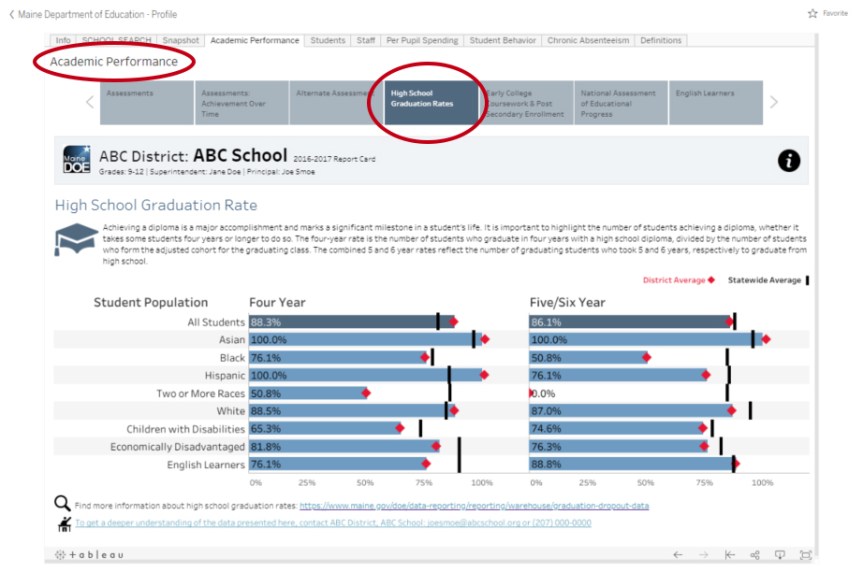
Achieving a diploma is a major accomplishment and marks a significant milestone in a student’s life. It is important to highlight the number of students achieving a diploma, whether it takes some students four years or longer to do so. As it relates to Maine’s Model of School Support, the Graduation Rate indicator is split into two rates of graduation:

  • graduation 5_6 yr (blue)
    5 and 6 Year Graduation Rate

    The 4-year rate is the number of students who graduate in four years with a high school diploma, divided by the number of students who form the adjusted cohort for the graduating class.

  • The 5 and 6 year rates reflect the number of graduating students who took 5 and 6 years, respectively to graduate from high school.

How will graduation rate data be presented on the school report card?

The school as a whole will receive a performance measure related to individual student groups meeting the annual graduation target.

Graduation Performance Descriptors:

Graduation – 4 Year

Emerging Developing Meeting Excelling
No eligible student group made their annual graduation target At least one eligible student group made their annual graduation target All eligible student groups made their annual graduation target All eligible student groups have met or exceeded the long-term goal of 90%

Graduation – Combined 5/6 Year

Emerging Developing Meeting Excelling
No eligible student group made their annual graduation target At least one eligible student group made their annual graduation target All eligible student groups made their annual graduation target All eligible student groups have met or exceeded the long-term goal of 92%

Eligible student groups include: Asian, Black, Hispanic/Latino, Two or More Races, White, Students with Disabilities, Economically Disadvantaged, Migrant Students, and English Learners.

Goals for four year adjusted cohort graduation rate:

Subgroup Baseline (Data and Year) Long-term Goal (Data and Year) 2030
All students 86.83% 2016 90% or maintain current 2016, whichever is greater, graduation percentages by 2030
Economically disadvantaged students 77.77% 2016
Children with disabilities 72.19% 2016
English learners 78.14% 2016
Race – Hispanic/Latino 83.46% 2016
Race – American Indian 84.91% 2016
Race – Asian 90.68 % 2016
Race – Black or African American 76.77% 2016
Race – Native Hawaiian or Other Pacific Islander 88.24% 2016
Race – White 87.29% 2016

The measurements of progress are based on increases in the percentage of all students in Maine who make progress toward the long-term goals on a three-year basis. Long-term goals were developed to reduce the percentage of non-graduating students to result in student groups all meeting the goal of 90% by 2030. The calculation process, for example, is as follows:

Subgroup: All Students

  • Step 1: 2016 Graduation Rate = 86.83%
  • Step 2: 90% (goal) – 86.83% (baseline) = 3.17%
  • Step 3: Differential for each 3-year step is 3.17 divided by 5 = .61%
  • Step 4: Add to the baseline .61 % and add the .61% to each subsequent step to reach the goal of 90% by 2030.

Goals for extended- year cohort graduation rate

Subgroup Baseline (Data and Year) Long-term Goal (Data and Year) 2030
All students 88.61% 2016 92% or maintain current 2016, whichever is greater, graduation percentages by 2030
Economically disadvantaged students 80.82% 2016
Children with disabilities 77.27% 2016
English learners 86.12% 2016
Asian 94.27% 2016
American Indian 83.49% 2016
Black 83.47% 2016
Hispanic 84.13% 2016
Native Hawaiian 93.33% 2016
White 88.84% 2016
Multiple Races 86.62% 2016

Graduation rate will be presented on the initial page of the report card in the following way:

reportcard1

reportcard2

reportcard3

reportcard4

For further information please contact Janette Kirk, Acting Director, Office of Learning Systems at Janette.Kirk@maine.gov.