Upcoming Test of the Integrated Public Alert and Warning System (IPAWS)

On Wednesday, October 3, beginning at 2:18 p.m. Eastern Time, there will be a nationwide test of the Integrated Public Alert and Warning System (IPAWS). The Federal Emergency Management Agency (FEMA), in coordination with the Federal Communications Commission (FCC), will conduct a nationwide test of IPAWS and its Emergency Alert System (EAS) and Wireless Emergency Alerts (WEA) to (1) assess the operational readiness of the infrastructure for distribution of a national message, and (2) determine whether improvements are needed.

The WEA portion of the test commences at 2:18 p.m. ET and the EAS portion follows at 2:20 p.m. ET. This test message will be sent to cell phones that are connected to wireless providers participating in WEA, which is why it is important to make local education agencies (LEAs) aware in advance.

Since learning time will likely be disrupted, school safety partners, including the U.S. Department of Education’s Office of Safe and Healthy Students and its REMS TA Center, and the Youth Preparedness group within FEMA’s Individual and Community Preparedness Division, highly encourage local agencies to use the time to provide a teachable moment about emergency preparedness. For example, LEAs can do the following:

  • Craft a customized message notifying of the upcoming IPAWS test, while also providing information that is specific to your district. For example, you may want to provide details about your local emergency notification systems or describe how your LEA plans to communicate with school populations during real emergencies.
  • Ensure that messaging sent about IPAWS is accessible to those with access and functional needs. FEMA has prepared an accessible version of the announcement about this month’s test that can be shared with the whole school community. All community members are encouraged to watch this brief video.
  • We recommend that schools and school districts plan a review of drill protocols with students to coincide with the IPAWS notification. For example, schools are required to conduct annual evacuation drills, and the interruption from the IPAWS notification on October 3 could serve as a marker to review drill procedures with students or to conduct this drill. If planning a drill or exercise at this time is not possible, emergency planning teams at schools and school districts can be encouraged to use this event as an impetus to setting their calendar of drills and exercises for the school year.
  • Schools and school districts need to create a Communications and Warning Annex as a part of any comprehensive and high-quality school emergency operations plans (EOPs) and as recommended in the Guide for Developing High-Quality School Emergency Operations Plans (PDF).
  • Utilize the fact sheets that FEMA created in to describe IPAWS and its EAS and WEA systems to LEA Web pages and share them via social media and other dissemination channels:

Maine and our nation’s federal partners are committed to strengthening the National Preparedness System, and this test provides just one example of that commitment.

For further information:

Contact the REMS TA Center, your national school safety technical assistance center, at info@remstacenter.org or 1-855-781-REMS [7367] if you have questions about this test or need general support with emergency preparedness planning.

Contact Pat Hinckley, Transportation and Facilities Administrator, at pat.hinckley@maine.gov or 207-624-6886 if you have questions about Maine school security.

Assessment Professional Development and Learning Opportunities

As a follow-up to the September 6, 2018 notice in the Maine DOE Newsroom regarding scheduled opportunities for professional development and learning around assessment, the Department is providing additional information and registration details for upcoming sessions.

Lexile Framework for Reading

On October 9- 11, 2018, the Department in conjunction with MetaMetrics® will be conducting three (3) regional ½ day repeated sessions in Presque Isle, Bangor/Brewer and Portland areas. Each ½ day /3-hour session will provide attendees an overview of the Lexile Framework for Reading and the utilization of Lexile levels to support and impact instructional practice. This session will discuss and review student Lexile levels as determined by student performance on the Spring 2018 ELA eMPowerME state assessment and as reported on 2018 Individual Student Reports (ISRs) to parents.

The intended audience for this session is Special Educators, Librarians, English Language Teachers, English Language Arts (ELA) teaching staff, and elementary school teaching staff.

To register for the Lexile professional development session please click here.

Date Location Session times Registration
October 9, 2018 Elks Lodge

508 Main Street,

Presque Isle, 04769

PM – 12:30 -3:30 pm To register for Oct. 9 sessions, click here.
October 10, 2018 Jeff’s Catering

15 Littlefield Road,

Brewer, 04401

AM – 8:30 -11:30 am

PM – 12:30 -3:30 pm

To register for Oct. 10 sessions, click here.
October 11, 2018 Elks Lodge

1945 Congress Street,

Portland, 04102

AM – 8:30 -11:30 am

PM – 12:30 -3:30 pm

To register for Oct. 11 sessions, click here.

Maine’s Assessment & Accountability Reporting System (MAARS) Review & Released Items

On November 13-15, 2018, the Department in conjunction with FocalPointK-12 will be conducting three, one day sessions in Presque Isle, Bangor/Brewer and Portland areas.

During each morning session, attendees will be provided an overview of MAARS with a focus on confidential reporting elements. Please note, in order for participants to engage fully in this session, participants should ensure necessary permissions to access MAARS have been granted and provided from the District Assessment Coordinator (DAC).

Afternoon sessions will focus on English Language Arts (ELA), Mathematics eMPowerME and Science released items and specifically the impact on curriculum and development review to instructional practice.

To register for the MAARS Review and Released Item session please click here.

The intended audience for this session is Superintendents, Assistant Superintendents, curriculum coordinators, and ELA, Math and Science teaching staff.

Date Location Time Registration
November 13, 2018 Presque Isle Registration 8:30 am

Session 9 am – 3:30 PM

To register for Nov.13 sessions, click here.
November 14, 2018 Bangor/Brewer Registration 8:30 am

Session 9 am – 3:30 PM

To register for Nov. 14 sessions, click here.
November 15, 2018 Portland Registration 8:30 am

Session 9 am – 3:30 PM

To register for Nov. 15 sessions, click here.

For further information or additional questions please contact Janette Kirk, Deputy Director, Office of Learning Systems at janette.kirk@maine.gov or 624-6707.

Online Learning Communities for Educators

Maine educators are invited to join online learning communities led by other Maine educators who will offer guidance and support for completing recognized online learning programs that are designed to develop various skills related to teaching and learning with technology. Educators can learn on their own time and at their own pace while still being a part of community of educators that are all working toward a common goal.

All of the online learning communities are free to join, though some have materials that need to be purchased in order to participate more fully.

  • Apple Teacher – iPad Badges (free)
  • Apple Teacher – Mac Badges (free)
  • Code.org Express Course (free)
  • Common Sense Educators (free)
  • Google Level 1 Certification ($10 exam fee paid to Google directly)
  • Wonder Workshop ($125 for robot and course bundle purchased with ACTEM discount)

To register, please complete this online form »

Note: Most offerings start on or around Oct. 1st and have a limit on the number of participants.

All educators who earn their badge or certificate by midnight on December 2nd will be invited to join a daylong celebration and professional learning opportunity. The celebration will likely be held on Thursday, December 13th or Friday, December 14th in the central Maine area. More details will be sent directly to participants later in the fall

For more information contact, Maine DOE Digital Learning Specialist, Amanda Nguyen at Amanda.Nguyen@maine.gov

Maine DOE Update – September 13, 2018

From the Maine Department of Education


Reporting Items

Reminder to Superintendents: Updating of District Assessment Coordinators (DAC) in NEO

As a reminder to superintendents, Maine DOE is currently in the process of releasing and reviewing assessment results from the 2017-2018 MEA test administration.  We will soon transition into sharing information about the upcoming 2018-19 test administration. | More

| Visit the DC&R Reporting Calendar |


News & Updates

Administrative Letter: Annual Notification of Eligibility for Schoolwide Programs that Include Students with Disabilities

Schools that receive federal Title I funds, have poverty rates of at least 40 percent and have approved Title IA Schoolwide Plans are eligible to use their Title I funds – and funds from other sources – to develop “schoolwide programs.” | More

Updated Special Education Forms

Several of the Maine DOE Special Education forms have been updated and an optional referral form for special education services has been developed.  All vendors have been notified of the changes. A complete list of the forms is available at the bottom of this notice. Below are the detailed changes to the forms. | More

State Special Education Determination

The Individuals with Disabilities Education Act (IDEA) requires each state to develop a state performance plan/annual performance report (SPP/APR) that evaluates the state’s efforts to implement the requirements and purposes of Part B (ages 3 through 20) and Part C (birth to 3) of the IDEA and describes how the state will improve its implementation. | More

School Safety and Security Bulletin: If You See Something, Say Something

Throughout the 2018- 2019 school year, the Maine Department of Education along with multiple other emergency management agencies will provide tips and resource information to Maine schools. | More

Seeking School Highlights for School Report Cards

The Maine Department of Education is requesting the assistance of school principals in the development of the new 2017-2018 School Report Cards that will be publically released later this year as part of the rollout of Maine’s Model of School Support and the Every Student Succeeds Act | More

Schools Participating in the Maine CDC – School Oral Health Program

The Maine Center for Disease Control – School Oral Health Program (SOHP) has been a part of many school’s programs since the 1980’s. The program started with a weekly fluoride mouth rinse and dental sealants to second graders and classroom education. | More

Health Update: Mosquito-Borne Illnesses and Schools

The Maine Department of Education is requesting the assistance of school principals in the development of the new 2017-2018 School Report Cards that will be publically released later this year as part of the rollout of Maine’s Model of School Support and the Every Student Succeeds Act | More

More Dispatches | Press Releases | Priority Notices


Professional Development & Training Opportunities

Attendance Matters: Connecting for Student Success Regional Meetings

Attendance Matters: The Fall Connecting for Student Success regional meetings sponsored by Maine Department of Education and Count ME In are happening statewide.  You can attend a regional meeting that is convenient for you. | More

Interactive Workshop on the Legal Rights of English Learners

All educators are invited to attend this workshop which will provide participants with information regarding the legal responsibilities of schools serving English learners. Districts receiving federal funds under Title I and/or Title III of the Elementary and Secondary Education (ESEA) are strongly encouraged to participate in this workshop, as it will clarify the core requirements for English learner programming that must be met before supplemental federal funds may be utilized. | More

2018 STEM Education Innovation Challenge Grant Competition for K-12 Educators

The Maine STEM Collaborative has announced the 2018 STEM Education Innovation Challenge Grant Competition to provide K-12 educators the opportunity to try out highly innovative ideas in STEM teaching and learning. | More

Visit the Professional Development Calendar |


Latest DOE Career/Project Opportunities

Attendance Matters: Connecting for Student Success Regional Meetings

Attendance Matters: The Fall Connecting for Student Success regional meetings sponsored by Maine Department of Education and Count ME In are happening statewide.  You can attend a regional meeting that is convenient for you.

  • Tuesday, October 16 in Bangor 12:00 to 2:30
  • Wednesday, October 17 in Presque Isle 12:00 – 2:30
  • Thursday, November 1 in Augusta 9:00 – 11:30
  • Thursday, November 29 in Portland 8:30 – 11:00 (Full)

Attendees will hear schools and agencies share updates on programs and effective strategies as well as a short presentation on anxiety-steps to support students. Sessions are free but registration is required.  

Attendance matters because early absences can affect later achievement, since students can miss some of the key building blocks for learning.  Absences add up- just two days a month can mean 18 absences a year.

Register Now  

For more information, please contact Gayle Erdheim at Gayle.Erdheim@maine.gov, Emily Poland at Emily.Poland@maine.gov or Susan Lieberman at slieberman@countmeinmaine.org.

Schools Participating in the Maine CDC – School Oral Health Program

The Maine Center for Disease Control – School Oral Health Program (SOHP) has been a part of many school’s programs since the 1980’s. The program started with a weekly fluoride mouth rinse and dental sealants to second graders and classroom education.

The Program has evolved to over the last several years from the mouth rinse to fluoride varnish application twice a year along with dental screenings for the children.  In the last year The Maine CDC has met with the Department of Education’s School Nurse Consultant, Emily Poland and an advisory group to restructure the SOHP with the goal to make implementation of the activities of the program easier for schools and school nurses. We understand that school nurses have many demands for their time and school resources are very tight. We surveyed the school nurses this past Spring for feedback on a restructure of the SOHP.  We had a 99% response rate back and 91%, responded stating they were in favor of a new structure to the SOHP.

A newly designed SOHP has been designed to  fit the needs of Maine schools as well as the Maine Center for Disease Control. District public health hygienists will work with schools to provide dental screenings, fluoride varnish, dental sealants (when applicable), dental education and care coordination. The district hygienist will be working with school nurses and staff throughout this upcoming school year to provide these services at our participating schools.

Dental decay in children is still the most common childhood disease. Over 51 million hours of school time is lost annually due to dental disease. Maine is working towards reducing the rate of dental decay among Maine’s school children.

For more information contact Nicole Breton, Director of Rural Health and Primary Care at Nicole.Breton@maine.gov or 287-5524.

Health Update: Mosquito-Borne Illnesses and Schools

Maine Department of Education in collaboration with Maine Center for Disease Control and Prevention (Maine CDC) is sharing this important guidance with schools regarding mosquito-borne illnesses. Maine CDC developed the information and guidance in this letter.

Three mosquito-borne illnesses are considered a local risk in Maine: Eastern Equine Encephalitis (EEE), Jamestown Canyon virus (JCV), and West Nile virus (WNV).  These are potentially serious viral infections transmitted to people from the bite of an infected mosquito.  These diseases are especially severe in children (as well as adults over 50).  It is important to practice preventative strategies since there is no vaccine or effective treatment for humans.

Maine saw the first human case of WNV in 2012, the first human case of EEE in 2014, and the first human case of JCV in 2017. Maine did not have any positive EEE or WNV mosquito pools, human cases, or animal cases in 2017. Maine had two human cases of JCV in 2017. Mosquito testing in Maine does not include JCV and laboratory testing for JCV in humans is done out of state.

Maine identified a WNV case in a Maine resident and a WNV positive mosquito pool in Kittery to date in 2018. The human case of WNV became ill on a road trip and likely acquired the infection out of state. Massachusetts, New Hampshire, and Vermont identified mosquito pools positive for WNV to date in 2018. Massachusetts also identified several humans with WNV and New Hampshire identified several birds with WNV to date in 2018.

The risk for contracting mosquito-borne diseases is highest from dusk to dawn and when temperatures are above 50 degrees (and especially above 60 degrees), since these are the conditions when mosquitoes are most actively biting.

Schools play an important role in preventing mosquito-borne illnesses.  Maine CDC and its consulting experts recommend:

  • Cover up outdoors. Children and others on outdoor field trips and participating in other outdoor activities for a significant amount of time when the temperature is above 50 degrees should be encouraged to cover up with long sleeve shirts, pants, and socks; and/or,
  • Use repellent.Use an EPA approved repellent containing DEET, picaridin, IR3535, or oil of lemon eucalyptus on exposed skin and/or clothing.  The repellent/insecticide permethrin can be used on clothing and can be effective through several washes.  Always follow the package directions. Details on recommended repellents.
    • School employees and volunteers must have authorization from parents or guardians before applying repellents to minor children (CMR 01-026, Chapter 10, Section 2.I.4.iii).
    • Schools that schedule practices or games at dusk or evening with temperatures above 50 degrees should encourage the use of repellent for all participants including coaches and observers.

Implement Integrated Pest Management strategies.Since we anticipate the risk from mosquito-borne illnesses to continue, schools should consult with their IPM Coordinator to review their IPM policy. Information on Maine’s School IPM Program.

Please monitor Maine CDC’s arboviral website for the most up to date information on positives detected in the state. If mosquito-borne disease activity increases in your area, the following strategies should be implemented:

  1. Use EPA approved repellents. These should be available to both students and staff who are outdoors, particularly during dusk and dawn hours. If you have an outdoor event, repellent should be available to spectators as well to limit the risk of mosquito-borne diseases.
  2. Consult with your school IPM coordinator and implement a plan to reduce the number of mosquitoes and mosquito breeding sites on school grounds.
  3. Limit and/or reschedule evening outdoor activities. Unless the dusk temperature is forecast to be less than 50 degrees, limit or reschedule outdoor evening activities such as school athletic events so people are able to go indoors by one hour before sunset.

All these recommendations are especially true in those areas with previously-identified mosquito-borne illnesses. However, the lack of identified virus in an area of the state does not mean there is no risk.

Maine CDC has one-page fact sheets for EEE, WNV, and repellents which we encourage you to send home with students, share by email, and/or post on your school website(s), as you deem appropriate. Access the facts sheet here.

Resources to learn more about mosquito-borne illness and mosquito control:

Maine Department of Education and Maine CDC continue to work very closely together and are greatly appreciative of your assistance in keeping Maine’s children and school communities healthy.

Seeking School Highlights for School Report Cards

The Maine Department of Education is requesting the assistance of school principals in the development of the new 2017-2018 School Report Cards that will be publically released later this year as part of the rollout of Maine’s Model of School Support and the Every Student Succeeds Act. The highlights will appear in the School Report Card along with other school data and information, as part of a two-page graphical snapshot which may be viewed online or printed as a PDF for distribution.

A “School Highlights” section will be included on the Report Cards to provide the opportunity for schools to emphasize elements of which they are especially proud. Some examples that have already been submitted include: college credit programs, specific athletic programs, active parent groups, school resources officers, gifted and talented programs, special projects, Job’s for Maine Graduates Programs, mentoring programs, chorus and band, student clubs, specific facilities and learning spaces, after-school programs, Positive Behavior Interventions and Supports systems, attendance programs, hands-on learning opportunities, and much more.

The Maine Department of Education will be reaching out to principals via email asking them to submit their school highlights in an online survey. The data collection survey tool provides a list of categories with examples of possible responses. Schools may choose to create their own categories in the provided “Other” selection. Up to four categories will be available for submission.

School highlights will be due to the Department by October 5, 2018. Please share this information with the principals in your district.

For further questions and information contact Maine DOE Assessment and Accountability Data Coordinator Penny Henry at Penny.L.Henry@maine.gov.


2018 STEM Education Innovation Challenge Grant Competition for K-12 Educators

The Maine STEM Collaborative has announced the 2018 STEM Education Innovation Challenge Grant Competition to provide K-12 educators the opportunity to try out highly innovative ideas in STEM teaching and learning.

All K-12 teachers in STEM, arts, humanities, and social sciences are eligible to apply. Teachers are strongly encouraged to collaborate with informal educators, higher education faculty and staff, not-for-profit organizations and businesses to strengthen their applications and to maximize opportunities for success.

More detailed information, including a timeline, selection criteria, and the application process can be found on the Maine Space Grant Consortium website.  Applications are due no later than 5 p.m., Monday, October 15, 2018.

For more information visit the Maine Space Grant Consortium website or email mestemchallenge@gmail.com.

Reminder to Superintendents: Updating of District Assessment Coordinators (DAC) in NEO

As a reminder to superintendents, Maine DOE is currently in the process of releasing and reviewing assessment results from the 2017-2018 MEA test administration.  We will soon transition into sharing information about the upcoming 2018-19 test administration.

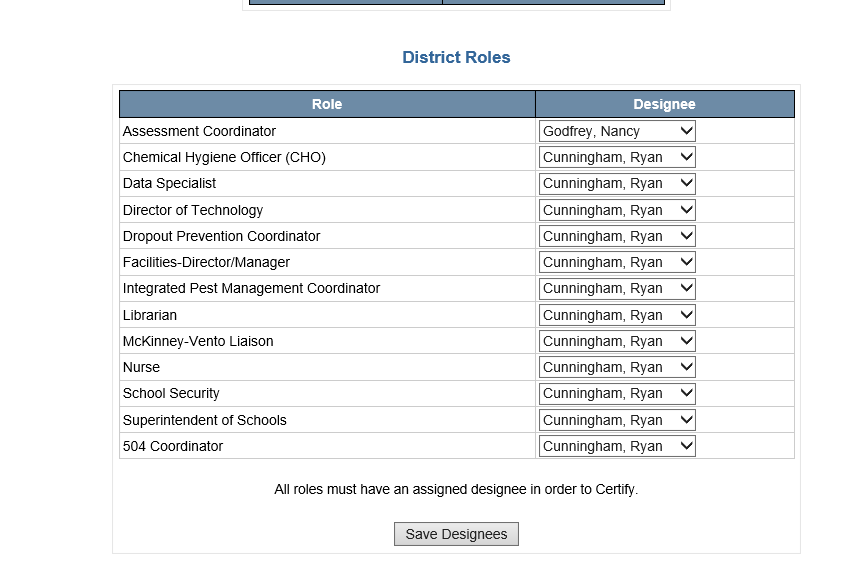
All critical communication regarding the Maine Educational Assessments (MEA) is sent to the individual listed as the District Assessment Coordinator (DAC) within District Roles in NEO.  Please verify the correct individual is listed in NEO. A current listing of DACs can be accessed by downloading the most current version here. (Attached excel of DACs as of today 9/10/18).

If the DAC listed is not accurate, please update DAC information within the District Roles Section on the certification page of the Staff Module of NEO.

  1. Log into NEO
  2. Go to Staff Module
  3. Click on certButton2 and choose Certification Report
  4. Scroll down to the bottom of the screen to the District Roles section
  5. Under Designee – click on the dropdown arrow and select the correct person that will be the District Assessment Coordinator (DAC). The person must already have another position for your district in NEO staff or the person will not show on the list.
    district roles.png
  6. Once the person is selected, Click the Save Designees button to save the information to the database.
  7. If you have issues with the NEO staff module, please send an email describing the problem to MEDMS.Helpdesk@maine.gov
  8. Any other questions can be directed to Eric Buckhalter, Management Analyst eric.buckhalter@maine.gov or 207-624-6770.