Special thanks to Jobs for Maine’s Graduates for sharing the following article with the Maine DOE for publication.
For the second year in a row, Melissa Coppa’s Jobs for Maine’s Graduates students at Nokomis Regional High School in Newport held a “Sleep-in-a-Box” event so that students could raise funds for homelessness awareness in their communities. Continue reading “Nokomis holds “box out” for homeless”→
Staff information was due to be completed by Sept. 30, and the Oct. 1 students were all due to be in the system and uploaded to the Department by Oct. 15.
The Maine Department of Education’s English as a Second Language/Bilingual Programs, in collaboration with Project Reach at the University of Maine, provided training on Maine’s English Language Development (ELD) standards last week to 60 teachers and administrators from 31 SAUs, including Caribou, Ellsworth, Berwick and all points between.
Maine law requires all SAUs to implement a system of intervention by this fall, and we’re bringing you the tools to do it. Through RTI, teachers can identify academic and behavioral problems, ensuring success for all students.
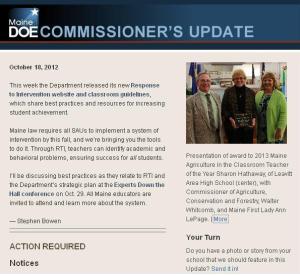
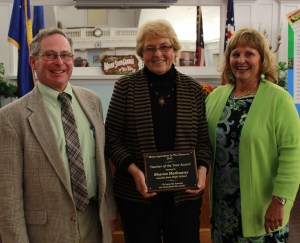
Presentation of award to 2013 Maine Agriculture in the Classroom Teacher of the Year Sharon Hathaway, of Leavitt Area High School (center), with Commissioner of Agriculture, Conservation and Forestry, Walter Whitcomb, and Maine First Lady Ann LePage.
Maine Agriculture in the Classroom celebrated its annual meeting and dinner on Oct. 17 at the State Grange in Augusta with presentations by Maine First Lady Ann LePage and Commissioner of Agriculture, Conservation and Forestry, Walter Whitcomb.
A number of grant recipients presented their projects at the meeting, including this year’s Maine Agriculture in the Classroom Teacher of the Year Sharon Hathaway, of Leavitt Area High School in Turner, who initiated a course to promote student understanding of agriculture and natural resources, incorporating current and historical connections to their community.
The Maine DOE recently revamped its RTI website, offering guidance tools to help schools and teachers identify students at risk for poor learning outcomes, monitor student progress, identify students with disabilities, provide evidence-based interventions and adjust the intensity of those interventions depending on a student’s responsiveness.
K-12 staff from around the state are invited to discuss best practices surrounding response to intervention (RTI), standards-based learning and learner-centered instruction at the Experts Down the Hall Conference on Oct. 29 at the Augusta Civic Center.

 Maine DOE Newsroom