2018-2019 Maine School Immunization Report Due December 31, 2018

Maine law (20A M.R.S.A. 6358, Chapters 126 & 216) requires students enrolled in grades K-12 to be immunized against diphtheria, tetanus, pertussis, measles, mumps, rubella, polio and varicella (chicken pox). Additionally, all students enrolled in grades 7-12 must be immunized against meningococcal meningitis. Under this law, students are required to have either vaccine administration records, a physician note or laboratory evidence to prove immunity, a physician note indicating the student is medically exempt, or a religious or philosophical objection note from a parent/guardian for each of the required vaccines listed above.

In accordance with this law, each year, the Maine Department of Health and Human Services (DHHS) Maine Immunization Program, in conjunction with the Maine Department of Education, sends out the Maine School Age Immunization Assessment Survey to collect immunization information on all students enrolled in Maine public and private schools. The data from this survey is used to measure compliance with this law and also to assess the level of immunization coverage throughout the State of Maine. The survey can be completed online using Survey Monkey through the following web link: https://www.surveymonkey.com/r/school2018me

Who must report and what is reported:

  • All schools with students enrolled in these grades (K, 7th, 12th) MUST report. If you fail to report by the deadline the superintendent of your school will be notified.
      • Kindergarten – reporting on all required school age immunizations (DTaP, Polio, MMR, Varicella)
      • Seventh grade– Tdap and meningococcal conjugate vaccine (MCV4) ONLY – 1 dose of each is required
      • Twelfth grade – MCV4 ONLY – 1 or 2 doses required based on age the first dose was given

Missing immunizations will require follow up. All students must either have an immunization record or exemption on file for each required vaccine. Superintendents will be notified of any non-compliance.

To complete the survey, you will need the number of students enrolled (full or part-time) for grades K, 7th, and 12th. For each required vaccine, you will need the number of students vaccinated, the number of students with either medical, religious, or philosophical exemptions, and the number of students missing records (non-compliant). A pdf copy of the survey is available here:

Complete the survey online
The deadline for completing the survey is December 31, 2018, after which the survey will be closed. This is extended from the usual December 15 deadline.

For additional information or assistance, contact Jessica Shiminski from DHHS at 207-287-3746 or 1-800-867-4775 or email: jessica.shiminski@maine.gov.

Resource to Help Prevent Adverse Childhood Experiences

Adverse childhood experiences—commonly known as ACEs—affect children and families across all communities. ACEs can impact kids’ health and well-being, and they can have long-term effects on adults’ health and wellness. They can even have consequences that impact entire families, communities, and our whole society. Thankfully, ACEs are preventable.

The U.S. Department of Health and Human Cervices, Center for Disease Control has provided an new online training tool, Preventing Adverse Childhood Experiences.

This training will help you understand, recognize, and prevent ACEs. You’ll learn about risk and protective factors, outcomes associated with ACEs, and evidence-based strategies you can use to reduce or eliminate the impact of ACEs and stop them from occurring in the first place.

Get the knowledge and insights you need to help create healthier, happier childhoods for kids today, and bright futures for adults tomorrow.

Training topics include:

  • Adverse Childhood Experiences, Brain Development, and Toxic Stress
  • The ACE Study
  • Prevalence and Consequences of ACEs
  • Risk and Protective Factors for ACEs
  • Essentials for Childhood: Assuring Safe, Stable, Nurturing Relationships and Environments

For further information, contact Emily Poland, School Nurse Consultant for the Maine Department of Education at emily.poland@maine.gov.

Maine DOE Update – November 1, 2018

From the Maine Department of Education


Reporting Items

PRIORITY NOTICE: EPS Oct 1 Enrollment/Special Ed (EF-S-05) Reporting Deadline Extended to November 5, 2018

The Maine Department of Education would like to inform all public schools, charter schools, and private schools that receive public funds, that the EPS Oct 1 Enrollment/Special Ed (EF-S-05) Report Certification deadline that was originally scheduled for October 31, 2018 has been extended to the end of day on Monday, November 5, 2018. | More

Reminder: Annual Audit Requirements

Pursuant to Title 20-A MRSA 6051 §4, statements of assurance and Maine Education Financial System reconciliations are due to the Department by November 1, 2018. Please submit via email to DOE.audit@maine.gov . Any adjustments identified by these reconciliations should be uploaded to the Maine Education Financial System in NEO by November 30, 2018. | More

| Visit the DC&R Reporting Calendar |


News & Updates

Administrative Letter: Change in English Learner Identification and Exit Criteria

Under the Every Student Succeeds Act, states are required to develop uniform statewide policies for identifying and exiting English learners (ELs). In light of this requirement, the Maine Department of Education has sought to review and refine its policies in order to best meet the needs of its students. Over the past year and a half, the Department has collected stakeholder input from around the state regarding its definition of English language proficiency. Additionally, the Department has conducted extensive analysis of assessment data to determine the level of English language proficiency needed in order to succeed academically on par with non-EL peers. | More

Maine DOE to Recognize Bilingual Students Upon Graduation

During a special announcement at the Maine State House on October 29, 2018, Commissioner Robert G. Hasson, Jr of the Maine Department of Education announced a new opportunity called the Seal of Biliteracy that will be available to qualifying students upon graduation, starting in June of 2019. | More

PRIORITY NOTICE: Withdrawal of Proposed Rule Chapter 115: Credentialing of Education Personnel

In response to preliminary feedback, the Maine Department of Education has decided to withdraw the recently proposed changes to Rule Chapter 115: Credentialing of Education Personnel for further review and refinement. | More

What is Academic Progress? #success4ME

The Academic Progress indicator, is one of four (4) indicators utilized in Maine’s Model of School Supports and is used for grades 3-8. Academic Progress is defined as the comparison of individual student assessment performance scores from one year to the next, aggregated to the school level. | More

More Dispatches | Press Releases | Priority Notices


Professional Development & Training Opportunities

11/6/18 TransACT Training in Machias Cancelled

The TransACT training scheduled for November 6, 2018 in Machias, as described in this DOE newsroom article, has been cancelled due to low registration. Please note that the trainings scheduled for November 5, 2018 in Portland and Bangor are still happening as planned. | More

Visit the Professional Development Calendar |


Latest DOE Career/Project Opportunities

11/6/18 TransACT Training in Machias Cancelled

The TransACT training scheduled for November 6, 2018 in Machias, as described in this DOE newsroom article, has been cancelled due to low registration. Please note that the trainings scheduled for November 5, 2018 in Portland and Bangor are still happening as planned.

If you would like further information about TransACT Parent Notices, especially as it pertains to their use as a parent and family engagement tool, please contact April Perkins, Director of ESOL/Bilingual Programs & Title III at (207)624-6627 or april.perkins@maine.gov


What is Academic Progress? #success4ME

academic progress ela (blue)
Academic Progress – English Language Arts (ELA)

The Academic Progress indicator, is one of four (4) indicators utilized in Maine’s Model of School Supports and is used for grades 3-8. Academic Progress is defined as the comparison of individual student assessment performance scores from one year to the next, aggregated to the school level.

At the state, district, school, and classroom levels, Maine educators are committed to creating a culture of support and encouragement for families with children experiencing challenges. In the past, Maine has focused solely on achievement and in particular, achievement gaps between student groups. Academic achievement records the number of students on average, who are performing at state expectations. Although this is beneficial to track, when conducting a more detailed analysis of data, academic achievement does not take into account the individual growth of a student.

academic progress math (blue)
Academic Progress – Mathematics

What does this look like in Maine?

Each year students in grades three through eight are administered statewide assessments in both English language arts (ELA) and mathematics. Student performance on the state assessment is scored on a scale of 1 to 4.  A performance level of 3 or above indicates that a student is meeting grade-level expectations. Every student grades 3 -8 who has been in the same school for two consecutive years will receive a progress score by looking at his or her assessment results from the previous year in comparison to the current year. Individual students are assigned scores of 0 to 450 according to academic achievement scores from one year to the next. A score of 100 indicates expected growth. An individual score of less than 100 indicates that a student has not yet made adequate growth. The progress scores of all eligible students are added together and then divided by the number of eligible students.  The resulting number is the school indicator scores for ELA and math.

The above is repeated to determine a progress indicator score for mathematics and a progress indicator score for ELA.

How will academic progress data be presented on the school report card?

The school as a whole will receive a performance measure related to the percentage of students who are making academic progress. Academic progress rates will never be reported at the student level.

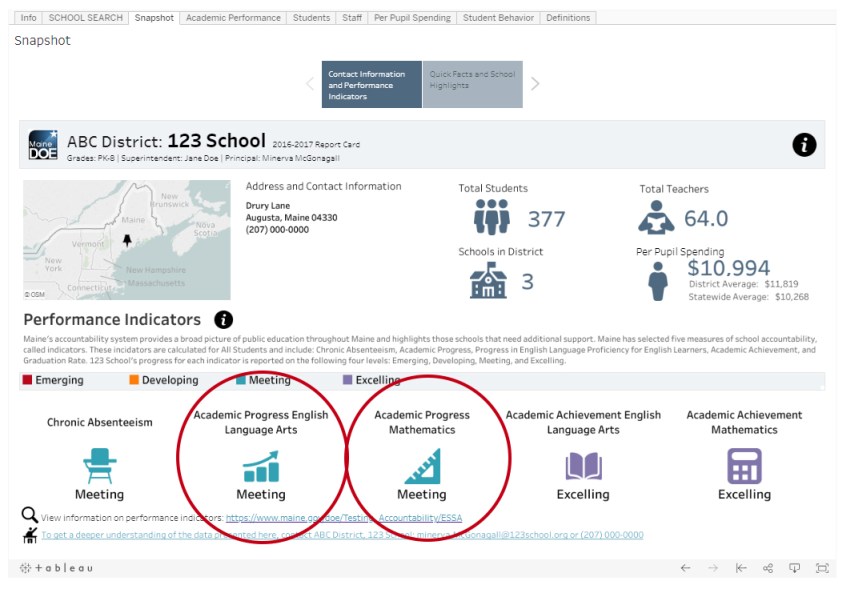
The school level descriptors for academic progress are as follows:

Academic Progress – English Language Arts (ELA)

Emerging Developing Meeting Excelling
A score of less than 100 for all eligible student groups A score of at least 100 for at least one eligible student group A score of at least 100 for all eligible student groups A score of at least 150 for all eligible student groups

Academic Progress – Mathematics

Emerging Developing Meeting Excelling
A score of less than 100 for all eligible student groups A score of at least 100 for at least one eligible student group A score of at least 100 for all eligible student groups A score of at least 150 for all eligible student groups

Eligible student groups include: Asian, Black, Hispanic/Latino, Two or More Races, White, Students with Disabilities, Economically Disadvantaged, Migrant students, and English Learners.

Academic progress data will be presented on the initial page of the report card in the following way:

reportcard1_AP

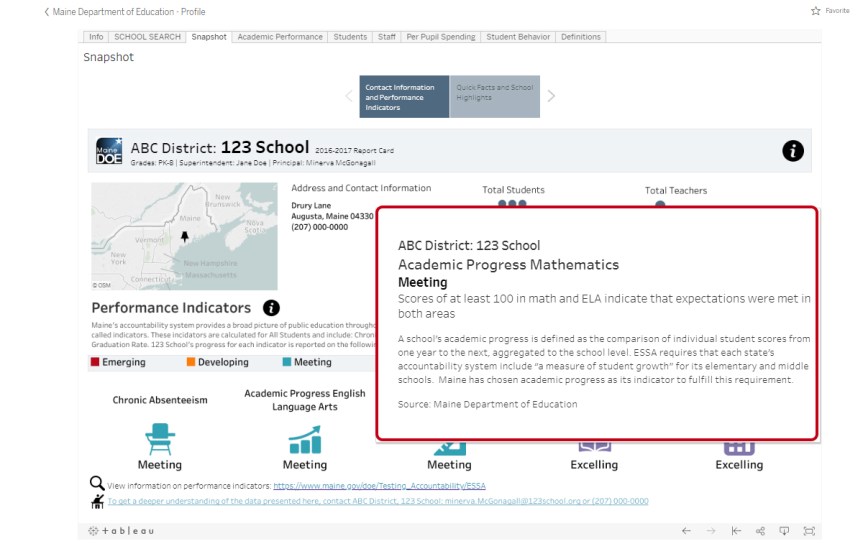
To assist parents and community members in understanding academic progress, the report card provides “hover over” features that explain the definition of the performance level.

reportcard2_AP

Further questions can be directed to Janette Kirk, Acting Director, Office of Learning Systems at janette.kirk@maine.gov

PRIORITY NOTICE: Withdrawal of Proposed Rule Chapter 115: Credentialing of Education Personnel

In response to preliminary feedback, the Maine Department of Education has decided to withdraw the recently proposed changes to Rule Chapter 115: Credentialing of Education Personnel for further review and refinement.

Rule Chapter 115 is a complex rule, and any change to its provisions has multiple implications. It is in the best interest of students and educators that we allow for further consideration, dialog, and input.

Further proposed changes to Rule Chapter 115 will be announced via the Maine DOE Newsroom.

Reminder: Annual Audit Requirements

Iinitial report to the Commissioner is due November 1st:

Pursuant to Title 20-A MRSA 6051 §4, statements of assurance and Maine Education Financial System reconciliations are due to the Department by November 1, 2018. Please submit via email to DOE.audit@maine.gov . Any adjustments identified by these reconciliations should be uploaded to the Maine Education Financial System in NEO by November 30, 2018.

Annual Audit Reports Due December 30th:

  • Annual audit reports are due within six months after the end of the audit period (e.g., reports for the fiscal year ending June 30th are due on or before December 30th).
    • Per statute, it is the school board’s responsibility to submit the annual audit document unless it is included in the engagement letter that the audit firm will submit the audit to the Department on behalf of the school board.
  • Per statute, the auditor is required to review the audit with the school board.
    • Municipal school units are required to submit either a combined annual audit or a school department audit and a municipal audit to the Department. The municipal annual report (a.k.a. town report) cannot be accepted in lieu of the complete municipal annual audit.
  • Per statute, Maine DOE must receive a SEFA (Schedule of Expenditure of Federal Awards), which includes federal award expenditures for all reporting entities, regardless if a Single Audit (formerly A-133 audit) is not required to be conducted. The SEFA provides information needed by Maine DOE to conduct sub-recipient monitoring as required by US DOE and is due at the time of the annual audit.
    • In municipal school units where a combined audit is not conducted, Maine DOE is to receive two audits: an audit with a SEFA for the school department and a city/town including a SEFA.
  • If a management letter is prepared by the auditor, a copy must be submitted to MDOE with the annual audit as this letter provides MDOE with information needed to conduct sub-recipient monitoring as required by US DOE.
  • Please submit all annual audit documents, reports, information requests, questions and other audit correspondence via email to DOE.Audit@Maine.gov or via the direct link provided on the Fiscal Review and Compliance webpage.

Extensions and Subsidy Payments

It is the Superintendent’s responsibility to request audit deadline extensions and/or exceptions, regardless if the request is for the municipal audit and/or school department audit. The forms are available on the Fiscal Review and Compliance webpage.

  • Extensions will expire no less than 30 days from the date the extension was submitted.
  • Extension requests will be considered until June 30th (six months after due date); extensions will not be valid after June 30th and all municipalities and school administrative units with overdue audits that have not submitted an extension request before May 30th will be place on the hold subsidy list and subsidy will be withheld in July.
  • Submitting the required documents will be the only way to be removed from the Hold Subsidy List.

For more information, review statutory requirements in Title 20-A MRSA 6051 §4 or email to DOE.Audit@Maine.gov.

PRIORITY NOTICE: EPS Oct 1 Enrollment/Special Ed (EF-S-05) Reporting Deadline Extended to November 5, 2018

The Maine Department of Education would like to inform all public schools, charter schools, and private schools that receive public funds, that the EPS Oct 1 Enrollment/Special Ed (EF-S-05) Report Certification deadline that was originally scheduled for October 31, 2018 has been extended to the end of day on Monday, November 5, 2018.

Ensure the data has been reviewed and is correct prior to certification.  Please do not certify your data if it is not correct. Contact the DOE Data Helpdesk at 624-6896 or medms.helpdesk@maine.gov if you have questions about data issues that need to be resolved.

If you have made corrections or changes in your Student Information System and have uploaded those changes to Synergy; you must also request a “refresh” of the EPS Oct 1 Enrollment/Special Ed (EF-S-05) Report in NEO in order for those changes to be reflected in that report.  This is not done automatically and requires the “Uncertify/Refresh Data” button to be pushed in the report in NEO.

If you’re not sure how to refresh the EPS Oct 1 Enrollment/Special Ed (EF-S-05) report, see the instructions entitled “Where is the Refresh Button” located on the Data Reporting Instructions webpage.

Further questions should be directed toward the DOE Data Helpdesk at 624-6896 or medms.helpdesk@maine.gov.

MEDIA RELEASE: Maine DOE to Recognize Bilingual Students Upon Graduation

Maine Department of Education makes Seal of Biliteracy available to all qualifying students

During a special announcement at the Maine State House on October 29, 2018, Commissioner Robert G. Hasson, Jr of the Maine Department of Education announced a new opportunity called the Seal of Biliteracy that will be available to qualifying students upon graduation, starting in June of 2019.

The Seal of Biliteracy is an award given at graduation in recognition of students who have studied and attained a high degree of skill in English and at least one other language by high school graduation.  For the first time, Maine will be offering all students an opportunity to graduate with the Seal in June 2019. The Seal seeks to encourage students to pursue biliteracy, recognizes the positive cognitive and academic benefits of being bilingual, and can serve as evidence of academic and workplace readiness.

There are two pathways to earn the Seal of Biliteracy. To qualify, all students must maintain a high degree of skill in their first language.  Students, whose first language is English, can earn the Seal by attaining a high degree of skill in another language.  Students whose first language is not English, can earn the Seal by attaining a high degree of skill in English.

In previous years, the Seal of Biliteracy has been offered to students in Portland Public Schools thanks to the work of Carlos Gomez, Director of Language Development. This Department of Education initiative will provide the opportunity to every student in Maine.  The Seal of Biliteracy started in California in 2008 and is now offered by 32 states and the District of Columbia.

Earning the Seal of Biliteracy comes with tangible academic and workplace benefits for students. Those students who choose to pursue post-secondary education can show the Seal of Biliteracy designation to select universities to earn college credit.  For those students who choose to enter the workforce after graduation, the Seal brings potential employers attention to the additional work ready skills they possess.

For more information please visit the Maine Department of Education website.


###


Administrative Letter: Change in English Learner Identification and Exit Criteria

Administrative Letter: 20
Policy Code: IHBEA
To: Public School Administrators
From: Robert G. Hasson, Jr., Ed. D. Commissioner
Date:  October 29, 2018
Subject: Change in English Learner Identification and Exit Criteria

Under the Every Student Succeeds Act, states are required to develop uniform statewide policies for identifying and exiting English learners (ELs). In light of this requirement, the Maine Department of Education has sought to review and refine its policies in order to best meet the needs of its students. Over the past year and a half, the Department has collected stakeholder input from around the state regarding its definition of English language proficiency. Additionally, the Department has conducted extensive analysis of assessment data to determine the level of English language proficiency needed in order to succeed academically on par with non-EL peers.

Following the completion of the review and analysis, Maine’s definition of English language proficiency is now a composite proficiency level (CPL) of 4.5, as measured by WIDA ACCESS for ELLs and WIDA Screener Online. All ELs who attain a composite proficiency level of 4.5 or higher on ACCESS for ELLs will be exited from English learner status. Students who achieved a CPL of 4.5-4.9 in 2017 or 2018 will be retroactively exited as of November 1, 2018. Districts will not need to take any action to exit these students, as the Department will do so automatically.

However, districts must take action to exit recently identified students who are no longer eligible for EL services based on the change in identification criteria. Any student who was identified as an English learner with a WIDA Screener Online CPL of 4.5 must be removed from EL status. To change a student’s status in the state student data system, the student’s district superintendent must submit a request for change in English learner identification, including the student’s Language Use Survey and WIDA Screener Online score report. All requests for change in English learner identification must be submitted by November 9, 2018 to ensure accuracy of 2018-19 ACCESS testing rosters. Please note that if a student identified as an EL has already been administered ACCESS for ELLs, he/she must achieve a CPL of 4.5 or higher on ACCESS for ELLs in order to exit.

ELs with significant cognitive disabilities who qualify for the state alternate academic assessment are administered Alternate ACCESS for ELLs. Please note that the exit threshold for Alternate ACCESS for ELLs has not changed and remains a CPL of P2.

After an EL demonstrates English language proficiency by attaining a CPL of 4.5 or higher on ACCESS for ELLs, federal and state regulations require that schools monitor the student’s academic progress for two years. If during that two-year period a continued need for English language acquisition services becomes apparent, the student must be provided services. Note that in such cases the student will not be designated as an EL in the state student data system and will not be administered ACCESS for ELs.

This Administrative Letter is a supplemental update to Administrative Letter 11, which provides more extensive information about the requirements for serving ELs, including more details on Maine’s EL identification policy.

To assist districts in communicating with students and families about Maine’s new definition of English language proficiency, the Department has developed a student and family guide, translated into the state’s top ten languages.

If you have questions or would like further information regarding serving ELs, please contact April Perkins, ESOL/Bilingual Programs, at april.perkins@maine.gov, (207)624-6627.