
The Maine Department of Education (DOE) recently received the verified aggregate data from Maine’s Through Year Summative Assessment, and Maine students’ average Rasch Unit (RIT) percentile scores are at and above the most recent MAP Growth National Achievement Norms.
The 2025 achievement norms were established using scores from approximately 13.8 million students nationwide over the course of two years.
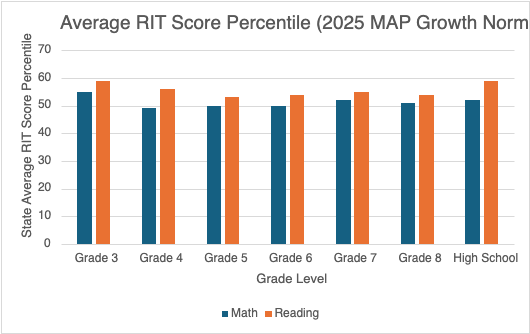
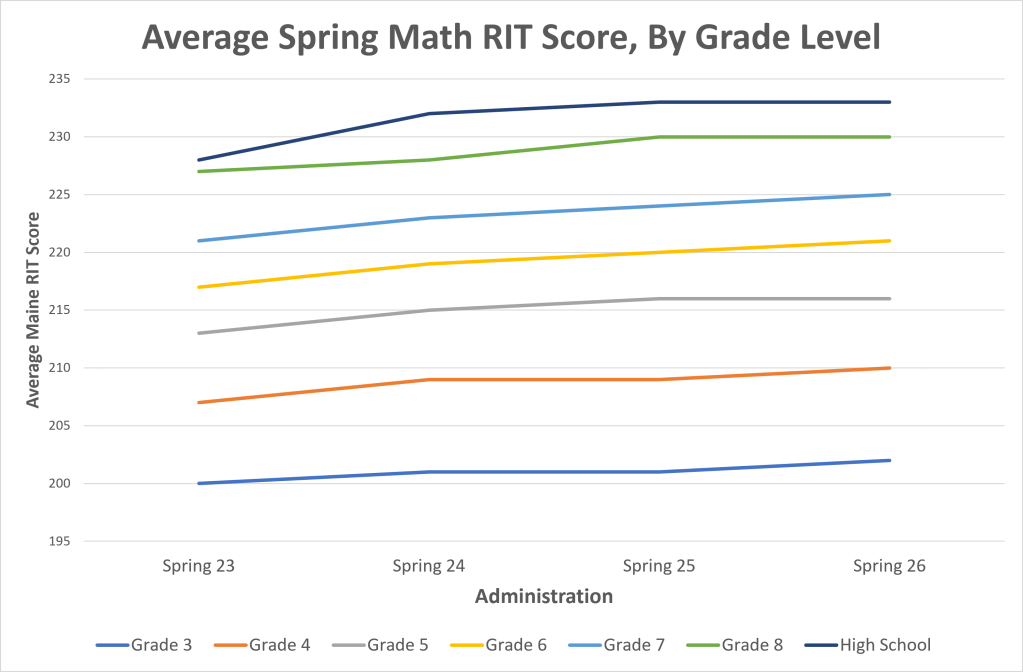
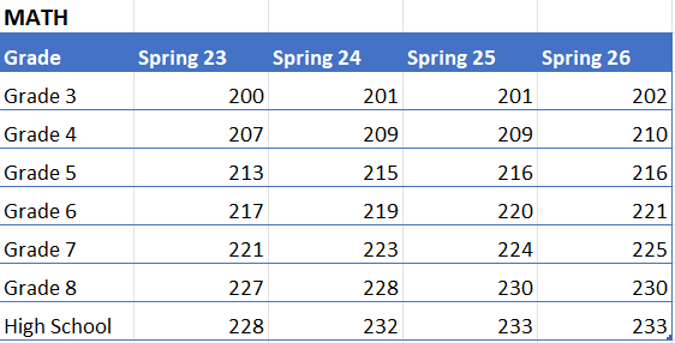
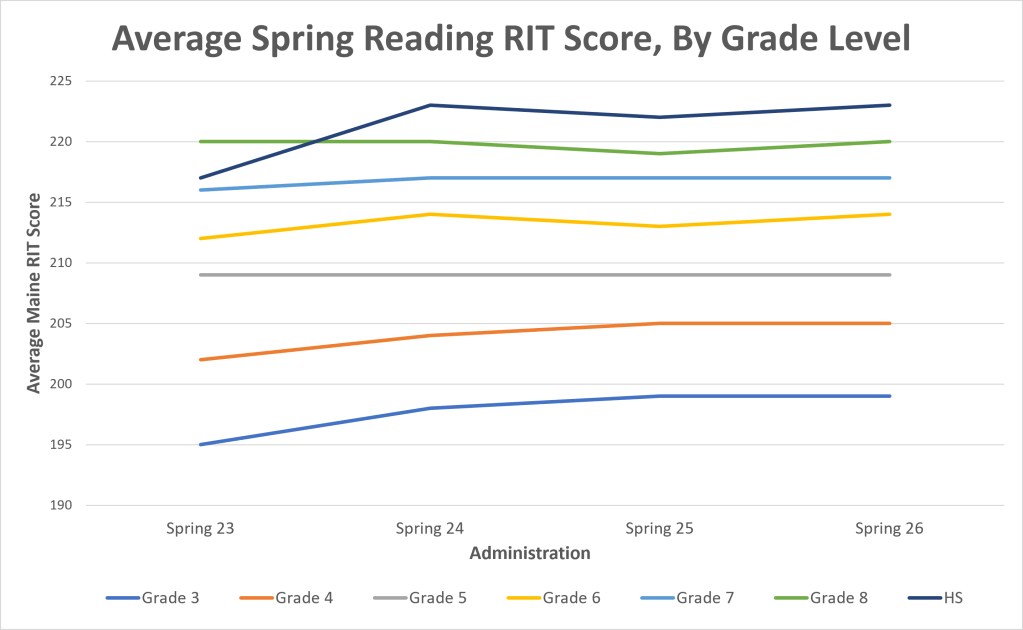
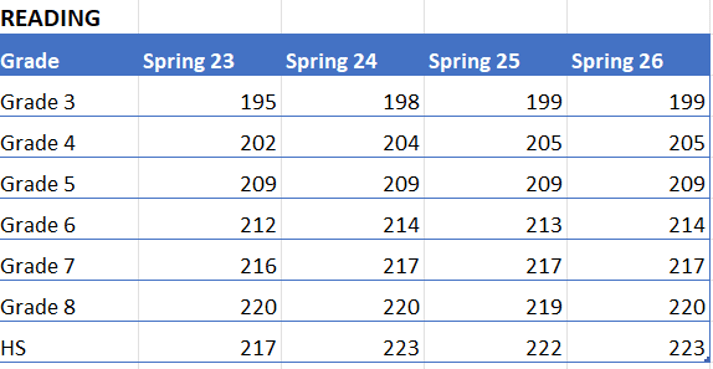
Maine students’ average summative achievement scores on the Through-Year Assessment have also increased every year since 2023, marking a positive trend that contributes to a much broader picture of student success.
MATH:
READING:
The 2024 National Assessment of Educational Progress (NAEP) state score estimates have received a great deal of media coverage over the past 18 months, with multiple new studies and reports continuing to recycle the same data from that testing event every few weeks. Maine’s 2024 NAEP score estimates were disappointing, continuing a slow decline that began in 2011.
While NAEP and the Through-Year Assessment both provide some information about student performance in Math and Reading, the two assessments are very different, and the data they offer are produced in very different ways. NAEP uses a random sample of approximately 1700 4th and 8th grade students per test and creates what the National Center on Education Statistics (NCES) calls state “score estimates”. The score estimates are actually a statistical projection that assumes that all students in the state would perform at a level similar to the sampled students. The Through-Year Assessment, on the other hand, is taken by more than 85,000 Maine students (every student in grades 3-8 and in grade 10). Unlike NAEP, the Through-Year Assessment provides student-level data and school-level scores that can be used by teachers to inform instruction, by parents to better understand how their child is performing, and by the State in determining levels of support through the Every Student Succeeds Act (ESSA).
For further assistance in understanding the differences between the Maine Through Year Assessment and the NAEP, please refer to this resource.
Experts caution against using standardized test scores alone to evaluate the success of schools, policies, or programs, recognizing that these data provide just a glimpse into the much bigger picture. Local assessments, teacher observations, passed course rates, and graduation rates, for example, offer information that builds toward a more complete picture of academic performance.
In our statewide Measure What Matters outreach, we heard from business leaders, educators, parents, and community members that the people of Maine prioritize active, applied learning; project based and “real world” projects; creativity, adaptability, and other durable skills that will prepare our students for success in a dynamic future landscape. We look forward to launching a framework next week based on these findings to shine a light on the exceptional education practices in schools across our state.

