

Back left to right – Ayesha Hall, Bryan Lescord, Julie Smyth, Marcy Whitcomb, Courtney Angelosante, Sue Gallant, Alexandra Cookson, Monique Sullivan, and Tamara Ranger. Front left to right – Shelley Chasse-Johndro, Intern Piper Hallen, Jennifer Belanger, Ann Hanna, and Sarah Nelson (arriving after the photo – Jess Anderson)
On June 17, educators from the Maine Department of Education (DOE) and partners from across Maine gathered for a meeting of the Maine Engagement and Attendance Center (MEAC), a statewide collaboration working to strengthen student engagement and attendance and to address chronic absenteeism in Maine schools.
MEAC Responds to Attendance in Maine
Established by the Maine DOE in 2024, MEAC brings together Maine DOE teams with partners, including Count ME In! and Maine Positive Behavioral Interventions and Supports (PBIS). The collaborative was created in response to the persistent challenge of chronic absenteeism and, through technical assistance and guidance, is designed to help schools move from responding to attendance problems after they occur toward proactive, evidence-based strategies that address the root causes of absenteeism.
MEAC’s strength is the breadth of expertise within the collaborative. Maine DOE teams and partners connect work across attendance, family engagement, multi-tiered systems of support, early learning, school climate, health, data, and community-based supports. Working across these areas helps to align efforts, identify gaps, and provides schools with more coordinated resources and strategies.

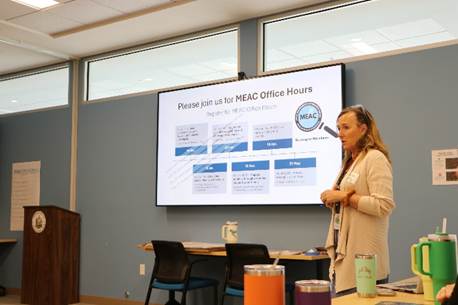
Engagement Specialist Sarah Nelson and Director of Office of School and Student Supports Julie Smyth share exit slip data from last year’s MEAC Office Hours. MTSS Specialist Bryan Lescord; Director of Strategic Partnerships Ayesha Hall; ESEA Federal Programs Director Shelly Chasse-Johndro; and Continuous School Improvement Coordinator Monique Sullivan listen in on the reflection.
In Maine, chronic absenteeism is defined as missing 10 percent or more of enrolled school days for any reason, including excused, unexcused, or disciplinary absences. As the 2026-2027 school year begins, attendance remains an important focus for schools across the state, as nearly 1 in 4 Maine students miss at least 3 weeks of school each year.
The June gathering offered an opportunity to review Maine’s attendance data, reflect on the past year’s work, and begin planning resources and professional learning for the 2026–27 school year.
The data-driven dialogue focused on Maine’s current attendance data, including grade level, county, and student demographics.
The conversation emphasized that attendance challenges can look different depending on students’ age and circumstances.
- For elementary students, where approximately 1 in 5 students are chronically absent, MEAC is focusing on family engagement and removing barriers to attendance.
- At the middle school level, where approximately 1 in 4 students are chronically absent, the focus is on developing a sense of belonging.
- For high school students, where approximately 1 in 3 students are chronically absent, MEAC emphasizes the importance of creating a sense of relevance and helping students see why school matters.
MEAC’s work has focused on weaving together Maine DOE initiatives to coordinate practical tools and opportunities for educators to learn from one another. The Maine DOE MEAC webpage features a growing collection of resources focused on data use, family engagement, school leadership, progress monitoring, and Tier 1 attendance strategies, including the Maine Attendance Toolkit. MEAC recorded a four-part series highlighting aspects of the Attendance Toolkit, which can be accessed on the MEAC webpage. The toolkit serves as a foundational springboard for building strong attendance systems across Maine schools.
Attendance Is Everyone’s Work
MEAC’s work reflects the understanding that regular attendance is connected to students’ ability to fully benefit from the learning opportunities, relationships, and supports their schools provide. The resources highlighted above emphasize that addressing attendance means looking beyond unexcused absences to consider the range of health, family, school climate, and other factors that can affect students’ ability to attend school consistently.
For MEAC, the work continues beyond any single meeting. As Maine schools prepare for another school year, the collaborative continues to develop resources, professional learning, and shared strategies to help more students attend school regularly and remain connected to their learning communities.
For further information and questions about MEAC, please visit the Maine DOE MEAC webpage or reach out to Sarah Nelson, Maine DOE Attendance and Engagement Specialist at Sarah.Nelson@maine.gov.

