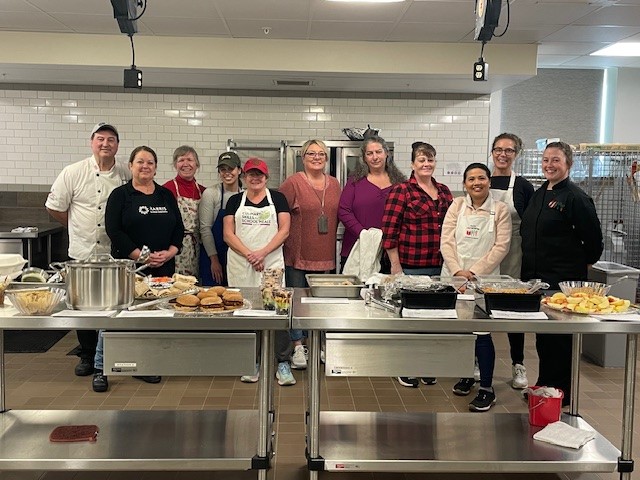
(Pictured: Wayne Napples and Jazmyne Peeples from RSU 75)
On May 7th, three school teams squared off at Central Maine Community College in Auburn for the Maine Department of Education (DOE) 2024 Farm to School Cook-off.
Teams representing RSU 75, Lewiston Public Schools and Auburn Public Schools, and consisting of one school nutrition employee and one student, sharpened their knives and skills for a fun day of cooking. They whipped up vegetarian and meat-based dishes using local tofu donated from Heiwa Tofu in Rockport and local chicken donated from Maine Family Farms in Portland; both of which were challenge ingredients for the competition. The dishes were scored based on presentation, taste, creative use of challenge ingredients, and feasibility to be used in a school kitchen.
The first course was a vegetarian meal highlighting tofu. Brittany Cote and Simon Bolduc from Auburn Public Schools came prepared making a delicious tofu parmesan meal made with Maine Marinara Sauce, which was a fun twist on the popular comfort food. Alicia Smith and her son Jesse Smith from Lewiston Public Schools made a tofu ramen bowl, using meatballs made with tofu and a kick of spice, and whole grain noodles for the pasta. Wayne Napples and Jazmyne Peeples from RSU 75 made a BBQ lime tofu kabob that was vibrantly colored with vegetables that resemble summer is right around the corner.
Alicia Smith and her son Jesse Smith from Lewiston Public Schools
Brittany Cote from Auburn Public Schools
Jesse Smith from Lewiston Public Schools
Wayne Napples and Jazmyne Peeples from RSU 75
Next, came the meat-based meal for round two of the competition. RSU 75 and Lewiston both came prepared making hot honey chicken sandwiches; each with their own unique style; one with a whole grain pretzel bun and the other with a whole grain croissant. Auburn created a chicken shawarma on a toasted whole grain flatbread, marinated chicken that brought aromatic spices across the kitchen and tzatziki sauce.
The RSU 75 team, who was new to the competition this year, ended up walking away with the grand prize, and meat-based meal winner. Lewiston walked away as the vegetarian meal winner. A great day was had by all, and the teams showed great creativity, execution of ingredients, and teamwork throughout the entire competition.
Guest judges were: Carrie Clark, a chef judge from Norimoto Bakery in Portland; Ellen Dore, the School Nutrition Director for RSU 16; and Georgia Knowles this year’s student judge, she is a 7th grader at King Middle School in Portland.
Lewiston Team holding their award as the vegetarian meal winners.
Team RSU 75 won round two for meat-based meal, here they are holding their award.
All of the teams pose for a group picture after the competition.
The Teams pose with the judges after the competition.
The Maine DOE Child Nutrition Team is always looking for new teams to participate in the cook-off! For more information and to learn more about Maine’s Farm & Sea to School Program, visit the Maine DOE website or reach out to the Maine DOE Child Nutrition Team.
(Jannet Harjula and Nancy Duguay serve lunch to St. George Municipal School kindergarten Students.)
Jannet Harjula started her education journey as the owner of a local daycare more than 30 years ago. Like so many educators, Harjula found herself drawn back to education after selling her business. She started substitute teaching at St. George School. It wasn’t long before she transitioned to school nutrition, where she has been since 2014, first as a food service assistant and now as the food service director.
Harjula starts her day bright and early at 6:30 in the morning with her right-hand woman, Food Service Assistant Nancy Duguay. Harjula jokes while carefully layering sausage on a sheet pan in preparation for lunch and breakfast sandwiches. Duguay and her counterpart, Dawn Gauthier, worked for Harjula at her former business. “We come in at 6:30 every morning. Nancy starts breakfast, and I start prepping for lunch. Dawn comes in after breakfast,” says Harjula.
The St. George kitchen sits behind the cafeteria, adjacent to the school gymnasium and music room. In the first hours of the morning, the sun filters through the cafeteria windows, illuminating a mural of animated fruits and vegetables dancing up the walls and a certificate of excellence celebrating Harjula and her team’s perfect score on their recent state inspection.
Duguay serving students cereal during breakfast.
Students start arriving around 7:30, giving Duguay about an hour to set everything up. Breakfast prep starts with washing fruit; today, it’s apples. Duguay runs hot water into an empty silver sink, so clean she can see her reflection as she washes each apple and places them carefully into a giant metal colander.
After filling her cart with orange juice, granola bars, and milk, Duguay heads to the cafeteria to meet the morning’s first students. “We have the best kids,” she beams as she greets each child by name and asks them about their weekend.
After breakfast, everyone pitches in to keep the dishes down and the kitchen clean. Gauthier arrives just as the last breakfast bowls are packed away. As the students start their day, data from their “crew” or homeroom teachers starts pouring into a shared spreadsheet created by St. George Technology Director Paul Meinersmann. “Before Paul, we had to do this all on paper,” said Harjula. “Someone had to bring the information down to us, or we had to go get it.”
With this data, Harjula and her crew know how much each lunch option needs to be made. “Every day, we [also] offer students a sandwich or salad, so they don’t just have to choose the hot lunch option,” she says.
At this point, the kitchen is a perfectly choreographed routine. Harjula starts putting together the breakfast sandwiches she made for today’s lunch in shiny tinfoil. To her right, Gauthier masterfully constructs sandwiches, layering ingredients while Duguay chops vegetables and portions each chef’s salads. As the women move around each other with the grace of familiarity, it is so much like watching a dance that one almost misses all that is being done. They make nearly 200 meals, keep every counter spotless, and never forget to wear the right gloves or wash their hands.
Between prepping for lunch, Harjula lays out the ins and outs of her job. “You have to keep things balanced,” she says about planning nutritious meals. “For some of these kids, this is the most nutritious food they eat. A lot of them aren’t getting healthy foods at home.” Harjula goes on to explain how she and Duguay sit down each month to plan meals, brainstorming on how to use the ingredients they already have in stock to build nutritious “colorful” meals.
Maine was one of the first states to provide universal meals to all students. This ensures that every child has access to nutritious food without stigma and so that they are prepared to learn and thrive in school.
It is thanks to school nutrition workers like Harjula and Duguay that Maine has the second most nutritious school meals in the country, according to ProCare Therapy. However, when it comes to the student’s preferences nutrition isn’t always their priority. “Pizza days are our most popular,” Harjula jokes with Duguay, who laughs and says, “We always have to make extra.” Most students don’t even know that Harjula makes sure their donuts are whole grain or that their pizza sauce is full of healthy vegetables.
From 10:30 – 1:00, Harjula and Duguay serve lunch to students from Pre-K all the way up to eighth grade. No matter their age, the students light up when they talk to Harjula. “The kids respect her, and you see that when they’re in line or putting their trays away, saying thank you all the time,” said Ashley Gill, St. George’s athletic director, as well as physical education and health teacher. “She’s very good to me and to a lot of people [at St. George].” St George students are just as excited to sing Harjula’s praises. “Jannet’s really sweet and funny,” said fifth grader Elena. Her friend Lilly chimes in, commenting, “she makes great food.”
In between each lunch, Harjula resets the dishes, Duguay cleans the cafeteria, and Gauthier takes care of the trash, recycling, and compost. In the blink of an eye, four sets of lunches have been served, every table and chair wiped down and stacked away, and, of course, Harjula’s kitchen is still spotless.
School Lunch Hero Day is organized by The School Nutrition Association.
With every student fed, Harjula can sit down for the first time in eight hours. The three nutrition workers sit together in the cafeteria to finish up the day’s paperwork. “We have to do a production report, which is what this is,” Duguay gestures to a sheet in front of her. “So we have to keep track of everything that we serve, how much we make, how much we have left, and how much we actually serve.” The team has been putting data into the system Meinersmann created throughout the day. Now, Duguay will use that data for her production report which Gauthier will use to create a daily summary report. Around 2:30, the day is done for everyone except Gauthier, who is the middle school softball coach, though Harjula and Duguay will often stay to finish work like meal prepping or large food orders. Talking about a day in the life of a food service director, Harjula keeps it concise: “It’s long, but we’ve got such great kids.”
May 3th, 2024 is School Lunch Hero Day! Make sure to celebrate the School Nutrition Workers in your school for the hard work they put in to ensure that every Maine student has nutritious, reliable meals at school. Click here for ideas on how you can show your appreciation!
State employees, including the Maine Department of Education (DOE), recently participated in the annual Take ME to Work Day by hosting their children and/or children they know for the day at the Maine Capitol Complex and at state-operated locations across Maine.
The day offered a chance for state employees to give their kids the opportunity to learn more about what they do for the people of Maine and see first-hand the inner workings and importance of our government.
Take ME to Work Day started with tours of the Maine State House, followed by a visit from Governor Janet Mills in the Hall of Flags. She greeted the kids and employees and delivered a message about the meaningful and fulfilling work of state government and its many employees.
Maine DOE’s Laura Cyr providing a tour.
Maine DOE’s Laura Cyr providing a tour.
Students in the Capitol dome.
Governor Mills addressing students and employees in the Hall of Flags.
While the state had many other activities for kids participating in Take ME to Work Day, the Maine DOE once again took the opportunity to provide a jam-packed day full of fun experiences and learning opportunities for Maine DOE employees and their kids.
Following the State House tour, a mock legislative hearing was held with the help of Laura Cyr, a member of Maine DOE’s Legislative Team. Cyr explained to students about the Legislative Committee on Education and Cultural Affairs and the types of bills they oversee. Then, students volunteered to pretend to be senators and representatives on the committee and hear about a mock bill: An Act to Improve Education by Lowering the Driving Age (to 10 years old). After introducing the hypothetical bill, each student got the chance to speak about the bill, either in favor, against, or neither for nor against the bill.
Laura Cyr leading students in a mock legislative hearing.
Laura Cyr leading students in a mock legislative hearing.
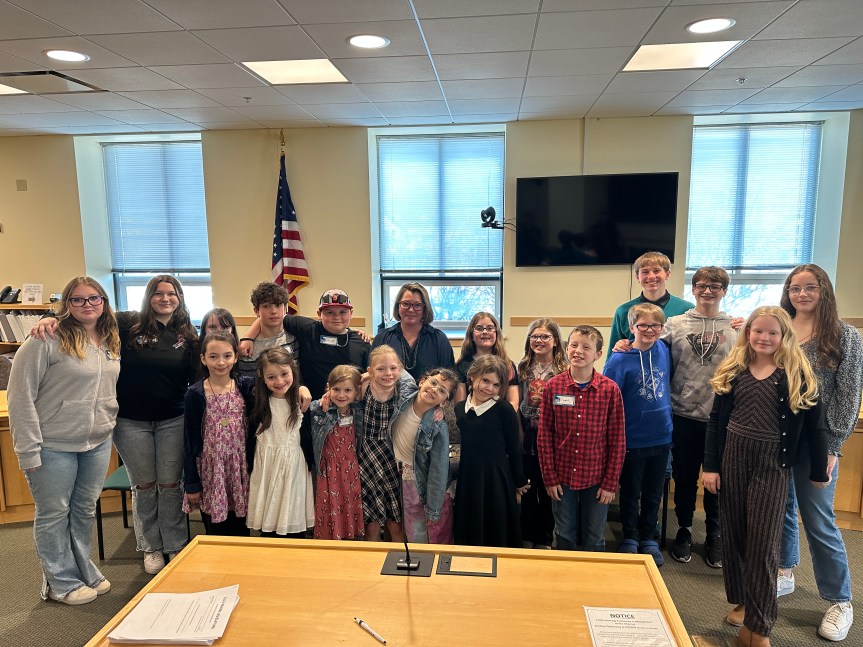
Students in the Education and Cultural Affairs Committee room at Maine’s Capitol Complex.
Students brought up many important points, including that it would be convenient to be able to drive themselves to school if they missed the bus, that anyone young or old who has a driver’s license should have to take driving classes, and that kids are probably not ready to be driving at age ten. They also discussed the potential parking kerfuffle that would take place at school if, suddenly, everyone younger than ten years old was driving to school. Ultimately, the kids decided that the bill would need many changes if it were to proceed.
Following the mock hearing, students and adults got the opportunity to ride a Thomas Electric Bus from C.W. Cressy & Son. On the ride, which took everyone across Augusta’s Memorial Bridge to more State of Maine office buildings, students enjoyed the quiet bus ride and talked about the fact that there is no traditional engine when you open the hood. The group also learned that charging an electric bus takes about 3 hours and will ride for 150 miles on that charge.
posing in front of the Thomas Electric Bus.
Riding on the Thomas Electric Bus.
Over across the bridge, the group’s destination was a visit with Maine DOE’s Child Nutrition Team to see the culinary classroom and participate in a make-your-own-pizza lunch. Led by Chef Michele Bisbee and her daughter, students learned about the different learning opportunities afforded to school nutrition staff across Maine, both in-person and remote, through the culinary classroom. They also washed up and made their own pizzas. While the group waited for lunch to cook, Chef Bisbee quizzed them on the different food groups and discussed the intricacies of serving nutritional food in Maine schools. Bisbee ended the discussion by asking kids to thank the school nutrition staff at their school next week when school is back in session.
Chef Bisbee helping students with a make-your-own-pizza lunch.
Chef Bisbee helping students with a make-your-own-pizza lunch.
After lunch, the group rode the electric bus back to the Capitol Complex and joined the Maine DOE Learning Through Technology Team’s Jon Graham to learn about and have hands-on fun with computer devices as part of Maine DOE’s Maine Teaches Computer Science (CS) initiative.
Following a brief overview and history of the Maine Learning Through Technology Initiative (MLTI), Graham showed kids all of the older and newer MLTI devices and showcased some of the computer science tools available to Maine schools through Maine DOE-administered grants and opportunities, such as Sphero BOLTs, Sphero Indi Cars, and a Dash robot. These tools allowed students to play around with and try computer coding in real time. Maine leads the nation in offering universal computer science education.
The day was full of fun opportunities, laughs, learning, new friends, and possibly some budding future Maine State employees.
Maine’s Take ME to Work Day occurs annually in the spring; for more information about the program, visit Maine’s Bureau of Human Resources Page.
(Pictured: Student Caleb Pratt representing RSU 54 in last year’s cook-off)
The Maine Department of Education (DOE) Child Nutrition Program is kicking off its 9th annual Maine Farm to School Cook-off in May. The cook-off aims to showcase the culinary skills of school nutrition professionals and students while promoting locally grown products in school meals. Teams representing schools across Maine, consisting of one student and one school nutrition professional, will compete to be the 2024 Farm to School Cook-off Champion! This year, one competition will be held at Central Maine Community College on May 7, 2024, from 11 am-2 pm. The competition will be live-streamed for those who would like to watch remotely and support the school teams.
Teams of school nutrition professionals and students representing Auburn, Lewiston, and RSU 75 will participate in this year’s event. Each team will prepare two lunch meals (one vegetarian and one non-vegetarian) within a specific time frame using at least three ingredients that are grown, raised, caught, or manufactured in the State of Maine and meet National School Breakfast and Lunch Program requirements as well as one USDA food. Local chicken breast donated by Maine Family Farms in Portland, ME, and local tofu from Heiwa Tofu in Rockport, ME, will be used as “challenge” ingredients in the competition. All recipes will later be shared in a Maine farm-to-school cookbook.
A panel of judges for the cook-off will include a student/student representative, school nutrition director, and professional chef. The dishes will be scored based on presentation, taste, creative use of the challenge ingredients, and feasibility for use in a school kitchen. Other criteria will include teamwork, food safety, and time management.
Members of the media are welcome to attend the cook-off but need to confirm prior to the day of the event. For more information and to confirm coverage, contact Marcus Mrowka at marcus.mrowka@maine.gov.
School Nutrition professionals have a lot on their plate, between preparing delicious food, adhering to strict nutrition standards, navigating student food allergies, and offering service with a smile. We hope schools across Maine will celebrate School Lunch Hero Day on May 3 to celebrate their hard work and commitment.
This day, the first Friday in May has been celebrated annually since 2013 and was designated by The School Nutrition Association and Jarrett Krosoczka, author of the “Lunch Lady” graphic novel series. School Lunch Hero Day allows parents, students, school staff, and communities to thank those who provide healthy meals to Maine students daily.
School nutrition employees must balance many roles and follow numerous federal, state, and local regulations to ensure safe and healthy meals are available in schools. School Lunch Hero Day allows the community to thank these hardworking heroes for their dedication to fueling our students’ success.
Here are some fun activities students could do to celebrate their School Lunch Hero:
Last month, the Maine Department of Education (DOE) Child Nutrition team hosted ten School Food Service staff members in their Culinary Classroom in Augusta for vegan/vegetarian culinary training.
Five teams of two prepared eleven dishes from lentil sloppy joes, Asian salad, sweet potato & bean burrito, and tortilla soup to cookie dough hummus. After preparing the dishes, they enjoyed the fruits of their labor and discussed each dish.
Comments included the ease of preparation, how ingredients could be used in other dishes, how appealing the look and flavor of several dishes were, and how some were a good way to use commodity products.
The Maine DOE Child Nutrition team operates the Culinary Classroom to provide culinary and food safety training to School Nutrition Professionals across the entire state of Maine. Along with in-person training, the team also records training videos and recipes that are accessible as needed via their website.
(Pictured: members of the nutrition team at RSU 89.)
Four school districts in Alaska, Iowa, Maine, and Ohio received awards for their trailblazing and innovative efforts to improve the nutritional quality of meals for their students. This announcement was made in front of nearly 850 school nutrition professionals at the School Nutrition Association Legislative Action Conference during National School Breakfast Week recently.
Regional School Unit 89, Maine’s own Katahdin Schools received the “Innovation in Preparation of School Meals” award for incorporating more scratch cooking into menu items, such as homemade sub rolls using their oatmeal bread recipe, homemade croutons, pickles, and roasted chickpeas.
RSU 89 has also partnered with a local farm, Keep Ridge Farm in Benedicta to source produce like squash, onion, eggs, carrots, and kale. They host monthly taste tests allowing the student body to determine what the next new menu item will be.
“At our annual Thanksgiving meal, we featured Keep Ridge Farm roasted squash, local farmer Steve Crouse’s potatoes that we boiled and mashed, and turkey from USDA Foods in our homemade gravy and homemade stuffing,” said Denise Tapley Proctor, food service director at RSU 89. “The meal was well received by the community, and the reactions of our kids make us love the change in direction our school is making to more scratch cooking.”
The three school districts that received awards are the first winners of the Healthy Meals Incentives Recognition Awards, jointly created by the U.S. Department of Agriculture and Action for Healthy Kids as part of USDA’s Healthy Meals Incentives Initiative, also known as HMI. These awards celebrate school districts that embrace opportunities to take their school meals to the next level. HMI is one of several ways that the Biden-Harris Administration is supporting schools to provide kids with nutritious meals that support their health and well-being.
Here are more pictures of the RSU 89 nutrition team preparing mashed potatoes from Keep Ridge Farm, homemade oatmeal rolls, USDA hamburger made into hamade gravy, USDA corn, and homemade apple strawberry crisp:
Windsor Elementary School educators Kristel Anuszewski and Jana Diket recently collaborated with Maine Sea Grant, Chef Andrew Wilkinson from North Coast Seafoods, and other Maine businesses to bring seaweed to the classroom and cafeteria.
Since the fall of 2023, both educators have been engaged in professional learning and other efforts to bring the sea inland to their community. Why seaweed? Seaweed farming and harvesting is considered to be “regenerative” and “sustainable” as it requires zero input for growth, no chemicals, fertilizers, or pesticides are needed–only providing benefits for the ecosystem and human health. It plays an important role in combating climate change by dampening wave energy and protecting coastal shorelines, absorbing carbon dioxide from the atmosphere, reducing the effects of ocean acidification by raising the PH, and supplying oxygen to ocean waters. Seaweed is also locally sourced, delicious, and one of the most nutrient-dense foods on the planet.
Seaweed farming and wild harvest also help diversify Maine’s marine economy. It’s a great opportunity and source of income for fishermen and others during the winter season, enabling year-round employment opportunities.
On January 16th, 2024, Windsor Elementary students explored and identified a variety of seaweeds that grow in the Gulf of Maine, and engaged in pressing and other art-related activities. These activities were followed by culinary arts on January 18th with Chef Andrew and his delicious “Seaweed-ish Meat(less)balls,” containing sugar kelp from Maine’s waters. Students also explored a variety of products like seaweed salad and kelp burgers, donated by Atlantic Sea Farms (Biddeford, Maine), as well as a variety of “wild” harvested seaweed products like kelp crunch, seaweed tea, seasonings, generously donated by Maine Coast Sea Vegetables (Hancock, Maine).
Soon after trying the meatballs with Chef Andrew in the morning, Isaiah, an initially skeptical 6th-grader, raised his hand and shared “I didn’t think I would like them, but I really do; may I change my choice for lunch?!”
Chef Andrew shares the story of his recipe–an innovation for seaweed–the Seaweed-ish Meatball with students in the Windsor Learning Commons.
Chef Andrew prepares his meatball recipe.
A seaweed identification station
Keri Kaczor arrives with seaweed buckets at WES.
Keri Kaczor and Jaclyn (Jax) Robidoux from Maine Sea Grant instruct grade 7 and 8 students on how to press seaweed
Although this event primarily engaged 6th, 7th, and 8th graders, all students were offered this option for lunch on January 18th. Windsor School Chefs Missy Parsons and Kara Bailey served up Seaweed-ish Meatballs with pasta and marinara. Chef Ron Adams of Maine Farm and Sea Cooperative, and Chef Mike Flynn, the Director of Student Nutrition Services, Somerville, Maine, stopped in with some Maine marinara with tomatoes sourced from Maine growers– delicious! There was also a special meal option, a kelp burger, served to faculty.
Principal Heather Wilson (left) and Kristel Anuszewski (right) enjoy Chef’s Seaweed-ish Meatball recipe.
Missy Parsons (WES school head cook), Chef Andrew Wilkinson (guest seaweed chef for the day at WES), Kristel Anuszewski (WES teacher and event organizer), Keri Kaczor (Maine Sea Grant, UMO), Chef Mike Flynn (RSU#12 Director of Student Nutrition Services), and Kara Bailey (WES kitchen assistant)
Kristel Anuszewski (WES Librarian and STEM teacher) and Jana Diket (middle school science and social studies teacher)
Prior to this collaboration, Anuskewski and Diket introduced their students to seaweed curriculum and activities, and kindergarten through 8th grade students all helped decorate the hallway in preparation for the events. Fish and seaweed adorned the walls, fabric hung from the ceiling with silhouettes of sea-life, creating a magical “seaprise” and experience for all. An intertidal ocean mural with seaweed and other creatures was also on display, built by the 7th and 8th grade students.
Diket plans to continue this work by installing a saltwater tank in her classroom, and both teachers plan on taking students on a field trip to the sea in the spring.
Keri Kaczor, Maine Sea Grant, shared, “It is wonderful to see educators and food service staff at Windsor Elementary collaborate to provide high-quality, hands-on science, art, and nutritional experiences for their students. It’s also a gift to have Maine’s seaweed industry and Chef Andrew generously commit their time, expertise, and products to this effort.”
This story was submitted by Windsor Elementary School through our Maine DOE Good News Submission form. To submit a story, please fill out the form here.
As a result of Public Law 2023, Chapter 457 which enacts 20-A MRSA §6664, the Maine Department of Education is proposing a new rule to guide the administration of the School Meal Equipment and Program Improvement Fund.
As required by law, a period of public comment opens January 17 through February 16, 2024. Written comments may be submitted to DOE Rulemaking Liaison Laura Cyr, State House Station #23, Augusta, Maine 04333; 207-446-8791 or laura.cyr@maine.gov until 5:00 pm February 12. For documentation purposes, written comments are preferred.
Timeline for Rulemaking for Rule Chapter 52 – New Rule – Routine Technical
(Pictured: part of the lunch spread provided at an MSAD 33 Summer Food Service Program (SFSP) meal site this summer.)
Portland’s Munjoy South playground filled with people as meals were distributed to students through the USDA Summer Food Service Program (SFSP) recently. The Munjoy South playground site, which is one of 12 summer meal sites throughout the city and over 400 across the state, is operated through Portland Public Schools. The site serves 20 to 30 students a day on average and on this particular day, was serving sandwiches, chicken drumsticks, cornbread, fruits, vegetables, milk, and more.
The SFSP is a federally funded and state-administered program that provides free, healthy meals and snacks to children, youth, and adolescents in low-income communities. Local sponsors, like Portland Public Schools, operate the meal program throughout Maine.
At the Munjoy South summer meal site were volunteers from the Maine Celtics and the Locker Project. The Maine Celtics volunteers help run summer day camps Mon-Fri for students and also enjoy playing quick games of soccer and basketball with anyone who wants to join in. Also present was The Locker Project, which helps fight food insecurity in Cumberland County by providing students and families with surplus local produce and other foods, in addition, the Book Fairy Pantry Project was there with a free book stand with ample children’s books for the taking.
Food provided by The Locker Project at the Munjoy South Playground Summer Meal Site
Books provided by the Book Fairy Pantry Project
On this day, also visiting the meal site were representatives from Maine Equal Justice, Good Shepherd Food Bank, the Islamic Food and Nutrition Council, AmeriCorps VISTA, Preble Street, Full Plates Full Potential, and the offices of Governor Mills, Senator Collins, Senator King, and Representative Pingree. These organizations were brought together by Anna Korsen, Full Plates Full Potential, Policy and Program Coordinator to showcase all that Portland Public Schools (PPS) has done to provide food for local youth and to witness the success and joy of so many community partners coming together to benefit the community.
Maine DOE Assistant Director of Child Nutrition Adriane Ackroyd speaking with state leaders at the Munjoy South Playground Meal Site.
State partners gather for a group picture at the Munjoy South Playground Summer Meal Site recently.
Maine has good reason to celebrate all that has been accomplished this summer and recently in the way of providing nutritious food to youth both during the summer and the school year.
Maine is one of the first states to provide meals at no charge to public school students during the school year. Starting with the pandemic-related waiver that allotted funds for schools across the United States to provide free meals for students in the 2021/2022 school year, this past year a new Maine-specific law went into effect that provides funds to Maine schools through its annual budget, specifically to provide school meals to all students, regardless of their family’s income. Maine is one of less than 10 states to continue with free meals for all students beyond the pandemic.
Maine is incredibly proud of its many partnerships between both federal and state-level partners, Maine school nutrition programs, and countless community partners across our state who have worked tirelessly to feed Maine’s youth through school-administered programming all year long.
We want to celebrate school nutrition champions like Dawn Hilton the Director of Food Services for PPS and Jim Hanna, Executive Director, Cumberland County Food Security Council for their ongoing work to organize local partners within their community at sites like the Munjoy South playground. In addition to Hilton, there are 106 other districts across Maine with countless school nutrition champions that partner with organizations within their communities to offer summer meal sites at 400 sites throughout Maine.
Special thanks to Kittery School Department, MSAD 33/27, RSU 54, and Belfast Soup Kitchen for providing pictures from some of their summer meal sites this summer:
Kittery School Department
Kittery School Department
MSAD 33
MSAD 33
MSAD 33
MSAD 33
MSAD 27
RSU 54
Belfast Soup Kitchen Summer Meals site, a partnership with SNAP-Ed.
For Portland’s efforts, Hilton would like to thank her Summer Meal Team for their continued help in fighting food insecurity along with the Maine Celtics, Cumberland County Food Security Council, Full Plates Full Potential, and the Locker Project for their endless support in their work during the summer. It is because of community partnerships like these, that exist in every corner of Maine, Maine DOE can leverage federal programs like Maine’s Summer Food Service Program to direct funding to communities across our state to help fight food insecurity throughout the summer.