The Maine Department of Education’s World Language Specialist, Lavinia Rogers is available to talk with and support districts interested in creating a plan to realize world language programs for all students, especially those districts who may be experiencing a teacher shortage in that area.
More information and resources about world languages can be found on the Maine DOE’s website, or feel free to contact Lavinia directly to request a meeting or ask questions. She is available at lavinia.m.rogers@maine.gov or (207)624-6825
The Maine Department of Education is seeking input to inform the work of leveraging technology to improve student learning. The survey should take no more than 5 minutes to complete. Maine DOE leadership will be reviewing the results as it plans for continued support of technology integration in Maine schools. The survey will remain open until December 21, 2018.
As part of its 2018-19 Assessment Literacy series, the Maine Department of Education will present full-day workshops to continue supporting educators in examining eMPower ELA and math, and MEA science assessment data, connecting that data with locally generated assessment information, and identifying high impact instructional strategies that foster student engagement and achievement of learning standards.
State level assessment provides school systems with a useful lens through which educators can evaluate the effectiveness of curricula and instructional practices. This information can help educators improve programming to increase the number of students meeting expectations for learning standards in English language arts (ELA), mathematics, and science. The availability of released item data and sample state assessment items, coupled with local level assessment information, enables educators to dig more deeply into what instructional practices are benefiting student learning as well as where adjustments could be made to result in greater positive impact.
Join Maine DOE ELA, Math, and Science specialists as they provide professional learning and resources that:
Connect state eMPower and science assessment to instructional practices
Delve into the roles cognitive demand and stamina play in instruction and assessment
Explore protocols for linking state level data analysis with local level data analysis
Participants will select one of 3 content areas in which to focus their learning during the day: English language arts, mathematics or science. Schools are strongly encouraged to register teams of 3 so that they will have representation in each of the 3 featured content areas. An alternate option is for educators to come as a team representing one content area (e.g. science teachers from a middle school). Time will be provided during the day for teams to share their learning across content areas and to collaboratively plan for how to disseminate the day’s content back in their respective schools. Lunch will be provided during each full day session which will run 8:30 am – 3:30 pm. Contact hours will be provided.
Cost is $40 per individual or $100 per 3-person team. Registration requires a credit card.
For further information, please contact Lee Anne Larsen, Acting Deputy Director of the Office of Learning Systems at 207-624-6628 or leeann.larsen@maine.gov.
As a reminder, the Maine Department of Education has scheduled a public hearing on November 15, 2018 as part of the scheduled periodic review of the Maine Learning Results. The Department is seeking public comments regarding the proposed revisions to Rule Chapter 132, revised science and technology and social studies standards.
The public hearing will take place in room 103A of the Burton Cross Building in Augusta. Anyone present may speak at the public hearing, which will be live-streamed. People that wish to speak will be asked to sign in and, preferably, provide two written copies of comments, as well as an electronic copy.
Anyone unable to attend the public hearing may send written comments by 5 pm on December 3, 2018. Written comments may be emailed to sis.doe@maine.gov with the subject “Science Standards Review,” or “Social Studies Standards Review,” or mailed to Maine Department of Education, attn: Beth Lambert, 23 State House Station, Augusta, ME 04333.
Below is a list of relevant links, as well as the hearing information including a link for the live stream:
The Tobacco and Substance Use Prevention and Control Program with the Maine Centers for Disease Control and Prevention (MECDC), in partnership with the Maine Department of Education (Maine DOE), is seeking interest from Maine schools who would like to pilot the social emotional learning (SEL) program, Second Step, funded by a grant through MECDC.
The grant’s larger goal is to provide primary prevention for substance use and is part of Maine’s State Opioid Response plan. The Second Step Curriculum is research-based and available for grades Kindergarten through 8th grade. Many of the skills within the Maine Learning Results for Health Education in elementary school align with goals of Second Step, to nurture skill building and prevent problematic developmental behaviors that are part of the trajectory toward later substance use.
If you are interested in adding Second Step to your school’s curriculum, are already implementing Second Step, or are implementing a SEL curriculum other than Second Step, the MECDC and Maine DOE would like your feedback about your interest and experience.
This brief survey will take approximately 5 minutes. Your input will be used to assess what programs are currently being implemented, where there are opportunities to pilot Second Step in Maine, and what districts are specifically interested in piloting Second Step.
Maine CDC and DOE will select pilot sites based on best fit and evaluate the program’s success, with the goal of expanding the program to more sites in coming years. Thank you in advance for your interest and feedback.
The graduation rate indicator is one of four indicators used in Maine’s Model of School Support. It will be used as an indicator of success for high schools only. Graduation is defined as graduating within four years after entering ninth grade. In Maine, the graduation rate indicator reflects the number of students graduating “on-time”, as well as the graduating students who progressed at a different rate and graduated in either five or six years.
In the past, graduation rate was never utilized when making determinations of schools eligible to receive support. Under Maine’s Model of School Support, the graduation rate for students meeting graduation requirements in four years in addition to the graduation rate of students meeting graduation requirements in five or six years will be utilized.
4 Year Graduation Rate
What does this look like in Maine?
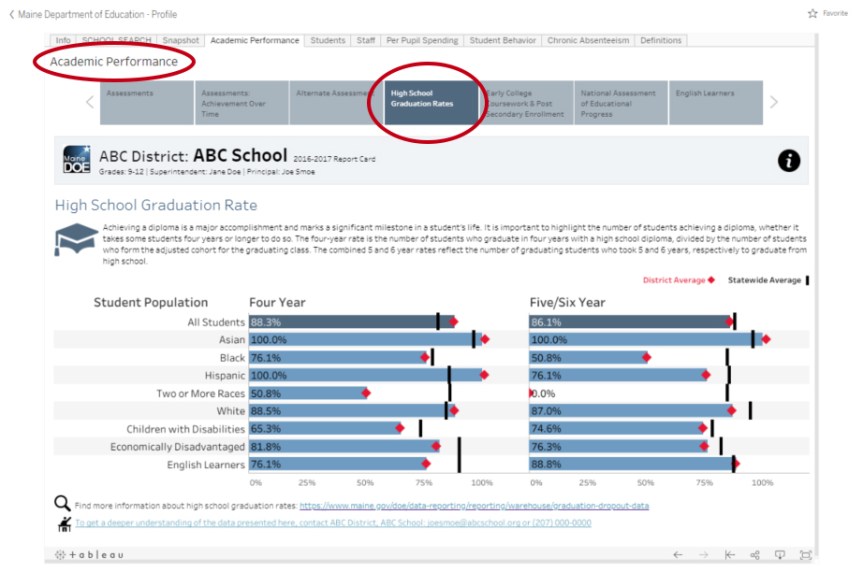
Achieving a diploma is a major accomplishment and marks a significant milestone in a student’s life. It is important to highlight the number of students achieving a diploma, whether it takes some students four years or longer to do so. As it relates to Maine’s Model of School Support, the Graduation Rate indicator is split into two rates of graduation:
5 and 6 Year Graduation Rate
The 4-year rate is the number of students who graduate in four years with a high school diploma, divided by the number of students who form the adjusted cohort for the graduating class.
The 5 and 6 year rates reflect the number of graduating students who took 5 and 6 years, respectively to graduate from high school.
How will graduation rate data be presented on the school report card?
The school as a whole will receive a performance measure related to individual student groups meeting the annual graduation target.
Graduation Performance Descriptors:
Graduation – 4 Year
Emerging
Developing
Meeting
Excelling
No eligible student group made their annual graduation target
At least one eligible student group made their annual graduation target
All eligible student groups made their annual graduation target
All eligible student groups have met or exceeded the long-term goal of 90%
Graduation – Combined 5/6 Year
Emerging
Developing
Meeting
Excelling
No eligible student group made their annual graduation target
At least one eligible student group made their annual graduation target
All eligible student groups made their annual graduation target
All eligible student groups have met or exceeded the long-term goal of 92%
Eligible student groups include: Asian, Black, Hispanic/Latino, Two or More Races, White, Students with Disabilities, Economically Disadvantaged, Migrant Students, and English Learners.
Goals for four year adjusted cohort graduation rate:
Subgroup
Baseline (Data and Year)
Long-term Goal (Data and Year) 2030
All students
86.83% 2016
90% or maintain current 2016, whichever is greater, graduation percentages by 2030
Economically disadvantaged students
77.77% 2016
Children with disabilities
72.19% 2016
English learners
78.14% 2016
Race – Hispanic/Latino
83.46% 2016
Race – American Indian
84.91% 2016
Race – Asian
90.68 % 2016
Race – Black or African American
76.77% 2016
Race – Native Hawaiian or Other Pacific Islander
88.24% 2016
Race – White
87.29% 2016
The measurements of progress are based on increases in the percentage of all students in Maine who make progress toward the long-term goals on a three-year basis. Long-term goals were developed to reduce the percentage of non-graduating students to result in student groups all meeting the goal of 90% by 2030. The calculation process, for example, is as follows:
Subgroup: All Students
Step 1: 2016 Graduation Rate = 86.83%
Step 2: 90% (goal) – 86.83% (baseline) = 3.17%
Step 3: Differential for each 3-year step is 3.17 divided by 5 = .61%
Step 4: Add to the baseline .61 % and add the .61% to each subsequent step to reach the goal of 90% by 2030.
Goals for extended- year cohort graduation rate
Subgroup
Baseline (Data and Year)
Long-term Goal (Data and Year) 2030
All students
88.61% 2016
92% or maintain current 2016, whichever is greater, graduation percentages by 2030
Economically disadvantaged students
80.82% 2016
Children with disabilities
77.27% 2016
English learners
86.12% 2016
Asian
94.27% 2016
American Indian
83.49% 2016
Black
83.47% 2016
Hispanic
84.13% 2016
Native Hawaiian
93.33% 2016
White
88.84% 2016
Multiple Races
86.62% 2016
Graduation rate will be presented on the initial page of the report card in the following way:
For further information please contact Janette Kirk, Acting Director, Office of Learning Systems at Janette.Kirk@maine.gov.
Maine educators are invited to participate in a professional learning workshop that supports the integration of technology across multiple content areas with a focus on STEAM (Science, Technology, Engineering, Art, and Math) as well as computer science, coding, and computational thinking. By using arts and craft techniques to teach circuits and programming, the workshop will introduce ways to engage learners of diverse backgrounds and interests in designing and building their own technologies and getting excited about STEAM!
During the workshop, educators will:
Engage in activities that can be used in classrooms with students who are learning STEAM, coding, and computational thinking concepts
Explore techniques that blend craft and code: students can use skills they have (crafting) to learn new skills (coding), offering new pathways to coding for students who find traditional pathways to learning code less accessible
Learn how to develop integrated learning opportunities, where the technology is used in service of the learning (instead of as the focus of the learning).
Understand how to create and foster a sense of wonder (instead of fear) when students try something new and somewhat challenging
The workshop will be led by a team from Chibitronics that has created Love to Code, an electronics and coding toolkit that gets students building circuits and coding in an art-friendly, hands-on way. Students will learn to build and program functioning circuitry within the pages of a picture book and then take these skills to design their own paper circuits (sample paper circuit projects). Students can then program a “Chibi Chip” to control their art work, making interactive artwork that comes to life with code!
Love to Code’s innovative features include a:
Picture book format, which teaches complex coding concepts by embedding them in metaphor and story;
Blend of craft and code, which allows learners to use skills they already have (crafting) as they learn new skills (coding).
Learn more about the presenters and see some of their projects, Jie Qi and Natalie Freed.
Event Information:
Date: Saturday, December 1st, 2018
Time: 8:30am – 3:30pm
Location: RiSE Center, University of Maine, Orono
Contact Hours: 8 hours can be earned
Cost: $15 (includes light breakfast, lunch, and Love To Code Kit)
Please bring a laptop or tablet with you to the event. In order to program the Chibi Chips, devices need to have a headphone port available. This might require you to bring an adapter/dongle depending on your device.
Draft Agenda:
8:00am: Registration and light breakfast
8:30am: Welcome, Introductions, and Connections
9:00am: Jie Qi and Natalie Freed– “From Make Believe to Making Tech: Paper Circuits and Programming”
10:00am: Break
10:15am: Learning with the Love to Code Kits
11:45am: Lunch – includes a networking activity
12:45pm: Expectations and goals for afternoon design and creation time
1:15pm: Design and Create: Make what you’ll take back to your school – workshop for colleagues, unit or lesson with students, etc
3:00pm: Wrap up, reflections, connecting forward
For answers to questions or more information, please contact Amanda Nguyen, Digital Learning Specialist for the Maine Department of Education at Amanda.Nguyen@maine.gov.
As a reminder, the Maine Department of Education has scheduled public hearings this week as part of the scheduled periodic review of the Maine Learning Results. The Department is seeking public comments regarding the current English language arts, mathematics, and career and education development standards.
Public hearings for each standard have been scheduled back to back in room 103 of the Burton Cross Building in Augusta. Anyone may speak at the public hearings which will be live-streamed. People wishing to speak will be asked to sign in and it will be helpful, but not mandatory, to provide a written copy of comments.
Below is a list of relevant links, as well as hearing times including live broadcast links for each event:
Hearing information:
November 7, 2018
Location: Cross Office Building, room 103, 111 Sewell Street, Augusta
Time: 6:00 – 8:00pm
Live link: https://zoom.us/j/136003377
Anyone unable to attend the public hearing may send written comments by 5pm on December 1, 2018. Written comments may be emailed to sis.doe@maine.gov with the subject “CED Standards Review,” “Mathematics Standards Review,” or “English Language Arts Standards Review,” or mailed to Maine Department of Education, attn: Beth Lambert, 23 State House Station, Augusta, ME 04333.
For further information about the standards review process contact Beth Lambert at Beth.Lambert@maine.gov.
The Maine Department of Education is excited to announce that Maine’s early care and education community is now able to access to the WIDA Early Years online learning modules. These modules focus on supporting young multilingual children, ages 2.5 to 5.5 years and are available at no cost to teachers and administrators. Multilingual children, commonly referred to as dual language learners, are children who are developing more than one language.
Each self-paced, interactive module provides opportunities for reflection and offers suggestions for applying content to local practice. The following modules are available:
Dual Language Learners and their Families
WIDA Early English Language Development Standards Framework
Dual Language Learners with Disabilities
Scaffolding Language Learning
Promising Practices
A description of each module, frequently asked questions, and instructions for creating a user account and registering for the modules can be found in the documents listed below:
If you are a program leader, administrator, trainer, or coach, we hope you will utilize these modules as a resource to support the professional learning needs of those serving multilingual children. The modules can be used in staff development sessions and/or shared with individual educators or teams of educators, such as professional learning communities.
Contact hours are available upon completion of a module. To receive a contact hours certificate, please download the certificate of completion generated by the WIDA Early Years online system and email it to april.perkins@maine.gov.
Additionally, the Department has purchased a set of WIDA Early Years Promising Practices Implementation Kits to assist districts in refining their programs for young multilingual children. These kits serve as a program self-evaluation tool, highlighting several evidence-based, highly effective strategies for supporting children’s development of multiple languages. Several districts with a significant number of dual language learners will receive these kits. A district that does not receive its own kit may request to borrow one from the Maine Department of Education.
WIDA Early Years resources have been provided to Maine educators through Title III, CDS, Head Start and public pre-k funds.
If you have any questions about these resources, or to request to borrow a WIDA Early Years Promising Practices Implementation Kit, please contact Maine DOE Director of ESOL/Bilingual Programs & Title III April Perkins at april.perkins@maine.gov or (207)624-6627.
This notice is one of four priority notices being sent to district and school administrators on 10/24/18 regarding proposed major substantive rules that have been filed with the Secretary of the State of Maine on this day (Rule Chapters: 101, 115, 122 and 132). Please share this notice with all interested parties.
As part of the scheduled periodic review of the Maine Learning Results, the Maine Department of Education is seeking public comments regarding proposed revisions to the social studies and science and technology standards found in Rule Chapter 132 Learning Results: Parameters for Essential Instruction. Please note that the Department of Education is only seeking comments on the Science and Technology Standards and Social Studies Standards sections of Rule Chapter 132 at this time.
The standards review process for the science and technology and social studies standards began in 2017 with a public comment period and a public hearing on the current science and technology and social studies standards. After the public comment period, steering committees were convened who were charged with reviewing all submitted comments and with developing blueprints for the revision of the state standards in their assigned content area. Once the blueprints were created, writing teams, consisting of pk-12 teachers who represent Maine’s cultural and geographical diversity, assembled to draft the standards revisions. Now, as part of this review process, the Maine Department of Education has submitted the revisions as part of a proposed rule change to Chapter 132.
Find the details for proposed changes for Rule Chapter 132 on the Maine DOE Proposed Rule & Rule Changes webpage (proposed rules are listed in order by rule number).
Public Hearing Information for Rule Chapter 132:
November 15th from 1-4pm
room 103 at the Cross Building, 111 Sewell Street, Augusta
Anyone may speak at the public hearing which will be live-streamed (A link to the livestream will be available prior to the public hearing). People wishing to speak will be the asked to sign in and, preferably, provide two written copies of comments, as well as an electronic copy. Anyone unable to attend the public hearing may send written comments
Comment Period Deadline: 5 pm on December 3rd, 2018
Written comments may be sent to Standards Review at sis.doe@maine.gov, or mailed to Beth Lambert, 23 SHS Station, Augusta, ME 04333.