
This week, we’ve launched an expanded and growing web page where we’ll continue to post details about our efforts to secure NCLB flexibility. Soon, that page will also have details about how you can have your say in the process.

This week, we’ve launched an expanded and growing web page where we’ll continue to post details about our efforts to secure NCLB flexibility. Soon, that page will also have details about how you can have your say in the process.

Advantage 2014 is the Auburn schools’ initiative to roll out iPads to kindergarteners and, ultimately, all city students in the early grades. The Auburn plan, however, involves more than simply equipping the city’s youngest students with tablet devices.
It’s a plan to make those devices an integral part of student learning: to use the adaptive power of iPads to boost basic literacy and numeracy skills, to use any range of iPad apps to enhance students’ problem-solving and critical-thinking skills, to provide students with a way to take control of much of their learning at a young age.
The Auburn school department has a well thought-out plan for deploying iPads, training teachers to use them effectively, and measuring the initiative’s success. And as this week is making clear, many will be watching Auburn’s journey every step of the way.
Please note: There will be no Commissioner’s Update on Nov. 24, Thanksgiving. The next Update will be published Dec. 1.
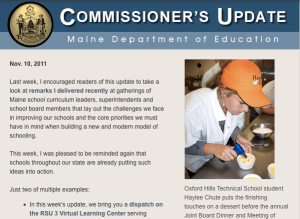
This week, I was pleased to be reminded again that schools throughout our state are already putting such ideas into action.
Just two of multiple examples:
It’s just further proof that as more of our schools look to move to the next level, they’ll have a growing number of examples to learn from right here in Maine.
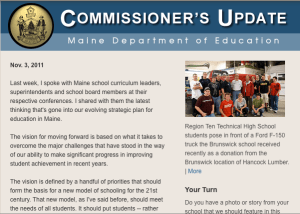
The vision for moving forward is based on what it takes to overcome the major challenges that have stood in the way of our ability to make significant progress in improving student achievement in recent years.
The vision is defined by a handful of priorities that should form the basis for a new model of schooling for the 21st century. That new model, as I’ve said before, should meet the needs of all students. It should put students — rather than administrative convenience — at the center of all structures, from bus schedules to where and how students learn.
Take a look at the remarks I delivered last week.
The vision and the plan are still evolving. Please use the comments feature in our Newsroom to participate in the discussion, or use the Contact Us link to send us your thoughts directly.
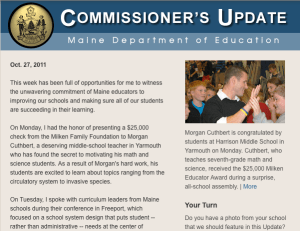
On Monday, I had the honor of presenting a $25,000 check from the Milken Family Foundation to Morgan Cuthbert, a deserving middle-school teacher in Yarmouth who has found the secret to motivating his math and science students. As a result of Morgan’s hard work, his students are excited to learn about topics ranging from the circulatory system to invasive species.
On Tuesday, I spoke with curriculum leaders from Maine schools during their conference in Freeport, which focused on a school system design that puts student — rather than administrative — needs at the center of everything we do.
And today and tomorrow, I plan to spend some time at the fall conference of the Maine School Management Association, whose members plan to focus on standards-based learning, closer integration of career and technical education with all other academics, and better preparation and more constructive evaluations for our educators — all in support of improved student learning.

Staff members at the Maine DOE worked with colleagues at the Maine Department of Health and Human Services and with partners in higher education to craft a plan that sets consistent standards of quality for our current patchwork of early learning programs and offers the programs incentives to subscribe to those high standards. The plan also proposes improvements that will make it easier for families to make informed early childhood care and education decisions, and proposes significant investments in the resources available to train Maine’s workforce of early childhood educators.
If we’re fortunate enough to receive Race to the Top funding, the benefits will be widespread and longlasting. The funding will help us add to the solid foundation for early learning we already have in Maine.
And the results are something the professionals in our public schools will notice. The high-needs children who enter kindergarten with a solid educational foundation will enter our state’s schools ready to succeed.
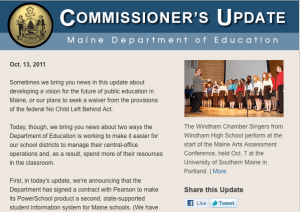
Today, though, we bring you news about two ways the Department of Education is working to make it easier for our school districts to manage their central-office operations and, as a result, spend more of their resources where they should be spent — in the classroom.
First, in today’s update, we’re announcing that the Department has signed a contract with Pearson to make its PowerSchool product a second, state-supported student information system for Maine schools. (We have already been supporting district implementation of Infinite Campus.) We’re also offering a reminder about Transfinder — a software program the Department offers to school districts at no charge to help them plan more efficient school bus routes that result in savings.
Both announcements are part of the Department of Education’s efforts to be more of a resource to our school districts — all in support of the teaching and learning at the core of our mission.

The discussion at Rockland’s Strand Theatre was a productive one. Our educators spoke of ambitious plans to make learning an engaging experience for our students by connecting them with resources and experiences that interest them — whether they’re within the school building, at the local career and technical education center, at a nearby community college or at a university campus.

For nearly 10 years, that federal law has trapped Maine’s schools in a system that emphasizes test preparation at the expense of genuine learning, test results at the expense of more honest measures of students’ academic growth, and instruction in math and reading at the expense of the broader curriculum our students need to develop the skills colleges and employers will demand.

Announcing Mrs. Margeson as the next Maine Teacher of the Year is just one more reminder of the paramount importance of quality teachers to successful student outcomes. It sounds like a no-brainer, but we need to do more to set high expectations so that all Maine students have an Alana Margeson in their classroom every year in every class.
I encourage you to check out Gov. LePage’s weekly message on Saturday in which he will speak about the role of teachers and about our plans for supporting teachers and other educators in improving student achievement.

