Materials from Presentation About ESSA & Report Cards

The Maine Department of Education held a presentation on Monday, December 10 about the details of Maine’s Model of School Support under the Every Student Succeeds Act (ESSA) which includes the release of the new, user-friendly, public Report Cards in early January. Below is a link to the PowerPoint Presentation, in addition to all of the handouts from the presentation.

Further questions about Maine’s ESSA Plan, Maine’s Model of School Support, and the Report Cards should be directed to Acting Director of Learning Systems, Janette Kirk Janette.Kirk@maine.gov or ESEA Federal Programs & School Turnaround Director Chelsey Fortin-Trimble Chelsey.A.Fortin@maine.gov.

What Is Progress in English Language Proficiency? #success4ME

Maine defines English language proficiency (ELP) as sufficient skill in English necessary to meaningfully access the curriculum. As part of Maine’s Model of School Support, part of Maine’s rollout of the Every Student Succeeds Act (ESSA), this indicator of school success focuses on English learners and measures the progress they make toward English language proficiency each school year. ESSA requires that each state include an indicator that gauges, “progress in achieving English language proficiency as defined by the State and measured by the assessments within a State-determined timeline for all English learners.”

What does this look like in Maine?

English learners are students who have a primary or home language other than English and are in the process of learning English. Around 3% of Maine’s students are English learners and their schools support them in learning English to succeed academically. They may receive English language support services inside or outside of their regular classes, through programs specifically for English language development, or through a variety of other supports. It usually takes 4-7 years for an English learner to become proficient in English, but this can vary depending on many factors.

Each year, English learners are administered ACCESS for ELLs, an assessment that measures a student’s ability to listen, speak, read, and write in English. A student’s overall score ranges from 1.0-6.0. In Maine, English language proficiency is defined as level 4.5, so the progress in English language proficiency indicator measures how much progress a student makes each year toward reaching level 4.5. A school’s score for progress in English language proficiency is based on the average percentage made towards the annual target for each student, where there are at least ten (10) English learners.

School level descriptors for progress in ELP is as follows:

Emerging Developing Meeting Excelling
The average progress towards the students’ annual target is less than 65% The average progress towards the students’ annual target is between 65% and 80% The average progress towards the students’ annual target is between 80% and 95% The average progress towards the students’ annual target is greater than 95%

How progress in ELP will be presented on the report card:

ELPreportcard1.png

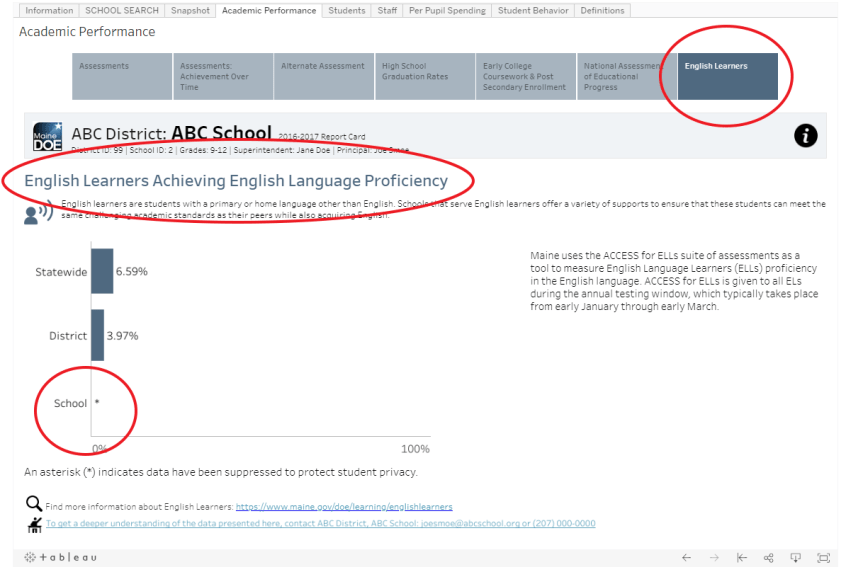
In the example provided below, there are less than 5 students who are English learners and therefore the data has been suppressed (notated by a *).

ELPreportcard2

ELPreportcard3


11/6/18 TransACT Training in Machias Cancelled

The TransACT training scheduled for November 6, 2018 in Machias, as described in this DOE newsroom article, has been cancelled due to low registration. Please note that the trainings scheduled for November 5, 2018 in Portland and Bangor are still happening as planned.

If you would like further information about TransACT Parent Notices, especially as it pertains to their use as a parent and family engagement tool, please contact April Perkins, Director of ESOL/Bilingual Programs & Title III at (207)624-6627 or april.perkins@maine.gov


MEDIA RELEASE: Maine DOE to Recognize Bilingual Students Upon Graduation

Maine Department of Education makes Seal of Biliteracy available to all qualifying students

During a special announcement at the Maine State House on October 29, 2018, Commissioner Robert G. Hasson, Jr of the Maine Department of Education announced a new opportunity called the Seal of Biliteracy that will be available to qualifying students upon graduation, starting in June of 2019.

The Seal of Biliteracy is an award given at graduation in recognition of students who have studied and attained a high degree of skill in English and at least one other language by high school graduation.  For the first time, Maine will be offering all students an opportunity to graduate with the Seal in June 2019. The Seal seeks to encourage students to pursue biliteracy, recognizes the positive cognitive and academic benefits of being bilingual, and can serve as evidence of academic and workplace readiness.

There are two pathways to earn the Seal of Biliteracy. To qualify, all students must maintain a high degree of skill in their first language.  Students, whose first language is English, can earn the Seal by attaining a high degree of skill in another language.  Students whose first language is not English, can earn the Seal by attaining a high degree of skill in English.

In previous years, the Seal of Biliteracy has been offered to students in Portland Public Schools thanks to the work of Carlos Gomez, Director of Language Development. This Department of Education initiative will provide the opportunity to every student in Maine.  The Seal of Biliteracy started in California in 2008 and is now offered by 32 states and the District of Columbia.

Earning the Seal of Biliteracy comes with tangible academic and workplace benefits for students. Those students who choose to pursue post-secondary education can show the Seal of Biliteracy designation to select universities to earn college credit.  For those students who choose to enter the workforce after graduation, the Seal brings potential employers attention to the additional work ready skills they possess.

For more information please visit the Maine Department of Education website.


###


Administrative Letter: Change in English Learner Identification and Exit Criteria

Administrative Letter: 20
Policy Code: IHBEA
To: Public School Administrators
From: Robert G. Hasson, Jr., Ed. D. Commissioner
Date:  October 29, 2018
Subject: Change in English Learner Identification and Exit Criteria

Under the Every Student Succeeds Act, states are required to develop uniform statewide policies for identifying and exiting English learners (ELs). In light of this requirement, the Maine Department of Education has sought to review and refine its policies in order to best meet the needs of its students. Over the past year and a half, the Department has collected stakeholder input from around the state regarding its definition of English language proficiency. Additionally, the Department has conducted extensive analysis of assessment data to determine the level of English language proficiency needed in order to succeed academically on par with non-EL peers.

Following the completion of the review and analysis, Maine’s definition of English language proficiency is now a composite proficiency level (CPL) of 4.5, as measured by WIDA ACCESS for ELLs and WIDA Screener Online. All ELs who attain a composite proficiency level of 4.5 or higher on ACCESS for ELLs will be exited from English learner status. Students who achieved a CPL of 4.5-4.9 in 2017 or 2018 will be retroactively exited as of November 1, 2018. Districts will not need to take any action to exit these students, as the Department will do so automatically.

However, districts must take action to exit recently identified students who are no longer eligible for EL services based on the change in identification criteria. Any student who was identified as an English learner with a WIDA Screener Online CPL of 4.5 must be removed from EL status. To change a student’s status in the state student data system, the student’s district superintendent must submit a request for change in English learner identification, including the student’s Language Use Survey and WIDA Screener Online score report. All requests for change in English learner identification must be submitted by November 9, 2018 to ensure accuracy of 2018-19 ACCESS testing rosters. Please note that if a student identified as an EL has already been administered ACCESS for ELLs, he/she must achieve a CPL of 4.5 or higher on ACCESS for ELLs in order to exit.

ELs with significant cognitive disabilities who qualify for the state alternate academic assessment are administered Alternate ACCESS for ELLs. Please note that the exit threshold for Alternate ACCESS for ELLs has not changed and remains a CPL of P2.

After an EL demonstrates English language proficiency by attaining a CPL of 4.5 or higher on ACCESS for ELLs, federal and state regulations require that schools monitor the student’s academic progress for two years. If during that two-year period a continued need for English language acquisition services becomes apparent, the student must be provided services. Note that in such cases the student will not be designated as an EL in the state student data system and will not be administered ACCESS for ELs.

This Administrative Letter is a supplemental update to Administrative Letter 11, which provides more extensive information about the requirements for serving ELs, including more details on Maine’s EL identification policy.

To assist districts in communicating with students and families about Maine’s new definition of English language proficiency, the Department has developed a student and family guide, translated into the state’s top ten languages.

If you have questions or would like further information regarding serving ELs, please contact April Perkins, ESOL/Bilingual Programs, at april.perkins@maine.gov, (207)624-6627.

WIDA Early Years Online Learning Modules (to Support Multilingual Children) Now Available at No Cost to Teachers and Administrators

The Maine Department of Education is excited to announce that Maine’s early care and education community is now able to access to the WIDA Early Years online learning modules. These modules focus on supporting young multilingual children, ages 2.5 to 5.5 years and are available at no cost to teachers and administrators. Multilingual children, commonly referred to as dual language learners, are children who are developing more than one language.

Each self-paced, interactive module provides opportunities for reflection and offers suggestions for applying content to local practice. The following modules are available:

  • Dual Language Learners and their Families
  • WIDA Early English Language Development Standards Framework
  • Dual Language Learners with Disabilities
  • Scaffolding Language Learning
  • Promising Practices

A description of each module, frequently asked questions, and instructions for creating a user account and registering for the modules can be found in the documents listed below:

Access the modules: WIDA Early Years online modules (visit and create your user account)

If you are a program leader, administrator, trainer, or coach, we hope you will utilize these modules as a resource to support the professional learning needs of those serving multilingual children. The modules can be used in staff development sessions and/or shared with individual educators or teams of educators, such as professional learning communities.

Contact hours are available upon completion of a module. To receive a contact hours certificate, please download the certificate of completion generated by the WIDA Early Years online system and email it to april.perkins@maine.gov.

Additionally, the Department has purchased a set of WIDA Early Years Promising Practices Implementation Kits to assist districts in refining their programs for young multilingual children. These kits serve as a program self-evaluation tool, highlighting several evidence-based, highly effective strategies for supporting children’s development of multiple languages. Several districts with a significant number of dual language learners will receive these kits. A district that does not receive its own kit may request to borrow one from the Maine Department of Education.

WIDA Early Years resources have been provided to Maine educators through Title III, CDS, Head Start and public pre-k funds.

If you have any questions about these resources, or to request to borrow a WIDA Early Years Promising Practices Implementation Kit, please contact Maine DOE Director of ESOL/Bilingual Programs & Title III April Perkins at april.perkins@maine.gov or (207)624-6627.

Training Opportunity: TransACT Parent Notifications – Part of Your Parent and Family Engagement Planning

The Maine Department of Education will be hosting three trainings across the state to assist districts in using TransACT, a resource that supports parent and family engagement. Use of TransACT is provided to Maine districts at no cost, sponsored by the Department’s Office of ESEA Federal Programs.

Description:

Research has shown that when parents and families engage in the education of their children, the children tend to perform better academically. TransACT’s Parent Notices are an important tool to engage parents and families, especially those with limited proficiency in English. This presentation provides:

  • Information about the TransACT Parent Notices purchased for you by the Maine Department of Education;
  • Directions for how to access those Parent Notices in English and other languages;
  • Highlights of the importance of communicating in a language that parents and family members can understand;
  • Information on how to identify important notices that need to be sent, who to send them to, and when they need to be sent; and
  • Information about other resources available from TransACT.

Facilitator Bio:

Dr. David Holbrook earned his Ph.D. in linguistics at the University of the West Indies in the Republic of Trinidad and Tobago and has over 20 years experience working with speakers of other languages. He has lived in five countries and worked in more than 15. He taught ESL at Colorado State University for approximately two years. He spent nearly six years at the Wyoming Department of Education, where he held positions as Federal Programs Division Director, Title I Director, and Title III Director. He trained with the U.S. Department of Education and participated in federal monitoring of Title III in five states. He served nine years with the National Council of State Title III Directors, two years as President. He was designated as their first Honorary Member and now serves as their Executive Director. His current position is as Executive Director, Federal Compliance and State Relationships for TransACT Communications.

Portland
November 5, 2018
8:00am-10:00am
1945 Congress St, Portland, ME 04102
Register

Bangor
November 5, 2018
1:30pm-3:30pm
Elks Lodge
108 Odlin Rd, Bangor, ME 04401
Register

Machias
November 6, 2018
11:00am-1:00pm
University of Maine at Machias
116 Obrien Ave, Machias, ME 04654
Register


Interactive Workshop on the Legal Rights of English Learners

All educators are invited to attend this workshop which will provide participants with information regarding the legal responsibilities of schools serving English learners. Districts receiving federal funds under Title I and/or Title III of the Elementary and Secondary Education (ESEA) are strongly encouraged to participate in this workshop, as it will clarify the core requirements for English learner programming that must be met before supplemental federal funds may be utilized.

The workshop, facilitated by Charo Basterra, Vice President of the Mid-Atlantic Equity Consortium (MAEC), will include practical applications, scenarios, and tools that promote appropriate implementation of practices to address the needs and rights of English learners. MAEC is one of four regional technical assistance centers funded by the United States Department of Education.

Three contact hours will be available upon completion of a feedback survey. Wireless internet and free parking will be available, either on campus or at an off-campus parking lot connected by a free shuttle service. The ESEA Title III office of the Maine Department of Education is sponsoring this event and there is no registration fee.

Date: September 20, 2018

Time: 9:00am-12:00pm

Location:
University of New England
Innovation Hall
716 Stevens Avenue
Portland, ME 04103

Register Now

If you have any questions about this workshop, please contact April Perkins, Director of ESOL/Bilingual Programs, at april.perkins@maine.gov or (207)624-6627.

New Video Available to Assist with English Learner Identification

A new video is now available to help train staff who assist families in enrolling in school. As part of the English learner identification process, the parent/guardian of every student enrolling in an SAU for the first time completes a Language Use Survey.

To support all Maine schools in administering this required form, the Maine Department of Education has produced a short video that explains the purpose of the Language Use Survey, how to access translation/interpretation services, and when further screening is needed to determine whether a student is an English learner.

Below please find a link to the video and the Language Use Survey:

If you have any questions about this video, please contact Maine DOE Director of ESOL/Bilingual Programs & Title III, April Perkins at (207)624-6627 or april.perkins@maine.gov.

Clarification of the Process for Addressing Complaints of Discrimination

The Maine Department of Education would like to clarify the process for addressing complaints of discrimination on the basis of race, color, or national origin. Title VI of the Civil Rights Act of 1964, 42 U.S.C. 2000d et seq. requires that schools communicate with families in their primary language as much as possible regarding academic, extracurricular, and family engagement activities. Schools are also required to provide students who are English learners (ELs) with an effective language support program that:

  • is evidence-based;
  • is regularly evaluated and modified as needed;
  • enables ELs to meaningfully access grade-level curricula while acquiring English;
  • is designed and implemented by qualified, ESOL-endorsed staff;
  • does not unnecessarily separate ELs from their non-EL peers;
  • does not place ELs in a facility below the standard provided to their non-EL peers; and
  • does not provide ELs with educational materials below the standard provided to their non-EL peers.

The US Department of Justice and the US Department of Education have issued guidance for schools and families regarding Title VI of the Civil Rights Act of 1964. Requirements for schools to provide translation/interpretation are described in this notice: Information for Limited English Proficient (LEP) Parents and Guardians and for Schools and School Districts that Communicate with Them. The January 7, 2015 Dear Colleague Letter outlines an EL’s educational rights.

To file a discrimination complaint, contact the United States Department of Education, Office for Civil Rights. A complaint may be submitted online or by downloading the complaint form and submitting it by mail or email. For more information and access to the online form and pdf, go to https://www2.ed.gov/about/offices/list/ocr/complaintintro.html.

If you have questions about this notice, please contact:

April Perkins
Director of ESOL/Bilingual Programs & Title III
23 State House Station
Augusta, ME 04333
Office: (207)624-6627
Cell: (207)441-9043
april.perkins@maine.gov