MEDIA RELEASE: Organizations Needed to Provide Free Meals to Children this Summer

With the assistance of the U.S. Department of Agriculture, Maine public schools have long offered a nutritious breakfast and lunch meal program to thousands of income eligible children in Maine during the school year. To extend this program, Maine Department of Education (DOE) Child Nutrition is seeking organizations who would like to participate in the federally funded Summer Food Service Program (SFSP), which provides children healthy free meals when school is not in session.

“For many children, their school provides the only reliable, nutritious meal that they can count on and we need to make sure those meals are there for Maine children during the summer break,” said Maine Education Commissioner Pender Makin. “By participating in this program, community groups and organizations can have a tremendous impact on the health and well-being of children in their communities. The Department of Education is thankful for those organizations that continue to be a part of this vital summer program and we welcome those joining this year to extend our reach and help feed additional children in Maine.”

In July 2021, 131 sponsors participated in the program, serving meals at 861 sites throughout the state. Although there are sponsors operating in every county in Maine, there is still a long way to go towards feeding all eligible children during the summer. Community partners are working to maximize the number of sponsors utilizing the availability of funds under the SFSP.

SFSP may be offered statewide in areas or at sites where more than 50 percent of the children are eligible for free or reduced meal benefits under the National School Lunch Program or census track data supports the need.  Organizations that provide services in rural communities or near migrant farm workers and tribal populations are urged to participate. Eligible sponsoring organizations include schools, nonprofit residential summer camps, government agencies, and tax-exempt organizations including faith-based organizations.

Maine DOE encourages any eligible organization to consider providing this much-needed service to Maine children. The agency will begin accepting applications to participate in February. Approved sponsors will be reimbursed for eligible meals served to children during the long summer break.

Interested organizations should begin planning now for a successful summer. Potential sponsors are required to receive training from Maine DOE. Training will occur virtually, and DOE staff will assist in the onboarding process. Maine DOE is available to consult by phone and email to answer questions regarding summer meals.

For more information about the Maine DOE’s Summer Food Service Program, contact adriane.ackroyd@maine.gov, call 592-1722 or visit https://www.maine.gov/doe/schools/nutrition/programs/sfsp.

###

Disclosures
Federal

In accordance with Federal civil rights law and U.S. Department of Agriculture (USDA) civil rights regulations and policies, the USDA, its Agencies, offices, and employees, and institutions participating in or administering USDA programs are prohibited from discriminating based on race, color, national origin, sex, disability, age, or reprisal or retaliation for prior civil rights activity in any program or activity conducted or funded by USDA.

Persons with disabilities who require alternative means of communication for program information (e.g. Braille, large print, audiotape, American Sign Language, etc.), should contact the Agency (State or local) where they applied for benefits.  Individuals who are deaf, hard of hearing or have speech disabilities may contact USDA through the Federal Relay Service at (800) 877-8339.  Additionally, program information may be made available in languages other than English.

To file a program complaint of discrimination, complete the USDA Program Discrimination Complaint Form, (AD-3027) found online at: https://www.usda.gov/oascr/how-to-file-a-program-discrimination-complaint, and at any USDA office, or write a letter addressed to USDA and provide in the letter all of the information requested in the form. To request a copy of the complaint form, call (866) 632-9992. Submit your completed form or letter to USDA by:

(1)     mail: U.S. Department of Agriculture
Office of the Assistant Secretary for Civil Rights
1400 Independence Avenue, SW
Washington, D.C. 20250-9410;
(2)      fax: (202) 690-7442; or
(3)      email: program.intake@usda.gov.

This institution is an equal opportunity provider.

State
The Maine Human Rights Act prohibits discrimination because of race, color, sex, sexual orientation, age, physical or mental disability, genetic information, religion, ancestry or national origin.

Complaints of discrimination must be filed at the office of the Maine Human Rights Commission, 51 State House Station, Augusta, Maine 04333-0051. If you wish to file a discrimination complaint electronically, visit the Human Rights Commission website at https://www.maine.gov/mhrc/file/instructions and complete an intake questionnaire. Maine is an equal opportunity provider and employer.

Commissioner of Education Pender Makin Kicks Off Read to ME Challenge at Solon Elementary School

Read to MeMaine Education Commissioner Pender Makin kicked off the state’s Read to ME Challenge at Solon Elementary School today by reading Mel Fell to Mrs. Currie’s second grade class. This is the seventh year that the Maine Department of Education is collaborating with community organizations and schools on this month-long public awareness campaign to promote the importance of literacy for all of Maine’s students, regardless of age.

The Read to ME Challenge encourages adults to read to children for 15 minutes, capture that moment via a photo or a video, and then post it to social media and challenge others to do the same using the hashtag #ReadtoME. The Department of Education will be highlighting Read to ME Challenge events throughout the month, including with Deputy Commissioner Dan Chuhta and Maine Department of Inland Wildlife and Fisheries Commissioner Judy Camuso.

“Read to ME is a simple yet powerful challenge that promotes literacy and a lifelong love of reading for children—and it’s fun,” said Maine Education Commissioner Pender Makin. “When you read aloud to a child it helps them build their own reading and vocabulary skills, exposes them to the world, establishes reading as an enjoyable and valuable activity, strengthens their bonds with trusted adults, and provides a foundation for future success as adults. I encourage everyone to join educators, parents and others across the state by completing the Read to ME challenge and making a difference for Maine children.”

The simple act of reading aloud to a child 15 minutes a day for five years results in 27,375 minutes of language exposure, which can put children on the path to high literacy achievement and helps them build knowledge and vocabulary. Research demonstrates a number of benefits to reading to children, from birth through their childhoods and even teenage years, including modeling reading as an enjoyable lifelong activity, stimulating brain development, reducing stress and anxiety, building knowledge of the world, and helping develop the skills necessary to succeed in their lives.

Schools and community organizations can find a toolkit and resources on the Department of Education website and the Department will be sharing videos, photos, and updates from the challenge all month long on social media. Participants in the challenge are reminded to use the hashtag #ReadtoME and to tag the Maine DOE at @mdoenews on Twitter, @MaineDepartmentofEducation1 on Facebook, and @mainedepted on Instagram.

MEDIA RELEASE: Education Commissioner Pender Makin Helps Fill Staff Shortages at Readfield Elementary School

Maine Education Commissioner Pender Makin helped alleviate some of the pandemic-related staff shortages at Readfield Elementary School today by helping teachers in several classes and working lunch duty.

The heightened transmissibility of Omicron has resulted in reduced staff in schools and increased the strain on educators and school staff across Maine. Readfield Elementary was one of several schools in RSU 38 last week that moved to remote learning due to staff shortages, and schools across the state have been forced to do the same in recent weeks. Makin encouraged Maine residents to become substitutes and volunteer for what schools need to help fill the gap caused by these shortages.

“It was such a joy to be with students and staff at Readfield Elementary today and to be able to lend a helping hand when everyone is stretched so thin,” said Maine Commissioner of Education Pender Makin. “There’s a tremendous need in our schools right now for parents and members of the community to become substitutes and volunteers so that we can keep schools open and serving the needs of Maine children. We as individuals can make a real difference in this moment and I encourage Mainers to help fill the needs in our schools.”

“In all my years working in education, I’ve never had a Commissioner reach out and do what you are doing,” said Readfield Elementary School Principal Jeff Boston upon greeting Makin. “You know your roots!”

Superintendent Jay Charette was also on hand and has been filling in as high school principal in recent weeks to cover shortages. “Our motto is ‘all hands on deck’,” he said in describing their approach to handling shortages.

While at Readfield, Makin helped students with their math skills in Ms. Gordon’s Math Intervention room, worked with 1st grade students in Miss Tarrio’s class to create glossaries for books they are working on, sat with and helped students in the Readiness Skills Program eat their lunches, and also took the opportunity to play paper, rock, scissors with students while on lunch duty.

Photos from the day are available upon request and will be shared on social media by following @MDOENews.

MEDIA RELEASE: Maine Department of Education Announces 2021/2022 Student Cabinet

The Maine Department of Education (DOE) has announced that 21 Maine students have been selected to join its Student Cabinet for the 2021/2022 school year. The newest members will join 14 students serving their 2nd year as Student Cabinet members, along with the Maine State Board of Education’s two Student Representatives who also serve on the Cabinet each year.

This is the third year the Maine DOE has appointed students to a Student Cabinet with the goal of integrating student voice into decision-making on education issues that impact their journey, and those of their peers, through Maine’s education system. In past years students have helped in highlighting mental health needs at school, raised issues of racial equity, and helped brainstorm ways to individualize learning.

“I’m thrilled to welcome our newest members of our Student Cabinet and to welcome back our returning members. Student Cabinet members come from every part of our state and reflect the full diversity of our student population, bringing their ideas, voice and experiences to the table to strengthen our schools,” said Commissioner of Education Pender Makin. “Their perspectives and their power to innovate, problem solve, and bring fresh ideas are critically important to our work at the Department of Education, and I look forward to working with this group of leaders.”

The Student Cabinet convenes virtually each month starting in December to provide regular input to Maine DOE. This year is a special opportunity for Cabinet members to design pilot projects that reflect on the past two school years, and reinvent how schools think about remote and responsive learning as part of the Reinventing Responsive Education Ventures (RREV) initiative.  RREV is the product of a $16.9 million award from U.S. DOE to support systemic investments which will strengthen a culture of innovation in PK-12 education and enhance learning experiences for all students. As part of this year’s program, the students are currently using design thinking processes to help identify and develop solutions to complex problems in education.

Comprised of 37 students in grades 5 – 12 and first year of college from all 16 counties in Maine, Maine DOE Student Cabinet members serve as representatives and advocates for the unique educational challenges in their region, as well as for underrepresented student groups who may face challenges in education.

To learn more about the Maine DOE Student Cabinet visit: The Maine DOE Student Cabinet Webpage.

MEDIA RELEASE: Maine Honors 11 Inspirational School Employees Through RISE Award

The Maine Department of Education (DOE) today announced the state finalists for the Recognizing Inspiring School Employees (RISE) Award.

In two special outdoor gatherings held today at East End Community School (Portland Public Schools) and Marcia Buker Elementary School (RSU 2), Maine Education Commissioner Pender Makin presented Maine’s two State-level Honorees each with certificates and flowers and thanked them for their service. Award nominators and members of their school community were also present to show their gratitude and share inspirational messages about how these individuals have impacted their community.

Created by Congress in 2019 and overseen by the U.S. Department of Education, the RISE Award honors classified employees in the education workforce who provide exemplary service.  The Maine DOE in coordination with the Office of Governor Janet T. Mills has selected 11 finalists from a pool of over eighty exceptional nominees submitted from across Maine by local educational agencies, school administrators, professional associations, nonprofits, parents/caregivers, students, and community members.

“As the daughter of a longtime public school teacher, I know how hard our teachers work every day to provide a quality education. These last few years have brought even greater challenges, and I am grateful to teachers across Maine who have risen to the occasion to educate our children and keep them safe,” said Governor Mills. “On behalf of all Maine people, I sincerely congratulate our RISE award winners on this well-deserved honor, and I thank them for all they do for our state.”

“Today I have been privileged to honor and recognize two of the thousands of heroes who are ensuring that Maine children have access to safe and successful schools,” said Commissioner of Education Pender Makin.  “These dedicated staff members support teachers and families, and ensure that the health, safety, nutritional and academic needs of students are met day after day. Without their dedication and hard work, our schools, our communities, would falter. I urge all Maine people to join me in recognizing these two individuals, and in thanking our entire education workforce, who continues to rise above and deliver on behalf of their students.”

RISE nominees demonstrate excellence in the following areas: (A) Work performance; (B) School and community involvement; (C) Leadership and commitment; (D) Local support (from co-workers, school administrators, community members, etc., who speak to the nominee’s exemplary work); (E) Enhancement of classified school employees’ image in the community and schools.

Of the 11 finalists, two state-level honorees have been selected and submitted to the U.S. Department of Education to represent Maine for consideration in the national RISE Award. The U.S. Department of Education will announce one national honoree and present the individual with an award in the spring. Each of Maine’s finalists will be honored with a letter from the Commissioner of Education and receive spotlights on the Maine Department of Education website.

Maine’s RISE State-Level Honorees:

Deb Bodge
Administrative Assistant/Secretary
Marcia Buker Elementary School, RSU 2

“Mrs. Bodge has been a foundation for Marcia Buker School for many years. Not only has she been resilient during the COVID crisis, but she continues, each day to know about each child and how their worlds work. She also does it all with a smile. She is a rock for our little school and is completely deserving of such an honor,” said one of her nominators, Julie York.

Betsy Paz-Gyimesi
Spanish Family and Community Engagement Specialist
Multilingual and Multicultural Center, Portland Public Schools (PPS)

“Betsy bridges the home/school divide for our families, is a fierce advocate in ensuring that students access programs and services that would nurture and advance their academic performance and social/emotional well-being,” said nominator Maureen Clancy, PPS Language Access Coordinator.

Maine’s RISE Finalists:

Kelly Brown
School Nurse
Kennebunk Elementary School, RSU 21

Vicki Dill
Head Cook, Food Services
Whitefield Elementary School, RSU 12

Jessie Eastman
School Nurse
Lincoln Elementary School, Augusta School District

Leland Gamache
Bus Driver/Custodial Staff
Libson Community School, Lisbon School Department

Ellen Kimball
Food Service Staff
T.W. Kelly Dirigo Middle School, RSU 56

Brittany Layman
Health and Wellness Coordinator/School Nurse
Earl C. McGraw Elementary School, RSU 22

Martha Thompson
Education Technician- Carpentry
Portland Arts and Technology High School
.
Melinda Williams
Special Education-Education Technician
Sanford School Department

Paula Quirk
Main Office Clerk
Waldo T. Skillin Elementary School, South Portland Public Schools

For a full description and picture of each of the nominees and finalists, visit the Maine Department of Education’s RISE webpages.

For more information about the RISE award including a description of a classified employee, visit the U.S. Department of Education Website. To learn more about Maine’s process including criteria and frequently asked questions, visit the Maine Department of Education Website.

MEDIA RELEASE: Maine DOE and MCCS Partner to Offer Free College Courses for Adult Education Students

MCCS_FMCC_logo_legMaine adults seeking to pursue college have a new option to jumpstart their education, with support from their local Maine adult education program. A new partnership between the Maine Community College System (MCCS) and the Maine Department of Education (DOE) will offer tuition-free college courses to Maine’s adult education students.

Maine adult education programs have supported adult students in their transition to college and career through the Maine College and Career Access program for almost twenty years. This new opportunity expands upon that idea by allowing adult education students to take a college course with the full support of their adult education program mentors so they can develop the habits, skills, and confidence to succeed in college.

“Maine’s adult education programs have assisted thousands of Maine adults in making a successful transition to college,” said Maine Education Commissioner Pender Makin. “This new partnership with the Maine community college system takes it to the next level by giving students the chance to try a college course with the support they need. We are excited to see the impact it makes for our adult education students.”

Adult education programs will work with adult students to select a course at the community college that is appropriate for their college and career goals, and then support the student as they complete the course. The goal is that they will continue their education once the course is completed.

“This is an opportunity for us to encourage and connect with adult students throughout Maine,” said MCCS President Dave Daigler. “The hope is that students can choose courses that align with their individual career goals and that we can help provide that motivation and support to continue on once they complete their adult education program.”

Tuition and fees for the courses are being generously provided by the Maine Community College System while the Maine Department of Education’s Office of Adult Education will provide textbooks and course materials for students.

Adult students interested in this program will need to be enrolled in a Maine Adult Education program to take advantage of the opportunity. Adults (with or without a high school diploma) who would like help achieving their educational and career goals can contact their local adult education program for next steps.

MEDIA RELEASE: Maine’s Teacher of the Year Journey Starts with Your Nomination

Help Honor and Elevate Maine Teachers. Nominations Now Open for County and State Teacher of the Year Program

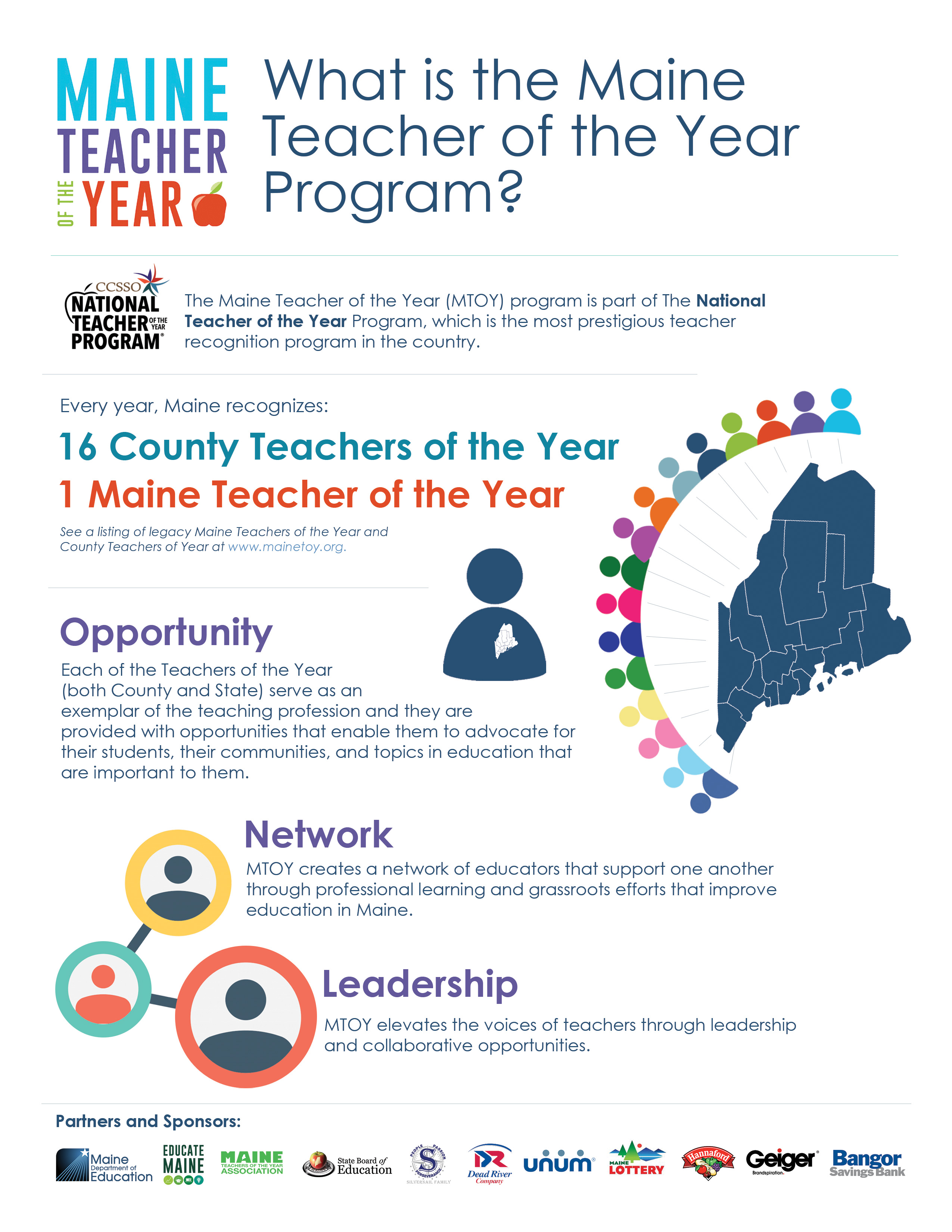
MAINE – Nominations are now open for the 2022 County Teachers of the Year and 2023 Teacher of the Year. Members of the public are encouraged to nominate educators who demonstrate a commitment to excellence and who inspire the achievement of all students.

“Our educators have continued to inspire, educate and care for their students during dynamic and difficult times,” said Commissioner of Education Pender Makin. “We encourage education colleagues, students, and community members to nominate an educator who exemplifies the committed heroes in our classrooms and schools.”

Nominations can be made through a nomination form on the Maine Teacher of the Year Website now through 5:00 pm on Feb. 4, 2022. Nominations will be accepted from students, parents, caregivers, community members, school administrators, colleagues, college faculty members, and associations/organizations (self-nominations, and nominations from family members are not accepted).

To be considered for the County and Maine Teacher of the Year award, a person must:

Maine’s County and State Teachers of the Year serve as advocates for teachers, students, and public education in Maine. They serve as advisors to the Department of Education and state-level education stakeholders across Maine.  Additionally, County and State Teachers of the Year join a cohort of teacher leaders that actively work together for the betterment of education in Maine. They also receive on-going professional learning and participate in many state and county leadership opportunities.

The 2022 County Teachers of the Year will be announced in May. The 2023 Maine Teacher of the Year will be selected from the 16 county honorees. The field will be narrowed to eight semi-finalists, and then three state finalists before the Maine Teacher of the Year is announced by Maine’s Education Commissioner at a school assembly in the fall. Each year, State and County Teachers of the Year are honored at the annual Teacher of the Year Gala also held in the fall.

MEDIA TOOLKIT
Help us promote the Teacher of the Year Program! Our goal is to expand and diversify our nomination pool!

About the Program:

Graphics:

Video Testimonials:

On behalf of, and in partnership with Maine Department of Education, the Maine Teacher of the Year program is administered by Educate Maine, a business-led organization whose mission is to champion college, career readiness, and increased education attainment. Funding is provided by Bangor Savings Bank, Dead River Co., Geiger, Hannaford, the Maine Lottery, the Silvernail Family, and Unum, with support from the State Board of Education and the Maine State Teacher of the Year Association.

The Maine Teacher of the Year program is committed to a nomination and selection process that ensures people of all backgrounds are represented.  Educate Maine and the Maine Department of Education champion that commitment by encouraging the nomination of educators from all culturally diverse experiences and backgrounds.

“We are proud to administer the Maine Teacher of the Year program in collaboration with the Maine Department of Education,” said Dr. Jason Judd, Educate Maine Executive Director. “Our unique program is a partnership between business and education designed to honor the good work of teachers, elevate the profession, provide professional growth opportunities and amplify the voice of classroom teachers.  The network of State and County Teachers of the Year is a valuable resource for our state and we often call upon their expertise to guide and inform our work.”

“We are grateful for our partnership with Educate Maine and for their commitment to a program that elevates the voice and role of Maine educators,” said Commissioner Makin. “We are also grateful for our sponsors and the network of Maine’s County and State Teachers of the Year for their ongoing advocacy and leadership.”

Through the generous support of Maine businesses, there is no cost to the local district when the Teacher of the Year is out of the classroom on their official duties, which includes representing educators state-wide and nationally through safely distanced in-person and virtual events that highlight the important work of Maine schools, communities, and educators.

For more information about the Maine Teacher of the Year program, visit the Maine Teacher of the Year website.

Media Contact: Dolly Sullivan, Educate Maine at dolly@educatemaine.org


U.S. DOE Announces Joint Temporary Action with U.S. DOT to Help Address School Bus Driver Labor Shortage

The U.S. Department of Transportation in coordination with the U.S. Department of Education has announced that the Federal Motor Carrier Safety Administration (FMCSA) is giving states the option of waiving the portion of the commercial driver’s license (CDL) skills test that requires applicants to identify the “under the hood” engine components. All other components of the written and road test will remain.

This announcement aims to alleviate some of the labor shortage challenges schools are facing and is one of many resources the U.S. Department of Education continues to provide to safely keep schools open for full-time, in-person learning.

“This Administration is listening to the needs of school communities and remains committed to making sure schools are open safely for in-person learning full time,” said U.S. Secretary of Education Miguel Cardona. “We’ve heard from educators and parents that labor shortages, particularly of bus drivers, are a roadblock to keeping kids in schools. Today’s announcement will give states the flexibility they need to help increase the pool of drivers, who are a key part of the school community, and get kids to school safely each day where students learn best. And American Rescue Plan funds can be used to hire these critical staff, including offering increased compensation or other incentives to recruit and retain staff.”

“This federal waiver will help states that are short on bus drivers,” said U.S. Transportation Secretary Pete Buttigieg. “By allowing states to focus on the testing requirements that are critical to safety, we will get additional, qualified drivers behind the wheel to get kids to school safely.”

Drivers receiving a CDL under this temporary waiver are permitted to operate intrastate school buses only; they are not authorized to operate trucks, motorcoaches, or any other type of commercial motor vehicle requiring a CDL.

The FMCSA waiver, which became effective Jan. 3, 2022, expires March 31, 2022. Read the full release from the U.S. Department of Education here.

Prepare to Become a School Bus Driver in Maine:

  1. Contact your local school district, Career and Technical Sites/Center, Adult Education Programs, or all to ask when the next School Bus Driver class begins. Some local classes are free.
  2. Study Section 10, School Buses, of the Maine Commercial Driver License Manual: https://www.maine.gov/sos/bmv/licenses/cdlmanual.pdf
  3. Call Maine Bureau of Motor Vehicles about commercial driver license (CDL) requirements, application, exam schedules, or extent of the Federal waiver. The direct contact for Maine BMV’s CDL Examination Section is 207-624-9000 ext, 52122. Between January 3, 2022 and March 31, 2022, the Federal waiver impacts a portion, not all, of the overall pre-trip inspection exam requirement.

Beginning February 7, 2022, Maine residents can search the U.S. Department of Transportation Federal Motor Carrier Safety Administration Training Provider Registry to find local CDL school bus trainers in Maine and your community.

Maine CDC & DOE Update Standard Operating Procedure (SOP) for Schools; Plan to Engage with School Administrators to Consider Additional Changes

For Immediate Release
Media Contact: Robert Long at Maine CDC

AUGUSTA – The Maine Center for Disease Control and Prevention (Maine CDC) and the Maine Department of Education (DOE) announced today further revisions to the Maine CDC’s public health guidance for responding to a positive case of COVID-19 in schools.

These revisions come in advance of students returning from winter break and, among other changes, reflect recently updated guidance from the U.S. CDC on quarantine and isolation periods. The revisions are intended to help keep students in-classroom while protecting their health and safety and that of staff.

Additionally, the Maine Department of Education, along with the Maine CDC, will continue to engage with school administrators from across the state to gather operational input on further potential changes to the guidance in light of the Omicron variant. These potential changes would continue to prioritize in-person learning and help keep children safely in the classroom.

Today’s changes to the School Standard Operating Procedures (SOP) are as follows:

  • Isolation and quarantine periods for students and staff are shortened consistent with recently updated guidance from the U.S. CDC,
  • The Maine CDC is aligning its definition of what constitutes a COVID-19 outbreak in schools with the State’s longstanding definition of an outbreak of other infectious diseases in schools. Effective immediately, the Maine CDC will open an outbreak investigation if a school reports that more than 15 percent of a school population is absent, which is the standard currently utilized to define an outbreak from other infectious diseases, such as influenza.
  • The Maine CDC will no longer consider exposure to COVID-19 in an outdoor setting or on a school bus, where the Federal government requires masks be worn, as a “close contact.”
  • The Maine CDC is updating its “test to stay” pooled testing program to enable more students to stay in the classroom. Previously, students and staff participating in pooled testing who were exposed to COVID-19 outside of a school setting were required to quarantine and not attend school. If they were exposed to COVID-19 in a school setting and participating in pooled testing, then they were not required to quarantine from school. Now, regardless of where the exposure occurs, if a student or staff member is participating in pooled testing, then they will not be required to quarantine from school.

Consistent with U.S. CDC guidance, the Maine CDC continues to recommend universal indoor masking by students, staff members, faculty, and visitors in K–12 schools, regardless of vaccination status. Local school boards are charged with the responsibility of implementing masking requirements for their school systems.

The Mills Administration has prioritized in-classroom learning and has provided school administrative units will several options to ensure that students can remain in school, including vaccination, universal masking, and pooled testing.

Maine has become a leader in pooled testing in schools. Pooled testing involves combining samples from individuals in a common group setting, such as a school, and has emerged as one of the most important tools in keeping preK-12 schools open and ensuring that Maine children can learn in person. Pooled testing allows schools to perform wide-scale testing of school communities efficiently and to easily identify positive cases in individuals who may be asymptomatic, notify close contacts, and reduce the number of children and staff who need to quarantine.

As of the week of December 20, 416 K-12 schools with 61,879 staff and students were participating in pooled testing statewide. This represents nearly 30 percent of all Maine staff and students. The Department of Health and Human Services’ pooled-testing contractor, Concentric, has reported that Maine’s participation rate for schools enrolling in the program is one of the highest they’ve observed across the country. Concentric works with Maine and eight other states to provide pooled testing in schools. Additional schools, students, and staff are encouraged to participate in this program, which the Department of Health and Human Services provides at no cost.

According to Maine’s Vaccination Dashboard, as of December 29, 2021, 49.3 percent of children ages 5 to 19 were fully vaccinated for COVID-19. Data from the U.S. CDC tracker show that Maine ranks fourth highest among states in the percent of 5 to 17 year olds fully vaccinated. As of the end of October, 83 percent of school staff were fully vaccinated. More than 500 vaccine clinics have been held at or coordinated with schools this fall, with more scheduled for the new year.

Since the fall of 2020, all Maine pre-K-12 schools have been providing in-person instruction to students.

The updated public health guidance for responding to a positive case of COVID-19 in schools can be viewed HERE.

###

MEDIA RELEASE: Video Message – Governor Mills Proclaims Dec. 6th-12th CS Education Week in Maine

Augusta, Maine – Monday December 6th marks the start of the 13th annual National Computer Science Education Week, which serves as a call to action to inspire PreK through 12th grade students to learn computer science, advocate for equity, and celebrate the contributions of students, teachers, and partners to the field.

In honor of National Computer Science Education Week, December 6th-12th, Governor Janet T.  Mills has proclaimed December 6th-12th, 2021 as Computer Science Education Week in Maine and has a special message to share.

To read the official proclamation, click here.

You can access the message from Governor Mills here:

To learn more about how you can get involved with Computer Science Education Week, check out our website or contact Maine DOE Director of Innovative Teaching and Learning Beth Lambert at Beth.Lambert@maine.gov.