MEDIA RELEASE: Call to Action for Maine Parents: Complete the Meal Benefit Application at School This Year – Even if School Meals are Free

Maine needs all parents and caregivers to take action this school year––by taking the time to complete the confidential Meal Benefit Application through your local school, even if school meals are already free for all students. Families, schools, communities, and our state can greatly benefit from the data that is gathered from the application, and this application is important for a number of reasons.

Since the start of the COVID-19 pandemic in March 2020, when school meals became complementary, there has been a significant drop in Meal Benefit Application returns––meaning less families are filling out the application.

The family income data provided by the application informs key funding for school resources. This includes school meal reimbursements, funding for Title I programs, funding and resources for after school programs, funding provided to schools from the Maine State Legislature for essential programs and services at school, funding for special education, teacher loan forgiveness, and much, much more!

Federal and state government use the aggregate data from the application to distribute education funding to schools across the county and state of Maine. In other words, if there is no data to inform the needs of the community, it could result in less education funding for your local district and for Maine.

By completing the Meal Benefit Application, you are directly investing in your child’s education and the children and families in your community.

Specific programs that are funded by the data collected from Meal Benefit Application:

How can I complete the Meal Benefit Application?  The application is available through your local school administrative unit (SAU) school nutrition program and it is completely confidential. Most SAUs have the application available to be completed online. Follow this link to access your SAU’s online application (if your school district is not listed, please contact them directly). A printed version of the application is also required to be available––it will often be part of beginning of year paperwork that comes home with your child.

This past school year has certainly had its challenges due to the Covid-19 pandemic. We are thrilled that, despite these challenges, all Maine children have had the opportunity to access free healthy school meals on a daily basis. We would like to extend our gratitude to Maine parents and caregivers who have participated in their SAUs’ meal programs. We know that with the continued support of Maine’s incredible families, we can ensure the best for our children.

MEDIA RELEASE: Maine DOE and Teens to Trails Partner to Increase Outdoor Opportunities for Maine Teens; Schools Can Apply NOW

Through a new partnership between the Maine Department of Education (DOE) and Teens to Trails, schools serving teens are encouraged to apply for $500-$1500 which includes training and start-up support for school-based outing clubs.

winter hikingWAVES (Wilderness Activities and Virtual Engagement for Students), a program of the Maine DOE, provides meaningful opportunities for Maine teens to engage socially with peers online or outdoors. Teens to Trails is a Maine organization whose mission is to connect high school students to life-changing outdoor experiences.
“We are thrilled by this partnership,” said WAVES Project Director Sarah Woog. “Teens to Trails is a Maine-based non-profit with proven expertise and passion for getting teens outside! Teens to Trails and WAVES have the shared goal of increasing Maine teens’ engagement with the outdoors. Together, we are excited to leverage our organizations’ resources and work collaboratively with schools to give all Maine students the opportunities they deserve.”

“In 2020, 53% of Americans participated in outdoor recreation, the highest participation rate on record,” said Teens to Trails Director Alicia Heyburn. “Outdoor spaces became places of refuge to safely socialize, improve physical health and connect with friends and family. Schools have an important role to play in continuing this positive trend by redefining the learning environment and using the outdoors to support the social and emotional wellbeing of students. The partnership between Teens to Trails and WAVES means that schools have trusted support to invest in making the outdoors welcoming and accessible to all students.”

Teens to Trails and the Maine DOE are eager to support an outing club at your school. School-based educators, with their administrators’ consent, are welcome to apply on behalf of their school. The application is simple, and the rewards are immense. Applications will be reviewed on a rolling basis, and the final deadline to apply is September 17.

Eligible schools:

  • Serve Maine teens;
  • Have the support of the school principal school administration;
  • Have school staff/faculty member as club advisor;
  • Commit to participating in two Teens to Trails programs in the first year;
  • Are able to demonstrate how funding will increase access to the outdoors for teens who may not otherwise engage.

Schools who receive funding may expect the following support:

  • Funds may be used for a club advisor stipend;
  • Access to Teens to Trails Club Hub for tips on running a sustainable club;
  • Professional Development day for outdoor club advisor(s);
  • Free summer white water rafting trip for club advisors to network and have fun;
  • Back-to-school student outdoor club recruitment materials;
  • Option to join four outdoor weekends with clubs from around the state;
  • Spring and Fall Trip Lotteries to win pre-planned adventures;
  • Access to gear to keep students warm and comfortable;
  • Ongoing support from Teens to Trails staff, including support planning for sustainability.

Please submit your application at your earliest convenience to secure funding and begin planning for YOUR school’s Outing Club! Find more information and apply here.
Please reach out to sarah.woog@maine.gov with any questions or feedback – WAVES and Teens to Trails will be in touch shortly!

MEDIA RELEASE: Eight Semifinalists Selected for 2022 Teacher of the Year

The Maine Department of Education, in partnership with Educate Maine, is pleased to announce the eight teachers that have been selected as semifinalists for Maine’s 2022 Teacher of the Year program. The semifinalists were selected from the 2021 County Teachers of the Year, who were honored in May in a virtual ceremony.

2022 Teacher of the Year Semifinalists:

Andrew Kirby
Aroostook County
Kirby has been teaching for 13 years and will be teaching science to grades 9-12 at Caribou High School.

I know Andrew is a teacher that will go above and beyond to work with students that need extra help, he sees when a student understands the material and may just need an alternative route to explain it, and is willing to adjust his classroom to the needs of his students to keep them successful.” – Andrea Hallett, Director of Guidance, Presque Isle High School

Paige Fournier
Cumberland County
Fournier has been teaching for 17 years and currently teaches special education at Freeport Middle School.

Paige’s influence on our building stretches well beyond the four walls of her classroom. She truly has changed the lives of many kids. She has such a positive impact on our entire school from the life skills classroom.” – Ray Grogan, Principal, Freeport Middle School

Michelle Laliberte
Franklin County
Laliberte has been teaching for 20 years and currently teaches PreK – Kindergarten at Rangeley Lakes Regional School.

Mrs. Laliberte truly makes learning fun for the kids, teaches teamwork and responsibility to very young kids with regular assigned classroom “jobs,” and involves the students’ families to help ignite the passion for learning both in and outside of the classroom.” – Kathryn Kay, Parent

Patti Forster
Knox County
Forster has been teaching for 29 years and is currently teaching English to grades 9-10 at Camden Hills Regional School.

Patti brings a huge heart and expert understanding of pedagogy to her work with students. She purposefully works with students who struggle with school or English. She is successful where other teachers have failed. As department head she leads her peers in bringing more social and emotional learning into their program, has developed and implemented a set of tier 2 interventions for students 9-12 who are struggling in English.” – Shawn Carlson, Principal, Camden Hills Regional School

Melissa Guerrette
Oxford County
Guerrette has been teaching for 20 years and currently teaches grade 5 at Oxford Elementary School.

Melissa Guerrette is a teacher that creates an impact at all levels: at OES, in MSAD #17, in the greater Oxford Hills Community, and in the state of Maine. She exemplifies what it means to be a reflective practitioner and is generous with her time and knowledge of best practices.” – Heather Manchester, Curriculum Director, RSU 17 / MSAD 17

Kelsey Stoyanova
Penobscot County
Stoyanova has been teaching for 7 years and currently teaches grade 8 English Language Arts at Reeds Brook Middle School in Hampden.

She forms meaningful relationships with her students and creates an environment that is welcoming. Along with that, I feel like I can be challenged in her class to do my best while also developing and working on skills that might be harder for me. We do this by having class discussions, creative projects, and interesting assignments.” – Tessa Castrucci, Student

Hillary Hoyt
Waldo County
Hoyt has been teaching for 7 years and currently teaches grade 3 at Leroy H. Smith School in Winterport.

Her desire to make sure each child feel like they are important is evident in her ability to individualize for each child, yet set high expectations of citizenship and respect. Her ability to restructure lessons and units to meet student’s interests, with such a diverse classroom, is unique.” – Dawn Moore, Principal, Leroy H. Smith School

Christine Goulet
York County
Goulet has been teaching for 21 years and currently teaches grade 2 at for Biddeford Primary School.

Christine has been a part of our Tiger community where her passion for teaching and learning has engaged, empowered, and supported all students in her learning environment which is not necessarily determined by the four walls of her classroom. Christine has a positive attitude, a growth mindset, and a strong passion of teaching all learners.” – Mandy Cyr, Director of Instruction, Biddeford School Department

The eight 2022 Teacher of the Year semifinalists will continue in the selection process which consists of a professional portfolio review and an oral presentation, and results in identifying three state finalists. The state finalists will then sit for a final interview and have a school-site visit before one of them is named the 2022 Maine Teacher of the Year.

The Teacher of the Year selection panel is made up of legacy Teachers of the Year, school administrators, Maine DOE staff, members of professional education organizations, and the business community. The 2022 Maine Teacher of the Year will be announced in October.

The Maine Department of Education’s Maine Teacher of the Year program is administered and managed by Educate Maine and supported by both the Maine State Board of Education and the Maine County and State Teacher of the Year Association. Funding for the program is generously provided by Bangor Savings Bank, Dead River, Geiger, Hannaford, Maine Lottery, the Silvernail Family and Unum.

More information about Maine’s Teacher of the Year program, the 2021 County Teachers of the Year, and the 2022 semifinalists can be found on the Maine Teacher of the Year website. For questions and information, please reach out to Program Director Dolly Sullivan at dolly@educatemaine.org or call 631-3385.

An ‘End of Year Message’ to Maine’s Education Communities from the Maine 2021 County Teachers of the Year

As the 2020/2021 school year ends and students, families and school staff transition to a summer schedule, now is the time to reflect on all that has been accomplished during a school year the world has never seen.

The 2021 County Teachers of the Year have put together a special “End of Year Message” to their colleagues, students and their communities who all worked together for the greater good of education across Maine this year.  These outstanding teachers share a message of gratitude for coming together to ensure our children had every opportunity to continue learning and growing this year. #StrongerTogether4ME

“The theme of being stronger together really came about when we started talking about how much we ALL have done, much of which isn’t as visible to people living outside of our schools. The actions of the groups mentioned in the video really proved that we truly are stronger together. We think this video highlights that truth,” the group said in a joint statement. 

“With that in mind, we want to know what you have seen that shows we are #StrongerTogether4ME students? Share your own images with the hashtag #StrongerTogether4ME on social media to celebrate!”  

The recently annouced 2021 Maine County Teachers of the Year were nominated by a member of their community and selected through a selection process earlier this year as part of the Maine Teacher of the Year Program. Throughout their year of service as County Teachers of the Year, they serve as ambassadors for teachers, students, and quality education state-wide through speaking engagements and collaborative work with education stakeholders and decision makers throughout Maine.

The Maine Department of Education’s Teacher of the Year Program is administered through a collaborative partnership with Educate Maine. To learn more about the Teacher of the Year program visit: https://www.mainetoy.org/

MEDIA RELEASE: School Nutrition Programs to Feed Children Beyond School Year with Summer Food Service Program

AUGUSTA — With the assistance of the U.S. Department of Agriculture, Maine public schools have long offered a nutritious breakfast and lunch meal program to thousands of children in Maine during the school year. During the pandemic, many flexibilities were put into place to ensure children had access to complementary meals while learning remotely from home or attending school in person.

We applaud those who worked tirelessly to provide food to children during a challenging school year. With summer right around the corner, that important service will continue in many areas of Maine. The Summer Food Service Program, a program of the U.S. Department of Agriculture, operates at hundreds of sites across Maine to ensure children get the nutrition they need.

“Maine’s National School Lunch Programs are an invaluable lifeline to our students for whom schools are a much needed and consistent source for food.” said Maine Department of Education Commissioner Pender Makin. “The Summer Food Service Program helps schools continue to provide this critical resource to Maine students through the summer months, and we are committed to assisting schools and communities as they address the needs of the whole child.”

The Summer Food Service Program may be offered statewide in areas or at sites where more than 50 percent of the children are eligible for free or reduced meal benefits under the National School Lunch Program or where census track data supports the need. This summer, area eligibility waivers have allowed sites to operate in areas that have need due to the COVID-19 public health emergency. Eligible sponsoring organizations include schools, nonprofit residential summer camps, government agencies, and tax-exempt organizations including faith-based organizations.

In July 2020, 112 sponsors participated in the program, serving meals at 730 sites throughout the state. Sponsors operate open sites in all 16 counties in Maine; anyone 18 and under may come to eat at no cost. Many sponsors will be utilizing USDA flexibilities which allow meals to be consumed off site to promote physical distancing and are offering innovative delivery and service models to meet the demand safely.

To find nearby Summer Meal sites, please visit USDA’s Summer Meal Site Finder website at: https://www.fns.usda.gov/meals4kids, text “Summer Meals” to 97779 or call Maine 211.

Updated information will be available late-June.

For more information about the Maine DOE’s Summer Food Service Program, contact adriane.ackroyd@maine.gov, call 592-1722 or visit https://www.maine.gov/doe/schools/nutrition/programs/sfsp.

###

In accordance with Federal civil rights law and U.S. Department of Agriculture (USDA) civil rights regulations and policies, the USDA, its Agencies, offices, and employees, and institutions participating in or administering USDA programs are prohibited from discriminating based on race, color, national origin, sex, disability, age, or reprisal or retaliation for prior civil rights activity in any program or activity conducted or funded by USDA.

Persons with disabilities who require alternative means of communication for program information (e.g. Braille, large print, audiotape, American Sign Language, etc.), should contact the Agency (State or local) where they applied for benefits.  Individuals who are deaf, hard of hearing or have speech disabilities may contact USDA through the Federal Relay Service at (800) 877-8339.  Additionally, program information may be made available in languages other than English.

To file a program complaint of discrimination, complete the USDA Program Discrimination Complaint Form, (AD-3027) found online at: http://www.ascr.usda.gov/complaint_filing_cust.html, and at any USDA office, or write a letter addressed to USDA and provide in the letter all of the information requested in the form. To request a copy of the complaint form, call (866) 632-9992. Submit your completed form or letter to USDA by:

(1)     mail: U.S. Department of Agriculture
Office of the Assistant Secretary for Civil Rights
1400 Independence Avenue, SW
Washington, D.C. 20250-9410;
(2)      fax: (202) 690-7442; or
(3)      email: program.intake@usda.gov.

This institution is an equal opportunity provider.

The Maine Human Rights Act prohibits discrimination because of race, color, sex, sexual orientation, age, physical or mental disability, genetic information, religion, ancestry or national origin.

Complaints of discrimination must be filed at the office of the Maine Human Rights Commission, 51 State House Station, Augusta, Maine 04333-0051. If you wish to file a discrimination complaint electronically, visit the Human Rights Commission website at https://www.maine.gov/mhrc/file/instructions and complete an intake questionnaire. Maine is an equal opportunity provider and employer.

MEDIA RELEASE: National Funding to Support Enhanced Access, Utilization of Wabanaki Resources

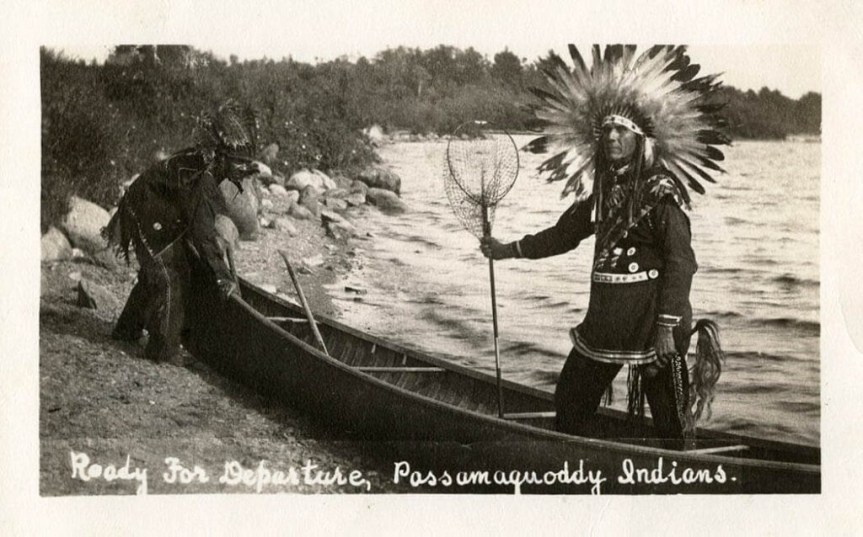
Image: Courtesy of the Hudson Museum HM7182.133

Collaborators on the project include partners from Raymond H. Fogler Library, the College of Education and Human Development and Native American Programs at UMaine, members of the Wabanaki Confederacy and the Wabanaki Studies Working Group, the Maine Department of Education, the Abbe Museum in Bar Harbor, Amherst College and the University of Massachusetts Amherst.

The National Endowment for the Humanities has awarded a grant of more than $59,000 to the University of Maine’s McGillicuddy Humanities Center to support development of a centralized digital portal that will improve access to Wabanaki historical and cultural resources and archival collections currently distributed across UMaine and, in the future, to incorporate collections curated by several external institutions.

“Teaching about the people whose land we inhabit today is crucial work and I am excited to be able to represent the Maine Department of Education (DOE) in support of this grant,” said Maine DOE Coordinator of Secondary Education and Social Studies Specialist Joe Schmidt. “During my time at the Department I have strived to make sure that we remove barriers for educators when it comes to teaching about Maine Native Americans and from the start of her time at the Department, Commissioner Makin has made this one of her top priorities as well. By working to develop a centralized portal of historic artifacts, educators will be better equipped to develop and deliver inclusive and accurate curriculum related to Wabanaki history and culture. Through this grant, we will take another step in making sure that all of our students can see themselves as important contributors to the past and present of all that Maine has to offer.”

UMaine professor of English Margo Lukens, a faculty adviser to the McGillicuddy Humanities Center, will lead the interdisciplinary Wabanaki Resources Portal project, which seeks to enhance utilization of existing resources to promote the study of Wabanaki history and culture at the elementary, high school and post-secondary levels in Maine and to facilitate interdisciplinary academic and arts scholarship.

UMaine’s archival holdings related to Wabanaki history and culture are extensive, and include the collection of Fannie Hardy Eckstorm, an early twentieth-century independent scholar of Wabanaki history and culture; the Molly Spotted Elk Collection, which provides a Penobscot view of the United States and Europe; the Linda Gilbert Collection of Penobscot Indian Music featuring original audio recordings about traditional song and dance; and the Maine Indian Collection, one of the largest institutional collections of Wabanaki baskets and basketmaking materials and tools, which is curated by the Hudson Museum. The museum also maintains a collection of significant primary resources, particularly images portraying traditional Wabanaki activities such as basketmaking and harvesting.

Other Wabanaki artifacts stewarded by UMaine include photographs of Passamaquoddy and Penobscot people including prominent tribal members Andrew Sockalexis and Lucy Nicolar Poolaw, who was also known as Princess Watawahso, characteristic objects from the 1880s through today, and the Senator William S. Cohen Papers related to the Maine Indian Land Claims Settlement Act of 1980. Fogler Library also maintains copies of recordings of Wabanaki speech and story now in the Library of Congress collection.

Much of the Wabanaki history and cultural material now housed in University of Maine collections is the intellectual and physical property of the Wabanaki tribes. A 2018 memorandum of understanding between UMaine and the Penobscot Nation delineates a process of artifact co-curation that includes tribal members to ensure culturally responsive care and use of archival material held by a nontribal organization. Maine’s Native American communities will be included in decision and policymaking related to the collections, including controlling access to culturally sensitive materials. UMaine is working to develop a similar memorandum of understanding with the Passamaquoddy Tribe.

Currently, access to UMaine’s resources is limited by siloed storage across multiple, unconnected locations and formats. Developing a centralized portal where digital copies of historic artifacts can be archived as searchable files will enhance interest in Wabanaki history and cultures while serving a diverse stakeholder base with interests in American history, literature, linguistics, law, art and natural sciences, as well as the study of colonization and decolonization in American society.

The Wabanaki Resource Portal project will center the ideas and perspectives of Wabanaki people in providing access to significant historical materials meant to educate the public, facilitate scholarship, preserve Wabanaki traditions and art, and support development of inclusive and accurate K–12 curricula that enhance the teaching of Wabanaki history and culture in Maine schools.

Collaborators on the portal project include partners from Raymond H. Fogler Library, the College of Education and Human Development and Native American Programs at UMaine, members of the Wabanaki Confederacy and the Wabanaki Studies Working Group, the Maine Department of Education, the Abbe Museum in Bar Harbor, Amherst College and the University of Massachusetts Amherst.

Lukens has co-authored “‘Still They Remember Me’: Penobscot Transformer Tales, Volume 1” with Penobscot language master Carol Dana and University of Southern Maine linguistics faculty Conor Quinn. The book recounts traditional tales of Gluskabe, the tribe’s culture hero, as told by Penobscot Newell Lyon to anthropologist Frank Speck. Speck published the stories in 1918 in an academic report titled “Penobscot Transformer Tales.” The 2021 bilingual edition of Transformer Tales, which was designed for language learning, presents the stories in contemporary Penobscot orthography with updated English translations and features artwork created by tribal members. The book will be available from the University of Massachusetts Press in June 2021.

For more information about this project contact Joan Perkins, joan.perkins@maine.edu

Wabanaki Seminar June 12, 2021 9am-12:15pm

The Maine Department of Education is delighted to invite educators statewide to our June 12 recognition of the 20th Anniversary of the signing of LD 291 which requires the teaching of Wabanaki History and Culture in Maine classrooms.

Please join us and a variety of educational leaders from 9-12:30 on Saturday, June 12. We will begin the morning with greetings from Governor Mills, Commissioner Makin and a keynote by legislation sponsor, Hon. Donna Loring.

Register here

For more information about the Wabinaki Seminar contact Joe Schmidt at joe.schmidt@maine.gov

MEDIA RELEASE: Three Maine Schools Win a Brand New $100K DON’T QUIT!® Fitness Center

Today, Governor Janet Mills and fitness icon Jake (Body by Jake) Steinfeld, Chairman of the National Foundation for Governors’ Fitness Councils (NFGFC), announced three Maine schools have won a state-of-the-art $100,000 DON’T QUIT! Fitness Center. The multi-million dollar DON’T QUIT! Campaign has selected Deer Isle-Stonington Elementary School in Deer Isle, Gorham Middle School in Gorham and SeDoMoCha School in Dover-Foxcroft for new fitness centers in recognition of their commitment to the health of their students.

“The last year has proven just how important investing in the health of our students is to keeping our state strong,” said Governor Mills. “I congratulate these deserving schools on being selected to receive a state of the art fitness center and I thank them for their commitment to the health and well-being of Maine children. These centers would not be possible without the generosity of the National Foundation for Governors’ Fitness Councils and Mr. Steinfeld and I thank them for their investment in the children of Maine.”

“We had an overwhelming response from elementary and middle schools throughout the great state of Maine. None of this would have been possible without the incredible support of Governor Mills, who helped make this campaign a huge success by putting the health and well-being of children first,” said Mr. Steinfeld.  “Three schools really embodied our mission of building a nation of the fittest, healthiest kids in the world.  I’m thrilled to announce that Deer Isle-Stonington Elementary School, Gorham Middle School and SeDoMoCha School are all being awarded a brand new $100,000 DON’T QUIT! Fitness Center. Congratulations to all, we look forward to visiting these three schools during our ribbon cutting ceremonies this fall!”

Each fitness center is financed through public/private partnerships with companies like The Coca-Cola Company, Anthem Blue Cross and Blue Shield Foundation, Wheels Up and Nike, and does not rely on taxpayer dollars or state funding. Fitness in Motion provides all the fitness equipment, which is manufactured right here in the United States. The foundation’s goal is to build a nation of the fittest, healthiest kids in the world.

These state-of-the-art DON’T QUIT! Fitness Centers will be unveiled during ribbon cutting ceremonies this fall. This year, the NFGFC program will have completed 40 states and will make its way into all 50 states in the coming years.

For more information about the National Foundation, visit www.natgovfit.org.

###

MEDIA RELEASE: Maine DOE Hosts Students Statewide for Virtual MLTI Student Conference

Maine students and teachers came together yesterday for a day of learning, collaboration, and innovative thinking at the 18th Annual Maine Learning Through Technology (MLTI) Student Conference.

Student Project: Maine Moose

Hosted by the Maine Department of Education (DOE) in partnership with CATES, the Conference was one of the largest synchronous student learning tech conference in the history of the world, with students from across Maine tuning in virtually to gain insights into the challenges facing Mainers during remote learning, how to develop innovations through peer collaboration to solve complex problems, and begin to develop the mindset of the social entrepreneur.

Student Project: You are important

In addition to participating in a number of innovative synchronous Block Sessions and asynchronous activities using Gathertown as a virtual conference platform to learn new skills and deepen knowledge, conference participants also had the opportunity to work in teams to develop a product or innovation that addresses their chosen challenge (Mental Health Support; Equity in Education; Peer Collaboration; New Ways to Learn).

“Get ready to be REALLY creative today! Be bold with your ideas and be guided by your wildest imagination,” said Education Commissioner Pender Makin in her opening remarks. “Design and innovate as if the future depends upon in. Because in so many ways, it truly does.”

“[The pandemic] has given you a front row seat that will inform your experience with this year’s innovation challenge,” added Maine CDC Director Dr. Nirav Shah in his remarks during the conference.

Students’ groups “pitched” their product to conference participants, who voted for their favorite in each challenge category – 38 hours of innovative pitches were created on flipgrid!

“Your pitches demonstrate what amazing thinkers, problem solvers, designers, and engineers, you all are,” said Maine DOE Director of Innovative Teaching and Learning Beth Lambert. “Your work today and in the innovation challenge will lead the way for our state and the entire nation when it comes to redesigning remote learning and the shape of our public education system!”

Pre-Conference students got the opportunity to learn about the different challenges related to remote learning during the pandemic and their implications for Maine DECD’s 2030 Vision + Goals so they could research interesting reports, design frameworks, innovation protocols, videos, and other information related to their challenge.

After the Conference each team of students that wishes to continue on to Part II of the $10,000 Challenge is matched with a mentor to further develop their innovation or venture and submit “a demo”, “pitch deck”, and/or executive summary for their product. Challenge Grand Prize winners will be announced at special online awards ceremony featuring UMaine innovation leaders, and invited to continue developing their innovation through the CATES Center for Social Innovation Summer Incubator program in prep for a fall launch.

For more information about the conference and the Innovation Challenge visit the MLTI website: https://mlticonference.com/

Media Release: Mills Administration Updates COVID-19 School Health Advisory System

All counties now green.

AUGUSTA — The Mills Administration today released an update to its color-coded Health Advisory System that classifies counties’ relative risk of COVID-19 transmission to assist schools as they continue with their efforts to deliver instruction and support students safely.

Maine’s Department of Health and Human Services (DHHS) and Center for Disease Control and Prevention (Maine CDC) assessed COVID-19 data and trends for all counties and released the following designations:

  • NOW GREEN: The new case rate in Androscoggin County has fallen by more than 25 percent, and the positivity rate is similar to that of several other counties.
  • All other counties remain green.

These designations are made out of an abundance of caution and for the consideration of school administrative units in their decisions to deliver instruction. DHHS and Maine CDC continue to review evidence that indicates lower transmission of COVID-19 in schools compared to the general population.

Over the last 30 days, the rate of new cases for school staff and students has fallen to 39 per 10,000, about 35 percent lower than a new case rate of 60 per 10,000 for the general population.

This continues to demonstrate that in-person learning in schools that follow public health precautions can be conducted safely, without increased transmission of COVID-19, when schools use proven health and safety protocols and resources.

The Health Advisory System categorizations are defined as follows:

  • RED: Categorization as “red” suggests that the county has a high risk of COVID-19 spread and that in-person instruction is not advisable.
  • YELLOW: Categorization as “yellow” suggests that that the county has an elevated risk of COVID-19 spread and that schools may consider additional precautions and/or hybrid instructional models to reduce the number of people in schools and classrooms at any one time.
  • GREEN: Categorization as “green” suggests that the county has a relatively low risk of COVID-19 spread and that schools may consider in-person instruction, as long as they are able to implement the required health and safety measures.  Schools in a “green” county may need to use hybrid instruction models if there is insufficient capacity or other factors (facilities, staffing, geography/transportation, etc.) that may prevent full implementation of the health and safety requirements.

The county-level assessments are based on both quantitative and qualitative data, including but not limited to recent case rates, positivity rates, and syndromic data (e.g., symptoms of influenza or COVID-19). Those data are publicly posted every week on the Maine CDC website. DHHS and Maine CDC also consider qualitative factors, such as the presence of outbreaks that may potentially affect school-age children.

The Health Advisory System reflects ongoing analysis of evolving data, and serves as one piece of information that school and district leaders can use to make decisions about how to deliver education during the school year. The qualitative and quantitative considerations and data used by the CDC in determining community transmission risk levels for schools can be located here: How County Risk Levels for Maine Schools are Determined

The Health Advisory System can be found on the Maine DOE website in Part I of the Framework for Reopening Schools and Returning to In-Person Classroom Instructionhttps://www.maine.gov/doe/framework/part-I.

Maine schools have been safely open since the fall by adhering to the six requirements for returning to in-person instruction and by following the protocols for identifying close contacts that are found in the Standard Operating Procedure for a positive case in schools, regardless of their county color designation.

The next update will be provided on June 4, 2021. Updating this advisory on a two-week basis aligns with the incubation period for COVID-19 and allows for greater stability in the trend data for small counties.

###

MEDIA RELEASE: Two Maine High School Students Named “National Cyber Scholars” After Winning Nationwide Competition to Identify Rising Stars in Critical Industry

30,000 Students Across the Country Sought to Qualify for this Cybersecurity Competition hosted by National Cyber Scholarship Foundation

The National Cyber Scholarship Foundation has named two Maine students, “National Cyber Scholars” after winning a rigorous 48-hour competition designed to evaluate aptitude in combating cyber threats, showcasing the advanced programming available in Maine schools.

Maine National Cyber Scholars:

  • Dena Arrison, Freeport High School
  • Vealy Lai, Maine School of Science and Mathematics

Over 30,000 high school students across the country sought to qualify for this year’s competition, and only 5,000 advanced to the first round. Of those students, only 600 nationwide performed well enough to earn the title “National Cyber Scholars.” These students each won a $2,500 scholarship and an invitation to participate in the Cyber Foundations Academy, a multi-week training and certification course.

Cybersecurity is a critical issue facing this country with the potential to impact our nation’s government, defense, communications and financial systems. According to recent studies, in order to properly defend our infrastructure from attack, we need to train more than 3 million cybersecurity professionals. This scholarship and competition are designed to attract and incentivize more students to enter the field.

“Congratulations to Dena and Vealy for this incredible honor! We are so proud of all the students that participated in this competition, and grateful for the schools who prepare, encourage, and support students in pursuing opportunities like this,” said Maine Education Commissioner Pender Makin. “Our state education system continues to make strides that allow us to adapt and prioritize the ever-changing advances in technology, including laying the foundational groundwork for a robust cyber security workforce here in Maine.”

“This scholarship recognizes high school students who have demonstrated exceptional cybersecurity talent,” noted David Brown, executive director, National Cyber Scholarship Foundation. “The NCSF mission is to help close the critical cybersecurity skills gap by identifying and developing the next generation of cyber professionals. Each and every student who participated in this competition has the potential to develop their skills and build a successful career in cybersecurity.”

There are several qualification pathways for the National Cyber Scholarship Competition including CyberStart America, a free online program that helps students discover their interest in cybersecurity and develop their talent and skills. The NCSC offers 600 college scholarships to top-ranking competitors. Additionally, National Cyber Scholars, along with the competition’s 1,000 finalists, are invited to participate in the Cyber Foundations Academy.

To learn more visit: National Cyber Scholarship Foundation.

###