There’s still time to register to attend the Maine Department of Education (DOE) Maine Learning Technology Initiative (MLTI) Student Conference! Join us for a fun-filled day of technology learning with #CampMLTI, the in-person student conference. Registration to attend the in-person MLTI student conference on May 23rd at the University of Maine in Orono is open until April 5th.
The MLTI Student Conference is a unique technology experience developed exclusively for students at MLTI schools. Since MLTI’s beginning in 2001 this conference has been providing students with their own conference where they can engage in authentic, relevant, technology-rich, learning experiences that prepare them for a fulfilling future. Starting in 2020, MLTI has offered a virtual Student Conference and now we offer two events annually. The 2024 virtual conference, the Maine Winter Classic, occurred last month and brought together approximately 5,000 participants from schools in every county across the state.
Submit a session proposal!
The Maine DOE is issuing a call for session proposals for the in-person student conference on May 23rd, 2024 at the University of Maine at Orono.
Conference Theme: #CampMLTI – This year’s conference is using a fun summer camp and camping-based theme. We love to have sessions that are tailored to the theme, but it’s not a requirement.There are endless possibilities for session topics. Technology-focused is essential; from traditional use of tech to unplugged, it’s all on the table.
Sessions should be “platform agnostic” (not device specific) and feature only free apps and tools that are accessible to all, and appropriate for 5th through 10th grade MLTI students. If you have concerns or questions about these requirements, please contact the Maine DOE Learning Through Technology team at doe-ltt@maine.gov.
Sessions can be led entirely by educators or students co-led with educators. We will also consider educational organization, higher ed, and other education stakeholder proposals.
Sessions are blocked for 90 minutes and should actively engage students in exploration, creation, and collaboration through technology and/or computer science. Presenters should plan to deliver their session twice, unless their schedule needs prohibit this.
As part of the scheduled periodic review of the Maine Learning Results, the Maine Department of Education (DOE) is seeking public comments regarding the current social studies standards. These comments will inform the work of the standards revision teams.
The standards review process opens with a public comment and public hearing prior to the convening of teams that will review and revise the social studies standards. The public hearing will occur on April 29th, Burton Cross Building, 111 Sewall Street, Augusta, Room 500, from 3-5pm and is intended to give anyone the opportunity to weigh-in on the direction of future social studies standards in Maine. Anyone may speak at the public hearing. People wishing to speak will be asked to sign in and it will be helpful, but not mandatory, to provide a written copy of their comments.
Anyone unable to attend the public hearing may send written comments by 5 pm on April 29th, 2024. Written comments may be emailed to sis.doe@maine.gov with the subject “Social Studies Standards Review” or mailed to Maine Department of Education, attn: Beth Lambert, 23 State House Station, Augusta, ME 04333. You may also fill out this form.
For further information about the standards review process contact Beth Lambert at Beth.Lambert@maine.gov.
The Maine Department of Education (DOE) wants your help designing the future of climate education in Maine. If you are a teacher, student or young adult (under 30), school administrator, or education partner, consider filling out the interest form below to be a part of the Maine DOE Climate Education Action Plan Task Force. | More
Maine school administrative units (SAUs) may apply for the Integrated, Consolidated 9-16 Educational Facilities Program through the application posted on the Maine Department of Education (DOE) Office of School Facilities website. The application deadline is June 30, 2025. | More
The Maine Department of Education (DOE), Child Development Services – Early Intervention for ME is seeking comments from the public on its annual application for federal funds under Part C of the Individuals with Disabilities Education Act (IDEA), which covers early intervention services for infants and toddlers with developmental delays and/or suspected disabilities from birth to their third birthday. | More
The Maine Department of Education (DOE) is seeking comments from the public on its annual application for federal funds under Part B of the Individuals with Disabilities Education Act (IDEA), which covers services to children with disabilities, ages 3-22. | More
As required under the Strengthening Career and Technical Education for the 21st Century Act (“Perkins V”), the Maine DOE is completing a non-substantive revision of our four-year Perkins state plan. Among minor updates, this revision to the state plan will also include adjusted values of Maine’s state-determined performance levels (“SDPLs” or “performance levels”) for the 2024-2025 school year through the 2027-2028 school year. | More
Calling all Maine kindergarten teachers, administrators, and curriculum directors! Are you interested in exploring strategies to help support transitions from early childhood settings into a Kindergarten setting? If so, you may be interested in engaging in an upcoming project the Maine Department of Education (DOE) is launching related to the design of a Kindergarten Entry Inventory (KEI). | More
Maine’s Preschool Development Renewal Grant is supporting the Maine Department of Education in offering grant funding to school administrative units (SAUs) to increase the number of eligible 4-year-olds attending high-quality public Pre-Kindergarten (Pre-K) programming through partnerships with licensed community providers (center-based and family child care) during the 24-25 school year. | More
Do you want to engage students in learning about Maine’s Natural Resources? Do you want to promote outdoor education? Do you want access to environmental science equipment? Do you want to provide students with more opportunities to master the Maine Science and Technology Learning Results Standards? The Envirothon KickStarter Program may be for you. | More
The hallways of United Technologies Center (UTC) were packed with students dressed in different uniforms adorned with the SkillsUSA emblem on March 15 as they came together from across Maine to test their talents at Maine’s annual SkillsUSA event. | More
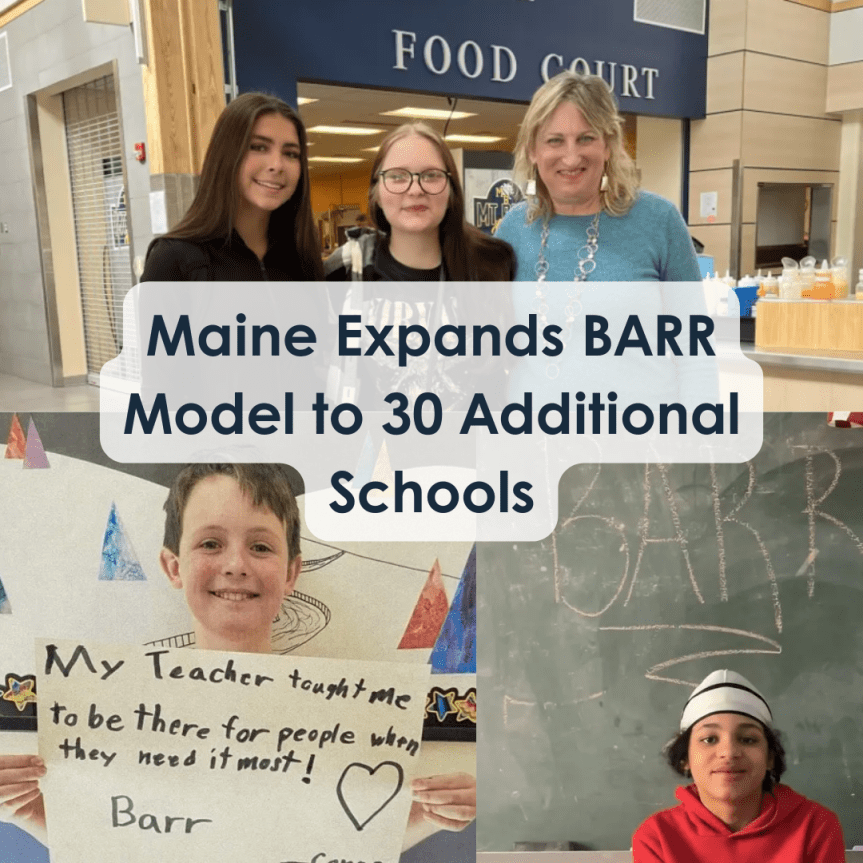
Noble Middle School has created a community of students who genuinely respect and trust their teachers and each other through the Building Assets Reducing Risks (BARR) model. “The teachers, the students, and everyone just support you. There’s really no negativity,” Chase, a Noble seventh grader, says of his school. | More
This year, Saco Middle School (SMS) has three exciting student technology projects that highlight highly engaging, student-driven learning. These projects are a combination of projects funded through the Maine Department of Education (DOE) Maine Learning through Technology Initiative (MLTI) as well as a student project submission to the Samsung Solve for Tomorrow STEM competition. | More
For the second consecutive year, a student group from Windham High School (WHS) volunteered to participate in the Can We? Project and hosted their peers from Poland Regional High School (PRHS) in mid-February to practice skills needed for civilized conversations. | More
Through the Preschool Development Renewal Grant (PDG), the Maine Department of Health and Human Services (DHHS), in partnership with the Maine Department of Education (DOE) are offering the opportunity for a summer summit series in 2024 and 2025 to support communities in their local system alignment and coordination for early childhood care and education programming from birth through the early elementary years. Teams accepted to participate in the summit will also be awarded $800 mini grants to support their efforts in developing and implementing action plans to address an identified early care and education need in their communities. | More
The Maine Department of Education (DOE), Child Development Services – Early Intervention for ME is seeking comments from the public on its annual application for federal funds under Part C of the Individuals with Disabilities Education Act (IDEA), which covers early intervention services for infants and toddlers with developmental delays and/or suspected disabilities from birth to their third birthday.
The application, which covers Maine fiscal year 2025 (starting July 1, 2024) is posted on the Maine DOE’s website at Part C Application. The Part C budget is estimated/projected based on Maine’s current award, pending the State’s receipt of the finalized federal award for the coming year. Both documents will be posted from March 22, 2024, through May 22, 2024.
Written comments will be accepted from Monday, April 1, 2024, until 4 p.m. on Tuesday, April 30, 2024. Please send comments to Erin Frazier at erin.frazier@maine.gov or 23 State House Station, Augusta, ME. 04333
Calling all Maine kindergarten teachers, administrators, and curriculum directors! Are you interested in exploring strategies to help support transitions from early childhood settings into a Kindergarten setting? If so, you may be interested in engaging in an upcoming project the Maine Department of Education (DOE) is launching related to the design of a Kindergarten Entry Inventory (KEI).
A KEI is a tool administered in the beginning of Kindergarten to help teachers gather information about children’s development across a range of domains so that teachers can be responsive to children’s learning. Additionally, data aggregated from KEIs can help strengthen Maine’s early care and education system by identifying areas of steady growth and continuous improvement.
In 2022, the Maine Department of Education (DOE), in partnership with the Department of Health and Human Services (DHHS), was awarded the Preschool Development Renewal Grant B-5. This three-year, $8,000,000/year grant supports early care and educational programming for our youngest students. One of the many projects included in the grant is the development of a KEI.
If you are an early childhood educator or school administrator serving these grade levels, please be on the lookout for an upcoming survey later this spring. The survey will gather multiple points of information including current assessment practices utilized as part of children’s transition into, and journey through, kindergarten. The survey will also gather educators’ thoughts about the design of a KEI and questions they may have. Additionally, the survey will offer an opportunity to recruit for educator involvement by either serving on a KEI Advisory Team or by being a Kindergarten Entry Implementation Team Member.
Keep watching your emails. More details and information will follow soon.
For questions, please reach out to Karen Mathieu, Maine DOE Kindergarten Entry Inventory Specialist, at karen.mathieu@maine.gov .
Maine’s Preschool Development Renewal Grant is supporting the Maine Department of Education in offering grant funding to school administrative units (SAUs) to increase the number of eligible 4-year-olds attending high-quality public Pre-Kindergarten (Pre-K) programming through partnerships with licensed community providers (center-based and family child care) during the 24-25 school year.
In order to realize its goal of achieving universal access for students to public Pre-K, the State is supporting SAUs in increasing the number of partnerships with licensed community-based providers (e.g., center based and family child care) to ensure equitable access to high-quality early care and education, especially for our most vulnerable children.
Partnerships with licensed community-based providers support SAUs to achieve full-day/full-week programming for children and to meet the needs of working families while increasing their offering of Public Pre-K.
The Public Pre-K Partnership Pilot Grant RFA will provide funding to support new partnerships with either a licensed center based provider or a licensed family child care provider.
The timeline for the RFA process is as follows:
March 22, 2024-RFA Released
April 8, 2024—Question Submission Deadline
April 25, 2024- RFA Submission Deadline
All questions about the Pre-K Partnership Pilot Grant RFA should be submitted to the Pre-K Partnership Pilot Grant Coordinator identified on the Grant RFPs and RFAs webpage.
Any additional questions about this opportunity may be directed to Michelle Belanger, Pre-K Partnership Specialist, Michelle.Belanger@maine.gov.
The Maine Department of Health and Human Services (DHHS), in partnership with the Maine Department of Education (DOE), was awarded a Preschool Development Renewal Grant (PDG) from the US Department of Health and Human Services in December of 2022. With this three-year grant, the state is implementing initiatives to build greater infrastructure and capacity to create a more coordinated, efficient, and high-quality mixed delivery system for children ages birth to eight and their families. The plan builds upon successful cross-agency work to ensure that all children enter Kindergarten prepared to succeed and are well supported during the early elementary years.
Included in this grant is the opportunity for a summer summit series in 2024 and 2025 to support communities in their local system alignment and coordination for early childhood care and education programming from birth through the early elementary years. Teams accepted to participate in the summit will also be awarded $800 mini grants to support their efforts in developing and implementing action plans to address an identified early care and education need in their communities.
The goals of the Early Childhood Summit include:
Fostering community level coordination and collaboration across the mixed-delivery early care and education system, which includes child care programs, head start and elementary schools, to improve alignment and transitions for children and families.
Strengthening understanding of evidence-based practices that are critical to leverage across the birth-grade 3 span in order to promote whole child development.
Supporting community-based planning and implementation efforts through mini-grants and ongoing technical assistance support.
What will the summit structure be like?
The content of the summit will include a variety of keynote addresses and workshop sessions connected to the goals outlined previously. Topics will include promoting inclusionary practices and addressing challenging behaviors, promoting play as a foundational learning strategy, and promoting smooth transitions from early childhood education programs into public schools for children and families. Time will also be provided for teams to work collaboratively on action planning.
When will the summits be held?
The 1-day summits will be held in two regions (see dates/locations below). Teams will apply to attend in one of the two locations. The summits will run from 8:30 a.m.- 4:00 p.m.
Thursday, July 11, 2024, Keeley’s Banquet Center, 178 Warren Avenue, Portland, Maine
Tuesday, July 16, 2024, Jeff’s Catering & Event Center, 15 Event Center Way, Brewer, Maine
What are the requirements of participation for all team members?
All team members will be expected to participate in the professional development and technical assistance components outlined below.
The components include:
Projected timeline:
One check in meeting prior to the July 2024 Summit
June 2024
Attendance and participation at Summer Summit July 2024
July 11 or 16, 2024
Bi-annual consult with the Departments (1/2)
Fall 2024
Bi-annual consult with the Departments (2/2)
Winter 2025
Attendance and participation at Summer Summit in July 2025
July 2025
What is the composition of teams?
Teams may have up to five members. There must be at least:
one public early elementary school educator and
one child care provider/educator represented (family child care and/or child care center) on the team.
The additional three members may include but are not limited to:
Representative of the local business community
Parent of a child using early childhood services
School Administrator
Home Visitor
Mental health care provider
Head Start Representative
Health care provider
Community librarian
Representative of an organization that supports workforce development
Provider of services under the federal Individuals with Disabilities Education Act, Part B or Part C
Provider of professional development to early care and education professionals
A faculty member of a career and technical center or higher education institution specializing in early childhood, if available
How will the mini grants work?
Each team will receive an eight-hundred-dollar ($800) grant to support their action planning and implementation work over the first year. Another min-grant will be available following successful completion of the first year and participation in 2025 summit.
Do you want to engage students in learning about Maine’s Natural Resources? Do you want to promote outdoor education? Do you want access to environmental science equipment? Do you want to provide students with more opportunities to master the Maine Science and Technology Learning Results Standards? The Envirothon KickStarter Program may be for you.
Through a collaboration between the Maine Association of Conservations Districts and the Spruce Mountain High School Envirothon Team, an Envirothon KickStarter Program is available to organizations that have not had teams compete in the last 2 years.
Available through a Diversity Grant from the U.S. Forest Service, the National Conservation Foundation, and the NCF Envirothon, the KickStarter Kits are intended to provide resources to help new advisors teach students content and skills related to preparing for an Envirothon Competition.
The Kits will include materials such as a Biltmore Log Scale Stick, Trees of Maine book, soil testing materials, water data sampling materials, and other supplies for environmental science. It is expected that organizations receiving Envirothon Starter kits will organize a team to compete in the 2024 or 2025 Envirothon and the kits will be available this spring through 2025 or until the funds are depleted.
Additionally, as part of the Envirothon KickStarter program, there will be online training for any advisors and students to help them learn about Envirothon, including newly formed and veteran teams. Teachers may receive contact hours towards recertification for participation.
For more information about Envirothon or the Envirothon KickStarter Program, you may email Spruce Mountain High School Envirothon Advisor Rob Taylor at rtaylor@rsu73.com.
More information on the Envirothon and how to register:
To register for a 2024 Maine Regional Envirothon, please visit: Maine’s Envirothon Registration Webpage. Registration is $125 per team and includes T-shirts for team members. Registration must be completed by April 5th.
Last month, the Maine Department of Education (DOE) Child Nutrition team hosted ten School Food Service staff members in their Culinary Classroom in Augusta for vegan/vegetarian culinary training.
Five teams of two prepared eleven dishes from lentil sloppy joes, Asian salad, sweet potato & bean burrito, and tortilla soup to cookie dough hummus. After preparing the dishes, they enjoyed the fruits of their labor and discussed each dish.
Comments included the ease of preparation, how ingredients could be used in other dishes, how appealing the look and flavor of several dishes were, and how some were a good way to use commodity products.
The Maine DOE Child Nutrition team operates the Culinary Classroom to provide culinary and food safety training to School Nutrition Professionals across the entire state of Maine. Along with in-person training, the team also records training videos and recipes that are accessible as needed via their website.
(Seventh grader Chase, above, told us he liked his teachers because they were kind and cared about him.)
Noble Middle School has created a community of students who genuinely respect and trust their teachers and each other through the Building Assets Reducing Risks (BARR) model. “The teachers, the students, and everyone just support you. There’s really no negativity,” Chase, a Noble seventh grader, says of his school.
“It’s a really great school,” says James, a sixth grader at Noble who has attended five different schools, traveling from Texas for his father’s job in the Navy. “There are amazing teachers and students, and the classes are really fun,” continued James, sharing that Noble was his favorite school he has attended yet.
Walking down the hall, it is easy to see why Chase and James love their school. One is struck by the way students brighten up when they speak to educators, calling out to them in the halls and even asking how their days are going. Noble’s method to success is its dedication to building positive relationships across the school community through BARR. BARR is an education model that combines relationship building (staff to staff, staff to student, and student to student) and real-time data to strengthen student engagement and well-being. In 2016, BARR and Intervention Coordinator Kristen Hobbs implemented the program at Noble.
“We were one of the first middle schools in the country to use BARR,” remembers Hobbs. “there was a double-blind study with BARR at Noble High School, then we fully implemented the program here the year after.”
Students going-away messages to an educator who recently left Noble.
In BARR’s block meetings, educators discuss students’ strengths and needs, analyze data, and deepen relationships within the school. At Noble Middle, these meetings alternate between sixth and seventh-grade teams.
Principal Michael Archambault details how BARR works at Noble as such: “Every kid is on a team, and they have four regular education or core subject teachers that make up the team. Every other week, the team, plus a school counselor, administrator, BARR coordinator, and potentially some interventionists, attend [a block meeting]. At the meetings, students are leveled zero, one, two, or three based on several indicators. It could be grades, at-risk behavior, or attendance. And then we go through and we talk about some of the kids that have come up that we need to sort of share information on and make sure we’re on the same page.”
As he continues, Principal Archambault shares how the team stays constructive during the meetings: “We start with a spark, like a positive about a kid, like they’re on the basketball team or they really like skateboarding. So, we try to start off with a strength and then talk about the student.”
Sitting in on Noble’s block meeting, one can’t help but note the affection these educators have for their students.
“Before BARR, teams would meet, but it was more about the nuts and bolts of how their team ran” said Hobbs. “BARR makes it so that you have to come up with intervention plans.”
The Acadia BARR team at Noble at their block meeting.
During Monday morning’s block meeting, seventh-grade social studies teacher Mark Lafond brought up a student struggling to complete work and come to class. He noted that the student has trouble seeing and that the parents might be unable to afford glasses. As a solution, he offered to bring in frames he had at home and have the lenses replaced with the student’s prescription. “My wife used to work for Warby Parker,” Lafond explained, “so we have a ton of [glasses] at home.” The way these educators will go the extra mile to help a child promotes trust and, in turn, creates positive teacher-student relationships, which is precisely what BARR is working to accomplish.
As the year progresses, each student is discussed in a block meeting at least once by their team, with the purpose of acknowledging and seeing every student. When block meeting interventions, such as Lafond’s plan to find his student glasses, are insufficient, they are moved up the risk scale. Students with continuously high-risk ratings are escalated to community connect meetings, which they refer to as “risk reviews” at Noble.
“We have risk reviews Monday and Friday mornings,” said Principal Archambault. “In that meeting, there would be a special education case manager, a social worker, counselors, administrators, and a school psychologist. The idea is to find community intervention.”
Principal Archambault also shared one of the most powerful parts of Noble’s BARR strategy, their mentorship program.
Hobbs created the mentorship early into Noble’s BARR journey to support students with high-risk ratings.
“It is definitely one of the stronger interventions that you can implement,” says Assistant Principal Melinda Luders. Since Noble started the program, Hobbs has personally created more than 200 mentor matches, with some mentors, including Hobbs, working with their mentees well into high school.
“It just continues to support the idea of kids knowing that they have an adult that is going to check in on them,” said Principal Archambault. “It doesn’t have to be like an agenda driven situation or anything like that. It’s about ‘we have a one-on-one relationship where you’re accountable to say hello to me, and I will make time for you.’”
Noble’s success with BARR is well known, which is why Loranger Memorial School Principal Matthew Foster drove from Old Orchard Beach to observe how the school implements the program.
“The goal for teachers is to get to know the kids in different ways,” said Foster, “That’s what we are looking at BARR for right now.”
Old Orchard Beach Loranger Memorial School Principal Matthew Foster observes Melanie Stevens’ sixth grade I-Time.
While at Noble, Foster observed a sixth-grade I-Time. I-Time is an activity taught by block teachers to their assigned group of students. It is a structured time for BARR educators to build those student-to-student and student-to-teacher relationships. This particular I-Time was a true masterclass taught by English Language Arts teacher Melanie Stevens. The respect and adoration Stevens evokes in her students shows how truly she has honed her craft.
As a teacher, Stephens is a big fan of BARR, especially the opportunity to build stronger relationships with her students: “I-Time is used to help these kids identify that they’re not alone in the things that they struggle with. It’s not like your typical SEL-type activities. It’s a little bit different in that some of them do get a little bit deeper because students don’t always have the outlets for the kind of conversation at home.”
Stevens used I-Time to discuss grief and how even the smallest everyday loss can change a person.
“There are so many things that happen in the day to day. [Grief] doesn’t have to be this huge, huge thing. It can be these little things as well,” said Stevens. She illustrated this by reading students a story about a young girl’s attempt to join a prestigious dancing school and having the students rip off a piece of their colored paper sheet whenever they heard something that made them feel bad. In the end, she gave the students tape and had them attempt to put the piece of paper back together again.
“What’s the point? Is it back to normal? Were you able to get it back to the way it was? What are we trying to get you to think about?” Stevens asked her class.
“Even if something happened a while ago, you could still remember it,” responded a student named Jackson. Another student, Sumner, from across the room, answered, “Mean things people say can change you.”
To round out the lesson, Stevens explained to her students the Japanese Art of Kintsugi, a method of repairing broken pottery with gold. Foster showed them an image of a blue bowl, cracks filled with gold, and asked, “It’s broken, but doesn’t it look better this way?”
Students torn paper from the I-Time activity on grief.
If you are inspired by Noble’s story and think BARR would be the right fit for your school, the DOE is offering additional BARR funding for the 2024-2025 school year.
Applications are now open to all willing and qualified public schools that want to become BARR schools. Click here to apply. Applications are due by March 22, 2024, at 5:00 p.m. EST.
The Maine DOE will cover all costs of implementing the program for schools new to BARR for the 2024-2025 school year. (Note: if you are already a BARR school with an existing contract, your costs will also be covered for the 2024-2025 school year, and you do not need to reapply.)
The Maine DOE used American Rescue Plan funding to create a competitive BARR grant to help schools invest in the model.