Walk into any classroom at Maranacook Community Middle School and you’d be hard-pressed to identify a 6th grader from an 8th grader in the class. And that’s part of the magic at Maranacook. Instead of being separated by grade level, students are grouped into multiage teams.
The school does more than blend grade levels—teacher teams work together to integrate learning across content areas around themes chosen by students each trimester. These themes can range from the end of the world to food to careers.
Before every trimester, teams get together and teachers will bring them through a process of inquiry. Students ask questions about themselves, the world around them, their community, their interests, and the world in general. Themes start to appear through this inquiry process and the students get to choose the theme they have the most interest in.
Principal Rick Sirois summed up a big part of the Maranacook approach.
“Student buy-in is key, giving them voice and choice, which I think we do well, and giving them multiple pathways to demonstrate what they know,” he said.
Maranacook is a shining example of integrating powerful interdisciplinary instruction and elevating student voice and choice.
The result? Students are engaged and excited to learn, they have ownership over their learning and immense pride in their school, teachers build strong connections and relationships with one another and with students, and students feel part of the same team regardless of grade level.
In one class on a team working on an Armageddon theme, students worked in groups to analyze the differences between two maps. One map featured the traditional layout of countries that we’ve all come to know. The other map country sizes were linked to population size. The students worked together to identify what was similar and different about the two maps and then answered the following questions after analyzing the maps: what things surprised you? what things concern you? What questions do you have?
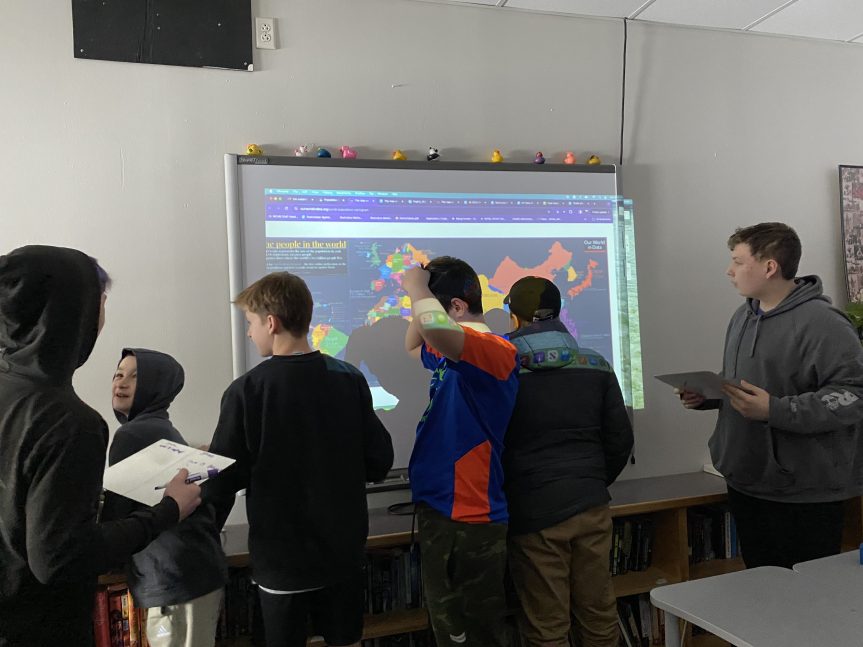
This was the third day of a unit on population. The students learned about global changes and advancements that grew the Earth’s population to 8 billion people and were now focused on the consequences of population changes and the different concentrations of those populations. Students identified consequences such as overpopulation, the overconsumption of resources in some places, deforestation, and how countries with small land masses can continue to handle large population booms.
Other topics the students will focus on for this theme include water shortages, global warming, nuclear war, and world leaders. Soon they will learn how to build desalinators.
“Oceanography was the theme in the first trimester and I think the kids thought we were going to do ocean waves, which we talked about, but our focus was how light waves and sound waves change when they’re in the ocean. That’s a heavy thing and they got it,” said teacher Karen Beckler.
Asked what they enjoy about school, one student shared, “We get to pick what we’re learning.”
“They make it fun while still being able to learn,” said another student. He said his team’s theme for the trimester was games, hobbies, and sports. In one class, students played UNO and had to talk about the probability of each color. In the next class, students had to roll dice 100 times and collect data on how they landed. In another class, each student had to research and do a report on a past Olympic competition and the city where it was held.
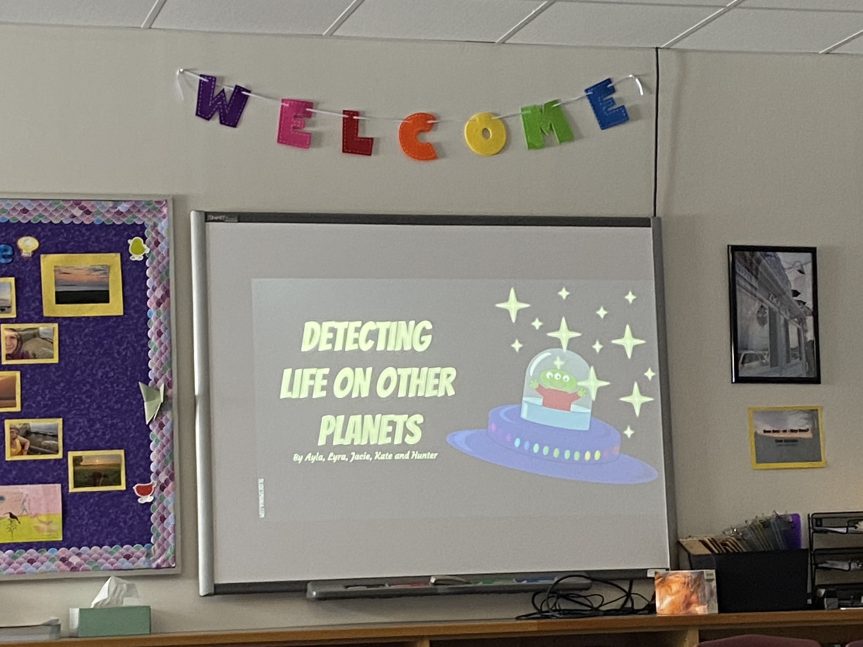
In another class on the same Armageddon-themed team, students were delivering group presentations answering different aspects of the question “are we alone?” The students presented their research investigating what scientists have said to answer that question, how the identification of alien life could impact religion on Earth, detecting life on other planets, and more. Students answered questions about their topic areas from the teacher and other students, and students filled out a rubric on what they learned while their peers delivered their powerpoints.
“I was a skeptic,” said Beckler, who recently came to Maranacook with decades of experience teaching in other districts. “I thought how are we going to meet all these science standards if the kids are picking the units and it’s not linear? But it’s amazing to me spiraling back on it from other years how much they remember from a unit they had a trimester the year before. And the kids who didn’t get it the first time have another opportunity to learn the same general concept but in a different situation. There’s a big chunk of kids, they’ve got to see it applied and not just once but many times.
Beckler continued, “And their retention is so much better. I did a unit on the organization of the body last year and this year when we did the nervous system, I drew something on the board and they were like oh that’s a nerve cell that makes nerve tissue and the organ is the brain and that is the collection of nerve tissue in the body. They applied what they did earlier.”
She also discussed how team teachers approach the themes in a way that builds off each other. Last trimester, students on her team were really focused on how they can know what is true, how humans learn, why they get distracted so often. Maranacook teacher Amy Tucker focused on AI since students raised questions about AI taking over the world or humans not having to think in the future because AI would do that for them. Another teacher on the team focused on executive functioning, keeping yourself organized, how to plan, how to regulate emotions and explore mindfulness. Beckler taught about the nervous system, how humans receive information and how the brain processes it. And students were able to cross reference and apply things they were learning across the classes.
“In our AI unit, we included a lot of ELA content, but we also looked at ethics and bias and what AI is actually doing. We focused on programming AI models, trying to add data to improve them. We also tested AI image software, searching for terms like ‘doctor’ and ‘teacher’ and ‘criminal’, and we collected data and found that the AI image generators we used were pretty biased. We then used the data to write about to what degree AI should be regulated,” said Tucker.
“We did AI last trimester and we saw how AI gives us information and how it could be biased,” reflected a Maranacook student. “AI is a useful tool if you know how to use it.”
Educators and students also shared the value they see in their multiage approach.
“By the end of trimester one you can’t distinguish who is a 6th grader who is a 7th grader based on their behavior because they have caught on so well and so fast,” said Beckler.
Teachers highlighted how their multiage approach helps sixth graders quickly integrate into the school, helps teachers better differentiate learning, better behaviors, more socialization between ages, and less of a power dynamic between older students and younger students.
“In some ways, our 6th graders are working harder so it makes the 8th graders keep their focus,” said Tucker.
One student said he liked the opportunity to know other kids across grade levels, which wasn’t the case at previous schools.
“Being an eighth grader, here I don’t have to be like I’m only friends with 8th graders. I’m friends with all grades,” he said.
“We’re doing a podcast and we’re going to interview people about their experiences on multiage teams and how it impacts them in high school,” said a student who is part of a three-person podcast team who interviewed each other, several of their peers, teachers, and high school students.
Student choice and voice extend beyond choosing themes to learn about.
During the lunch hour, students get to eat with their peers and have 30 minutes of activity time where they can choose to go outside, play Minecraft or Dungeons and Dragons together in the library, engage in robotics, socialize, catch up on school work, and more.
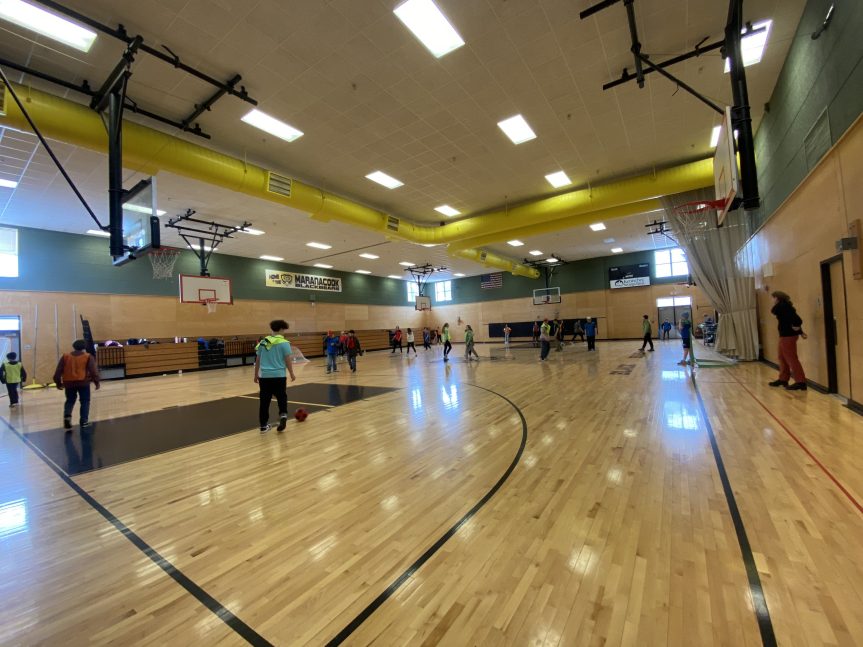
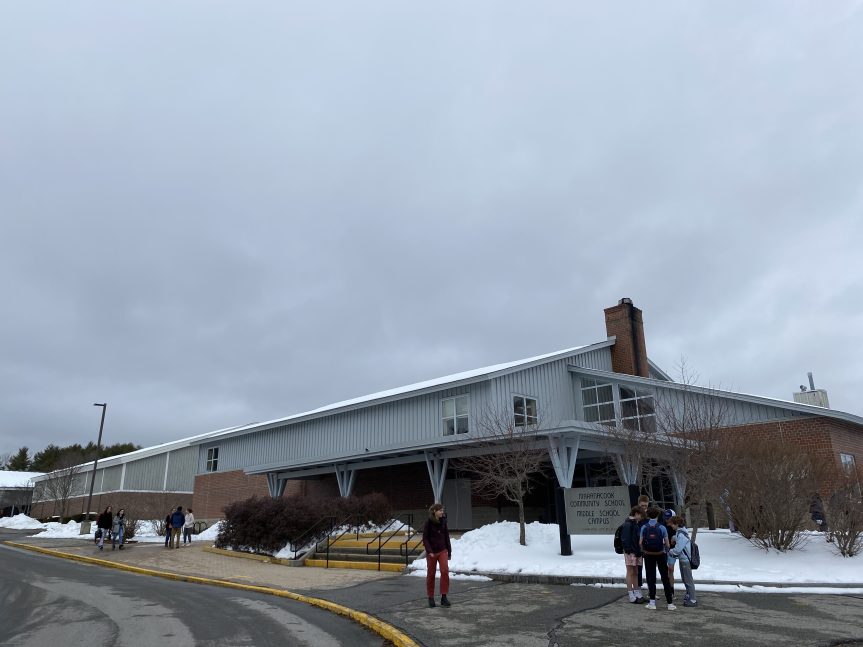
Maranacook Community Middle School sits perched above Maranacook Lake in Readfield and shares a campus with the high school. The school takes a Whole Student Approach built on strong relationships, engaged learning, supporting student and staff wellbeing, and family and community engagement. Each day for the school’s nearly 300 students begins and ends with advisory time to connect with and get support from their advisory teacher. Students have access to the school-based health center in the high school making it easier for families to schedule medical care when they need it, a community food bank, a clothing boutique, toiletries, backpacks, and other supplies. They also have a partnership with Kennebec Behavioral Health providing students with access to their counselors during the school day. The school also offers a mentor program where students can get matched with a high schooler. They meet once a week to play games, help with homework, talk about life and hardships, share experiences, and students get advice from someone a few years older.
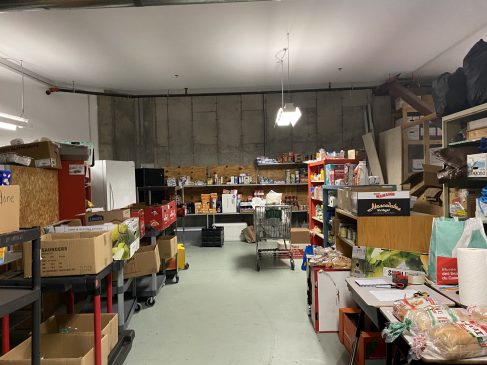
“We try to break down every barrier we can. Sometimes a family can’t get services outside of school hours so why not offer it here,” said Sirois.
Relationships run deep at Maranacook.
“One thing we always describe as the cornerstone of our school is the advisory program,” said Sirois. “That’s evidence that relationships are foundational at Maranacook and we start and end our day with our advisees every day. That is a huge piece and gives every student a person [they can lean on].”
Tucker agreed, saying, “Relationships are the biggest key, and every teacher will say that here. It goes a long way when you have those small groups and you can get to know them.”
“It’s not uncommon for an advisor to fill up a backpack with food and give it to a student on their way out,” added Sirois.
None of this comes easy. While Beckler started a skeptic, she’s leaned fully into the Maranacook way.
“This is year 30 of education for me and in some ways, I feel like a new teacher,” she said. “I feel like a new teacher in the sense that there’s a lot more planning and I put a lot more time in, but I’m also way more creative.
“It’s not the easiest place to teach,” Sirois admits. “There’s not a curricular book you can pull off the shelf.”
But the school has built a supportive community and teachers are provided the tools and time they need.
“The special sauce here is that the staff here work together incredibly well and share things. Every trimester is a different theme, so you are reinventing the wheel a lot. But you have so many colleagues that you can pick their brains and find cool activities that meet the learning standards while at the same time focusing on the theme that the kids chose,” said Beckler.
Teacher teams meet daily to prepare lessons, share resources, tackle how they are teaching different aspects of the theme students decided, and support one another.
“We spend a lot of our prep time together. Every day we have this period, and we usually are together. Even if we are working independently, we’re in the same room or checking with each other on what we’re working on and seeing where it all fits together. Sometimes it’s just sharing articles we saw or interesting things we heard about,” said Tucker.
The school is also in its first year of piloting BARR (Building Assets Reducing Risks) with one of their teams. They took advantage of the Maine Department of Education’s offer to support BARR implementation for any Maine school through federal emergency relief funds. BARR is built on relationship building and data, and the model has been shown to increase student engagement, reduce absenteeism and failure rates, and increase student and educator wellbeing. Since relationship building is core to Maranacook, BARR fits nicely.
“What I like about [BARR] is that it does everything that we do or that we aim to do and puts it in one neat package and gives us one system,” said Sirois. “It’s been super supportive of our MTSS efforts.”
Tucker agreed, saying, “It’s pulling together a lot of what we do and organizing it.”
The high school is also piloting BARR with its freshman class and both schools are looking at how they might build off their progress in year two of implementation.
“We’re organized really well for BARR,” said Beckler. “Because of our multiage, we can keep track of a kid over three years, know their background, know what they did the previous year because we keep them for the three years. That’s huge for BARR, that knowledge of [the students] and having flexibility during class time to do the I-Time activities. That would be seamless here.”
Educators and students also lean into family and community engagement.
“Every Thursday we run something called the Community Café,” said Sirois. “We have 18 to 25 senior citizens from our community come in and we feed them muffins and coffee and they’re greeted by students from the middle school and high school. We plan weekly events for the community. We’ve had everything from transportation opportunities for senior citizens to music performances. We’ve had kids help them open and read their mail, set up their phones and technology that they might not be used to, teams have presented what they did in class, sometimes they just play board games with them.”
Principal Sirois also mentioned a day of caring coming up, with middle and high school students going out to do a bunch of community service projects, including spring clean ups, stacking wood for those who can’t, and cleaning up gardens.
The school is also taking advantage of next week’s eclipse and making it an engaging and exciting learning opportunity.
“My kids are doing circles right now for math class, so when the eclipse stuff comes along we’re going to calculate the area of the moon, the area of the sun, and the area of the earth and talk about how can that tiny little moon block the sun which is so many increments greater,” said Beckler.
The school’s Acadia Team will travel to the University of Maine Farmington for a tour and presentation on eclipses. From there, students, educators, and parents will travel to Phillips Community Center for activities and the opportunity to view the eclipse inside the line of totality. Due to bus driver shortages, the school asked parents to volunteer to drive and chaperone the trip and received a huge response. They will be traveling by car caravan for this amazing opportunity.
Maranacook teacher Anna Satterfield shared that she and students will discuss the differences between a solar eclipse and a lunar eclipse and how something relatively small blocks light from something so large. They will be looking at scale and creating models of the sun-earth-moon system while working to align the planets and use scaled distances to create eclipses. The eclipse timing fits well with their team’s Armageddon theme.
Maine DOE staff visited the school upon the request of Tucker, who spoke about her school with incredible passion and excitement that it wasn’t an invite to pass up. After spending the day experiencing that same passion from teachers, administrators, and students, it’s easy to see why Amy wanted to share what makes Marancook Community Middle School so special.
Want us to visit your school? Contact us at Communications.DOE@Maine.gov.



 Maine DOE Newsroom