PRIORITY NOTICE: Proposed Revisions to Rule Chapter 122 (Grant Application and Award Procedure: Fund for the Efficient Delivery of Educational Services); Public Hearing on November 14, 2018

This notice is one of four priority notices being sent to district and school administrators on 10/24/18 regarding proposed major substantive rules that have been filed with the secretary of the State of Maine on this day (Rule Chapters: 101, 115, 122 and 132). Please share this notice with all interested parties.

The Maine Department of Education is seeking public comment regarding proposed revisions to Rule Chapter 122, Grant Application and Award Procedure: Fund for the Efficient Delivery of Educational Services.

The proposed revisions will:

  • Provide clarification by connecting language in rule to Title 20-A M.R.S. §2651
  • Correct statutory citations throughout
  • Provide clarification on project design, objectives, and sustainability
  • Revise programmatic criteria for evaluating grant applications
  • Add budget criteria for evaluating grant applications
  • Include clarification regarding consensus scoring
  • Refine the method of scoring proposals
  • Provide clarification regarding the eligibility for subsequent grants
  • Rename the Division of Purchases the Division of Procurement Services

Find the details for proposed changes for Rule Chapter 122 on the Maine DOE Proposed Rule & Rule Changes webpage (proposed rules are listed in order by rule number).

Public Hearing Information for Rule Chapter 122:
November 14, 2018 from 3:00 – 4:30 pm
Cross State Office Building, 111 Sewall Street, Augusta, room 501.
People wishing to speak will be asked to sign in and, preferably, provide two written copies of their comments. Anyone unable to attend the public hearing may send written comments.

Comment Period Deadline: 5 pm on November 26th, 2018.

Comments can be submitted to jennifer.g.pooler@maine.gov and deborah.j.lajoie@maine.gov with the subject “Chapter 122 – Comments” or mailed to Maine Department of Education, Attn: Jennifer Pooler/Deb Lajoie, 23 State House Station, Augusta, ME 04333.

For more information on proposed changes to Rule 122, contact Regionalization Project Manager Jennifer Pooler at Jennifer.g.pooler@maine.gov or Regionalization Coordinator Deb Lajoie at Deborah.j.lajoie@maine.gov.

PRIORITY NOTICE: Proposed Revisions for Rule Chapter 115 (Certification Rules); Hearing on November 15, 2018

Rule Chapter 115 has been withdrawn at this time. Click here for more information.

As part of the Maine Department of Education’s efforts to streamline and clarify certification processes for Maine educators, the Department is proposing revisions to Rule Chapter 115: Credentialing of Educational Personnel, Parts I and II. The revisions:

  • Align rule with recent statutory changes;
  • Integrate Part I Part II for better articulation, clarity, and usability;
  • Remove redundant and unnecessary language;
  • Refine grade spans to allow for flexibility in hiring and mobility of credentialed teachers;
  • Remove 029 (K-3) endorsement as the requirements closely parallel those of the 020 (K-8) endorsement; the 029 is rarely sought; and those denied a 029 endorsement often apply and qualify for the 020 endorsement;
  • Remove additional endorsements that are no longer applicable; and
  • Define a pathway that qualifies an eligible candidate to teach based on a combination of a four-year degree, work experience, and education coursework.

Find the details for proposed changes for Rule Chapter 115 on the Maine DOE Proposed Rule & Rule Changes webpage (proposed rules are listed in order by rule number).

Public Hearing Information for Rule Chapter 115:
November 15, 2018 from 9:00 – 11:00 AM.
Room 103 A and B in the Cross State Office Building, 111 Sewall Street, Augusta, Maine
People wishing to speak will be asked to sign in and, preferably, provide two written copies of their comments. Anyone unable to attend the public hearing may send written comments.

Comment Period Deadline: December 3, 2018

Comments can be submitted to Stephanie Fyfe at Stephanie.Fyfe@maine.gov

PRIORITY NOTICE: Proposed Revisions to Rule Chapter 101 (Maine Unified Special Education Regulation Birth to Age Twenty); Public Hearing on November 13, 2018

This notice is one of four priority notices being sent to district and school administrators, including special education directors, on 10/24/18 regarding proposed major substantive rules that have been filed with the Secretary of the State of Maine on this day (Rule Chapters: 101, 115, 122 and 132). Please share this notice with all interested parties.

The Maine Department of Education is proposing amendments to Rule Chapter 101 Maine Unified Special Education Regulations, Birth to Twenty. The proposed substantive changes are as follows:

  • Transfers responsibility for state agency clients from the SAU where the residential placement is located to the school administrative unit (SAU) where the parents reside;
  • Clarifies that when Education in Unorganized Territory (EUT) tuitions a student with disabilities to an SAU, in the absence of written authorization from the Superintendent of EUT, the receiving SAU shall have authority to commit resources;
  • Provides that parents who have obtained independent evaluations should provide those assessments to the SAU at least 3 days in advance of the IEP Team meeting;
  • Provides that SAUs are responsible for evaluating kindergarten-eligible children who are referred to Child Development Services (CDS) after April 1 of each year;
  • Provides that when a child has an abbreviated school day because of the child’s educational needs, the IEP Team must convene every 45 calendar days (currently every 20 school days);
  • Removes Asperger’s Syndrome from the definition of Autism in order to match current medical definitions;
  • Removes Section VIII, FAPE for Five-Year-Olds by IEP Team, which currently allows kindergarten-eligible children with disabilities to remain the responsibility of CDS instead of transitioning to public kindergarten;
  • Changes the requirements for highly qualified teachers to be consistent with federal requirements that have reverted to IDEA. The proposal retains the previous definition of highly qualified in 34 CFR 300.18 and addresses alternate routes to special education teacher certification;
  • Makes clear that vision services and definitions provided for 3- 20-year-olds are the same as those provided for 0- 2-year-olds;
  • Clarifies and revises various aspects of due process procedures; and
  • Provides that each SAU must singly or in collaboration with other SAUs contract for the services of a certified special education administrator for a minimum of three hours per month.

Non-substantive changes are proposed as follows;

  • Corrects typographical/spelling errors throughout the document;
  • Clarifies that a school year begins on July 1 and ends June 30 of every year;
  • Removes the reference to the date for implementation of general education interventions;
  • Removes references to specific magnet schools;
  • Removes the specific names of Maine Department of Education forms;
  • Replaces the term ‘native language” with “primary language”;
  • Requires documentation of age of majority notification in the written notice;
  • Clarifies that consultation services are a special education service when provided by a special education teacher, or by a speech language pathologist when speech language is the primary disability. Consultation is a related service only when provided by other providers, such as occupational therapists or physical therapists, or by a speech/language clinician or pathologist to a child whose disability category is not speech or language impairment;
  • Requires that invoices to the Department for special education for state wards and state agency clients must be timely;
  • Refines the definition of family training and counseling for infants and toddlers
  • Excludes children awaiting foster care from the definition of homeless;
  • Replaces the term English proficient with “English learner”;
  • Removes the term scientifically-based interventions; and
  • Clarifies the definition of parent to include the definition in IDEA Part C.

Find the details for proposed changes for Rule Chapter 101 on the Maine DOE Proposed Rule & Rule Changes webpage (proposed rules are listed in order by rule number).

Public Hearing Information for Rule Chapter 101
November 13, 2018 from 9:00 a.m. – 11:00 a.m.
Room 103A of the Burton Cross Office Building, 111 Sewall Street Augusta, ME. People wishing to speak will be asked to sign in and, preferably, provide two written copies of their comments. Anyone unable to attend the public hearing may send written comments.

Comment Period Deadline: December 3, 2018

Comments can be sent to the Department’s Director of Special Services, Janice Breton, at janice.breton@maine.gov.

Maine DOE and Thomas College to Host Learning Lab

Maine DOE and Thomas College will host a learning lab focused on teaching and learning with technology on Wednesday, November 14th from 9am – 1pm. Two local educators will model a technology-enhanced learning experience with students that other educators can observe. These educators can choose to either join a group of fourth graders engaged in an inquiry-based learning process about circuits or join a group of middle school students who are engaged in a design thinking and 3D printing activity. Educators will then talk with presenters about the design of the learning experience, and will wrap up the day by creating a learning activity to use with their own students.

All Maine Educators are welcome to register and are encouraged to come as a school team. We just ask that participants are part of a district in Maine and have completed the Maine DOE fingerprinting process as part of their employment in that district. Registration is free, lunch will be provided, and educators will earn four contact hours.

Register here (space is limited)

Sample Agenda:

  • 8:30am: Welcome and Introductions
  • 9am: Model Lesson – experience a technology enhanced learning activity
    • Option 1: 4th grade lesson – inquiry-based learning with circuits
    • Option 2: 7th or 8th grade lesson – design thinking and 3D printing
  • 10:15am: Break
  • 10:30am: Lesson deconstruction – learn how the activity was designed
  • 11am: Lunch
  • 11:30am:  Design/Planning Time – design your own activity
  • 12:45pm: Closing / Wrap
  • 1:00pm: End

For more information or answers to questions, please contact Amanda Nguyen, Digital Learning Specialist for the Maine Department of Education at Amanda.Nguyen@maine.gov.

Alternate Assessment Workshops – December 2018 Registration Now Open

Teachers administering alternate assessments may register for Personalized Alternate Assessment Portfolio (PAAP – MEA Alternate Science) and Multi-State Alternate Assessment (MSAA- MEA Alternate Mathematics and ELA/Literacy) assessment administration training. All registrations must be received by November 27th.

Teachers administering the MSSA & PAAP assessments should register here.

Training locations include:

Location Date Meeting Venue Address
Presque Isle 12/4/18 Hampton Inn 768 Main Street  Presque Isle, ME 04769
Orono 12/5/18 Black Bear Inn 4 Godfrey Drive  Orono, ME 04473
Augusta 12/6/18 Governor Hill Mansion 136 State Street   Augusta, ME  04330
Saco 12/7/18 Ramada Inn 352 North Street   Saco, ME  04072

For more information please contact Gina Troisi at Troisi.Gina@measuredprogress.org, or contact Sue Nay, Alternate Assessment Coordinator at sue.nay@maine.gov / 624-6774.

Students, Parents, and Schools Celebrate School Bus Driver Appreciation Week Oct. 22-26

A school bus driver’s career is about safely delivering the world’s most precious cargo – our students. Making a positive difference in the life of a child is what motivates school bus drivers.

Locally, parents, teachers, and superintendents celebrate National School Bus Driver Appreciation Week by making special cards, delivering special snacks, talking with drivers about how much their commitment to student safety means to families, schools, and the community, and learning about a day in the life of a school bus driver. School district transportation directors celebrate National School Bus Driver Appreciation Week by providing driver safety training at the district. It’s all about safety first.

Historically, Maine schools celebrate National School Bus Driver Appreciation Week during National School Bus Safety Week which occurs annually during the third week in October. It is a time for Mainers to reflect upon the outstanding job performance of our school bus drivers who transport students to and from school and school related events throughout the year traveling over 30 million miles of urban and rural roads. In Maine about 80 percent of students ride the school bus which is much higher than the national average of 50 percent.

School bus drivers provide an essential service. They are responsible for conserving the comfort, safety, and welfare of students they transport. Should a critical incident occur that requires student relocation, school bus drivers will be called on to deliver students to a safe haven.

A typical day in the life of a school bus driver means arriving early, performing daily pre-trip bus inspections, knowing what students ride the bus, where each student lives, and what school each student attends. During the day drivers may deliver students to field trips or education events and they may work at the school as a bus technician, safety officer, software technician, or custodian. At the end of each day the driver performs a post-trip bus clear and inspection to secure the bus in preparation for the next day.

School bus drivers like to drive, enjoy working with students, care about children’s safety, have great people skills, remain calm under pressure, and have flexible or full-time work schedules. School bus drivers must receive a commercial motor vehicle (CMV) commercial driver’s license (CDL) with school bus S and passenger P endorsement. This requires additional driving and skills tests that are administered by a certified examiner. School bus drivers must pass federally regulated skills and knowledge evaluations which are conducted with a written and driving exam. Federal regulations require random drug testing. Maine regulations require a background check and physical exam to determine driver fitness for duty. Important qualities for school bus drivers are good customer services skills, normal hand-eye coordination, good hearing and visual ability, patience, and good physical health. School bus drivers are the first school employee students see at the beginning of each school day and the last one they see at the end of the school day.

For information about how to become a school bus driver contact the Maine Association for Pupil Transportation (MAPT) http://www.maptme.org/.

What is Chronic Absenteeism? #success4ME

Maine’s student success indicator, chronic absenteeism is one of four (4) indicators utilized in Maine’s Model of School Supports and is used for all grades, K-12. Chronic absenteeism in Maine is defined as missing ten percent (10%) of enrolled school days where the student has been enrolled in the school for at least ten (10) days.

Is chronic absenteeism new?

At the state, district, school, and classroom levels Maine educators are committed to creating a culture of support and encouragement for families with children experiencing challenges with consistently attending school. In the past, Maine has focused on Average Daily Attendance (ADA). Average daily attendance records the number of students on average, who are in attendance at school on a daily basis. Although ADA data is beneficial to track, when conducting a more detailed analysis of data, ADA often masks students who are regularly or chronically absent from school. Maine has therefore determined that chronic absenteeism would be a data point collected beginning in the  2016/17 school year.

What does this look like in Maine?

Schools in Maine are examining their attendance data. On a daily basis, students are marked present or absent from school. In order to be present, the student must have attended 50% of their scheduled school day. One important item to note: excused absences (absences where a parent/guardian sends a note into school explaining the absence) and unexcused absences (absences where a parent/guardian provides no communication regarding the absence) both count as an absence.

Why is Maine using chronic absenteeism?

Research indicates a high correlation between chronic absenteeism and academic achievement however, the negative impact of being chronically absent isn’t only felt by the student who is absent, it can also impact the student who is present. Absent students lose valuable instruction time during the school day however, when students are chronically absent, teachers must reteach the same material during the school day, to students who missed out. This takes away from key instructional time and may impact overall student engagement and student achievement. In short, all learners in a school or classroom environment are impacted by chronic absenteeism.

How does this impact parents, students and schools and what can they do?

Parents

As schools examine chronic absenteeism data in more detail:

  • If your child is frequently absent from school, you may receive increased communication regarding your child’s attendance behavior and increased availability for support.
  • You may see increased district communication regarding attendance; every day counts.
  • You may see an increased focus and emphasis on family engagement and relationship building between the school and the family .

What can you do?

Ensure your child is in school every day. Obviously there are days when your child is sick and should remain home; however, scheduling personal appointments outside of the school day and taking vacations during school vacation breaks are two strategies that parents can immediately address to promote and encourage daily attendance. Communicate with the school should your child or the family experience issues that may impact their attendance or where you may require support.

Students

  • Individual students will not be identified publicly as being chronically absent.
  • There may be an Increased emphasis on relationship building between students and school staff.

What can students do?

Be engaged – develop relationships/friendships with peers and school staff. Share with parents and school staff when you are experiencing challenges or issues at school. Communicate.

Schools

  • Student data will be collected and combined to determine the percentage of students who are absent for more than 10% of enrolled school days.
  • This data will be utilized as an indicator within Maine’s Model of School Supports and will assist the Maine DOE in providing supports to schools experiencing challenges in the area of chronic absenteeism.
  • Availability of professional development and learning opportunities to provide best practice strategies in assisting schools address challenges related to chronic absenteeism.

What can schools do?

Continue to build engagement and relationships with families and students with frequent, sustained two-way communication. The school leadership team should examine data on a regular basis at the school, classroom, and individual student level and make a determination on how the school will inform parents of current absence rates. Seek supports and professional learning from the Maine DOE and other agencies and organizations.

How will chronic absenteeism data be presented on the school report card?

The school as a whole will receive a performance measure related to the percentage of students who are missing more than 10% of their scheduled school days. Chronic absenteeism rates will never be reported at the student level. The Maine DOE or the school will never identify your child publicly as being chronically absent.

The school level descriptors for chronic absenteeism are as follows:

School Level Indicator Descriptors

Chronic Absenteeism

Emerging Developing Meeting Excelling
All eligible student group populations have a chronic absenteeism rate of 10% or higher One or more eligible student group populations have a chronic absenteeism rate of less than 10% All eligible student group populations have a chronic absenteeism rate of less than 10% All eligible student group populations have a chronic absenteeism rate of 5% or less

Where eligible student groups include: Asian, Black, Hispanic/Latino, Two or More Races, White, Students with Disabilities, Economically Disadvantaged, Migrant students, Homeless students, English Learners and Parent in Military on Active Duty.

Chronic absenteeism data will be presented on the initial page of the report card in the following way:

reportCard

To assist parents and community members in understanding chronic absenteeism, the report card provides “hover over” features that explain the definition of the performance level.
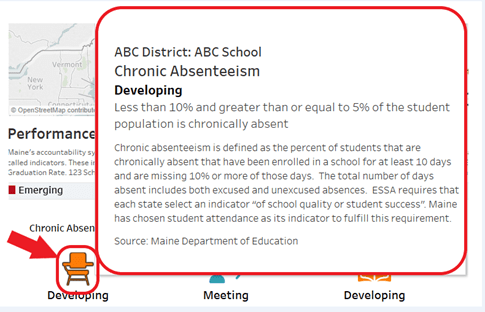
chronicabreportcard

Parents, educators and community members also have the opportunity to examine chronic absenteeism data by student group and to see the progress the school is making in reducing instances of chronic absenteeism school wide.
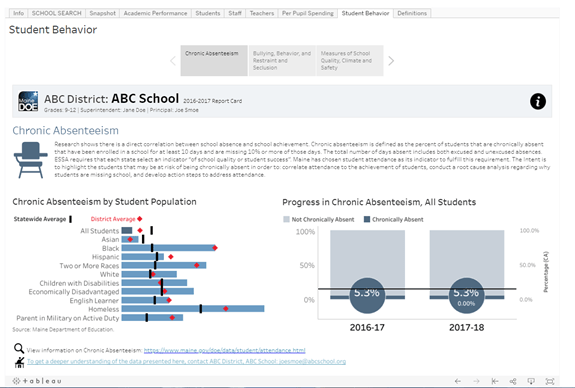
report card 2

Download the Maine DOE’s Chronic Absenteeism Info Graphic as an additional resource.

For further information or questions contact, Interim Director of Learning Systems Janette Kirk at (207) 624-6707 or Janette.Kirk@maine.gov.

October is National Farm to School Month

The Maine Department of Agriculture, Conservation, and Forestry (DACF) and the Maine Department of Education (DOE) join thousands of schools, farms, communities, and organizations across the country in celebrating National Farm to School Month. Maine is home to more than 8000 farmers and 185,000 students, making the partnership between schools and farmers an important part of the state’s agricultural landscape.

Over the last decade, more Maine schools have prioritized adding local foods to student menus. Many have developed school gardens and other education programs. In 2015, the USDA found that 79% of Maine school districts surveyed take part in farm to school activities. In that survey, school districts spent an average of 16% of their food budgets on local products, totaling $3.8 million statewide.

The Maine Department of Education supports Farm to School efforts by promoting local products during the annual Maine Harvest Lunch Week and Farm to School Cook-off, among other initiatives. According to Stephanie Stambach, the department’s Child Nutrition Consultant, “Students look forward to seeing local foods on the menu. When they know it is coming from a farm in their community they get excited, and it’s an educational opportunity. Students and parents seem increasingly aware of where their food comes from, and schools play an important role in supporting this awareness.”

Renee Page is the Maine Farm to School Network Coordinator. “Farm to School’s three-pronged approach includes agricultural-based education, experiential learning through gardens and greenhouses, and more Maine-grown food in school meals. These strategies help connect kids to their food and to farmers. They become savvier consumers and have better health and learning outcomes. These efforts also support the local food economy,” according to Page.

For farmers, schools can be important local customers. Martha Putnam, owner of Wealden Farm, is such a farmer. “Schools are a very good market. Working with them makes a difference and is a boost to farmers. It’s good for student awareness; they get to see the diversity of foods that Maine produces,” according to Putnam. Maine farmers and producers have provided local products to many schools across Maine, and have helped with annual programs such as Maine Harvest Lunch Week.

Schools across Maine provide local foods and nutrition education to their students, and many are eager to grow these efforts. In School Year 2019, students at more than 150 Maine schools will receive a variety of fruits and vegetables at no cost during the school day as part of the USDA Fresh Fruit and Vegetable Program (FFVP). Food service directors at schools participating in the FFVP program can be excellent partners for farmers, especially those who are new to selling to schools.

For more information, contact Maine DOE Child Nutrition Consultant Stephanie Stambach at 207-624-6732 or stephanie.stambach@maine.gov, Department of Agriculture, Conservation, and Forestry Marketing Director Leigh Hallett at 207-287-3494 or leigh.hallett@maine.gov, or Renee Page from Healthy Communities of the Capital Area at 207-588-5347 or r.page@hccame.org.

PRIORITY NOTICE: Seeking Public Comment for English Language Arts, Mathematics, and Career and Education Development Education Standards

As part of the scheduled periodic review of the Maine Learning Results, the Maine Department of Education is seeking public comments regarding the current English language arts, mathematics, and career and education development standards. Find links to each of the current standards below along with details for submitting comments.

Current Standards:

The standards review process opens with a public comment period and a public hearing prior to the convening of steering committees who are charged with reviewing all submitted comments and with developing blueprints for the revision of the state standards in their assigned content area. Once the blueprints are created, writing teams, consisting of pk-12 teachers who represent Maine’s cultural and geographical diversity, will assemble to draft the standards revisions.

Anyone may speak at the public hearings which will be live-streamed. People wishing to speak will be asked to sign in and it will be helpful, but not mandatory, to provide a written copy of comments.

Public hearings will occur on November 7th in room 103 at the Cross Building, 111 Sewell Street, Augusta, at the following times:

  • 2-4pm: Career and Education Development
  • 4-6pm: Mathematics
  • 6-8pm: English Language Arts

A link to the live-streamed hearings will be available prior to the public hearings.

Anyone unable to attend the public hearing may send written comments by 5 pm on December 1st, 2018. Written comments may be sent to Standards Review at sis.doe@maine.gov, or mailed to Beth Lambert, 23 SHS Station, Augusta, ME 04333.

Upcoming Maine Assessment Literacy Professional Development Opportunities

As part of the Maine DOE Assessment Literacy Professional Development series, a MAARS webinar and three in-person sessions focused on the eMPowerME assessment (grades 3-8) and science assessment (K-12) have been scheduled.

State Assessment & Released Items Professional Development

As part of the Maine DOE Assessment Literacy Professional Development series the Maine DOE will be hosting three regional sessions in Presque Isle, Bangor and Portland on November 13, 14 and 15, 2018 respectively. Where applicable, the DOE encourages that a team representative across grade spans be in attendance at the session. An opportunity for team time will be incorporated into the days agenda.

Each of the three (3) sessions will focus on the eMPowerME assessment (grades 3-8) and science assessment (K-12) and will include:

  • AM session will primarily focus on Confidential Reports in MAARS
    • Navigation within MAARS* to access data
    • Overview of the state assessment data
  • PM session will primarily focus on the utilization of released items
    • Review of released item data
    • An advanced session for data analysis
      • How this analysis can impact curriculum development and instructional practices

* DACs should ensure that staff attending have necessary permissions and log-in information to access MAARS.

The audience for this session is District Assessment Coordinators (DACs), teachers, principals, and central office staff. Registration begins at 8:30 am with the session beginning promptly at 9 am (until 3:30pm). Lunch will be provided.

Presque Isle – November 13, 2018

University of Maine at Presque Isle
Campus Center – Multipurpose Room
Parking map

Bangor – Orono – November 14, 2018

University of Maine
Wells Conference Center, Orono

Portland – November 15, 2018

Keeley’s Banquet Center
178 Warren Ave
Portland, ME 04103

To register for any of the regional MAARS Review and Released Item sessions please click here.

MAARS Webinar

October 31, 2018
10:00 – 11:00 am

The audience for this session is returning and new District Assessment Coordinators (DACs) and Career and Technical Education (CTE) Directors. The content of the webinar will include:

  • Role of DACs
  • MAARS Public Reports Overview
  • MAARS Confidential Reports Overview
  • How to add/delete/change MAARS roles and permissions (‘districtadmin’, ‘districtuser’ ‘schooluser’ ‘rosteruser’)

The updated above listed roles within MAARS will be a critical element to prepare for the upcoming November MAARS Workshops.

To access the October 31, webinar please use this link.

For questions contact Maine DOE’s Assessment Team at (207) 624-6770 or eric.buckhalter@maine.gov