2018 STEM Education Innovation Challenge Grant Competition for K-12 Educators

The Maine STEM Collaborative has announced the 2018 STEM Education Innovation Challenge Grant Competition to provide K-12 educators the opportunity to try out highly innovative ideas in STEM teaching and learning.

All K-12 teachers in STEM, arts, humanities, and social sciences are eligible to apply. Teachers are strongly encouraged to collaborate with informal educators, higher education faculty and staff, not-for-profit organizations and businesses to strengthen their applications and to maximize opportunities for success.

More detailed information, including a timeline, selection criteria, and the application process can be found on the Maine Space Grant Consortium website.  Applications are due no later than 5 p.m., Monday, October 15, 2018.

For more information visit the Maine Space Grant Consortium website or email mestemchallenge@gmail.com.

Reminder to Superintendents: Updating of District Assessment Coordinators (DAC) in NEO

As a reminder to superintendents, Maine DOE is currently in the process of releasing and reviewing assessment results from the 2017-2018 MEA test administration.  We will soon transition into sharing information about the upcoming 2018-19 test administration.

All critical communication regarding the Maine Educational Assessments (MEA) is sent to the individual listed as the District Assessment Coordinator (DAC) within District Roles in NEO.  Please verify the correct individual is listed in NEO. A current listing of DACs can be accessed by downloading the most current version here. (Attached excel of DACs as of today 9/10/18).

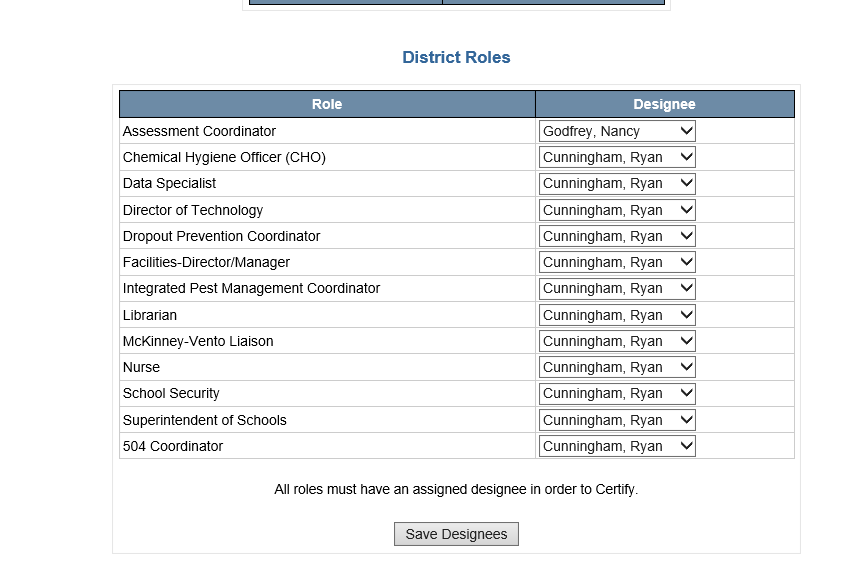
If the DAC listed is not accurate, please update DAC information within the District Roles Section on the certification page of the Staff Module of NEO.

  1. Log into NEO
  2. Go to Staff Module
  3. Click on certButton2 and choose Certification Report
  4. Scroll down to the bottom of the screen to the District Roles section
  5. Under Designee – click on the dropdown arrow and select the correct person that will be the District Assessment Coordinator (DAC). The person must already have another position for your district in NEO staff or the person will not show on the list.
    district roles.png
  6. Once the person is selected, Click the Save Designees button to save the information to the database.
  7. If you have issues with the NEO staff module, please send an email describing the problem to MEDMS.Helpdesk@maine.gov
  8. Any other questions can be directed to Eric Buckhalter, Management Analyst eric.buckhalter@maine.gov or 207-624-6770.

State Special Education Determination

The Individuals with Disabilities Education Act (IDEA) requires each state to develop a state performance plan/annual performance report (SPP/APR) that evaluates the state’s efforts to implement the requirements and purposes of Part B (ages 3 through 20) and Part C (birth to 3) of the IDEA and describes how the state will improve its implementation.

The SPP/APRs include indicators that measure child and family outcomes and other indicators that measure compliance with the requirements of the IDEA.

The Office of Special Education Programs (OSEP) uses information from the SPP/APR, information obtained through monitoring visits, and any other public information to annually determine if the state:

  • Meets requirements in implementing the requirements of the IDEA
  • Needs assistance in implementing the requirements of the IDEA
  • Needs intervention in implementing the requirements of the IDEA
  • Needs substantial intervention in implementing the requirements of the IDEA

For the 2016-17 school year (the most recent determination), OSEP determined that the Maine Department of Education (Maine DOE):

  • needs assistance in implementing the requirements of Part B of the IDEA;
  • and meets requirements in implementing the requirements of Part C of the IDEA.

As a result, the Maine DOE has accessed technical assistance provided by federally-funded agencies and is working with schools to improve student outcomes and implementation of the IDEA.

View each state’s determination letter and information on how the determinations were made.

Updated Special Education Forms

Several of the Maine DOE Special Education forms have been updated and an optional referral form for special education services has been developed.  All vendors have been notified of the changes. A complete list of the forms is available at the bottom of this notice. Below are the detailed changes to the forms:

The Revised IEP Form includes two changes:  The first change is in Section 7B of the IEP (Alternate Assessment).  This section now includes check boxes to ensure that this IEP Team determination is completed annually with the Participation Decision Flowchart.  If the IEP Team determines that the child shall take the alternate assessment, then a statement as to why the child cannot participate in the regular assessment and why the particular alternate assessment selected is appropriate should be included.   The second change is in Section 8 of the IEP (Special Education and Related Services).  This section now includes “Nursing Services” and “Behavioral Health Day Treatment” as related services.  If a child requires support from a behavioral health professional in a day treatment setting, the frequency of that support should not be considered in the calculation of the LRE percentage.  The frequency of this service is not in lieu of specially designed instruction, the frequency of this service is concurrent with special education and other related services.

The Written Notice includes an updated phone number for Southern Maine Parent Awareness which is listed in the resources for parents to contact in receiving assistance in understanding or obtaining the procedural safeguards.

The optional Seven-Day Waiver form was updated to include language to clarify that a description of proposals or refusals should be documented, not just proposals by the SAU.

The Speech/Language – Teacher Input forms were updated to include the same header as the other state forms.  These forms include teacher input for: Voice, Language, Functional Communication, Fluency, and Articulation.  These forms are considered optional, and are not required in the initial or re-evaluation of a child suspected of having a Speech or Language Impairment.

The Referral for Special Education Services form is now available.  This form provides an opportunity for the referring party to document academic and functional strengths and weaknesses of the child, relevant local and state assessment data, and attempted interventions.  This form is considered optional, and is not required in the referral of a child suspected of having deficits to the degree that requires special education services.

The Procedural Manual has been updated to provide guidance and clarity to the optional and required Maine DOE special education forms.  The effective date of the aforementioned forms and the Procedural Manual will be October 1, 2018.

Special Education Forms:

For more information contact Roberta Lucas at Roberta.lucas@maine.gov.


School Safety and Security Bulletin: If You See Something, Say Something

Throughout the 2018- 2019 school year, the Maine Department of Education, State Fire Marshal’s Office, Department of Health and Human Services, Maine State Police, Maine Sheriffs Association, Maine Chiefs of Police Association, and the Maine Emergency Management Agency will provide tips and resource information to Maine schools to help provide some guidance for identifying signs and preventing school violence.

School Safety and Security Bulletin  – September 2018

Further questions and inquiries can be send to Pat Hinkley, Maine DOE Transportation and Facilities Administrator at pat.hinckley@maine.gov.

Interactive Workshop on the Legal Rights of English Learners

All educators are invited to attend this workshop which will provide participants with information regarding the legal responsibilities of schools serving English learners. Districts receiving federal funds under Title I and/or Title III of the Elementary and Secondary Education (ESEA) are strongly encouraged to participate in this workshop, as it will clarify the core requirements for English learner programming that must be met before supplemental federal funds may be utilized.

The workshop, facilitated by Charo Basterra, Vice President of the Mid-Atlantic Equity Consortium (MAEC), will include practical applications, scenarios, and tools that promote appropriate implementation of practices to address the needs and rights of English learners. MAEC is one of four regional technical assistance centers funded by the United States Department of Education.

Three contact hours will be available upon completion of a feedback survey. Wireless internet and free parking will be available, either on campus or at an off-campus parking lot connected by a free shuttle service. The ESEA Title III office of the Maine Department of Education is sponsoring this event and there is no registration fee.

Date: September 20, 2018

Time: 9:00am-12:00pm

Location:
University of New England
Innovation Hall
716 Stevens Avenue
Portland, ME 04103

Register Now

If you have any questions about this workshop, please contact April Perkins, Director of ESOL/Bilingual Programs, at april.perkins@maine.gov or (207)624-6627.

Administrative Letter: Annual Notification of Eligibility for Schoolwide Programs that Include Students with Disabilities

Administrative Letter: #18
Policy Code:  BGE
To: District and School Administrators, Special Education Directors
From: Robert G. Hasson, Jr., Ed. D., Commissioner
Date: September 5, 2018
Subject: Annual Notification of Eligibility for Schoolwide Programs that Include Students with Disabilities

Schools that receive federal Title I funds, have poverty rates of at least 40 percent and have approved Title IA Schoolwide Plans are eligible to use their Title I funds – and funds from other sources – to develop “schoolwide programs.”

Schoolwide programs are comprehensive reform strategies aimed at raising the achievement levels of all students.

To facilitate the inclusion of students with disabilities in schoolwide programs, the Individuals with Disabilities Education Act (IDEA) and the federal regulations at 34 CFR §300.206(a) allow school administrative units (SAU) to use a portion of the funds they receive under Part B of IDEA for any fiscal year to fund such schoolwide programs.

SAUs can use those funds as long as students with disabilities receive the services to which they are entitled under their Individualized Education Programs and that are guaranteed under IDEA.

The amount of Part B funds a school expends for schoolwide programs cannot exceed the amount the SAU has received for that fiscal year, divided by the number of children with disabilities in that unit, multiplied by the number of children with disabilities participating in the schoolwide program.

For more information visit Maine DOE’s ESSA Webpages or contact Maine DOE’s Title IA Data Specialist Daniel Weeks at daniel.r.weeks@maine.gov, or Director of Special Services Jan Breton at janice.breton@maine.gov.

Assessment Professional Development and Learning

During the month of July, Department staff engaged in the review of submitted Comprehensive Needs Assessment (CNA)/SAU Consolidated Plans. All submitted plans have been reviewed and the Department continues final synthesis of review notes and team meetings in order to provide meaningful feedback to districts.

Cross team discussions during the review of submitted district CNAs/SAU Consolidated Plans afforded the Maine DOE  a unique opportunity to identify trends in challenges and successes experienced by  schools and districts across the state.  As a result of this review, the Department has developed a series of professional development and learning opportunities related to assessment and instructional practice. Full details including the list of dates will soon be available on the Maine DOE Professional Development & Training Calendar – at this time a listing can viewed in the following downloadable excel listing:

2018 Professional Development & Learning Opportunities (excel)

The first session of the series will be conducted via webinar and will focus on a Balanced Assessment System. This session will include an overview of the planned opportunities and timeline in addition to reviewing the key components of a Balanced Assessment System. Registration details regarding this session can be found below.

Session: Balanced Assessment Systems
Location: Webinar
Date & Time: September 26, 2018 at 2 pm
Join the Webinar (no registration necessary)

For further information please contact Janette Kirk, Deputy Director, Office of Learning Systems at Janette.Kirk@maine.gov or 624-6707.


ESSA Implementation and Report Card Release #success4ME

Formerly known as No Child Left Behind, the federal Elementary and Secondary Education Act (ESEA) of 1965 was reauthorized as the Every Student Succeeds Act (ESSA) in December, 2015.

During the fall of 2018, the Maine Department of Education (DOE) will begin implementation of ESSA including the rollout of Maine’s Model of School Supports and the public release of the Maine’s School Report Cards.

The reauthorization of ESSA provides Maine with the opportunity to develop and refine Maine’s strategic vision for education and provides flexibility for Maine to develop an accountability system known as Maine’s Model of School Supports, which incorporates measures of success beyond that of academic assessment data.

Over the coming weeks and months, in on-going communications from the Maine DOE Newsroom; official social media sites Facebook and Twitter (with use of the hash tag #success4ME); and in-person meetings throughout the State, the Maine DOE will be providing updates and information regarding Maine’s Model of Support, why it matters, and how it impacts schools and students.

In addition, the Department will be providing workshop sessions across the state for principals and school leaders to learn more about the School Report Card Dashboard and the Model of School Supports.  Registration information will be forthcoming.

Anticipated Timeline

  • September 2018 – January 2019 (and beyond): Ongoing communications via the Maine DOE Newsroom and in-person meetings scheduled throughout the State to prepare local officials and communities for the release of the implementation of ESSA and the public release of the report cards.
  • October 15, 2018: Confidential release of Maine Educational Assessment (MEA) student results with three weeks for districts to review and verify the data.
  • November 5, 2018: Public release of MEA student results.
  • November 2018: Internally, the Department will run the final and full 2017/2018 data through the Model of School Supports to check for accuracy.
  • December 2018: Confidential preview of School Report Cards for districts and schools followed by the public release of the School Report Cards.
  • January 2019: Department staff will meet with schools identified for tier III supports at regional meetings held throughout the State.


For further information, please contact Janette Kirk, Deputy Director, Office of Learning Systems at Janette.Kirk@maine.gov or 624-6707.


Helpdesk Ticketing and Immediate Communication Procedures

Due to recent Data Team staff departures, the Maine Department of Education (DOE) Helpdesk currently has only one fulltime dedicated staff member, with augmented assistance from other members of the Data Team. While the Department is in the process of hiring additional staff, we ask that communications to the Helpdesk be submitted via email at MEDMs.helpdesk@maine.gov.

Emails to the Helpdesk automatically generate into a ticket tracking system, receive a ticket number, and will be answered in the order that they are received. The tickets and emails can be used for training new staff while not requiring the end user to sit on hold for an answer. The emails can also be forwarded to other Maine DOE staff for assistance.

If your situation does require verbal communication, you can record that in the email ticket and the Helpdesk will call you back.

It is anticipated that full staffing of the Helpdesk will resume by October 2018, and at that time we welcome calls for immediate assistance.

The Maine DOE and its Data Team appreciate your patience and understanding during this transition period.