What Really Works in Education 2023 Conference: High Leverage Practices & Collaboration for Inclusive Classrooms

Are you looking for strategies, tips, and practical techniques around high-leverage instructional practices and collaboration that work with diverse learners to create Inclusive Classrooms?  This conference is for you and your team!

For the first time ever, the popular What Really Works in Education conference is coming to Maine!  This year’s conference, hosted by the Maine Department of Education’s Office of Special Services and Inclusive Education, will engage learners around high-leverage practices by local, national, and international experts.

Participants will leave with tips, tricks, strategies, and tools to add to their educational toolkit from each session in the conference.

The one-day event will feature strategies on Collaboration and Inclusion for administrators, general and special education teachers, preservice educators, educational technicians, and related service personnel including strands on Collaboration and Behavior and Collaboration and Academics.

  • Date:  Wednesday, October 4, 2023
  • Location: University of Maine Augusta
  • Cost: $50 per participant which includes breakfast, lunch, and a copy of the 2023 book of Connecting High Leverage Practices to Student Success: Collaboration in Inclusive Classrooms (Jenkins & Murawski).
  • Register for the conference here.
  • For more information visit the Inclusion Conference website.

Keynote Speakers 

Dr. Wendy W. Murawski

Wendy W. Murawski, PhD, is the Executive Director and Eisner Endowed Chair for the Center for Teaching and Learning at California State University, Northridge (CSUN), where she is also a professor in the Department of Special Education and the Director of SIMPACT Immersive Learning. Dr. Murawski is the national Past President of the Teacher Education Division (TED) of CEC and award-winning researcher, author, and educator, including Teacher Educator of the Year for the state of California. Dr. Murawski holds an EdS, MEd, and MBA and  is an internationally known speaker and frequently requested keynote speaker, presenting in Europe, Asia, Africa, and North America. She has published extensively around inclusive education, co-teaching, collaboration, and Universal Design for Learning, including 18 books and numerous chapters, blogs, and peer-reviewed articles. Prior to higher education, she was a general and special education teacher in Virginia and in California. Currently, Dr. Murawski is the CEO of 2 TEACHâ (www.2TeachLLC.com), an educational consulting company dedicated to promoting inclusive education, and 2 TEACHâ Global, championing inclusive education around the world.

Dr. Melissa C. Jenkins

Melissa C. Jenkins, PhD, is an assistant professor of Special Education at the University of Mary Washington in Fredericksburg, VA and co-author of Connecting High-Leverage Practices to Student Success: Collaboration in Inclusive Classrooms. She brings over 18 years of public school experience to her role as a teacher educator, having worked in Virginia public schools as a special education teacher, instructional coach, and central office administrator. Dr. Jenkins is dedicated to helping educators bring high-quality, inclusive practices to schools. She is also a consultant with 2 TEACHâ Global educational consulting. She loves speaking and writing about collaborative practices, early mathematics intervention, and positive behavioral support. When not working, Melissa enjoys practicing yoga to find literal and figurative balance in life.

Why Inclusion?

The federal Individuals with Disabilities Act (IDEA) requires that each public agency (SAU) must ensure that to the maximum extent appropriate, children with disabilities, including children in public or private institutions or other care facilities, are educated with children who are nondisabled; and special classes, separate schooling, or other removal of children with disabilities from the regular educational environment occurs only if the nature or severity of the disability is such that education in regular classes with the use of supplementary aids and services cannot be achieved satisfactorily. §300.114

Over 20 years of research studies have consistently demonstrated that the inclusion of students with disabilities in general education classrooms results in favorable academic, social, and economic outcomes. This includes positive benefits for typical peers in classrooms who benefit from involvement and relationships with students who have disabilities in inclusive settings.

Effectively including students with disabilities in the general education classroom requires teachers and school administrators to further develop an understanding of the individual strengths and needs of the whole student.

For more information about Inclusion in Maine or the What Really Works in Education conference, contact Tracy Whitlock at tracy.w.whitlock@maine.gov.

Lamoine Students First Middle School Students from Maine to Compete at National SkillsUSA Competition in Atlanta

In June, three students from Lamoine Consolidated School’s Team Engineering Challenge team made history by being the first middle school team to go to Atlanta, Georgia to compete at the National Leadership and SkillsUSA Conference. Benjamin Baldridge, Ian Frost, and Jordan Chan fundraised over $10,000 to attend the weeklong conference and compete in the world’s largest skill competition after winning gold at the State Championships in Bangor back in March.

“The Team Engineering Contest is designed to evaluate and recognize outstanding students for excellence and professionalism in the areas of critical and creative thinking skills and the decision-making process to solve a problem,” said Lamoine teacher Miranda Engstrom who accompanied the team to Atlanta. “The contest fosters creativity, innovation, teamwork, and problem-solving skills.” Students demonstrate an occupational skill and present a clear explanation of the topic through displays, examples, experiments, and practical testing operations.

The conference and competition ran from June 19-24 with students competing for 16 hours over the course of three days. The Lamoine students earned 9th place overall, and students also earned special Skill Point Certificates for meeting a threshold contest score. Students can then use these certificates in their employment portfolios to show proficiency and workplace readiness for a particular specialty.

These students are three of 42 middle school Career and Technical Education (CTE) students at Lamoine who compete at the Maine SkillsUSA competition. They are excited to attend the Maine State Leadership Conference again next March and try to qualify for Nationals again.

“They are excited to share with their peers and teachers all they learned during their conference and showcase their treasures they collected when we were in Atlanta,” said Engstrom. “They wish to thank the many generous donors that helped them fundraise to get them there, helped them grow as leaders and thinkers, and make memories that will last a lifetime.”

Maine DOE Update – August 4, 2023

From the Maine Department of Education


Reporting Items

Open Reports: Graduation Certification Report and Staff Certification Report

Graduation Certification – The Graduation Certification Report is now open in NEO and available for certification. The Maine Department of Education (DOE) Data Team hosted a webinar on Tuesday, August 1st regarding this report, and the recording is available on the Maine DOE Data Team YouTube Channel. |  More

| Visit the DC&R Reporting Calendar |


News & Updates

Maine Department of Education Hosts 1st Computer Science Summer Institute

Nearly 100 educators from across the state attended a multi-day institute in July, focused around computer science education. Educators spent two and a half days engaging in sessions and collaborating to integrate computer science into their classrooms and upcoming school year activities. Topics included Robotics & Programming, Coding & Hardware, Augmented & Virtual Reality, and much more! |  More

Share Your Good News! Maine DOE Seeking to Highlight ESSER Federal Emergency Relief Funding Projects

The Maine Department of Education (DOE) is looking to share stories of school administrative units (SAUs) using Federal Emergency Relief Funding to positively impact their students and school communities. |  More

Teacher Shortage Areas For 2023-2024 School Year

The U.S. Department of Education (USDOE) annually designates teacher shortage areas for the purposes of deferment of loan repayments or reductions of teaching obligation. The Maine Department of Education (DOE) recently requested input regarding designated teacher shortage areas for federal reporting and would like to thank all those who submitted information during the comment period. |  More

Resources Available for WIDA ELD Standards

On May 25, 2021 the Maine Department of Education announced through a Priority Notice its adoption of the WIDA English Language Development Standards Framework, 2020 Edition as a critical companion to the Maine Learning Results. WIDA’s ELD Standards Framework, 2020 Edition, serves as a foundation for systems that foster engaged interactive student learning and collaborative educator practice. |  More

Unraveling Roots: Cultivating Genealogy as an Instructive Journey

At the end of June, a group of teachers met to learn about using genealogy to teach inclusive history with Dustin Axe, the Youth Genealogy Curriculum Coordinator with the New England Historic Genealogical Society (NEHGS). This workshop kicked off the American Ancestors pilot that supports teacher planning for inclusive historical inquiry projects using genealogy. During the next school year, teachers in this pilot program will participate in monthly virtual meetings to deepen their understanding of this work and to collaborate with each other.|  More

MCI Teacher Ethan Brownell Named 2023 Maine History Teacher of the Year

Ethan Brownell, at teacher at the Maine Central Institute (MCI), has been named the 2023 Maine History Teacher of the Year, an award presented annually by the Gilder Lehrman Institute of American History, the nation’s leading organization dedicated to K-12 American history education.  |  More

Build Academic and Social Emotional Skills with SpiritCorps Maine (Funded Through ARP Grant)

Through a partnership with Spirit Series, the Maine Department of Education is offering SpiritCorps, a three-week, project-based, narrative writing and self-discovery program designed for students from 7th to 10th grade. First-time participating schools receive 100% funding through January 1, 2024, thanks to a federal ARP grant. Openings for the fall remain available on a first-come, first-served basis! |  More


Maine Schools Sharing Success Stories

| Submit your Maine School Success Story |


Professional Development, Training, and Events

Professional Learning Series: Conceptual Classrooms & Educational Programs for Teachers

The Maine Department of Education (DOE) Interdisciplinary Instruction (II) Team is excited to introduce “Conceptual Classrooms & Educational Programs for Teachers” (ConCEPT), an innovative initiative aimed at enhancing your teaching practices and student engagement through concept-based inquiry strategies. Grounded in evidence-based research, this program offers a comprehensive learning experience that will equip you with valuable tools and knowledge to transform your classroom approach. |  More

| Visit the Professional Development Calendar |


Latest DOE Career/Project Opportunities:

View current Maine Department of Education employment opportunities here


Professional Learning Series: Conceptual Classrooms & Educational Programs for Teachers

The Maine Department of Education (DOE) Interdisciplinary Instruction (II) Team is excited to introduce “Conceptual Classrooms & Educational Programs for Teachers” (ConCEPT), an innovative initiative aimed at enhancing your teaching practices and student engagement through concept-based inquiry strategies. Grounded in evidence-based research, this program offers a comprehensive learning experience that will equip you with valuable tools and knowledge to transform your classroom approach.

What does ConCEPT offer?

  • Connection to Research: Discover evidence-based strategies and practices that support effective concept-based inquiry in the classroom.
  • Mapping and Planning: Learn how to design curriculum and instruction using concept-based frameworks, empowering your students’ learning journey.
  • Collaboration: Engage in collaborative activities and discussions with fellow educators, fostering a community of shared ideas and experiences.
  • Sustainable Change Leadership: Acquire leadership skills to drive sustainable educational change in your school community.
  • Customization: Tailor your learning experience to suit your team’s unique pathway, ensuring maximum impact on your teaching practices.

Why should you participate in ConCEPT?

  • Enhanced Curriculum Design: Develop concept-based inquiry curriculum and instruction design skills that align with the latest educational standards.
  • Strengthened Pedagogical and Content Knowledge: Deepen your understanding of both pedagogy and content across various subject areas.
  • Active Learning Strategies: Discover dynamic and engaging active learning strategies to invigorate your classroom environment.
  • Take Away Ideas and Materials: Gain valuable resources, ideas, and materials to enrich your teaching practices.
  • Integrated SEL Strategies: Learn how to integrate Social-Emotional Learning (SEL) effective strategies to create a nurturing and inclusive classroom atmosphere.
  • Learning from National Experts: Benefit from the expertise of renowned national educators who will guide and inspire you throughout the program.

Who is ConCEPT designed for?

ConCEPT is open to teams of 3-6 members from K-12 schools. Participants may include Classroom Teachers, Instructional Coaches, Curriculum Coordinators, and other Administrators (Superintendent/Principal). Teams must include at least one Classroom Teacher and at least one Administrator (e.g., Coach, Coordinator, building/district Supervisor, etc.). The rest of the team may be made up of any combination of participants.

Program Details:

  • Cost: Participation in ConCEPT is entirely free!
  • Contact Hours: You can earn up to 24 contact hours during the program.
  • Reimbursement: Districts/schools are eligible for reimbursement of costs associated with planning, such as substitutes or after-contract hours, up to $5000.
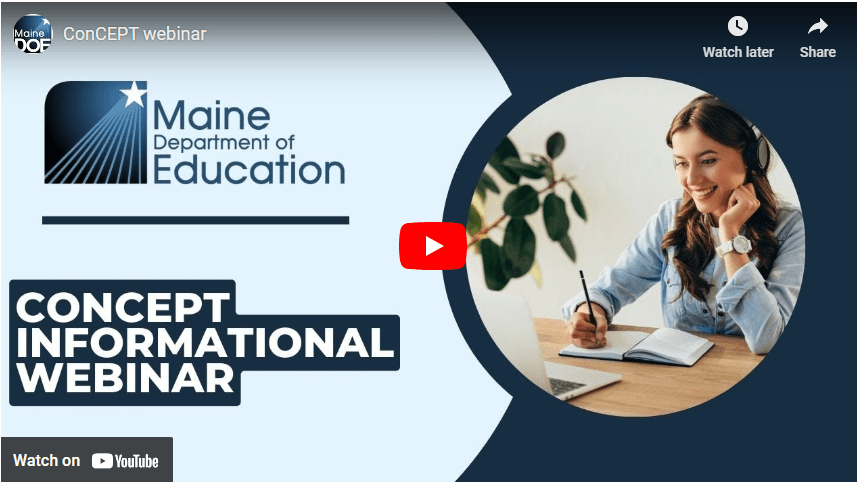
  • The II team will be offering a series of informational webinars dedicated to providing comprehensive insights into the ConCEPT pilot program. These live webinars are scheduled to take place during the last week of August and will be recorded for accessibility throughout September.
  • The application period will be open throughout the entire month of September.

Join us in this exciting educational journey that will empower you to create enriching concept-based learning experiences for your students. We look forward to seeing you continue to thrive as educators and positively impact your classrooms and school communities.

We look forward to sharing further details about the webinar schedule and registration process soon. Stay tuned for updates on our website and social media channels.  School administrators and educators are encouraged to visit the Maine DOE Interdisciplinary Instruction team’s website during the month of September to access the application form and learn more about the selection criteria and ConCEPT pilot program requirements. Don’t miss the chance to part of a transformative educational pilot that will support positive change

For further information or to enroll in the ConCEPT program, please contact Kathy Bertini, the Interdisciplinary Instruction Team Coordinator, at (207) 816-0294 or kathy.bertini@maine.gov. You can also visit the Maine DOE website for additional details.

MCI Teacher Ethan Brownell Named 2023 Maine History Teacher of the Year

Ethan Brownell, at teacher at the Maine Central Institute (MCI), has been named the 2023 Maine History Teacher of the Year, an award presented annually by the Gilder Lehrman Institute of American History, the nation’s leading organization dedicated to K-12 American history education.

Brownell has been teaching for 12 years – 10 of which have been at MCI where he currently teaches AP US History, AP US Government and Politics, Model UN, Sociology, and 11th grade American History & Government. Additionally, he advises the Model UN and Youth & Government and co-advises the tabletop gaming club.

Inaugurated in 2004 and now celebrating its twentieth anniversary, the History Teacher of the Year Award highlights the crucial importance of history education by honoring exceptional American history teachers from elementary school through high school. The award honors one K–12 teacher from each state, the District of Columbia, Department of Defense schools, and US Territories.

In addition to a $1,000 honorarium, Brownell receives a core archive of American history books and Gilder Lehrman educational materials, recognition at a local ceremony in their honor, and becomes one of 53 finalists for the 2023 National History Teacher of the Year Award. In fall 2023, ten finalists for the National History Teacher of the Year will be announced.

Brownell believes that teaching social studies “helps us examine the human experience in all its beauty and ugliness. History, geography, and civics help us to understand the world we live in and those we share it with. We learn critical skills to help us contextualize events and communicate with each other in a hyper-connected world. Also, it’s just fun to study the past and it’s stories. The more we know about human experience, the more interesting we, the world, and each other will be – it’s a beautiful feedback loop.”

“I love to talk about things that I care and that my students care about,” Brownell shared. “I have the privilege to teach a wonderfully diverse set of students, and it’s amazing to see them sharing their own experiences across time and space. Model UN and Youth & Government are amazing vehicles for this: seeing my students engage with others from around the state on vital issues past, present, and future makes me hopeful.”

Brownell is honored to be recognized through this award. “My first experience with the Gilder Lehrman Institute was at their Reconstruction summer institute with Eric Foner and Martha S. Jones. It was an amazing week doing one of my favorite things: being a student and learning in a collaborative atmosphere. It means a lot to be recognized by an organization that helped me so much in my own practice.”

In order to be considered for the History Teacher of the Year award, eligible teachers must first be nominated by a colleague, parent, or student. After receiving a nomination, teachers must submit a resume, teaching materials, and a letter of recommendation to be considered for the state award. History Teacher of the Year winners are selected by a committee of educators and education professionals in their state. For more information on the award process, visit the Gilder Lehrman Institute website.


Resources Available for WIDA ELD Standards

On May 25, 2021 the Maine Department of Education announced through a Priority Notice its adoption of the WIDA English Language Development Standards Framework, 2020 Edition as a critical companion to the Maine Learning Results. WIDA’s ELD Standards Framework, 2020 Edition, serves as a foundation for systems that foster engaged interactive student learning and collaborative educator practice. The Framework is centered on equity for all students and fosters the assets, contributions, and potential of culturally and linguistically diverse children and youth. It also provides a clear and coherent structure to guide the development of curriculum, instruction, and assessment of content-driven English language learning.

As you continue to implement the WIDA ELD Standards Framework, 2020 Edition in your educational setting, the Maine Department of Education would like to make you aware of several resources which may support your work.

New guidance for educators and administrators implementing the WIDA ELD Standards Framework

  • WIDA recently launched two new implementation guides to support educators and administrators as they implement the WIDA ELD Standards Framework.
    •  The WIDA ELD Standards Framework Implementation Guide is designed specifically for classroom teachers and instructional leaders, as well as other professionals who work with multilingual learners. It includes guidance about planning for language development in units and lessons, sample resources, and ideas for what implementation of the Framework could look like in practice.
    • This guide is accompanied by an Administrator Supplement focusing on programmatic aspects of systemic ELD standards implementation for school and district administrators.
  • All Maine educators may access WIDA’s excellent virtual, self-paced eWorkshops through their WIDA account.
    • Click here to read about how to get started with WIDA’s eWorkshop The WIDA ELD Standards Framework: A Collaborative Approach
    • This eWorkshop explores ways to use the WIDA ELD Standards Framework, 2020 Edition to support multilingual learners’ achievement and language development It contains many wonderful examples and videos demonstrating how the implementation looks in a classroom setting. For K-12 educators. Time to complete: 4 hours
    • Contact hours are available through WIDA upon completion of all eWorkshops
  • The Maine Department of Education has the following asynchronous professional learning opportunities for deepening your knowledge about the WIDA ELD Standards:

The State ESOL Specialist is available to support you directly through technical assistance calls and in-person professional learning opportunities. 

For further information please contact Jane Armstrong, State ESOL Specialist, jane.armstrong@maine.gov.

Open Reports: Graduation Certification Report and Staff Certification Report

Graduation Certification – The Graduation Certification Report is now open in NEO and available for certification. The Maine Department of Education (DOE) Data Team hosted a webinar on Tuesday, August 1st regarding this report, and the recording is available on the Maine DOE Data Team YouTube Channel.

Due Date: August 15th

Resources:

Staff Certification – All staff in the NEO Staff module for all districts have been rolled over to the new school year in Pending Status. All staff will need to be reviewed, updated, or deleted in NEO Staff for the current school year. Update email addresses and phone numbers for district personnel, this information is used by the Maine DOE to contact proper individuals for various purposes. Years of experience increment automatically for individuals with previous experience in a position.

A webinar about this year’s report will be hosted on Tuesday, October 3rd at 10 am. Please join the webinar at the specified time using this link: EPS – Staff Certification Webinar.

Reporting Resources:

For training in the completion of these reports please contact Data Quality Trainer Alexandra.Cookson@maine.gov or call 207-446-3897

For issues with reports in Synergy and/or NEO please contact MEDMS.Helpdesk@maine.gov or call 207-624-6896

Maine Department of Education Hosts 1st Computer Science Summer Institute

Nearly 100 educators from across the state attended a multi-day institute in July, focused around computer science education. Educators spent two and a half days engaging in sessions and collaborating to integrate computer science into their classrooms and upcoming school year activities. Topics included Robotics & Programming, Coding & Hardware, Augmented & Virtual Reality, and much more!

These educators also spent some time exploring connections between the mobile computer science labs and SLAM clubs at their schools to help leverage the mobile lab technology to promote student leadership and engage students as experts with the mobile labs.

Check out this video to learn more about the CS Summer Institute.

These educators will be sharing some of the awesome computer science learning experiences they’ve been creating at the CS Ed Showcase on August 17th. For more information about the CS Ed Showcase, check out this article.

#MaineTeachesCS #CSISummerInstitute #MLTI #MLTISLAM

If you have questions or would like to know more about computer science education in Maine, contact the (Acting) Learning Through Technology Coordinator and Computer Science Specialist, Emma-Marie Banks at emma-marie.banks@maine.gov

This event was funded by the Governor’s Emergency Education Relief Funding (GEER).

Teacher Shortage Areas For 2023-2024 School Year 

The U.S. Department of Education (USDOE) annually designates teacher shortage areas for the purposes of deferment of loan repayments or reductions of teaching obligation. The Maine Department of Education (DOE) recently requested input regarding designated teacher shortage areas for federal reporting and would like to thank all those who submitted information during the comment period. The comments related to teacher shortage enabled the DOE to add additional teaching endorsements to the USDOE proposal. The following are PreK-12 teacher shortage areas for the 2023-2024 school year:

  • General Elementary
  • Early Childhood
  • English for Speakers of Other Languages
  • English/Language Arts (Middle and Secondary Level)
  • Mathematics (Middle and Secondary Level)
  • Science-Physical (Secondary Level)
  • Science-Life (Secondary Level)
  • Science (Middle Level)
  • Physical Education
  • World Languages
  • Visual Arts
  • Teacher of Students with Disabilities (See note below.)

In Maine, the annual teacher shortage list is utilized by the DOE to determine which endorsements are eligible for an emergency certificate.  It should be noted, however, that on October 4, 2022, the U.S. Department of Education Office of Special Education Programs (OSEP) released a memorandum to clarify the requirements of IDEA Part B, which outlines the expectations for the preparation and training of all special education teachers nationwide. Noted in the memo, special education certification or licensure requirements may not be waived.

For federal purposes, the benefits to student financial aid recipients, such as loan cancellations, are indicated in the following regulatory provisions:

  • 34 CFR 682.210(b)(5)(ii), (b)(7), (q), and (s) enable a borrower who had no outstanding Federal Family Education Loan (FFEL) Program loan on July 1, 1987,  but who had an outstanding FFEL Program loan on July 1, 1993, to qualify for deferment of loan repayment under the Stafford Loan Program anytime within the life of the borrower’s loan(s) for up to three years of service as a full-time teacher in a private elementary or secondary school in a teacher shortage area designated by the Department, and as certified by the chief administrative officer of the particular school in which the borrower is teaching;
  • 34 CFR 674.53(c) enables Federal Perkins Loan borrowers who are full-time teachers of mathematics, science, foreign languages, bilingual education, or any other field of expertise where the State educational agency determined there is a shortage of qualified teachers to qualify for cancellation of up to 100 percent of the outstanding balance on the borrower’s Federal Perkins loans; and
  • 34 CFR 686.12(d) enables grant recipients to fulfill their teaching obligation under the Teacher Education Assistance for College and Higher Education (TEACH) Grant Program (regarding the requirement to serve at least four academic years, within eight years of graduation) by teaching in a “high-need field,” which includes academic disciplines/subject areas identified as teacher shortage areas at the time the grant recipient begins teaching in that field.

Stafford Loan and Supplemental Loans for Students (SLS) borrowers who have questions concerning their loans, including the teacher shortage area deferment, can contact the Federal Student Aid Hotline at 1-800-4FED-AID.

Federal Perkins Loan borrowers should contact the school where they received the loan.

For questions related to the 2023-2024 shortage areas, please contact Michael Perry, Acting Director, Office of Higher Education and Educator Support Services, at michael.t.perry@maine.gov.

Unraveling Roots: Cultivating Genealogy as an Instructive Journey

At the end of June, a group of teachers met to learn about using genealogy to teach inclusive history with Dustin Axe, the Youth Genealogy Curriculum Coordinator with the New England Historic Genealogical Society (NEHGS).  This workshop kicked off the American Ancestors pilot that supports teacher planning for inclusive historical inquiry projects using genealogy.  During the next school year, teachers in this pilot program will participate in monthly virtual meetings to deepen their understanding of this work and to collaborate with each other. Twice a year, teachers will meet with NEHGS in one-on-one meetings that are personalized to their instructional needs.  There will also be a monthly professional learning community led by the Maine Department of Education for teachers to collaborate and share their work.

As many teachers know, teaching genealogy can be challenging.  By focusing instruction on critical research and thinking skills, teachers learned how to empower students to make personal connections to history by connecting to the process of historical inquiry instead of the product.  As one teacher commented, “I loved all the resources available online for schools and the multiple levels of scaffolding that were available. [Dustin] did an excellent job at making this accessible to all learners regardless of their circumstances, but also gave us a framework for research/investigations that can be applied to any topic.” According to NEHGS, research finds that genealogy can help students’ well-being and connect them to their communities when it is done well.  The free resources from NEHGS support high-quality genealogical practices.

One strategy to make genealogy more accessible is to look at the lives of other people, particularly those who have impacted their community. NEHGS developed several case studies of key figures in American history, as well as important Mainers, like Gerald Talbot and Samantha Smith. Rooted in inquiry-based practices, the skills and processes learned by doing genealogical research can help students learn about important events for communities that place more value on the collective. In this way, many of the resources provided by NEHGS can help teachers develop inclusive lessons that can meet the requirements of state mandates regarding Wabanaki and African-American studies and the history of genocide including the Holocaust.  “I had not considered using genealogy with my students, but I now see that it can be a good way to connect to my students and for them to connect with history,” remarked a teacher after the workshop.

For more information about the American Ancestors program, check out www.AmericanAncestors.org/Family-History-Curriculum or contact Dustin Axe at dustin.axe@nehgs.org

The Maine DOE encourages all schools and districts across the State of Maine to learn more about interdisciplinary instruction on our website or by contacting the Interdisciplinary Instruction Team Coordinator at Kathy.bertini@maine.gov