Students, Parents, and Schools Celebrate School Bus Driver Appreciation Week Oct. 22-26

A school bus driver’s career is about safely delivering the world’s most precious cargo – our students. Making a positive difference in the life of a child is what motivates school bus drivers.

Locally, parents, teachers, and superintendents celebrate National School Bus Driver Appreciation Week by making special cards, delivering special snacks, talking with drivers about how much their commitment to student safety means to families, schools, and the community, and learning about a day in the life of a school bus driver. School district transportation directors celebrate National School Bus Driver Appreciation Week by providing driver safety training at the district. It’s all about safety first.

Historically, Maine schools celebrate National School Bus Driver Appreciation Week during National School Bus Safety Week which occurs annually during the third week in October. It is a time for Mainers to reflect upon the outstanding job performance of our school bus drivers who transport students to and from school and school related events throughout the year traveling over 30 million miles of urban and rural roads. In Maine about 80 percent of students ride the school bus which is much higher than the national average of 50 percent.

School bus drivers provide an essential service. They are responsible for conserving the comfort, safety, and welfare of students they transport. Should a critical incident occur that requires student relocation, school bus drivers will be called on to deliver students to a safe haven.

A typical day in the life of a school bus driver means arriving early, performing daily pre-trip bus inspections, knowing what students ride the bus, where each student lives, and what school each student attends. During the day drivers may deliver students to field trips or education events and they may work at the school as a bus technician, safety officer, software technician, or custodian. At the end of each day the driver performs a post-trip bus clear and inspection to secure the bus in preparation for the next day.

School bus drivers like to drive, enjoy working with students, care about children’s safety, have great people skills, remain calm under pressure, and have flexible or full-time work schedules. School bus drivers must receive a commercial motor vehicle (CMV) commercial driver’s license (CDL) with school bus S and passenger P endorsement. This requires additional driving and skills tests that are administered by a certified examiner. School bus drivers must pass federally regulated skills and knowledge evaluations which are conducted with a written and driving exam. Federal regulations require random drug testing. Maine regulations require a background check and physical exam to determine driver fitness for duty. Important qualities for school bus drivers are good customer services skills, normal hand-eye coordination, good hearing and visual ability, patience, and good physical health. School bus drivers are the first school employee students see at the beginning of each school day and the last one they see at the end of the school day.

For information about how to become a school bus driver contact the Maine Association for Pupil Transportation (MAPT) http://www.maptme.org/.

Maine Schools Join Others Around The Nation to Recognize National School Bus Safety Week October 22-26

National School Bus Safety Week, scheduled October 22-26 this year, is a public education program that promotes school bus safety.

Nationally, each day about 480,000 school buses travel the nation’s roads transporting about 25,000,000 students to and from schools and school-related activities. This makes school buses the largest mass transportation program in the nation.

studentPoster

2018 National School Bus Safety Week theme: My Driver – My Safety Hero.  The theme is derived from the Poster contest the year before.  The 2017 winning poster, depicted above, was drawn by Aumkar Patel, a 5th Grader at Henry County Schools in McDonough, GA.

In Maine, there are about 3,000 school buses traveling about 30,000,000 miles per year and delivering about 140,000 students. While national ridership of school buses is at 50 percent, about 80 percent of Maine students ride the school bus. Local school transportation teams throughout Maine will educate the public about school bus safety and local transportation safety training during National School Bus Safety Week.

Transportation is a great equalizer in education, providing students from all economic backgrounds with the opportunity to learn and succeed. Additionally, as pointed out by the National Highway Traffic Safety Administration U.S. Department of Transportation, “School buses are by far the safest way for children to get to and from school.”

School buses are specifically designed and engineered for safety in order to protect occupants against crashes and incidents on the road. Nearly every part of a school bus has higher standards of safety when compared to ordinary cars. The following school bus safety features are not found on any other passenger vehicle:

  • School bus seats are above the crash line so that the impact of a vehicle colliding with a school bus hits beneath the seated passengers
  • Passenger seating and crash protection are required for school bus seating systems
  • A steel cage around the fuel tank that provides bus fuel system integrity
  • Emergency exits are provided by way of doors, windows and roof hatches
  • Bus body joint strength that specifies the minimum strength of the joints between panels of the bus body and the body structure
  • Rollover protection that specifies the minimum structural strength of buses in rollover-type crashes

In addition to school bus safety design, State-level school bus safety laws support good driving behavior. In Maine, these laws include:

  • Passing a stopped school bus with its red lights flashing is a criminal violation punishable by a $311 minimum fine for the first offense and a mandatory license suspension for the second offense.
  • A vehicle may not proceed until the school bus resumes motion or until signaled by the bus operator that it is okay to proceed.
  • A school bus operator who observes someone illegally passing a stopped school bus can report violations to a law enforcement officer.
  • School buses are required to stop at railroad crossings.
  • Unless otherwise posted, the school zone speed limit is 15 miles per hour during school opening or closing hours, as well as recess.

More information about National School Bus Safety Week can be found here: https://www.napt.org/nsbsw

For information about school transportation policy contact Transportation and Facilities Administrator Pat Hinckley at pat.hinckley@maine.gov

The National School Bus Safety Week public education program is sponsored by the National Association of State Directors of Pupil Transportation Services (NASDPTS), National School Transportation Association (NSTA), National Association for Pupil Transportation (NAPT), Pupil Transportation Safety Institute (PTSI) and school bus manufacturers and suppliers.

Maine DOE Update – October 18, 2018

From the Maine Department of Education


Reporting Items

PRIORITY NOTICE: 2017-18 MEA Confidential Assessment Results Now Available to Districts

The 2017-18 Maine Educational Assessment (MEA) Confidential Results are now available in the Maine Assessment and Accountability Reporting System (MAARS). The confidential portal is now open to district personnel with “DRAFT” district/school/student reports containing 2017-18 Maine Educational Assessment (MEA) data. Updated content: Three quick reminders that will assist you when logging into MAARS to review confidential data.  | More

October EPS Data Team Open Question and Answer Webinar

If you have questions about October EPS processing and how to finish up (or start…), please join the data team for a webinar on Wednesday, October 24, 2018 | More

| Visit the DC&R Reporting Calendar |


News & Updates

Piscataquis Community High School Teacher Named Maine 2019 Teacher of the Year

Guilford, Maine – In an all-school assembly today at Piscataquis Community High School, Maine Department of Education Commissioner Robert G. Hasson, Jr. named English teacher Joseph Hennessey Maine’s 2019 Teacher of the Year. | More

PRIORITY NOTICE: Seeking Public Comment for English Language Arts, Mathematics, and Career and Education Development Education Standards

As part of the scheduled periodic review of the Maine Learning Results, the Maine Department of Education is seeking public comments regarding the current English language arts, mathematics, and career and education development standards. | More

What is Chronic Absenteeism? #success4ME

Maine’s student success indicator, chronic absenteeism is one of four (4) indicators utilized in Maine’s Model of School Supports and is used for all grades, K-12. Chronic absenteeism in Maine is defined as missing ten percent (10%) of enrolled school days where the student has been enrolled in the school for at least ten (10) days. | More

Seeking Districts to Participate in Free Pilot of NBC Learn K-12 Product

NBC Learn is collaborating with the Maine Department of Education to offer all districts in Maine the opportunity to participate in a free pilot of their K-12 product. | More

October is National Farm to School Month

The Maine Department of Agriculture, Conservation, and Forestry (DACF) and the Maine Department of Education (DOE) join thousands of schools, farms, communities, and organizations across the country in celebrating National Farm to School Month. Maine is home to more than 8000 farmers and 185,000 students, making the partnership between schools and farmers an important part of the state’s agricultural landscape.| More

More Dispatches | Press Releases | Priority Notices


Professional Development & Training Opportunities

Upcoming Maine Assessment Literacy Professional Development Opportunities

As part of the Maine DOE Assessment Literacy Professional Development series, a MAARS webinar and three in-person sessions focused on the eMPowerME assessment (grades 3-8) and science assessment (K-12) have been scheduled.| More

Visit the Professional Development Calendar |


Latest DOE Career/Project Opportunities

October EPS Data Team Open Question and Answer Webinar

If you have questions about October EPS processing and how to finish up (or start…), please join the data team for a webinar on Wednesday, October 24, 2018

Data Team – October EPS Open Question and Answer Session

Wed, Oct 24, 2018 3:00 PM – 4:30 PM EDT

For additional information or questions contact Maine DOE Education Data Manager, Charlotte M. Ellis at 207-624-6696–desk or Charlotte.Ellis@maine.gov.


What is Chronic Absenteeism? #success4ME

Maine’s student success indicator, chronic absenteeism is one of four (4) indicators utilized in Maine’s Model of School Supports and is used for all grades, K-12. Chronic absenteeism in Maine is defined as missing ten percent (10%) of enrolled school days where the student has been enrolled in the school for at least ten (10) days.

Is chronic absenteeism new?

At the state, district, school, and classroom levels Maine educators are committed to creating a culture of support and encouragement for families with children experiencing challenges with consistently attending school. In the past, Maine has focused on Average Daily Attendance (ADA). Average daily attendance records the number of students on average, who are in attendance at school on a daily basis. Although ADA data is beneficial to track, when conducting a more detailed analysis of data, ADA often masks students who are regularly or chronically absent from school. Maine has therefore determined that chronic absenteeism would be a data point collected beginning in the  2016/17 school year.

What does this look like in Maine?

Schools in Maine are examining their attendance data. On a daily basis, students are marked present or absent from school. In order to be present, the student must have attended 50% of their scheduled school day. One important item to note: excused absences (absences where a parent/guardian sends a note into school explaining the absence) and unexcused absences (absences where a parent/guardian provides no communication regarding the absence) both count as an absence.

Why is Maine using chronic absenteeism?

Research indicates a high correlation between chronic absenteeism and academic achievement however, the negative impact of being chronically absent isn’t only felt by the student who is absent, it can also impact the student who is present. Absent students lose valuable instruction time during the school day however, when students are chronically absent, teachers must reteach the same material during the school day, to students who missed out. This takes away from key instructional time and may impact overall student engagement and student achievement. In short, all learners in a school or classroom environment are impacted by chronic absenteeism.

How does this impact parents, students and schools and what can they do?

Parents

As schools examine chronic absenteeism data in more detail:

  • If your child is frequently absent from school, you may receive increased communication regarding your child’s attendance behavior and increased availability for support.
  • You may see increased district communication regarding attendance; every day counts.
  • You may see an increased focus and emphasis on family engagement and relationship building between the school and the family .

What can you do?

Ensure your child is in school every day. Obviously there are days when your child is sick and should remain home; however, scheduling personal appointments outside of the school day and taking vacations during school vacation breaks are two strategies that parents can immediately address to promote and encourage daily attendance. Communicate with the school should your child or the family experience issues that may impact their attendance or where you may require support.

Students

  • Individual students will not be identified publicly as being chronically absent.
  • There may be an Increased emphasis on relationship building between students and school staff.

What can students do?

Be engaged – develop relationships/friendships with peers and school staff. Share with parents and school staff when you are experiencing challenges or issues at school. Communicate.

Schools

  • Student data will be collected and combined to determine the percentage of students who are absent for more than 10% of enrolled school days.
  • This data will be utilized as an indicator within Maine’s Model of School Supports and will assist the Maine DOE in providing supports to schools experiencing challenges in the area of chronic absenteeism.
  • Availability of professional development and learning opportunities to provide best practice strategies in assisting schools address challenges related to chronic absenteeism.

What can schools do?

Continue to build engagement and relationships with families and students with frequent, sustained two-way communication. The school leadership team should examine data on a regular basis at the school, classroom, and individual student level and make a determination on how the school will inform parents of current absence rates. Seek supports and professional learning from the Maine DOE and other agencies and organizations.

How will chronic absenteeism data be presented on the school report card?

The school as a whole will receive a performance measure related to the percentage of students who are missing more than 10% of their scheduled school days. Chronic absenteeism rates will never be reported at the student level. The Maine DOE or the school will never identify your child publicly as being chronically absent.

The school level descriptors for chronic absenteeism are as follows:

School Level Indicator Descriptors

Chronic Absenteeism

Emerging Developing Meeting Excelling
All eligible student group populations have a chronic absenteeism rate of 10% or higher One or more eligible student group populations have a chronic absenteeism rate of less than 10% All eligible student group populations have a chronic absenteeism rate of less than 10% All eligible student group populations have a chronic absenteeism rate of 5% or less

Where eligible student groups include: Asian, Black, Hispanic/Latino, Two or More Races, White, Students with Disabilities, Economically Disadvantaged, Migrant students, Homeless students, English Learners and Parent in Military on Active Duty.

Chronic absenteeism data will be presented on the initial page of the report card in the following way:

reportCard

To assist parents and community members in understanding chronic absenteeism, the report card provides “hover over” features that explain the definition of the performance level.
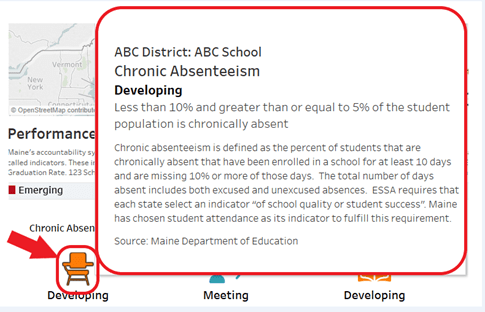
chronicabreportcard

Parents, educators and community members also have the opportunity to examine chronic absenteeism data by student group and to see the progress the school is making in reducing instances of chronic absenteeism school wide.
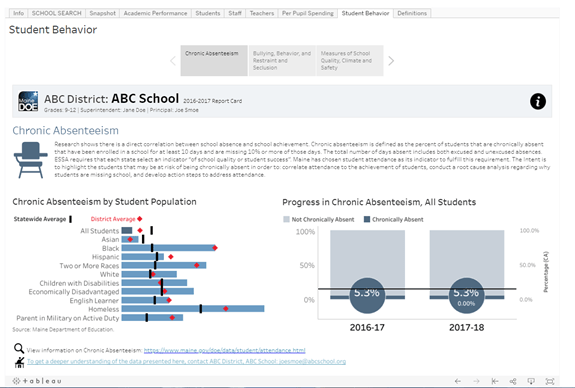
report card 2

Download the Maine DOE’s Chronic Absenteeism Info Graphic as an additional resource.

For further information or questions contact, Interim Director of Learning Systems Janette Kirk at (207) 624-6707 or Janette.Kirk@maine.gov.

October is National Farm to School Month

The Maine Department of Agriculture, Conservation, and Forestry (DACF) and the Maine Department of Education (DOE) join thousands of schools, farms, communities, and organizations across the country in celebrating National Farm to School Month. Maine is home to more than 8000 farmers and 185,000 students, making the partnership between schools and farmers an important part of the state’s agricultural landscape.

Over the last decade, more Maine schools have prioritized adding local foods to student menus. Many have developed school gardens and other education programs. In 2015, the USDA found that 79% of Maine school districts surveyed take part in farm to school activities. In that survey, school districts spent an average of 16% of their food budgets on local products, totaling $3.8 million statewide.

The Maine Department of Education supports Farm to School efforts by promoting local products during the annual Maine Harvest Lunch Week and Farm to School Cook-off, among other initiatives. According to Stephanie Stambach, the department’s Child Nutrition Consultant, “Students look forward to seeing local foods on the menu. When they know it is coming from a farm in their community they get excited, and it’s an educational opportunity. Students and parents seem increasingly aware of where their food comes from, and schools play an important role in supporting this awareness.”

Renee Page is the Maine Farm to School Network Coordinator. “Farm to School’s three-pronged approach includes agricultural-based education, experiential learning through gardens and greenhouses, and more Maine-grown food in school meals. These strategies help connect kids to their food and to farmers. They become savvier consumers and have better health and learning outcomes. These efforts also support the local food economy,” according to Page.

For farmers, schools can be important local customers. Martha Putnam, owner of Wealden Farm, is such a farmer. “Schools are a very good market. Working with them makes a difference and is a boost to farmers. It’s good for student awareness; they get to see the diversity of foods that Maine produces,” according to Putnam. Maine farmers and producers have provided local products to many schools across Maine, and have helped with annual programs such as Maine Harvest Lunch Week.

Schools across Maine provide local foods and nutrition education to their students, and many are eager to grow these efforts. In School Year 2019, students at more than 150 Maine schools will receive a variety of fruits and vegetables at no cost during the school day as part of the USDA Fresh Fruit and Vegetable Program (FFVP). Food service directors at schools participating in the FFVP program can be excellent partners for farmers, especially those who are new to selling to schools.

For more information, contact Maine DOE Child Nutrition Consultant Stephanie Stambach at 207-624-6732 or stephanie.stambach@maine.gov, Department of Agriculture, Conservation, and Forestry Marketing Director Leigh Hallett at 207-287-3494 or leigh.hallett@maine.gov, or Renee Page from Healthy Communities of the Capital Area at 207-588-5347 or r.page@hccame.org.

PRIORITY NOTICE: Seeking Public Comment for English Language Arts, Mathematics, and Career and Education Development Education Standards

As part of the scheduled periodic review of the Maine Learning Results, the Maine Department of Education is seeking public comments regarding the current English language arts, mathematics, and career and education development standards. Find links to each of the current standards below along with details for submitting comments.

Current Standards:

The standards review process opens with a public comment period and a public hearing prior to the convening of steering committees who are charged with reviewing all submitted comments and with developing blueprints for the revision of the state standards in their assigned content area. Once the blueprints are created, writing teams, consisting of pk-12 teachers who represent Maine’s cultural and geographical diversity, will assemble to draft the standards revisions.

Anyone may speak at the public hearings which will be live-streamed. People wishing to speak will be asked to sign in and it will be helpful, but not mandatory, to provide a written copy of comments.

Public hearings will occur on November 7th in room 103 at the Cross Building, 111 Sewell Street, Augusta, at the following times:

  • 2-4pm: Career and Education Development
  • 4-6pm: Mathematics
  • 6-8pm: English Language Arts

A link to the live-streamed hearings will be available prior to the public hearings.

Anyone unable to attend the public hearing may send written comments by 5 pm on December 1st, 2018. Written comments may be sent to Standards Review at sis.doe@maine.gov, or mailed to Beth Lambert, 23 SHS Station, Augusta, ME 04333.

Upcoming Maine Assessment Literacy Professional Development Opportunities

As part of the Maine DOE Assessment Literacy Professional Development series, a MAARS webinar and three in-person sessions focused on the eMPowerME assessment (grades 3-8) and science assessment (K-12) have been scheduled.

State Assessment & Released Items Professional Development

As part of the Maine DOE Assessment Literacy Professional Development series the Maine DOE will be hosting three regional sessions in Presque Isle, Bangor and Portland on November 13, 14 and 15, 2018 respectively. Where applicable, the DOE encourages that a team representative across grade spans be in attendance at the session. An opportunity for team time will be incorporated into the days agenda.

Each of the three (3) sessions will focus on the eMPowerME assessment (grades 3-8) and science assessment (K-12) and will include:

  • AM session will primarily focus on Confidential Reports in MAARS
    • Navigation within MAARS* to access data
    • Overview of the state assessment data
  • PM session will primarily focus on the utilization of released items
    • Review of released item data
    • An advanced session for data analysis
      • How this analysis can impact curriculum development and instructional practices

* DACs should ensure that staff attending have necessary permissions and log-in information to access MAARS.

The audience for this session is District Assessment Coordinators (DACs), teachers, principals, and central office staff. Registration begins at 8:30 am with the session beginning promptly at 9 am (until 3:30pm). Lunch will be provided.

Presque Isle – November 13, 2018

University of Maine at Presque Isle
Campus Center – Multipurpose Room
Parking map

Bangor – Orono – November 14, 2018

University of Maine
Wells Conference Center, Orono

Portland – November 15, 2018

Keeley’s Banquet Center
178 Warren Ave
Portland, ME 04103

To register for any of the regional MAARS Review and Released Item sessions please click here.

MAARS Webinar

October 31, 2018
10:00 – 11:00 am

The audience for this session is returning and new District Assessment Coordinators (DACs) and Career and Technical Education (CTE) Directors. The content of the webinar will include:

  • Role of DACs
  • MAARS Public Reports Overview
  • MAARS Confidential Reports Overview
  • How to add/delete/change MAARS roles and permissions (‘districtadmin’, ‘districtuser’ ‘schooluser’ ‘rosteruser’)

The updated above listed roles within MAARS will be a critical element to prepare for the upcoming November MAARS Workshops.

To access the October 31, webinar please use this link.

For questions contact Maine DOE’s Assessment Team at (207) 624-6770 or eric.buckhalter@maine.gov

PRIORITY NOTICE: 2017-18 MEA Confidential Assessment Results Now Available to Districts

The 2017-18 Maine Educational Assessment (MEA) Confidential Results are now available in the Maine Assessment and Accountability Reporting System (MAARS). The confidential portal is now open to district personnel with “DRAFT” district/school/student reports containing 2017-18 Maine Educational Assessment (MEA) data.

Schools and districts have until October 31, 2018 to review and verify the district and school data. Should a district determine there are discrepancies in the data, please contact Varun Motay, Data Analyst at Varun.Motay@maine.gov. Access the data in the link below:

MAARS Portal »

Once verified, the MAARS Public portal will be available with 2018 MEA results on November 5, 2018.

Three quick reminders that will assist you when logging into MAARS to review confidential data:

1. Use the Focal Point link

Please ensure you are clicking “Focal Point” icon and not the ‘Google’ icon when signing into MAARS.  The “Google” icon is not supported for the MAARS application. If you inadvertently click “Google” please clear the browser cache, close all browser windows, and (if on a Mac) QUIT/EXIT the browser. Then open a new browser and go the https://lms.backpack.education and click on the FocalPointK12 icon to login. If any additional problems arise, please contact the Focal Point Helpdesk.


2. Ensure you have your log-in credentials in hand

For username and/or password information, please check with your District Assessment Coordinator. If there are any further issues, contact the Focal Point Helpdesk.

3. Use a browser other then Firefox

Firefox is not recommended and may lead to instances of blank screens after logging in. Please use a different browser if you are currently using Firefox to ensure a stable user experience.

If you are using another browser, try clearing your cache and cookies, restarting the browser completely (as outlined above in issue 1), and try opening the page once more. If the issue persists, please contact the Focal Point Helpdesk

Focal Point Helpdesk Contact information
Phone: 866-377-4265 ext. 1
Helpdesk Access: https://support.focalpointk12.com
Email: support@focalpointk12.net

For questions contact Maine DOE’s Assessment Team at (207) 624-6770 or eric.buckhalter@maine.gov or contact Interim Director of Learning Systems Janette Kirk at (207) 624-6707 or Janette.Kirk@maine.gov.

MEDIA RELEASE: Piscataquis Community High School Teacher Named Maine 2019 Teacher of the Year

Guilford, Maine – In an all-school assembly today at Piscataquis Community High School, Maine Department of Education Commissioner Robert G. Hasson, Jr. named English teacher Joseph Hennessey Maine’s 2019 Teacher of the Year.

Hennessey was selected earlier this year as the 2018 Piscataquis County Teacher of the Year. He began his teaching career in 2012 and has held teaching positions as both an English teacher and a teacher for at-risk youth ever since. He specializes in English literature and composition and has taught speech and debate as well. In his current position at Piscataquis Community High School, Hennessey has implemented a college prep, literature based interdisciplinary course that focuses on students’ interests and aims to prepare them for life after graduation.

“Mr. Hennessey is a unique and highly effective teacher. His formal manner and personality combined with a dry sense of humor and setting high standards for his students, make him an icon of our school,” said Piscataquis Community High School Principal John Keane in a written statement nominating Hennessey for 2019 Teacher of the Year. “With only four years with us, he has become legendary amongst his students and their families. Watching him in class is truly watching a person who has honed his craft to perfection,” he added.

Hennessey was selected from more than 300 teachers who were nominated by a member of their community earlier this year. The Teacher of the Year Program is a year-long process that involves educator portfolio and resume submissions, interviews, oral presentations, and classroom visits made by a selection panel comprised of State Board of Education members, school administrators, Maine Department of Education staff, former Teachers of the Year, and other Maine business partners.

“Joe sees every student as a learner and an intellectual, and he truly strives to ensure that every student sees themselves that way too,” said Emily Gribben, Maine Department of Education Educator Effectiveness Coordinator and member of the 2019 Teacher of the Year Selection Panel. “I think it is also of note that not one student has failed his class and it is obviously not for lack of rigor,” she added.

As the 2019 Maine Teacher of the Year, Hennessey will travel throughout the state and country collaborating with other educators to support the efforts underway to prepare all students for college, work, and civic life. He is Maine’s representative in the National Teacher of the Year program which includes a national forum with other State Teachers of the Year, a week at a NASA Space Camp, and a visit to the White House.

The Maine Teacher of the Year program is administered by Educate Maine, a business-led advocacy organization, in partnership with the Maine Department of Education and the Maine State Board of Education. Funding for the program is generously provided by Bangor Savings Bank, Dead River, Geiger, Hannaford, Maine Lottery, and Pratt and Whitney.

For more information about the Maine Teacher of the Year program, visit www.mainetoy.org.

###