Yarmouth takes grand prize in Farm to School Cook-off

Whole grain crepes, a wild blueberry kelp smoothie, granola encrusted French toast and fish tacos were featured on the menu as the top two teams of school food service staff faced off at Freeport High School on April 26. This was the final round of the 2nd Annual Maine Farm to School Cook-off, sponsored by the Maine Department of Education, Child Nutrition department. The cook-off aims to promote local products in school meals while showcasing the skills of school food service staff.

Pictured L to R: Stephanie Stambach (Maine DOE), Nikki Dovoren, Blaire Currier (Yarmouth School Department Food Service)

Each team prepared a breakfast and lunch meal that was presented to a panel of judges including a culinary arts student, chef and school nutrition director. The judges scored the dishes based on presentation, taste, creativity and food cost, as well as food safety and time management.

For breakfast, Yarmouth whipped up whole grain crepes with a strawberry topping and Maine maple syrup. This was paired with a wild blueberry kelp smoothie. The judges were impressed by the flavor and texture of the smoothie and commended the team for introducing a less common food to students in an appealing way. RSU 52 created a granola encrusted French toast and wild blueberry compote paired with a strawberry smoothie. Each team was tasked to incorporate wild Maine blueberries as a challenge ingredient in their breakfast dishes.

For lunch, Mexican fare was featured by both teams. RSU 52 cooked up chicken quesadillas with a fresh fruit salsa and grilled potatozana. Yarmouth prepared fish tacos using Gulf of Maine fish with a side of roasted potatoes and apple salsa. The judges commended the teams for a creative twist on a traditional salsa. Maine potatoes were used as the challenge ingredient for lunch.

Congratulations to Yarmouth who took the grand prize and was named the 2017 Maine Farm to School Cook-off Champion! All recipes from the cook-off will be shared in a Maine farm to school cook-off recipe book to be compiled this summer.

For information on how you can be part of next year’s Farm to School cook-off, contact Maine DOE’s  Child Nutrition Consultant Stephanie Stambach at Stephanie.stambach@maine.gov.
Improving the Success of Career and Educational Development (CED)

The Maine Department of Education (DOE) is looking at the Career and Educational Development (CED) standards within the Maine Learning Results system to understand how schools are meeting the requirements of this content area. In examining this we are asking all school *principals, or a designated staff member focused in this content area to take a few moments to fill out this brief survey:

CED Survey: https://www.surveymonkey.com/r/3WHX828
(All surveys should be completed by Friday, June 9, 2017.)

Our goal is to get a snap shot of current implementation trends, discover challenge areas, and determine what supports may be useful for schools to best ensure the successful application of this content area within their curriculum.

College and career readiness development begins in elementary school and is reinforced and expanded as students move toward the attainment of their high school diploma. As such, we want to ensure that all schools at every level have the resources necessary as they work to meet the CED standards.

For questions contact Danielle Despins at danielle.r.despins@maine.gov or 207-624-6608.

*Administrators, please forward this message to the principals in your district.


Administrative Letter: New School Approval Process, Maine Schools Update due June 15, 2017

Administrative Letter: #8
Policy Code: KLL
TO: Private School Administrators
FROM: Robert G. Hasson, Jr., Ed. D. Commissioner
DATE: May 15, 2017
SUBJECT: New School Approval Process, Maine Schools Update due June 15, 2017

In accordance with 20-A M.R.S.A Chapter 117, the Maine Department of Education (DOE) requires private schools seeking approval status to be approved annually. Private schools, until and including 2017-18, have undergone a manual approval process, working with the School Enrollment Specialist.

Currently the Department is working toward moving the private school approval process to the NEO education information system by 2019. Our goal is to streamline and facilitate the entry and transfer of important and sensitive information critical to the school approval process.

Effective immediately, private schools seeking approval/renewal are required to enter their organization data (the NEO Maine Schools Update) on the same schedule as the public schools,* and complete staff data in the NEO Staff module prior to submitting the annual application/report. Please see this linked notice posted on April 12, 2017. The remainder of the Private School Approval process currently remains a manual process.

New Maine DOE School Approval web pages have been set up to fully outline the process, and link to instructions and guides for completing the required information in the NEO Maine Schools and Staff modules. The Private School Approval  web page will be the source for required private school approval annual applications/reports and checklists, and will also provide links to other Department resources related to school approval, such as certification, helpdesk, and private school approval for receipt of public funds.

Please contact Pamela Ford-Taylor, Maine DOE School Enrollment Specialist at 207-624-6617 or Pamela.Ford-Taylor@maine.gov with questions or comments about the new requirements, the new web pages, or the school approval process.

*NEO Maine Schools must be completed by June 15 of this year. As a preliminary step, in order for an organization to be updated in Maine Schools, the superintendent or chief administrator of the school must be verified in the NEO Staff Module by contacting the Helpdesk staff, 624-6896 at the Department of Education, who can also assist schools who are new to the process or in any stage of the Maine Schools NEO report completion. For School Approval, please contact Pamela Ford-Taylor.

Public Preschool Annual Report due July 31

The Maine DOE is reminding school administrative units that have created or expanded a public preschool program within the past two years (2015-16 or 2016-17) to complete the Public Preschool Annual Report by July 31, 2017. The report can be found here 

This year’s report has been shortened to gather only the most pertinent information from Maine’s public preschool programs. 

Please note this report is not required from SAUs with programs existing prior to 2015 or those who completed the Public Preschool Application by the March 31 deadline.

If you have questions about the survey or to inquire if your SAU is required to complete it, please contact Maine DOE’s Early Childhood Program Monitor Nicole Madore at nicole.madore@maine.gov or at 624-6677.

Applications now being accepted for Health Education and Physical Education Teacher Leader Cadre

The Maine DOE Health Education (HE) and Physical Education (PE) programs are seeking quality, motivated applicants to join the Maine Health Education and Physical Education Teacher Leader Cadre (HEPEC). Participants of this initiative are charged with leading the way in ensuring high quality proficiency-based HE & PE in all Maine schools. Cadre participants will work together to provide Maine HE & PE professionals with curriculum, instruction and assessment resources and tools; professional development that supports effective proficiency-based education teaching strategies; and skills and resources to educate about and advocate for quality HE & PE. Successful applicants will:

  • receive training in facilitation and leadership skills and formative assessment;
  • develop and deliver professional development at local, regional and statewide events; and
  • develop a website for the field, as well as, establish other effective modes of communication to share resources and materials.

Administrators are asked to identify potential teachers (pre-K through high school) and encourage them to join the HEPEC for teacher leaders. Enthusiasm and a desire to learn and to lead are more important than the current years of experience. Interested individuals need to complete an online application and submit at least one letter of support from a colleague. Successful applicants will need written approval from administration to participate in the project including permission to attend all the trainings. Maine DOE has grant funding to reimburse substitute pay, mileage and lodging for training days as well as to pay stipends for the Summer Institute. To apply, click here.

For more in-depth information contact Maine DOE’s Health Education & Health Promotion Coordinator Susan Berry at susan.berry@maine.gov or Maine DOE’s Health Education & Physical Education Consultant Jean Zimmerman at jean.zimmerman@maine.gov.

Important Title VI Small Rural Schools Achievement (SRSA) program update

The US Department of Education will be sponsoring a series of webinars now through June 28 to assist eligible Title VI SRSA districts with the online application process. The webinars will provide a walk-through designed to take applicants from the start to the finish. An information sheet, including dates, times and links for registration can be found here. Register early as space is limited to 350 seats for each webinar session. For questions, please contact Maine DOE’s Title VI Director Daniel Weeks at Daniel.r.weeks@maine.gov or 624-6749.


2017 County Teachers of the Year honored

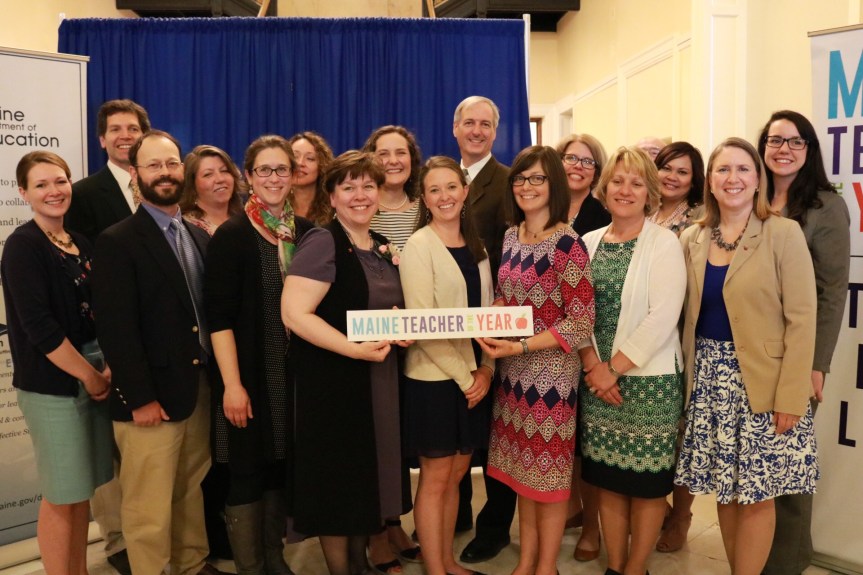
Teachers from each of Maine’s 16 counties were today honored in Augusta’s State Capitol at an annual event in the Hall of Flags announcing the 2017 Maine County Teachers of the Year. The group is the county finalists for Maine Teacher of the Year, an honor awarded each year to one teacher in Maine.

The educators were each nominated by a member of their community for their exemplary service in education, and dedication to their students. They were selected by a distinguished panel of teachers, principals and business community members from a pool of hundreds of other nominated teachers in their communities.

CTOY2

2017 County Teachers of the Year:

  • Androscoggin: Nesrene Griffin, Governor James Longley School
  • Aroostook: Leslie Marquis, Fort Kent Community School
  • Cumberland: Brooke Teller, Casco Bay High School
  • Franklin: Allison Warman, Rangeley Lakes School
  • Hancock: Marielle Edgecomb, The Peninsula School
  • Kennebec: Lisette Bordes, Messalonskee High School
  • Knox: Iris Eichenlaub, Camden Hills Regional High School
  • Lincoln: Christopher Coleman, Great Salt Bay Community School
  • Oxford: Janet Harriman, Sacopee Valley High School
  • Penobscot: Kasie Giallombardo, Nokomis High School
  • Piscataquis: Kaitlin Young, SeDoMoCha Elementary School
  • Sagadahoc: John Dever, Mt. Ararat High School
  • Somerset: Eric Brown, Lawrence High School
  • Waldo: Christi Goosman, Searsport District High School
  • Washington: Rhonda Stevens, Beatrice Rafferty School
  • York: Jen England, Noble High School

Ambassadors for teachers, students, and quality education in Maine, these teachers will continue to participate in the intensive State Teacher of the Year selection process, including the submission of a video showcasing their classroom instructional practices.

The field will be narrowed to eight semi-finalists who will begin working on their professional portfolio, a component of the National Teacher of the Year process. After the portfolio review and presentations to a select panel, the field is narrowed to three finalists. In October, the 2018 Maine Teacher of the Year will be selected after a school site visit and final interview.

The Maine Teacher of the Year is a program of the Maine Department of Education, administered by Educate Maine, a business-led organization working to ensure Maine’s students and workers are the best educated and highly skilled in the world.

For more information, visit www.maine.gov/doe/toy/.

###


PRIORITY NOTICE: Maine DOE announces change in English learner reclassifications

Maine DOE has changed English learner reclassifications to Overall Composite Proficiency Level Score of 5 or greater on ACCESS 2.0.

Maine recently received its 2016-17 ACCESS 2.0 for ELLs scores and many of our English learners scored at proficiency levels lower than expected. This is because of a process that established new expectations for what scale score students must achieve in order to reach each proficiency level.

WIDA explains as follows: “The changes to students’ ACCESS for ELLs 2.0 proficiency level scores reflect the increased language demands of college and career readiness standards. WIDA raised the bar for language proficiency and students needed to showcase higher language skills in 2016–2017 to achieve the same proficiency level scores (1.0–6.0) in previous years. This is the result of a process to determine the student performance required for each proficiency level through a series of decisions made for each grade level by expert panels of teachers as well as district and state English language learner administrators.”

The following bullets are intended to clarify what has changed and what has not:

  • The ACCESS for ELLs 2.0 test questions did not get more difficult.
  • The scoring of the ACCESS for ELLs 2.0 domains did not change.
  • The same performance on the ACCESS for ELLs 2.0 in 2015-16 and in 2016-17 would also result in the same scale score.
  • The only change is in the scale score required to achieve each proficiency level (1-6).
  • At each level, in 2016-17, the student needed to achieve a higher scale score to reach a given proficiency level.
  • In other words, the same performance in 2015-16 and in 2016-17 would result in the same scale score, but the proficiency level score would be higher in 2015-16 than in 2016-17.
  • If parents or teachers want to know if a child’s English language proficiency improved from 2015-16 to 2016-17, they should compare the scale scores across the two years, but not the proficiency level scores.

The exit criterion in Maine has always been rigorous. We are currently the only state that requires a 6.0 proficiency score on the overall composite. After looking at our 2016-17 data, it is apparent that the 6.0 exit criterion is too high given the new cutscores for proficiency levels. We have therefore changed Maine’s exit criteria to a 5.0 proficiency level score. The 5.0 proficiency level in 2016-17 is similar to the 6.0 proficiency level in earlier years.

You may find the following materials helpful:

Direct questions about ACCESS for ELLs 2.0 and the educational or English language acquisition services for English learners to Nancy Mullins, Maine DOE ESL/Bilingual Programs, at nancy.mullins@maine.gov (207) 624-6788.

Maine DOE recommendations for dyslexia screening

In accordance with 20-A M.R.S. §4710-B, the Maine Department of Education recommends universal screening for all K-2 children.  The law pertains to screening children K-2 for traits indicating that the child may be at-risk for difficulty learning to read, it is not a diagnostic assessment.  The intent is to identify at-risk children so that they may receive early evidence-based intervention known to help children with SLD/dyslexia.

 There is a list of suggested screening tools available on the Maine DOE website, along with other useful information about dyslexia, resources and frequently asked questions.

Maine Unified Special Education Regulations (MUSER) has long recognized dyslexia as a Specific Learning Disability [MUSER VII (2) (L)], consistent with the Individuals with Disabilities Education Act (IDEA) (20 U.S.C. 1401) and the Federal Regulations (34 CFR 300.8) which implement the IDEA Law. However, there has been confusion regarding the use of the term, dyslexia.  Consequently, in 2015 Michael Yudin, Assistant Secretary, Office of Special Education and Rehabilitation Services (OSERS) issued a, “Dear Colleague” letter specifying that nothing in IDEA or the implementing regulations prohibits the inclusion of the condition that forms the basis for the child’s disability determination in the child’s IEP. https://www2.ed.gov/policy/speced/guid/idea/memosdcltrs/guidance-on-dyslexia-10-2015.pdf.

If you have further questions regarding dyslexia or 20-A M.R.S. §4710-B, please contact Lisa Whitis, MEd, JD, Maine DOE Dyslexia Coordinator at Lisa.Whitis@maine.gov or 624-6643.


MEDIA ADVISORY: 2017 Maine County Teachers of the Year to be announced 5/11 at 2pm

FOR IMMEDIATE RELEASE
CONTACT: Rachel Paling (207) 624-6747 or rachel.paling@maine.gov

What: 16 Maine teachers will be announced and honored as part of the Maine Department of Education’s annual Maine County Teachers of the Year awards. The teachers were nominated by a member of their community and chosen by a panel of teachers, principals and business community members.

The educators serve as ambassadors for teachers, students, and quality education and are available to make presentations to local and regional organizations. Into the summer, they will continue to participate in an intensive State Teacher of the Year selection process.

Who: 16 Maine teachers (one from each county), Department of Education Commissioner, Robert Hasson, Executive Director of Educate Maine, Ed Cervone, State Board of Education, Martha Harris, and 2017 Teacher of the Year, Tammy Ranger.

Where: Hall of Flags, Maine State Capital

When: Thursday, May 11, 2017 from 2:00pm – 4:00pm

For more information contact Maine DOE Director of Communications, Rachel Paling at rachel.paling@maine.gov or call 624-6747.

###