AUGUSTA – As educators look to better support student success following the release of the state’s new letter grades, the Maine Department of Education is offering a series of school improvement webinars.
The one-hour webinars begin this Thursday and are free for educators.
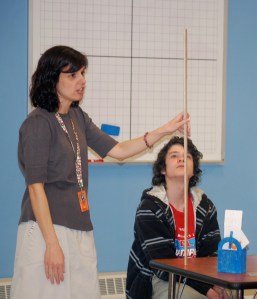
Biddeford Middle School student Breneg Howard listens as math lab coach Heidi Miller shows students how to measure the rebound of a bouncy ball. View more photos from this event
Last week I visited Biddeford Middle School as well as elementary schools in MSAD 54, where administrators and teachers are taking hands-on, customized learning to the next level with math labs, academic coaches and workshop-model classrooms.
These districts were the last stops on my Promising Practices Tour, which has taken me to all nine superintendent regions to see innovative practices schools are implementing that show promise and support the Maine DOE’s vision of an evolving education system.
While touring Biddeford Middle School, I was struck by the school’s highly effective use of a full-time math coach. Students attend Coach Heidi Miller’s math lab once a month with their core math teachers, receiving dual instruction as they solve experiential problems. Continue reading “Biddeford and MSAD 54 bring coaches to the classroom”→
When we released the A-F report cards for the state’s schools as part of our new Maine School Performance Grading System, we wanted to engage educators and the public in a positive, productive conversation about how we can work together to improve our schools.
Troy Howard students engage in conversation with Commissioner Bowen about the school’s standards-based academy system. View more photos from this event
When I visited Troy Howard Middle School on Thursday as part of the tail end of my Promising Practices Tour, I was impressed by the school’s two-year academy system that puts students first by placing them in one of three academies based on their learning styles.
Under Principal Kim Buckheit’s leadership, the Belfast school implemented the standards-based academy system to give seventh and eighth graders more control over their learning. The Innovation Academy offers a hands-on approach to those who benefit from project-based learning, the International Academy brings a global perspective to students trying to see the bigger picture, and the Ecology Academy combines experiential learning with the practice of ecological sustainability.
The Center for Best Practice has released its fifth case study showcasing districts successfully implementing proficiency-based practices. The schools of RSU 20 (Belfast/Searsport area) figure prominently in the history of the state’s move toward learner-centered education. Both Troy Howard Middle School and Searsport District High School were enthusiastic early adopters and promoters of reforms around standards-based reporting, interventions and formative assessment. Simultaneously, many of the elementary schools of the district moved in that direction as well.
The Department provisionally adopted Chapter 180, the rules for implementing required teacher and principal evaluation systems, seven weeks ago today. A number of you have been asking me and other Department staff when you can expect the new rules on teacher effectiveness evaluations to go into effect. This is to update you on where that stands and why we have not been able to help you move forward with that work.
The following is a news release from the Maine Charter School Commission.
AUGUSTA — The Maine Charter School Commission in a public meeting held Tuesday in Augusta discussed, voted and signed three public charter school contracts – culminating months of work on the part of the schools and the commission. The Maine Charter School Commission has the responsibility to approve up to 10 public charter schools in the State in 10 years. The three schools are the Baxter Academy for Technology and Sciences to be located in Portland; the Fiddlehead School of Arts and Science in Gray; and the Harpswell Coastal Academy in Harpswell. These three schools will open September 2013.
Maine Administrators of Career and Technical Education (MACTE) and the Maine DOE CTE team are co-sponsoring a day-long “Developing Instructional Literacy Strategies for Maine CTE Educators” training. This interactive professional development opportunity offers CTE instructors a practical working definition of literacy that lends itself to integration in a CTE curriculum. Participants in the training will leave with a set of literacy strategies that can be applied to their CTE instructional classrooms and shops.